Will the Real St. Matthew Please Stand Up?

“That finger of Jesus, pointing at Matthew. That’s me. I feel like him. Like Matthew.” Pope Francis remarked in his 2013 interview with Fr. Antonio Spadaro, S.J.

“It is the gesture of Matthew that strikes me: he holds on to his money as if to say, ‘No, not me! No, this money is mine.’ Here, this is me, a sinner on whom the Lord has turned his gaze. And this is what I said when they asked me if I would accept my election as pontiff.”

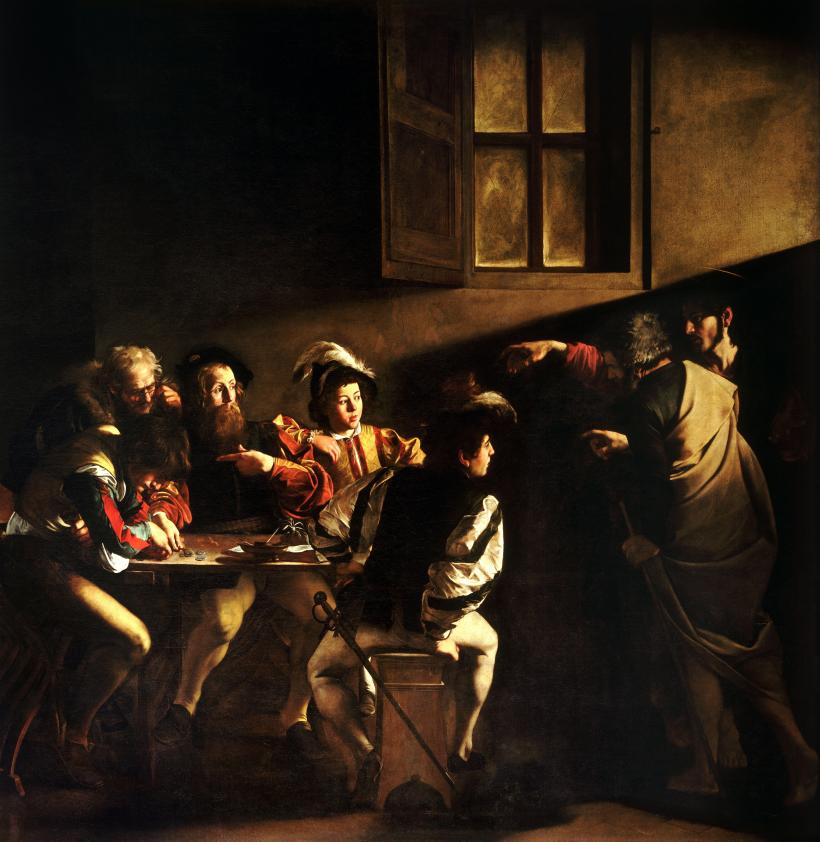
In Caravaggio’s The Calling of St. Matthew, Pope Francis found the perfect image to express his own surprise at being uniquely called by Christ to serve the Church as supreme pontiff.

But, we have a problem. Which figure in the painting is St. Matthew?

(If you haven’t already done so, take a moment to give the painting at top a good look and try to figure it out for yourself.)

Besides the faintest loop over Christ’s head, there are no halos in this painting. Nor should there be – St. Matthew was only Matthew the tax-collector at this point. Here he is, in the midst of his sin, and in corrupt company. Matthew has just as much chance of being called out of this situation as any of the five guys in the tax office.

So, which one is he?


Option 1: The Bearded Man

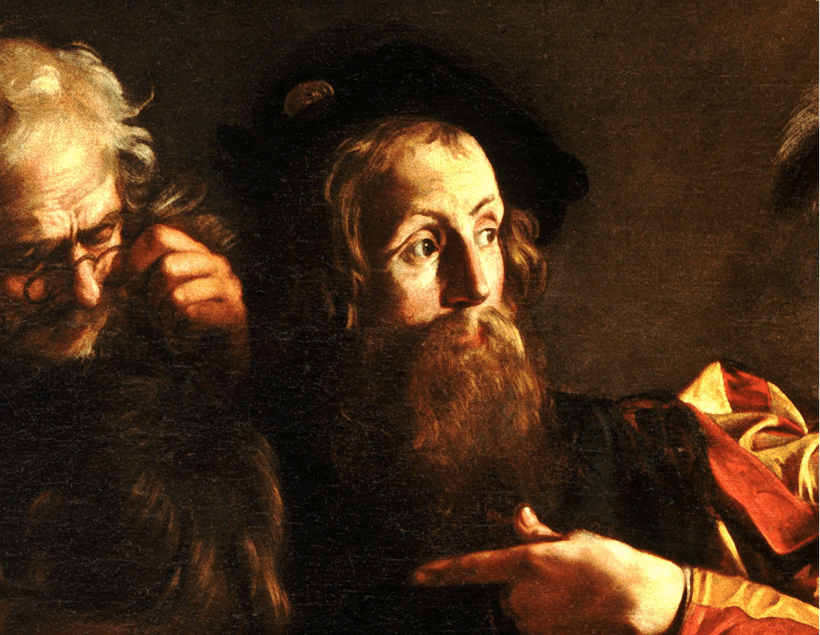
At first glance, Matthew appears to be the man with long beard. His eyes show surprise, his face is illuminated, his finger seems to point toward his breast. And, maybe just to help us out, he has a distinguishing coin in his hat and a right hand fingering money on the table. If there is anyone in this painting who is reacting as the one who is called, it’s this guy.

bearded-guy

There are two other reasons why the bearded man is the best candidate for Matthew.

First, Caravaggio did not paint The Calling by itself. With this painting in the Contarelli Chapel in the San Luigi dei Francesi Church in Rome, Caravaggio painted two other scenes from the life of St. Matthew: The Inspiration of St. Matthew and The Martyrdom of St. MatthewIn both of these adjacent paintings, Matthew is depicted as a man with a sizable beard.

The second reason concerns some of the interesting history going on at that point. Before this was painted, there was a passing fear that France might go the way of the Church of England. This fear partially subsided when the Huguenot (Protestant) Henry IV converted back to Catholicism upon taking the French throne in 1593. Caravaggio was commissioned six years later to paint three works for the church of San Luigi dei Francesi (St. Louis of the French). To flatter the now-Catholic king of France (and appease his patron), Caravaggio painted St. Matthew to resemble Henry IV. (You can see the bearded resemblance here.)

But that might not be the whole story.


Option 2: The Hunched-Over Man

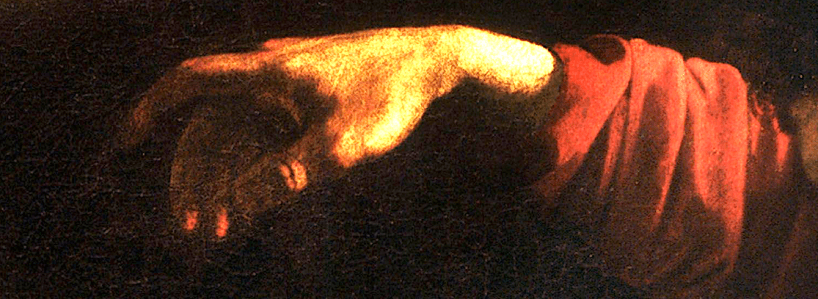
People make a big deal about Christ’s pointing gesture just below the window in the painting. His hand is unusually relaxed for a definitive signaling of direction. The reason for this is very likely that Caravaggio is alluding to a more famous painting: The Creation of Adam by Michelangelo.

finger-edited

fingers

Michelangelo’s Adam is depicted in the Sistine Chapel fresco in the moment just before his animation, with his finger less than an inch from that of God. Michelangelo, instead of showing an Adam already filled with life, depicts the precise moment prior to his ensoulment with all the drama of a limp wrist.

Like Michelangelo, Caravaggio is not capturing the moment of the calling of Matthew; he is capturing the precise moment before the calling of Matthew. The finger of Christ the New Adam has yet to be fully extended, the call is only just about to happen. The whole painting is in that dramatic tension of the moment before the call. If Matthew is the hunched-over man at the end of the painting, it almost would be more accurate to call it The Moment before the Calling of St. Matthew.

hunched-over-guy

And here, Matthew is still a sinner, still a tax-collector, still fingering his coins and gripping his money bag. The bearded figure to his left echoes the perceived direction of Christ’s soon-to-be-extended finger, pointing not to his own breast but to the hunched over man next to him. This man’s face, only half-illuminated by the light that comes from Christ’s entrance, still intently looks down to the table; he has but to lift his head an inch to make eye contact with Christ. Will his eyes meet the gaze that tests mortal men and will he remain the same? Will he respond to the call?


So, which one is Matthew?

It’s still not entirely clear.

But that’s probably how Caravaggio wants it to be. Caravaggio’s art was at the cutting edge of the subjective turn of modern thought. As a controversial artist of his time, he departed from the idea that art is exclusively at the service of the true, good, and beautiful, and turned instead toward an innovative realism. (Remember our earlier post on what makes art good.)

Part of Caravaggio’s goal is to pull the viewer into the painting. He wants this ambiguity; he knows that things are not so cut and dry in this world. Christ entered a world in chaos, a world engulfed in sin. He calls us out of that darkness and into His light.

Turning again to the painting, if we go to the source of Christ’s call and look above His outstretched right hand, we are at the foot of the cross (the fourfold window pane forms a cross). At that cross, at our Lord’s ultimate crucifixion, darkness appears to triumph over light, chaos over order, death over life.

But it is precisely at that moment when Christ conquers. It is from that cross that Christ calls His disciples, and it is to that cross that Christ calls His disciples. We are drawn up while we are still sinners into the cross, into the central mystery of our faith.

Pope Francis, without weighing in on the identity of Caravaggio’s Matthew, hits on what our response should be to Christ’s call: “I am a sinner, but I trust in the infinite mercy and patience of our Lord Jesus Christ, and I accept in a spirit of penance.”

Independent of who we decide Matthew to be in this painting, our response to Christ should be the same as that of Pope Francis. We are that sinner uniquely called by Christ. How will we respond to His call?


Main image: “The Calling of St. Matthew,” Michelangelo Merisi da Caravaggio, 1599-1600

Post by: Deacon Peter Gruber

Should Christians Dance?

A young priest sets out into the countryside to journey to his new assignment… He is not quite sure how to get there, but in the evening, while walking in a field he finds two boys. They tell him he has just crossed into the parish boundary. Father gets on his knees and prays in thanksgiving for being sent there and in preparation for the work he will do in the little country town. The first and most important job, he would find out, will be to eradicate “the scourge of dancing.”

Of course we are speaking of the one whom they called “the saint” even during his lifetime – St. John Vianney, the Curé of Ars. We are not speaking of Rev. Shaw Moore, the antagonist of Footloose… Although the two might have gotten along, ecumenical issues aside.

Dance is commonly assumed to be an art form and a generally good way to recreate. Such assumptions are in fact so deep that the suggestion that it might be better to do away with public dances is seen as rigid, cruel, “medieval,” etc. One can only imagine the reactions of North Dakota’s teens to then Bishop Aquila’s decision a few years ago to ban dances (and pajama days) in one of his Catholic schools in the Diocese of Fargo… Maybe even some parents and faculty were upset. But would they have told John Vianney that he had been “too rigid” after he finally conquered the last of the dancers in the tiny village of Ars, which by that point had become the brightest beacon of holiness and civility in all of France?

The Abbé Trochu, in his famous biography of the saint, notes that, while St. Francis de Sales “wore gloves” when treating the topic, Vianney did not. “Go on! Dance! Dance all the way down into Hell!” Thus spake the saintly curé from the pulpit, time and time again. After decades, Ars was perfectly obedient to its pastor and was much happier for it.

Imagine the efforts it would have taken to accomplish the same feat in a 21st American century town even of normal size by today’s standards.

The people of Ars were not having dainty upper-crust waltzes, but neither were they “grinding,” “twerking,” or doing any other kind of categorically pornographic actions, which no reasonable person would think to call morally acceptable. They were simply dancing like country folk, having some drinks, and then getting too familiar with each other. The saint saw that this was not an accidental relationship, and he thought “the dance” to be the single greatest occasion of sin in Ars.

Note that it was seen by him as an occasion of sin, not necessarily a sin in itself, except perhaps inasmuch as a certain recklessness therein could be an expression of a lack of due care to avoid offending God. So, the question remains: can a Christian dance?

It depends.

The downfall of dance is usually what is touted as its greatest quality – the ability to arouse and express the passions. It is violent, it is sensual, it is angry, it is sad, it is joyous, it is whatever you need it to be. It intensifies all these things and shows them to others, while “freeing the spirit.” That’s the point. And that’s the problem.

In expressing the passions haphazardly, one can lose a grip on reason and be drawn to wherever that passion leads. The main problem is with sensuality.

First of all, we can, without hesitation, discard the utterly obscene motions and actions that have no other purpose than to sexualize the participants. These are not only done out of inordinate desire for the pleasures of the body, but they are also scandalous. Scandal here means a “stumbling block” to the spiritual lives of others – to cause sin in them. We are bound to avoid causing sin in others inasmuch as it is possible while not neglecting other duties. Nobody has ever had a duty to do anything like one would find going on at the average American high school dance. And it can never be good art, if art is the good expression of something good to express.

Secondly, we must examine the motivations and circumstances of those dances which are less clear. Should a desperate bachelor engage in a romantic tango with a beautiful woman he’s just met? Perhaps this will be a real challenge to him interiorly, urging him to go further and further… The same may hold true for her, which he must be careful about as well. Such a dance loosens the foundation on which chastity rests.

But what about a professional dancer who is so used to these movements and is so concentrated on his craft that he is greatly fortified against temptations? It seems the difficulty begins to disappear. And if a man is dancing with his wife, certainly there is no problem.

The case becomes different according to the abilities and circumstances of those involved, and according to the capacity of a dance to evoke problematic urges.

What would John Vianney think of the teens of Bomont jumping on the Kevin Bacon rock-n-roll-will-free-your-soul bandwagon? If we are honest – which we are here to be – we must say that he would probably be just as indignant as he was when he arrived in Ars, if not more so. He would think Rev. Moore was a wuss and a bad leader for finally caving. He would go to his bedroom, scourge himself to a bloody pulp, not eat for a few days, then start preaching, if his approach in Ars is any indication.

While the final scene of the film doesn’t have anything too bad (especially since these kids who have apparently never danced before are actually professionals), it is the culture and ideas which are introduced by the habitual loosening of inhibitions in social settings with the opposite sex (that often also involve alcohol) which sends up red flags. It is the dark cloud on the horizon: there is not yet a storm, but one is coming.  Just as well, the spirits of angst and rebellion are not spirits from God, but they are exactly what Kevin Bacon’s character and the whole idea of rock-n-roll are about.

There are ways to “cut loose” and socialize that do not involve the dangers of “the dance.” Running, golfing, hiking, and yes, even spelunking are all appropriate alternatives. I simply can’t imagine John Vianney giving a sermon against spelunking… Can you?

“But wait!” some will say. “There is that scene where Bacon’s character goes before city council and throws down some verses from Scripture about how great dancing is! Ha. Game, set, and match, you Jansenist clown!” Unfortunately, we will have to save the detailed examination of the Scriptural treatment of dancing for another post. For now it will suffice to say that the Holy Bible decidedly does NOT encourage us to “kick off our Sunday shoes” so that we can do the worm to impress our friends.

Here is a challenge to those who have charge of Catholic schools: take a good, long look at the reality of what is going on at your dances, and whether it is worth the spiritual risk.


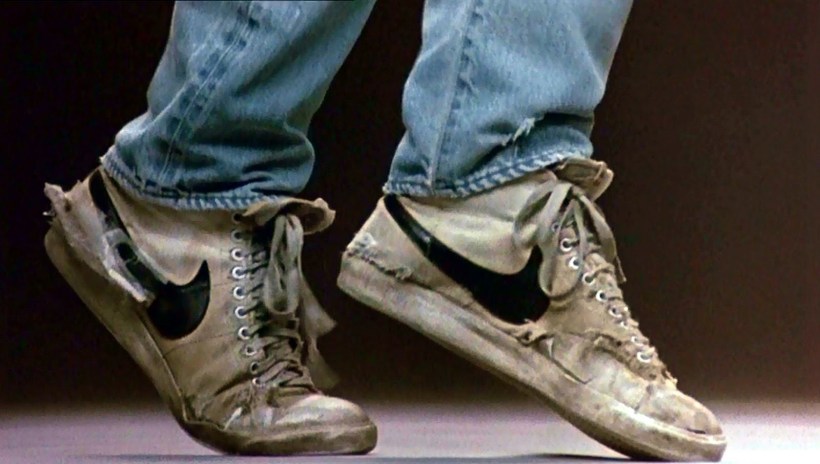
Main image: screenshot from “Footloose” (1984)

Post by: Eamonn Clark

The Transfiguration and the Meaning of Christian Mystery

“Master, it is good that we are here; let us make three tents, one for you, one for Moses, and one for Elijah.” (Luke 9:33)

Peter had two options for approaching the event of the Transfiguration: he could see it as (a) a problem that needs to be solved, or (b) as a mystery.

When Jesus led Peter, James, and John up the high mountain, they woke up to a scene that seemed to defy all understanding. Jesus brings them up to the top of Mount Tabor and begins to glow unworldly bright. Then Moses and Elijah from the Old Testament show up and all three of them have a conversation.

Peter, thinking quickly on his feet, intrudes into their conversation and asks whether he should build three tents. For us, this sounds like odd, but for Peter, he must have thought he had solved the problem: this had to be the beginning of the end times. He might have picked up on how Jesus is fulfilling the Old Testament festivals. He knew of the Jewish tradition that Moses and Elijah would come again before the end of the world. Jesus, along with Moses and Elijah, was finally going to restore the kingdom of Israel and reap the much-anticipated harvest of souls. It was the Christological fulfillment of the Jewish Festival of Booths.

They needed tents.

However, Peter “did not know what he was saying.” He approached the Transfiguration as a problem to be solved, not as a mystery to be entered into. So while Peter was still speaking, a higher voice corrected him: “This is my beloved son with whom I am well pleased. Listen to him.”

The Limits of Science

When Christians use the word “mystery,” we do not mean a problem without an answer. No, for Christians, a mystery is something that is so intensely knowable that it exceeds the powers of human comprehension.

Let me give you an example.

Once, my five-year old niece told me, “Did you know that, when I’m in the car, the moon follows me? It really does!” My immediate response was to try to explain to her that since the moon is so far away, it only looks like it is following her. My impulse was to set up an experiment, putting her in one car and her sister in another car. They would go separate directions and observe how the moon follows both of them. Then I could prove to my niece that, since the moon cannot possibly be following both of them, there must be another explanation. That explanation would be in the reality of the great distance between the earth and the moon, a distance that can be observed and measured. Science would win out over childish naïveté.

But before I could thoroughly disprove her childish notion, she interrupted, “No. The moon really follows me.” With such opposition, I thus abandoned my attempt to scientifically disprove her childish perception.

For my five-year old niece, the moon was a mystery; it really did follow her. The moon was so beyond her that, rather than disconnecting her, it implicated her in its path. However mistaken her understanding of perspective, she approached it with wonder. And she rightly would not let that wonder be extinguished.

To me, the moon was a problem that needed to be solved; it could be measured and placed conceptually at a distance. I knew that its movements and phases are configured to a different pattern than my sporadic movements. Although technically more correct, the approach that reduced the moon to a problem prevented me from being gripped by the mystery of the moon and sharing in my niece’s wonder. To my niece, however, the moon was a mystery to be entered into.

Like my niece with the moon, a mystery is so beyond us, that we cannot help but be pulled into it. A mystery is so large that it necessarily involves the viewer. In this way, God Himself is a mystery, being so far beyond us that, at the same time, He embraces us and loves us in our very being.

Mysteries are not problems; they are not to be solved – they are to be entered into. A mystery is like a piece of art that pulls the viewer in; it is not a mere opportunity for scientific analysis.

The Mystery of the Transfiguration

It is in this way that the event of the Transfiguration is a mystery. Since mysteries overwhelm us, they implicate us – they require our response. Our response, then, to the mystery of the Transfiguration is not to solve the puzzle of Moses and Elijah’s appearance, but to enter deeply into the reality of what is before us. Through the mystery of the Transfiguration, we share in Jesus’ own prayer with the Father. By beholding the glory of Christ transfigured and listening to him, we become sons and daughters in the Son. By entering in to the mystery of the Transfiguration – by listening to God’s chosen Son – we become what we contemplate.

How do we enter in to the mystery of the Transfiguration? For us Christians, we go to the source and the summit of the Christian life – the Holy Sacrifice of the Mass. Like Peter at the Transfiguration, we can look at the Mass just as a problem to be solved, a ritual to be analyzed, a puzzle to be deciphered. Or we can enter into the mystery of the Mass.

In every celebration of the Mass, we ascend the mountain with Christ, and we encounter something that overwhelms our understanding: God incarnate – the second Person of the Holy Trinity – comes to us as bread and wine. So great is the glory of Christ in the Eucharist, so utterly beyond us, that we are pulled into the mystery. The altar is our Mount Tabor, where we see His glory, not with the eyes of flesh, but with the eyes of faith. Over the altar the Father’s voice mystically resounds, “This is my beloved Son; listen to him.” We who enter into this mystery by receiving the Body of Christ in Holy Communion are enveloped by the cloud of the Holy Spirit. At Mass, we enter in to the mystery of God’s glory. He gazes on us, and we gaze on Him, and we become what we contemplate.


Main Image: The Church of the Transfiguration

Animation & Iconography

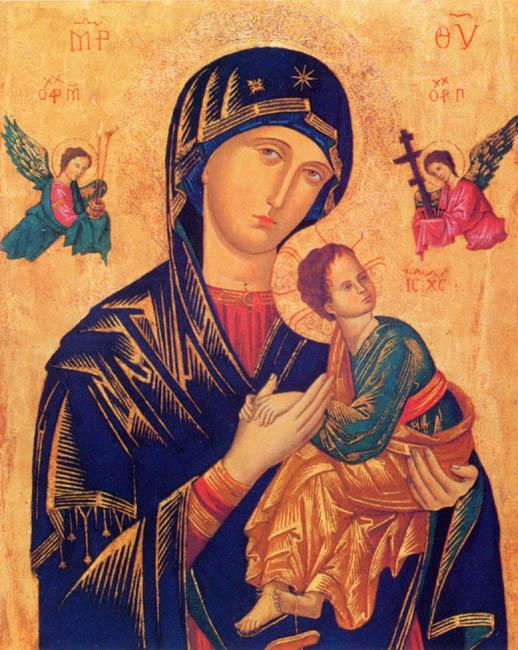
There is a charming story told about St. Bernadette, the Lourdes visionary. After the apparitions were well over, people wanted to know what Mary looked like, especially to construct a statue for the Grotto. She gave a sculptor as many details as she could remember, but the result dissatisfied her: “That is not Our Lady!” She was then brought all kinds of paintings – Our Lady of This and That, and whatnot. None of them matched her memory. Finally, she picked up a picture of Our Lady of Perpetual Help. “That is the Blessed Virgin!”

Desprestaur
Our Lady of Perpetual Help

The “non-realism” of icons, at its root, is a sign of respect for the mystery of the holiness of the subject being depicted. It leaves something to the imagination, as if to say “it is impossible to depict the reality, you must go find it for yourself.” It is revelation through negation, perhaps what we could call a “weak apophatic” mysticism. The medium also allows for one to emphasize certain features of a subject as a symbol.

Icons are never “drawn” or “painted,” they are always “written,” like a word. The goal is not to capture the reality so much as it is to start one down the right path to a real encounter with the subject, and ultimately with God. There is great value in this. We would find it odd to have a devotional picture of someone posing as the Blessed Mother… We do not find it odd to have an icon, which is “less realistic” but is still somehow much more accurate, as St. Bernadette would affirm.

One might call to mind many scriptural corollaries to this – the ubiquitous treatment of “seeing God” as difficult or impossible, the veil over Moses’ face, the gradual progression from Law to Spirit… And, if you pay close attention to the Gospels, almost no miracle of Christ takes place in direct visibility – it’s always in the midst of chaos, in a storm, in a cloud, inside a body, etc. This is why a scene like this – while well done in other ways – might feel a little “off”:

If this is what His miracles looked like, He may as well have flown around Jerusalem (Mt. 4: 5-7) and been done with it.

This whole issue of the delicacy of mystical imagery is particularly poignant in film, where actual people who we know are not “real” become stand-ins: they do the walking, talking – all of it. Sometimes this is helpful. But no matter how good an actor or director is, you know that “this is not how it actually looked, and that’s not actually Jesus/Mary/etc.” If you want an “authentic picture,” you have to do more work in a way because you need to deconstruct what is being shown and then stick to a mostly shapeless image in your mind.

For these reasons, I want to suggest that the art of animation gets a largely undeserved bad rap, or is at least not given enough serious attention.

This is an absolutely wonderful bit from The Prince of Egypt. The film has a pretty killer soundtrack, but the step back from the “big orchestra” pieces here is particularly effective. The lyrics are a play off of the song which is sung by Moses and the Israelites after the crossing of the Red Sea. Most important, however, is the symbolic imagery – notice especially the moment at 0:38, as a type of the Crucifixion. All of this achieved through “a kid’s medium”… Still very moving, no?

Compare and contrast with the same scene from a live-action film (go to about 1:14:00):

Here is another example of religious animation done extremely well, telling the story of Bl. Joan of Aza giving birth to her son, St. Dominic:

This short wouldn’t work nearly as well if it weren’t animated. Think about it. There’s an ethereal character to it that allows for the strange to be beautiful in a way that live-action characters would render impossible. (It would end up looking more like this, which wouldn’t seem right.)

These are just a few examples. But it is clear that the “unreal” can achieve certain goods that the “real” can’t, especially with spiritual realities which are distant (or “unreal”) to our intuitions.

In art class in elementary school, we often thought the goal of painting, drawing, etc. was to make the work look as similar to the subject as possible. Maybe this attitude never quite left some of us. And maybe it’s time it did, especially if we are using art to evangelize or catechize.


Post by: Eamonn Clark

Why is only this called Praise and Worship?

Deep in the silence of the Roman catacombs, a dim light grows brighter from around the corner as several torchbearers approach. There is urgency in their demeanor, but there is also a peacefulness. As they turn into the long, narrow corridor, the figure of an emaciated but sturdy pontiff can be seen slowly making his way behind them in full vesture. He is preparing to celebrate Mass over the tomb of one of his favorite martyrs, but he is trying to escape the notice of the emperor’s soldiers above. He turns to one of his deacons: “We’ll keep the volume on the amps down this evening, but I think we can still use the drum set.” The little group starts their liturgy to a hushed rendition of “Gather Us In.”

Suddenly, several of the emperor’s guard are heard rushing down from above! But the worship leaders will not be deterred, singing all the louder, “Gather us in, the rich and the haughty, gather us in, the proud and the strong…” The men get closer and closer. “Not in the dark of buildings confining, not in some heaven light years away…”

You decide what happens next: Are the soldiers so touched by the devotion and beauty of what they encounter that they are miraculously converted, or is this pope martyred for having terrible taste in music?

This is a ridiculous example meant to illumine a serious problem… The crisis of liturgical music, and even more broadly, the crisis of Christian music today in general.

Before we get into it, can we atone for the sins of the video above with a sample of something that won’t offend our sensibilities and is possibly similar (albeit very distantly) to what might have actually been sung in such a setting?

Ahh. That’s better.

We can realize the disparity in the dignity of the two pieces. We laugh at the thought of acoustic guitar accompanying someone like Pope St. Sixtus II, whose mere memory emboldens faith and charity. But when we imagine him being surrounded with this wonderful a capella piece performed by Ensemble Organum, it moves the mind to another world – we sense that this chant has a gravity and that anything done while it is sung is at least similarly serious. (And yes, it is a capella… The deep tones are droning.)

You will no doubt agree that this music is ordered to the praise and worship of God. Why then, does “Praise and Worship” refer to a class of music with such vast differences, like “Gather Us In,” (which, to be honest, is really more like a hymn than real P&W) or the stuff you would hear on the local Christian music radio station?

It starts in the same time and place that many other important things began to be destroyed: the late 1960’s in California. Coming on the heels of the secular music revolution going on at that time, “Jesus music” made its debut. A small group of hippies figured out that “free love” wasn’t all it was cracked up to be and starting becoming “born-again” Christians. Then they simply incorporated biblical messages into the music they were already playing in the back of the van and on the street corner. The growing popularity of the music of the ecumenical Taizé community in France also had some influence over the new genre, which is not so bad in itself, but when combined with 70’s guitar gets a little strange.

Credit needs to be given for the desire to leave a terrible way of life and to embrace and share the Christian faith. But if you are listening from far away, you ought to be able to tell whether a song is more likely to be about the Incarnation or about dropping acid. It is fundamentally a problem of proportion between means and ends. (This will be explored in other posts.)

The novelty of such a strange mix took off, and it turned into a bona fide industry within a few years. Soon it became “contemporary Christian music,” even having its very own magazine.

This all of course also conveniently followed the Council, which had set the stage for a plethora of misguided innovations.

So whence did the name “praise and worship” come? Perhaps there was some event or concert that first popularized the phrase, or maybe some big producer started talking about the music in that way. But that it has become accepted terminology – over and against Mozart – is surely more than hearing other people use the term. There must have been some kind of large-scale interior breakdown of the sense of latria (adoration) in order to identify praising and worshiping with only a specific kind of Christian music, and music of dubious liturgical quality at that. It would seem that the Church of What’s Happening Now deemed its music to be superior to all that had gone before, and thus gave it the truly dignified title of “praise and worship” – as if it were the first time music had ever been used for such things… And this is to make no mention of the often self-centered lyrics that sort of miss the point of praise and worship to begin with. (This one might be the worst.) If the songs you sing at church use personal pronouns more than “You,” “God,” “Christ,” etc., then there might be a problem.

Maybe this theory is a little “out there.” But then again, the 70’s were “out there” too.

How is this for a thought: if it isn’t praising God, or aiding in the worship of Him, then it really isn’t Christian music at all. It might be about Christian themes, it might be done by people who are not afraid to say they are Christians, etc. But if we really want to bestow the name “Christian” onto something, it had better be ordered toward Christ. We should remind ourselves how seriously St. Ignatius of Antioch took that title.

There’s no easy solution to this. But let it be known that the official stance of CRM is that all Christian music is also Praise and Worship music. Maybe introducing this idea in our parishes and schools could help recall to mind the truth of the matter and tone down some of the craziness.


Main image credit: http://www.confrontmagazine.com/wp-content/uploads/2014/09/crowd2.jpg

There was no music on Calvary

Chances are, you’ve heard of St. Ignatius Loyola. Chances also are that you have tried his oft-recommended technique of meditation involving placing yourself in some scriptural scene, trying to imagine all the details of what is going on around you.

This is certainly a good method for reflecting on Scripture, but we 21st century Christians typically have a roadblock to achieving the real purpose of this exercise. It is a case of art revealing and concealing the truth simultaneously… We usually want to “cinematize” what we imagine.

This is easily proven. If you were asked to place yourself at the Mount of Olives during the Ascension, you would probably be tempted to insert a soundtrack at least, and maybe even some crazy angles and close-ups of wide-eyed apostles. But this is just not how we experience real events. So why would we try to experience the Gospel in this way? If I asked you to imagine eating breakfast, there wouldn’t be any orchestral accompaniment. When you start to dream about going home after a long day at work, are your kids running in slow-motion to embrace you? Maybe this type of dramatization opens up a place in ourselves that allows for a greater emotional response, which certainly can quicken true devotion up to a point, but eventually we might find ourselves responding more to the “art” than to God. Of course, this is a new phenomenon, since film is a new art form.

This scene from Gibson’s The Passion of the Christ is pretty well done. But try watching it once with the sound, and once without. Notice the difference – perhaps the one is more emotional, but perhaps the other is more spiritual. (One day I would love to make a short film about some incident in the Life of Christ with no “fluff”… No music, dramatic lighting, slow motion, etc.)

The “silence and normalcy” of the events in the Life of Christ highlight His Incarnation – Jesus is really human, and, like other humans, does not have built-in theme music, a wind-machine on hand (that incident on the Sea of Galilee notwithstanding), or a traveling make-up crew.

The truth is that we are all outdone in spiritual maturity by Elijah. If we weren’t taken in by the storm, we would have been enthralled by the earthquake. If that didn’t get us, we would have bowed down at the fire. But Elijah knew it was the small whisper of wind that was the voice of the Lord.

It is significant for us Christians that Elijah encounters this voice at Horeb, where all those same kinds of things had happened before with Moses and actually were true representations of the voice of God. It seems that in general God becomes quieter and quieter throughout the course of Scripture and salvation history… Paradoxically, the quieter He becomes, the closer we can get to Him.

Sometimes a little fire or earthquake is fine, but often it is a snare. The true life of the spirit is quiet, invisible, and secret. Just as the flesh of the Son of God concealed His Divinity on the cross while simultaneously revealing it, our outer life conceals and reveals our deepest interior life; and since the interior life is what matters most, our default habit ought to be to deal with it directly insofar as it is possible. If we feed the spirit, that will shine forth in our flesh (just ask Moses). On the contrary, expending too much energy enhancing our outer lives through entertainment and pleasures leaves our interior life hanging high and dry – though sometimes people can be tricked into thinking that a fun and “rewarding” life is sure evidence of holiness and Divine affirmation of one’s choices (or even mistakenly branded by well-meaning persons as critical tools of the New Evangelization). Hormones, seratonin, and even genuine spiritual consolations are not the real substance of the spiritual life, they are only afterthoughts and can even be obstacles to growth. The really good stuff is quiet, and sometimes without a drop of sensible devotion. This is a bit like how cinematizing the Life of Our Lord can, in a way, rob it of some of its power. That isn’t to say there is no place for it, just as sometimes God really does bless us materially, but it ought not be the primary way we try to encounter the Almighty.

There was screaming, crying, and there were even a few words, but there was no music on Calvary.


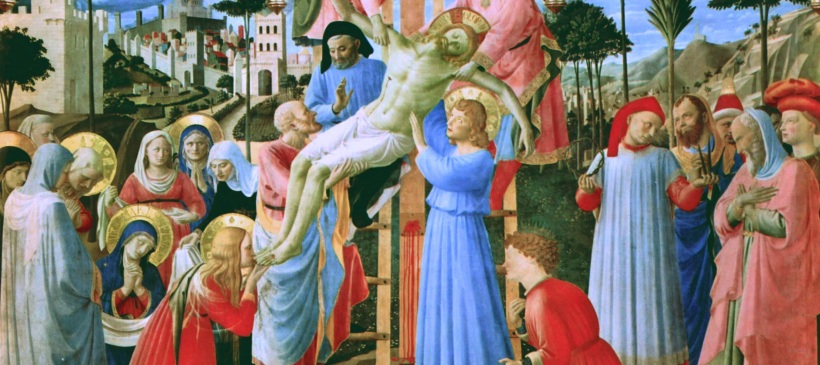
Main image: The Deposition from the Cross, Fra Angelico