The Contraception Post…

Eamonn Clark, STL

People say that the Church is “obsessed with sex.” This is only half-true. People are obsessed with sex, and the Church is obsessed with people. Given that the great majority of souls which are lost carry sexual sins with them, and are even lost on account of those sins, it is worth addressing here one of the more common kinds of such wrongdoing – the use of contraception.

In this post, I will explain the following items:

  1. The difference between natural and unnatural sexual vice
  2. The moral significance of unnatural vice, especially contraception
  3. Why periodic continence (“NFP”) is not contraception
  4. The effects of contraception on the individual soul
  5. The effects of contraception on marriages
  6. The effects of contraception on society
  7. The effects of certain contraceptives on one’s physical health
  8. The infallible character of the Church’s teaching on contraception
  9. How to confess the use of contraception
  10. Remedies for those struggling with contraception

Hopefully, this will be a helpful guide for couples, married or unmarried, and for clergy who are responsible for teaching, preaching, and counseling on these important matters. As you can tell by the length, it is thorough.

The difference between natural and unnatural sexual vice

In moral theology, an act is called “natural” if it aligns with the God-given purpose of a particular faculty which one possesses. For example, it would be natural to communicate the truth by speaking to another through signs or symbols. The faculty of communication is ordered towards this end – we have the gift of the power to express thoughts through language in order to pursue the truth in a community. If this gift is reordered to undermine the pursuit of truth, it is called lying. Lying is an unnatural act, a perversion of the order found in the faculty of communication. We have the capability to use language precisely so that we can express what is in our mind; thus, every lie, which distorts this, is a sin, however slight it may be in some cases. (Deceptive language is its own separate discussion requiring some distinctions – I did a post on this a while ago. But we will return to this analogy with language later.)

Another example is digestion. Something like what one sees in that scene at the party in Hunger Games 2 is a kind of perversion… Eat until you’re full, then make yourself throw up so you can go on eating – it is about the pleasures of the experience to the exclusion of fulfilling the purpose of the faculty being used. In fact, one guarantees that the purpose of the faculty will not be achieved by an act of the will which interrupts the order itself. In this case, one is taking food out of oneself which is suitable for consumption, simply for the pleasures of having more food. With dishonest communication, one is using words which do not signify what is in one’s mind to deceive another.

The power to reproduce is also a faculty. The sexual organs are not body parts with a wide range of legitimate uses, unlike the hand or the foot. There is a clear purpose for them, without which they would not make any biological sense. Nature would not provide organs which are merely there for useless pleasures. Just as communication benefits the community and individual as rational, and just as the digestive faculty benefits the individual as physical, so too does the sexual faculty benefit the community as physical. Eating keeps the body alive, reproduction keeps the human race alive. The former is important, but the latter is even more important.

Natural sexual vice (“natural vice” from here on out) is therefore easily distinguished from unnatural sexual vice (“unnatural vice”). Natural vice is the sort which is not a use of the sexual faculty whereby reproduction is essentially impeded by an act of the will. Unnatural vice is the opposite – something is intentionally done whereby the sexual faculty is integrally unable to achieve its fundamental purpose, namely, the conception of new human life.

Natural vice essentially reduces to extramarital relations. Various characteristics which have a special quality in relation to reason change the act from being mere fornication to being adultery (marriage), rape (violence), sacrilege (consecrated person), incest (family relation), and so on. This kind of act is seriously immoral principally on account of the danger to the potential child, who is owed the stability of a father and mother committed to each other for life. This evil is compounded by whatever special harm is done due to other circumstances.

Unnatural vice includes all those sorts of sexual acts which of themselves, according to their character, cannot produce a child. This includes masturbation, homosexual activity, immoderate/dishonest foreplay (or similar behavior), and contraceptive activity. It also includes more “extreme” behaviors, such as zoophilia (animals) and necrophilia (corpses) – which are perhaps more common vices than people might think, especially among certain populations.

Pedophilia is its own strange phenomenon which sits somewhat in between unnatural and natural vice as a condition, but as an act it is either unnatural due to its homosexual character or is simply a particularly bad kind of natural vice if it be heterosexual. This is notwithstanding the fact of the infertility of a child – infertility is an accidental characteristic of the act, not an essential one, as will be explored more below.

It is true that some factors outside of one’s control could contribute to desires to engage in unnatural vice, especially the way one is raised and educated in morals. Anyone who struggles with unnatural vice – which is the vast majority of adults in the developed world – is called to repentance and reform. When deliberately indulged in by those who basically understand what the sexual faculty is (i.e. not small children or those with severe mental illness), unnatural vice is mortal sin, thus excluding one from the life of grace and ultimately from Heaven should one fail to repent adequately before death. These people are, nonetheless, still to be treated as human beings who are loved by Christ; this is, of course, why they are called to repentance and reform in the first place. Those who have an abnormally strong and persistent drive towards entirely perverse matter (i.e. persons of the same sex, animals, corpses, etc.) must recognize that this is a cross which they must take up and carry. They cannot licitly act on this desire, ever.

Unnatural vice is categorically more perverse sexual activity, and thus worse as sexual sin, than natural vice, despite individual acts in the latter category being potentially worse as sins. (For instance, a married man forcibly violating his sister who is a nun would rightly be seen as a worse sin than a 14-year-old boy abusing himself as a result of a pornography addiction.) The reason unnatural vice is worse overall as sexual vice is that it entirely reorders the sexual faculty away from its God-given purpose. In natural vice, there is some element that is not a characteristic of the sexual act itself which renders the act immoral; in other words, it is something “not sexual” that makes this sexual act a sin.

The moral significance of unnatural vice, especially contraception

There seems to be a general sense among Westerners that we are all basically okay. Christianity teaches us that this is not true – actually, we are all basically broken. Understanding the significance of original sin is the key to understanding the reality of personal sin. One must know the bad news of our helplessness in the face of sin and death – and the subsequent fairness of eternal damnation – in order to contextualize the Good News of the possibility of new life in Christ, and thus the need for redemption in the first place. It does not seem that Our Lord is optimistic about the possibility of the great majority of people saving their souls. Quite the opposite, in fact: “Enter through the narrow gate. For wide is the gate and broad is the road that leads to destruction, and many enter through it. But small is the gate and narrow the road that leads to life, and only a few find it.” (Matthew 7:13-14)

This point helps us to orient the conversation around discipleship, which is always a conscious choice. The developed world actively urges lifestyles and values which are utterly opposed to the dictates of the Gospels. Unnatural vice is one of the big ones.

True, very few people have a tolerance for the more extreme behaviors listed, but by sanctioning behaviors in the same genus they can no longer reasonably condemn the related species. What they have left is mere emotional revulsion. It makes no sense to argue that contraception or sodomy is acceptable but that fooling around with a dog is not, unless one reduces the question entirely to the realm of active rational consent. This reduction involves a complete rejection of the principle that the precise part of human nature at issue informs the morality of its use, which in turn calls into question the role of human nature in general as a foundation for understanding all morality; that is to say, if morality is just about consent in regard to sexual matters, why is consent not the basis for all morality? This is a broader and deeper discussion than can be had here in detail, but suffice it to say that God creates us, including our bodies, with powers for particular purposes, and those purposes are the way we pursue flourishing, so long as they are subjected to and rightly ordered toward higher goods of the intellect and will (viz., the pursuit of truth and friendship). Human nature teaches us how to be happy, with the desires of our lower powers being at the service of our higher powers, not the other way around. We can obviously consent to bad things being done to us – for instance, we can consent to be killed by another.

Unnatural vice, including contraception, reorders a great gift of God away from the purpose for which God designed it. Imagine a father who gives his son a very expensive new car. The son is very happy to have the car. He puts it in neutral and then pushes it off a cliff. He thought to himself, “I just want to see how it would fall and crash. It gave me pleasure. And it’s my car, so I can do what I want with it.” The father would undoubtedly be very offended at such an abuse of the gift he gave to his son, no? That’s because he gave his son that gift for a particular purpose – to drive around in, not to push it off a cliff.

The stakes are indeed much higher when it comes to human generation, and the One Who gives the gift is the Almighty Creator. To abuse the sexual faculty for its associated pleasures is like pushing the car off the cliff, but much, much worse: the car is just about the son’s personal flourishing, while the sexual faculty is not only about our personal flourishing but also about the continued existence of humanity.

No doubt, other people will be having kids, and the practitioner of unnatural vice may also eventually procreate. This is sometimes presented as a counter-argument. There are several problems with this. First, this sidesteps the primary problem, which is that a faculty is being perverted. It does no good to protest that other sons will drive cars given by their fathers, or that he can carpool, or that he can buy another car – this car was given to this son by his father, and it was given to this son to drive. Second, unnatural vice spreads by social contagion and has accompanying bad effects in society. We will explore this more later.

Unlike with a vice like autoeroticism (and then only to some degree), no excuse can be made in terms of a lack of deliberation in the use of contraception. Taking the proper understanding of “how babies are made” for granted, the use of any sort of contraceptive implies an understanding of what one is doing vis-à-vis the sexual faculty: voluntary sterilization. There is likewise always some delay between the intention of the sexual act and the administering of a contraceptive. Given that one is necessarily aware of the character of one’s action, and that there is always some time to deliberate, it follows that there is never a time when the consensual use of contraception is not mortal sin for both parties. (The case of someone who does not consent to his or her spouse’s use of contraception is different, as Pius XI explains in Casti Connubii, 59 – one can consent to the sexual act without consenting to any artificial impediments to its fertility – onanism/withdrawal in particular… the usages of artificial barriers are to be actively resisted rather than merely passively resisted.)

Why periodic continence (“NFP”) is not contraception

There is a natural rhythm of fertility and infertility in women, and eventually they become infertile. Men, on the other hand, are always fertile unless there is a serious problem with their health. Not long after this was properly understood (around the mid-1800’s) there has been an openness on the part of the Church toward allowing for the use of infertile times in a woman’s cycle to enjoy sexual union and simultaneously to avoid the possibility of having children. This takes for granted that there is both a legitimate reason to avoid having children and a legitimate reason to engage in relations, presumably beyond mere recreation but more so because it is truly needed or is lawfully requested by one’s spouse (a contestable point which I will explore at length at a later date).

The objection is laid down: this amounts to contraception. Instead of using a barrier or a chemical to restrict insemination or ovulation, one simply guarantees infertility by using timing.

The normal response is that the use of periodic continence, or natural family planning (NFP), to avoid conception is that it uses the natural rhythm of the woman and therefore does not constitute a violation of the natural order of procreation. It is not contraceptive to not have relations during some times and to have relations during other times.

This is true, but it is somewhat vague and does not address the underlying suspicion about the intention being the same, namely, to presume upon infertility as a condition for having relations. It is better to point out also that not wanting the faculty to achieve its end and simultaneously predicting its failure to do so is different from intentionally and artificially guaranteeing sterility by removing something natural to the faculty and its organs (i.e. a hysterectomy in view of sterilization) or by adding something which is foreign to that system (i.e. a barrier). In this case, the matter or means of sexual activity is rendered unfit by an act of the will – what was the right object of sexual action is now made improper due to the subversion of that matter’s purpose by the one acting upon it or using it. In other words, everything works rightly in periodic continence: sometimes she is fertile, and sometimes she is not, and it is not immoral to want things to work the way they are meant to. This is very much like what is called a “broad mental reservation,” wherein someone tells a truth hoping to deceive, due to some reasonable motive. This is not a lie – as intentionally telling the truth is not lying. In the contraceptive act, something is made not to work rightly. It’s the “making something not work rightly” while using that thing’s system which makes contraception immoral and leaves periodic continence as a legitimate option. Contraception, then, as we have seen, is like lying. And while some truths are unimportant to communicate, human life does not admit of degrees of importance in the same way – it is always serious.

There are potential misuses of NFP – I alluded to two possible cases (unjustified avoidance of children, merely recreational sexual activity) – but there is only venial sin here. While still immoral, and certainly an occasion of worse sin, it will not kill the soul or be likely of itself to introduce terrible disorders into a marriage or into society. NFP, by the way, can and should also be used as a tool to try to conceive.

The effects of unnatural vice in the individual soul

We naturally have a strong desire to propagate our own species, just like plants and animals. This is outdone only by the natural desire for self-preservation, through eating and shelter and self-defense. But the guilt and stain of original sin is transmitted by physical generation from one human to another. It seems that, as a fitting consequence, we are driven to sexual sin more vehemently than to other sins… it’s almost like original sin is a virus that wants to propagate itself through a manifestation of its effects, just like sneezing or coughing. However, unlike a virus and more like a parasite, original sin is also comfortable with simply afflicting its host. The viral paradigm corresponds to natural vice, and the parasitic paradigm corresponds to unnatural vice.

A virus can certainly kill its subject. But it’s sort of “just business,” as viruses are only quasi-living entities. A parasite kills in a more disturbing way – almost as if it’s personal. It’s a hunter, and you are the prey. Like a parasite, original sin starts to eat away at the interior life of a person engaged in unnatural vice (or any other vice, except natural vice). And it grows stronger as the host grows weaker, like a tapeworm adding new sections over time.

The “daughters of lust” are eight in number. Four afflict the intellect: blindness of mind, rashness, thoughtlessness, and inconstancy. These relate, respectively, to the perception of an end as good, a lack of due consideration of the means to attain the end, a lack of judgment about the rightness of the means, and the mind’s command to carry out the means. Four afflict the will: self-love, hatred of God, love of the world, despair of the next life. These correspond respectively to the end concerned (conversion towards oneself and away from God) and the means (this world, which removes thought of the future world). The worse the vice, the stronger the daughters. Unnatural vice is categorically a worse vice, as it is a worse perversion of human sexuality in itself. Therefore, the daughters will be stronger in the one afflicted by unnatural vice than one who simply fornicates and risks having many children out of wedlock.

The individual who is willing to use contraception is much more likely to be promiscuous. This goes without saying… it’s sort of the whole point, for the single person.

The effects of contraception on marriage

Certainly, not everything which follows will apply to every marriage, but most of what follows applies to most marriages to some degree. Each individual, and therefore each marriage, is unique. Reception is according to the mode of the receiver… Unnatural vice will have different effects in each relationship, but these are some general tendencies which leap out at me.

From the outset, we must insist that marriage is primarily about raising a family to be virtuous members of society and to teach them to glorify God. It is not merely about personal psychological fulfillment – one’s psychology is disordered if it is not seeking God’s glory in all things, after all. Marriage fundamentally exists as a natural office wherein new citizens are raised to be good men and women, and members of the family learn to become saints through the edification and assistance received from each other. This is the point, and it is certainly something one ought to take psychological pleasure in.

The first effect is a diminished need, and subsequently a diminished capacity due to a lack of practice, for meaningful communication. She no longer needs to bother to say that it’s that time of the month – which means that more serious conversations don’t need to be had about one’s needs and desires in relation to the prospect of welcoming another child. Over time, many opportunities are missed for growing in the skills to sift through these challenging topics which touch on every element of a couple’s life together. As a result, over time the communication skills of the couple will be less than what they could be, and they might even be quite emaciated.

The second effect follows from the first, which is a decrease in intimacy. This will often begin with a lack of emotional intimacy and eventually a lack of physical intimacy expressing those absent emotions. Without the need for good, strong communication about the most important things in the couple’s life, they have less need to be vulnerable with each other. This can create a coolness, or at least a kind of shallowness, which is often intractable and can be extremely damaging in the long run.

The third effect follows from the second, which is a selfish objectification of the other. In denying generosity with God in the act which is naturally ordered towards creating new human life, the most powerful thing a person can naturally do, one turns in the great gift of human sexuality in on oneself. Spouses then use each other as tools for pleasures according to their own mind. This may be limited at first to the bedroom, but if what is most powerful and important can be subverted in order to be turned to one’s own temporal desires, it stands to reason that lesser things can be manipulated as well. The spouse becomes merely the tool to get what one wants. In the midst of the pursuit of selfish designs, one forgets that it is the search for God within and together with one’s spouse in the service of one’s family and society which rightly motivates marriage in the first place.

The fourth effect also follows from the second, and it is boredom. This could be emotional or social boredom, and with time it will almost definitely include boredom with each other’s bodies. After all, there has been so little need for restraint that all the psychological mystery of the sexual encounter is entirely gone, together with the intimacy which surrounds it and makes it positively meaningful. The couple gets too sexually accustomed to each other.

The fifth effect, more general in nature and usually only present in the long-term, is regret. We do not often encounter people who regret the children they had, but we do encounter people who regret the children they did not have. What preoccupies people at their deathbed are chiefly two things: their soul, and their family. They may fret over both, or they may be consoled. But a family that doesn’t exist brings neither fear nor consolation to the one who withheld their procreative power in favor of minding pets and taking luxurious vacations; it brings emptiness and pain. Even before the deathbed, one’s old age can be very lonely indeed. Was chasing those pleasures really worth the awful feeling of wasting away, of being abandoned and forgotten, especially if the other effects I’ve mentioned have accrued and become fully mature? Those who do have at least some children who pause to consider it will likely admit that in fact the pleasures now of being visited by their children and watching them become parents and so on is much more enjoyable than any other achievement or experience in their life – and if they go the step further in reasoning, they will almost always admit that they cut themselves short by not having more children.

The sixth effect is the delay or rejection of marriage between a couple. Why bother? After all, it is easier to cohabit and just “wait and see.” The social effects of cohabitation are that an unrealistic perception of the other is cultivated – it’s a “try out.” It turns out that playing house is not the same as marriage and starting a family. The data is not actually as clear as one might think on the relationship between cohabitation and divorce, but studies have generally found them to be correlated positively. More research is needed, perhaps with more precision as to demographics. However, promiscuity in general is wildly positively correlative to divorce rates, though there are some oddities in those numbers which are difficult to explain. Yet such promiscuity is no doubt engaged in so widely due to the availability of contraception.

The final effect, a kind of summation and completion of the foregoing, is divorce, which, by American data, is about 50% more likely among couples who never practice periodic continence but have recourse instead exclusively to contraception. This statistic does not evaluate couples who have never used contraception, and it does not take into account the decline of marriage in general.

The effects of contraception on society

Clearly, the effects on the couple themselves are also effects on society, but there are more directly “social” effects outside the pair themselves.

The first effect is a kind of entitlement toward having children. If one sees no problem with blocking the production of new life, as if one is the master over it rather than God, then it follows that one may easily come to see having children as a right which exceeds the demands of the natural order of their production. This is made manifest in the use of artificial means of conception, such as IVF and surrogacy, wherein the child is treated as property, or like a pet, which one purchases rather than receives as a free gift from God. Over time, this attitude seeps into the way that children are treated in society, namely, as “projects” of their “owners,” rather than individuals with their own eternal souls which have an ordering for them preordained by God. Hence, we see little to no meaningful moral education on the part of schools. However, given the depravity of the current Western understanding of morals, especially in certain areas, perhaps makes it better that public moral education is minimal.

In fact, this general moral depravity is itself the second effect. In Humanae Vitae, St. Paul VI predicted four effects of contraception, one of which we have already examined (increased objectification, in particular the objectification of women). He also predicted a lowering of moral standards in general (obviously correct), and a more widespread use of forced sterilization (Google “forced sterilization” and “[country/region]”). He additionally predicted that marital infidelity would skyrocket. And so it was that shortly after the advent of “the pill,” starting in earnest after Griswold v. Connecticut (1965), the United States saw the rise of “no-fault” divorce (starting in 1970). If sex doesn’t have to mean the possibility of babies, then the permanence of marriage is without any objective foundation, as that permanence is primarily for the sake of potential and actual children. Rather, marriage is then at the service merely of one’s own psychological fulfillment. Not long after no-fault divorce, we had Roe v. Wade (1973). Well, the fact is that sometime contraception fails, and the “problem” needs to be dealt with so that one’s psychological fulfillment (“dreams”) can continue to be pursued. In the ultimate avoidance of the responsibility to suffer for the sake of another, we were tricked into thinking that there is no such thing as human nature and so the unborn child is simply a “private” matter. The maturation of the next step took a while, it is granted, though there were already motions towards it in the late 1960’s. This is the so-called “gay rights” movement, achieving its latest major victory with Obergefell v. Hodges (2015). If there is no intrinsic need to bother with the risk of children in sex, and there is perhaps not even human nature but rather just “privacy” and psychological fulfillment, then it is not only unclear why marriage should be permanent, but it is also unclear why our biology should matter at all for the use of sex or even the contracting of marriage. And finally, we see today the most recent link in the chain, which is the rejection of the reality of our sexual biology in its entirety: transgenderism. If our biological sex isn’t relevant to how we have sex, then maybe there is not really such a thing as biological sex, or maybe it is just not significant at all. Perhaps this is the end, perhaps it will go further, or in different directions, such as into the normalization of polyamory, as I have already explored in another post. I think that is the most likely route.

The third effect is the dumbing down of public discourse. This follows from the descent into moral depravity. Since the behaviors society tolerates and promotes become more and more obviously indefensible through reason, the use of force, whether social, legal, or physical, is required to protect those behaviors from becoming taboo or illegal once again. The reduction of the quality and depth of public discourse is also is a product of the daughters of lust, as explained above. The mind and will are turned away from the true and the good and can’t even really perceive this – so what is there to talk about, really, except the trivial things of life?

The fourth effect is, in fact, demographic winters. A cursory glance at the changes in birth rate in first world nations over the past few decades should be enough to convince one of the fact. It turns out that, when unnatural vice is treated as acceptable, the existence of the human race, at least in a given sovereign territory, can be threatened. Yes, it is more complex than this, but, to take an extreme example, it can’t honestly be denied that if Japan or South Korea didn’t have contraceptives they would not be teetering on a demographic cliff. China might be heading in the same direction – so too might the USA.

The effects of certain contraceptives on one’s physical health

I am a moral scientist, not a medical scientist, but here I will offer a few points which are well-established, with links to sources with more information, on the effects of some oral contraceptives can tend to have on women. It is true that permanent sterility is not an effect of oral contraception, but other items one might want to consider include:

  • An increased likelihood of some cancers (including about a quarter increased likelihood of breast cancer)
  • Gingivitis
  • “Lady problems”
  • Instability of weight (loss or gain)
  • Decreased attractiveness (yes, really – see below)
  • Manipulation of mood
  • Decreased libido (nature’s sense of irony)
  • Various gastro-intestinal problems (diarrhea, constipation, vomiting, etc.)
  • Other severe (albeit rare) issues

I highly recommend listening to this excellent talk by Janet Smith on contraception, which includes a discussion of the shocking and scientifically well-established fact that oral contraceptives make women unconsciously less subjectively attractive (this part starts around 27 minutes into the talk) – and it even warps their perception about the attractiveness of men. Aphrodisiacs are perhaps not real, but pheromones are.

The infallible character of the Church’s teaching on contraception

Humanae Vitae was published in 1968, just after the onset of the “sexual revolution.” Its primary teaching was of course that the use of contraception (as contraception) is always immoral. Ever since the publication of Humanae Vitae, there has been an argument made that the document is not infallible, and so the teaching contained therein is also not infallible. It is a remarkable fact that St. Paul VI judged the way he did, given that the overwhelming majority of bishops advising him on the issue were opposed to his conclusion. (Two notable exceptions included the Ven. Fulton Sheen and Bishop Karol Wojtyła, the future St. John Paul II.) By what is best explained as a movement of the Holy Spirit, in favor of the protection of the Pontiff from error in such a weighty matter now being so hotly contested, Paul VI judged against the majority and in favor of the extremely unpopular minority. Perhaps not since St. Athanasius had there been such a moment.

It is true that the encyclical genre, into which Humanae Vitae clearly falls, is not usually considered to be infallible unless otherwise evident. However, one would hardly conclude that encyclicals cannot contain truths which are already part of the infallible and subsequently irreformable doctrine of the Church, such as teaching that God is a Trinity, or that the direct and intentional destruction of innocent human life is always evil. The teaching of Humanae Vitae on the intrinsic immorality of contraception belongs to this kind of teaching.

We have already seen the natural foundations of the immorality of contraception, beginning with the character of the act itself as a species of unnatural vice and exploring also the various bad effects which the habit tends to have on individuals, couples, and society. We could add to this a firm basis in Scripture, most notably in the case of Onan, who spilled his seed on the ground instead of raising up children for his deceased brother and was slain by God as a result. (Genesis 38:8-10) The teaching of Paul VI finds immediate support in nearly contemporary magisterial literature in Pius XI’s encyclical Casti Connubii, which rendered an identical judgment. Pius XI quotes St. Augustine on the question in defense of his own position, and many other major authorities could be brought forward as well, including St. Thomas Aquinas, St. Alphonsus Liguori, St. Jerome, St. Caesarius of Arles, St. John Chrysostom, and others. One will in fact find no support for the liceity of contraception among any such author.

Other than abortion (and maybe capital punishment), it would be difficult to find a moral teaching more universal than on the immorality of unnatural vice, which contraception is clearly part of. (By the way, contraceptives of various kinds have been around and well-known for thousands of years.) Therefore, supposing that the ordinary universal magisterium of the Church possesses the character of infallibility, which it clearly does, then the teaching of Paul VI on contraception is simply the reiteration of this infallible teaching. Subsequently, since truths about human nature and its rightful use do not change, this teaching likewise cannot change.

How to confess the use of contraception

There are some points worth making on the right confession of the use of contraception.

First of all, if one has simply sinned by the use of a contraceptive, it suffices to say that one has engaged in contraceptive sex, stating approximately how many times this has occurred. (Other forms of sterile/unnatural sexual activity must be confessed as separate sins, of whatever kind.)

Second, if one has deliberately held the opinion that contraception is not immoral, over and against the judgment of the Church, this ought to be confessed as well. The intellect is bound to assent to the teaching of the Church on this matter – otherwise, one presumes to usurp for himself the judgment of a moral item which has already been definitively ruled upon by the Church.

Third, if one has undergone a contraceptive surgery, this ought to be confessed as its own distinct act, specifying that one has mutilated oneself in view of contraception. This is because a sterilization is not only an act of contraception, it is an act of violence against the good of one’s own body. In my opinion, one is normally bound to reverse such a surgery if physically and financially possible. This would of course be impossible with irreversible surgeries (i.e. hysterectomies) and also seems unnecessary in the case where the couple includes a post-menopausal woman who can no longer conceive due to natural sterility. Still, in these special cases, the will must remain open to the theoretical possibility of conception, even though conception be unwanted and even impossible.

Remedies for those struggling with contraception

Individuals who habitually use contraception must become aware of the fact of their own darkness in this matter, and they must trust, rather blindly, that on the other side of making this radical change in their life they will as a result encounter a kind of peace, joy, and power that they are presently unable to grasp.

They must make a good confession, naming this sin and any other sins of similar gravity. Otherwise, due to the lack of sanctifying grace in the soul, not only will they likely struggle immensely to improve in chastity but whatever progress they make will not redound to any merit. Those with the guilt of mortal sin cannot please God until they are properly reconciled to Him – and, should they fail to make proper reconciliation, they will lose their souls forever at death. Even before confession, they ought to make a good act of contrition immediately, apologizing to God for having thus offended Him, seeking to make confession as soon as reasonably possible.

Couples should open an honest conversation about why they are using contraception and what effects they think it may have and have had on their relationship. They must avoid blaming the other – unless only one party has been consenting, then they are both to blame, even if in different ways and to different degrees. The point of such soul-searching is healing in view of integrating themselves back into an ordered way of conjugal life. Sharp arguments must be avoided at all costs. The point is not to compete, it is to complete. The couple then must together strongly resolve that, no matter what, they will no longer defraud and degrade each other out of the search for pleasures cut off from their natural purpose but will instead trust God and each other enough to welcome whatever children may be conceived. In some cases, working with a good and like-minded marriage counselor could be helpful.

Individuals, including spouses, must also now struggle to attain the virtue of chastity. I have written a post giving in-depth advice on this, but here I will note that the removal of people from one’s life who are occasions of promiscuity is on the top of the list for the unmarried. For the married, they ought to consider more deeply what duties they undertook when exchanging vows, and if they have children already they ought to consider why they would not want another, even to go so far as to poison or mutilate themselves.

Finally, all who wish to attain to chastity must pray for assistance earnestly, frequently, and humbly. It will then be given, along with any other virtue which is thus requested.

Conclusion

One will find any number of voices that contradict what is presented here. Those voices may even claim the cloak of Catholicism. Yet the honest and open conscience will recognize that twisting the gift of human sexuality inward on oneself is a grave offense against God in every instance. And yet He is ready and eager to forgive immediately – so long as one still draws breath. The shame of such sins, once recognized as sins, can be overwhelming to the point of near-paralysis, and the pleasures indulged in can indeed deeply blind one to the good of virtue, as noted. But one must go onward and upward, with humble confidence in God’s mercy and assistance for all those who wish to pursue Him. Chastity is most especially a product of hope.

It is my deep desire that these observations will help individuals and couples embrace the heights to which they are called as chaste souls, and fruitful husbands and wives. I will pray for those who are challenged by this post, and I ask that they return the favor.

Comments are closed. Questions are accepted through the Contact tab.

Our Lady, Queen of Virgins, pray for us.

The Confession Post…

Eamonn Clark

There is nothing our accuser in Hell hates more than a self-accuser, nothing he loves more than a self-excuser.

There are many means to fight against sin and everlasting death – principally, baptism, but also frequent prayer, fasting and other penances, and almsgiving, together with a constant desire to grow in virtue, the reception of the Sacrament of Confirmation, and the reception of the Eucharist.

But all of it will profit one nothing if the Sacrament of Confession is neglected. In fact, it will be to one’s eternal shame and confusion that all the spiritual resources of the Church found in this sacrament (in the midst of the other advantages named above) were so readily available and yet were ignored. In fact, it would perhaps have been better for such a person never to have received faith at all than to have thrown away its gifts in this way. (2 Peter 2:21-22) Many souls who consider themselves to be spiritual are dragged down to Hell because of their stubborn refusal to humble themselves by using the order of forgiveness of sins instituted by Christ Himself, an order already implied even in the Old Testament, when the dynamic between the priests and lepers is described (see Leviticus 13; cf. Matthew 8:4, Luke 17:4 regarding the cleansing of the ten lepers by Christ – “Go, show yourself to the priest,” etc.). The soul which needs to go to confession is a spiritual leper; half dead, half alive, in need of healing and purification.

Today is the day to resolve to go to confession.

First, I want to lay out the basic points of Catholic doctrine and law on Confession. Second, I will address the most common excuses for avoiding Confession. There will come a time when arguments will cease, however…

First, Catholic doctrine and law.

The Sacrament of Confession is administered to the baptized by a duly authorized priest for the remission of personal sins committed after baptism. An integral (or “real”) confession requires several parts: confession, contrition, absolution, and penance (or satisfaction). In turn…

Confession: One approaches a priest and names one’s mortal sins in kind and number, after an honest attempt to recall them to memory; one may also confess venial sins (although these may be forgiven in other ways, such as the reception of the Eucharist, or certain prayers and sacramentals, as long as one is not already in mortal sin). Any attempt to hide a mortal sin by consciously failing to confess it when one knows it to be a mortal sin with reasonable certitude renders the entire confession invalid and constitutes a sacrilege – an enormous sin. Mortal sins remembered only after the confession have been forgiven but must still be made known in the sacrament at a later time, which time one should not postpone. This is because the act of confession is related to the order of the person’s soul and also to the Church; not only must one do appropriate penance under obedience within the judicial framework established by Christ (the hierarchical/ministerial priesthood) for his sin for his own sake, but he must also rectify the harm he has done through his sin to the entire Body of Christ, the Church, which is wounded by every sin. (Some extraordinary sins also carry canonical penalties which require a special juridical process – but we leave this aside here.)

Contrition: One is truly sorry for his sins because they offend God, in addition to fearing punishment for them. The Sacrament of Confession takes one’s fear of punishment (servile fear) and makes up for the lack of the fear of God as a Friend and Father (filial fear) by the grace contained in the sacrament. The former kind of sorrow is called “attrition,” the latter is called “contrition.” (NB: the person who is absolutely unable to go to Confession who makes a good act of contrition – that is, a real apology to God because of the offensiveness of one’s sins – is forgiven by God. However, when it becomes possible to go to Confession, one must do so, and this intention needs to be there, at least implicitly, in the act of contrition outside the Sacrament; see the section above, and note the need for doing penance under obedience.) Without contrition for mortal sin, one is not a friend of God. All the prayer and penance of such a person amounts to nothing except a disposition to reconcile with the Lord. One who dies without restoring this friendship (called “charity”) condemns himself to the pains of Hell, forever. Effectively God says to such a person, “Thy will be done.” One receives something other than God, for all eternity. Contrition also implies a purpose of amendment, meaning, one intends to avoid all sin in the future, even though we all know that we will continue to fail. The point is that one wants to do the will of God starting “right now,” not later.

Absolution: The priest delivers the formula of absolution, essentially consisting in the words, “Ego te absolvo” (which can be translated, “I absolve you”). There are usually other words which accompany this fundamental form, which are important for driving home what is occurring but not essential for validity.

Penance: One must intend to do the penance which is delivered by the priest in reparation for the sins which were confessed. (A failure to do the penance after the fact does not invalidate the sacrament – but it is obligatory nonetheless.) Again, we note that the key is obedience to the juridical order established by Christ – in doing our penance (provided it is not a sin itself – in which case, one should approach another priest in Confession and explain the situation, also if it seems extremely unreasonable or inappropriate), we do the will of the Church as such. We can be assured that this is what God wants us to do for Him. This is freedom.

The law of the Church regarding the use of Confession is in fact so important that it constitutes one of only five “precepts” of the Church, each of which are interrelated (perhaps worth its own post) and aim at sustaining the bare minimum of commitment to the spiritual life that is generally necessary for avoiding total spiritual catastrophe. They admit of special exceptions (like missing Sunday Mass due to sickness), but they generally bind the conscience. The five precepts are: to contribute to the material needs of the Church; to attend Mass on Sundays and other prescribed days (e.g. Christmas, Immaculate Conception, etc.); to fast and abstain from meat on the prescribed days (e.g. during Lent); to receive Holy Communion once a year during the Easter season; to go to Confession once a year.

It used to be a widespread problem that Catholics would hardly ever receive Holy Communion, despite frequent attendance at Mass, sometimes accompanied by an automatic or “rote” use of Confession. Today, we usually have the opposite problem – infrequent use of Confession, automatic and rote reception of Holy Communion. (We should recall that to receive Holy Communion while consciously in mortal sin is a sacrilege – once again, an enormous sin. In cases of grave necessity, one may attempt to elicit an act of perfect contrition, which includes the intention of going to Confession when possible, and then receive Holy Communion – but these are very rare instances.) It seems Christ would be much more pleased with very few receptions of Holy Communion with many receptions of forgiveness in Confession, rather than the other way around. For example, St. Francis of Assisi may have only received Holy Communion three times in his entire life.

The precepts of the Church are the most fundamental “rules” which the Church prescribes. The Church has the commission to teach, to govern, and to sanctify, in accord with Christ’s own teaching, governing, and sanctifying power and authority (prophet, king, priest – frankincense, gold, myrrh) – the precepts invoke the full authority of the Church in governing the spiritual lives of the members of the Mystical Body of Christ, the Church. In other words, it is Christ Who gives these precepts. Therefore, to neglect any of the precepts knowingly and willingly constitutes mortal sin, and though ignorance of the precepts “as” precepts could excuse one from grave sin (e.g. “I didn’t know I had to go to Mass on Sundays”) it is practically impossible to avoid mortal sin without doing what the precepts tell us to do – that’s why the Church puts them forward: it is for our benefit. So, it is obligatory under pain of mortal sin to confess one’s sins once a year – and if you think you have nothing to confess after a whole year, try asking your friends and relatives (especially your spouse) for some ideas. They will set you straight on that. Then you can also confess pride and self-ignorance. Even if you don’t have mortal sins to confess, you still have the opportunity to examine how you can do better.

In sum: it is seriously obligatory to confess one’s sins once a year, to be sorry for them, to receive absolution, and to do the penance assigned.

Second, the most common objections against the use of the Sacrament of Confession. Maybe you can find other excuses – but if you are honest with yourself, you will find that they are always derived from a distrust of Christ and His Church, and/or inordinate self-reliance. Such excuses should normally be brought up in the Sacrament, by the way.

“I just confess my sins to God.”

This is certainly a good thing to do. As we have already noted, God can and does forgive sins when one is truly contrite – and venial sins can be forgiven apart from Confession by the use of prayers, sacramentals, or the reception of the Eucharist (unless one is in mortal sin already). The first problem, however, is that when dealing with the matter proper to Confession (mortal sin), one who “confesses to God” cannot be fully sure of his own motivation for his sorrow – fear of punishment, authentic love of God, or maybe some other motive (psychological discomfort, for instance). Confession removes this lack of clarity – all one must do is make a good effort to make an integral confession. Furthermore, as we also already saw, the key is the order of judgment and reparation (or penance) instituted by Christ: one’s sins – especially and principally one’s grave sins – wound not only the soul of the individual sinner (who frequently is not even aware of the depth of that damage and therefore needs Father to drive the point home), but it also wounds the whole Church. Therefore, when it is possible, one must subject himself to that judicial order, which is the sacrament. If we deny this, we are calling the sacrament superfluous, unnecessary, unimportant – we are implying that we would have advised the Risen Christ not to bother instituting this sacrament in the first place (John 20:23 – “Those whose sins you forgive are forgiven, those whose sins you retain are retained”). What an insult to the Son of God – which should be confessed. (This is part of the core of the Protestant doctrine on forgiveness of sins, by the way.) God wants us to confess our sins to Him in the way that He indicated by instituting the Sacrament of Confession to begin with.

“I am embarrassed of my sins/I am afraid/it’s too difficult.”

This is a more understandable and less offensive cause of avoiding the sacrament. However, it is still completely insufficient, for a few reasons. To begin with, unless it is Father’s first few months as a priest, you can be pretty well assured that he has heard it before, or at least something very close. Even if not, you are quite unlikely to say something all that “shocking,” and the sorrier you are in your expression of your sins, the less shocking it will be. “But you don’t understand – my impiety/sexual perversion/whatever/etc. is so extreme/weird/shameful that it is just too much to mention.” Well, your sin is probably not quite as “out there” as you think, but the discomfort is telling you something; that you are ashamed, which is right and just. It should be uncomfortable to say what you did, because it is evil – but you should not fear saying it. It is you who make it difficult to the point of being impossible. If it comes down to it, write your sin down, and just resolve to read it – that could help you get through it. But the discomfort actually can provide the condition for the great feeling of freedom – the secret is out, even though God already knew what you did. Now your mind is free, and your soul is cleansed. And the sin dies in the confessional. Do not fall into the false humility of Simon Peter in the boat – “Depart from me O Lord, for I am a sinful man!” (Luke 5:8) It is precisely because you are sinful that the Lord should not depart, and you should ask His forgiveness in the way that He wants.

“I will feel too good about being forgiven.”

Sometimes, a person will make the argument that it is this precise feeling of freedom which is a “trap” of some kind. The idea is that it is “purer” to apologize to God directly and avoid the Freudian “release” of the confessional process. Often this is a pious-sounding cover for a deeper problem – for example, inordinate shame of sin (see the section above), which could be the real reason motivating any of these excuses – but perhaps such a person really think it is “more spiritual” to avoid the sacrament. After all, one might “feel holy” instead of being holy by going to Confession, right? The problem is, once again, the order of forgiveness instituted by Christ is contradicted. In fact, one of the advantages of the sacrament is precisely the feeling of being forgiven – it is a good feeling (or it can be) – which is supposed to teach us to love the forgiveness of the Lord and to keep seeking it. God actually wants people to feel good about forgiveness, at least sometimes. This is to make no mention of the fact that being forgiven does actually make a person holy, even if not perfectly so. In actuality, a person who lets himself believe the lie that “avoiding feeling holy” justifies avoiding confession is deceived far more than a person who tends toward thinking that “feeling forgiven” is the same as holiness… the former lets himself think that his own psychology is more important than the order established by Christ and commanded by the Church in His Name, while the latter simply feels a little too spiritual when actually doing something which Christ truly wants. Disobedience with the feeling of pure intentions is far worse than obedience with the feeling of being a bit holier than one really is. Disobedience is a higher kind of pride than a mere swelling of the ego. Better to do God’s Will poorly than to do well what is not His Will.

“I just don’t have time/it’s too much effort/it’s inconvenient.”

Nonsense. We put plenty of time and energy into all kinds of pursuits which are not even that important for our natural, temporal lives… Hobbies, socializing, getting ahead at work… Surely, we can muster the energy and make the time to drive to the local parish on a Saturday afternoon to put our souls in order – instead of watching television and surfing the internet. And if there is no time for Confession advertised at the parish that is convenient, make an appointment at your leisure – or just show up at a daily Mass and tell Father you want to make confession before or after. (But if you need to go to confession, don’t dare to receive Holy Communion in the meantime.)

“I am afraid of becoming scrupulous.”

It is true that there is an abuse of the sacrament by overuse, or rather, inappropriate frequency deriving from a warped sense of morality. To be clear – some saints went to Confession once a day (such as Ignatius of Loyola), and it was not abnormal for many to go two or three times per week in centuries past. However, this is probably not advisable for the average layman, or even the average priest (once or twice a month is a standard practice). In any event, a person who is tending toward going to Confession every day is most likely doing so because of a neurosis, an overly sensitive conscience, a poor understanding of morality or of the sacrament… not because they are the next Ignatius of Loyola. This is a problem, but the fear of such a problem is insufficient for avoiding the sacrament altogether, as it still remains the order of the forgiveness of sins which Christ wants used. If a person really is afraid of a “runaway train” then he should approach a priest and explain this fear, and ask for his advice on how often to go to confession (except when one is absolutely sure one has committed a mortal sin – sure in the way one could swear on a stack of Bibles that it is so), and then obey it. If it’s once a year during Lent, then it’s once a year. If it’s once a month, so be it. Obedience is the key – just like we have already been pointing out.

“The priest might not be holy.”

So what? None is good but God alone. And yet the Lord wants to use broken instruments to show His power and glory. It is insulting to the Lord to assume that He cannot work well through bad instruments – and clearly, He wanted to use mere men to do His work, even evil ones like Judas. The thought which animates this objection is heretical in the strict sense – it is Donatist (and Protestant). Christ is the Voice which says the words, “Ego te absolvo,” through the priest – be he adulterer, murderer, or idolater. If you have been falling into the Donatist heresy, you should bring that up at your next confession, by the way.

“I had a bad experience.”

It happens – and it can be a great psychological obstacle. Sometimes, Father is exhausted and short on patience. Sometimes, he is just plain short on virtue (see above). Well, thank God, in most places there is more than one priest available. Try again – it is Christ you are seeking, not Father So-and-So. Maybe start by saying how bad your last experience was with confession, and go through what happened… that could be helpful.

“My sins are too great.”

No, they are not. See above about Simon Peter in the boat – “Depart from me O Lord!” This too is its own sin – to assume that God is not powerful enough, or merciful enough, to forgive you. (You should apologize to Him in the Sacrament for thinking so little of Him.) There are plenty of sinners much worse than you who have come back to the Lord. My favorite Old Testament example is King Manasseh – an idolatrous genocidal maniac who finally turned his life around after decades of terrorizing Jerusalem (see 2 Kings 21 and 2 Chronicles 33). St. Paul was the leader of the Jewish version of ISIS, then he became “the Apostle.” A popular modern example is Rudolf Hoss – commandant of the holocaust death-camp at Auschwitz, who is likely happy in Heaven now. You are not that bad. (You are also likely not as bad as the groveling and apostate Simon Peter in the courtyard, denying knowing the Lord Who sat just around the corner, nor as bad as the soldiers who crucified Christ – whom He forgave during the act itself.)

All of these excuses are great short-term investments in psychological comfort. They are very bad spiritual investments in both the short-term and the long-term. You will not regret overcoming your excuses – and in Hell, one only regrets his state… no longer is one capable of the kind of regret which leads to repentance. The regret of Judas leads to confusion, pain, despair – the regret of Simon Peter leads to repentance. Their sins were basically equal, but their outcomes could not have been more different. Choose wisely.

Conclusion

The soul which neglects making at least an annual confession slides slowly into more and more problematic sins – and then eventually is solidified in his favorite vices. When there are many people neglecting the sacrament in one place, such as in a parish, the devotional life will become more and more anthropocentric (no prayer before and after Mass, clapping for musicians, careless reception of the Eucharist, little tolerance for “challenging” homilies, a preoccupation with “being involved” with the Mass, etc.), and “social justice” initiatives will tend to overshadow what is left of the devotional life. This is not a good trend, and it is gaining ground in many areas around the world. More and more preaching on the need for the use of the Sacrament of Confession is called for – consider this my small contribution. Let us walk while we have the light… for soon the light will be taken away, and the darkness will come. (John 12:35)

GO TO CONFESSION! (And please share this post if you think it could help someone – spread this net far and wide…)

I am providing a few good resources here:

A formula for perfect contrition (it is not “magic,” remember – though it could be a good practice to say once or twice a day): “O my God, I am heartily sorry for having offended Thee, and I detest all my sins, because I dread the loss of heaven, and the pains of hell; but most of all because they offend Thee, my God, Who are all good and deserving of all my love. I firmly resolve, with the help of Thy grace, to confess my sins, to do penance, and to amend my life. Amen.”

My own post on learning chastity – perhaps the least favorite virtue of the young, especially young men… be ashamed of sins of lust, but be more ashamed not to confess such sins!

A good examination of conscience for single adults …and for married people … and for young adults/teens … and just in case you want it, for kids.

More advice on how to make a good confession

The Summa Theologiae on the necessity of Confession (composed by a colleague of St. Thomas, based on another of his works)

The Council of Trent on the Sacrament of Confession (Session 14), and the Roman Catechism (from Trent) on the Sacrament of Confession (promulgated by Pope St. Pius V)

The Catechism of the Catholic Church on the Sacrament of Confession

Some detailed history and theological analysis of the Sacrament of Confession and also especially of Absolution

If you liked this post, please share and subscribe!

NFP book release

Dear readers,

Today I am releasing a long-awaited text on Natural Family Planning, on the eve of the USCCB’s “NFP Awareness Week.”

You may sign up to be emailed the book here, if you are not already on my company mailing list. I won’t use this blog just to push company content – though I will point to it occasionally.

I hope to begin writing a bit more on these pages… It has been a while. Thanks for sticking around!

God bless you,
-Eamonn

Catholic History Initiative

Dear Readers,

With the approach of the start of this academic year, I am coming very close to the end of my doctoral studies. This has had me thinking about “what’s next.” As you know, I am working on the athletics and philanthropy stuff as seen in my last post.

I’m also getting into history.

After the fifth time I tried to leave Rome failed, I have resigned myself to staying there indefinitely. This bodes well for a career or at least intense hobby in the world of history, especially Catholic history. I’ve also been getting familiar with various archives in Rome, and now I also have an extremely helpful connection or two…

About ten years ago, I had started to collect filmed interviews of priests who had been ordained before Vatican II. It was so interesting… And I thought it was an important contribution. I still think that – not everyone I interviewed is still alive today. It’s a strange feeling to have a kind of responsibility to be a custodian of the stories of men who’ve gone before oneself.

I’m a moral theologian by training, but I’m very drawn to history, especially ecclesiastical history (and archaeology, its handmaiden). Part of it’s the existential thrill of uncovering the past and feeling part of a larger story than your own brief existence. Part of it’s the fear that people will not appreciate the present because they don’t know the past and its many lessons. And, being in Rome, it’s also just plain easy – every rock has a story to tell.

For these reasons, I am launching Catholic History Initiative.

The show is going to be very different. First of all, it’s not just a show. It has a WhatsApp group connected to it – anyone in the group can talk with anyone else, and we can and will plan episodes together. We may even have some LIVESTREAMED visits to sites I hope… If you just want to get an email with a link to the latest episode, that’s fine too. Second, the feeling of the on-site episodes will be a bit “rough and tumble.” It’s a notch or two above “me and my cell phone.” Here’s a teaser I shot in an afternoon and edited in an evening:

The episodes will typically be once a week (at least) and will usually be about 3 to 5 minutes – this is my projection. There will be a non-publicly listed video posted on YouTube which you will receive the link for.

I will be doing all kinds of stuff in Rome, but also around Italy and the rest of Europe and even well beyond. Want to learn about the missionaries and martyrs of the Pacific Islands? Want to wander around the Seven Churches of Revelation? Want to see where the ancient Ecumenical Councils were held? Then you want to sign up for CHI.

The truth is that I wish I could do this for free, but I can’t. The full price is 100 Euro per year or 10 Euro per month. I am offering a special discount to readers of this blog – use the code CRM30 to receive a 30% discount off your first year. The funds help me to produce the show and also help my company, Pro Fide, to start businesses in the missions.

The first episode is coming at the end of next month.

The show’s website is here. I hope you’ll join me on the many adventures which await…

God bless you and happy Sunday,
-Eamonn

So I ran 100 miles…

Hi blog. It has been a while.

Now that we are almost 2 months into my “post-race” period, I think it’s safe to say I’ve recovered. Here’s the story of what happened when I ran from Rome to Assisi, what that means, and what’s coming next for me.

Let me be blunt. When I started out on the path of fundraising for Catholic mission projects, I was about as naive as it gets. The fundamental lessons I learned include especially something I have also learned from my limited business experience: the only person you can really count on is yourself. Others might say they’ll do this or that for you – that doesn’t matter until it’s real. Meetings are not progress. Soft-commitments are not progress. Fancy party invitations are not progress. Only contracts and cash are progress.

I also learned that credibility is king. Want to ask for $100,000 to work on some educational projects in the jungle? Great! Here is your interaction. “Who are you? …Who? Okay, well, here’s my card, email me.” You’ve just been politely shown the door to Nodonationsville.

But the coldest, hardest truth I learned is that nobody cares. What I mean is that no matter how good the cause, how well-crafted the proposal, or how exotic the promotional hook is, if it does not correspond to the potential donor’s interests, it will be a failure. It’s not like you’re the only person asking for funds. People with means have many options, and they have many people treating them like wallets with legs. You have to find out what the donor cares about and show that your project corresponds to their interests and values. Otherwise, you are climbing up an even steeper hill than before. Now instead of simply building trust and asking for help you are trying to reform someone’s values. Don’t try to do that. And if their interests are too divergent to make a real connection, then YOU must become their interest. It’s easier to build a relationship with Mr. Billionaire than it is to teach him why YOUR hospital project should get funded as opposed to the ones he is already working on in the USA in a context he understands with people and bank accounts he trusts to work. And then he will fly away from the island in his helicopter to go to Monaco a day early. (This is a true story.)

So, as much as I wish I could say I was playing 5-dimensional chess from the start, the truth is that it was about 99% fake-it-til-you-make-it, fly by the seat of your pants, jump in and find out what happens…

Here’s what happened.

I finally identified a single project to support with direct philanthropy. A small one, with a realistic goal. Relatively uncontroversial – help sisters in Africa with their clinical work by funding the purchase of medicines. In the meantime, and on the side, I would work on finding the right partners and investors for some kind of commercial work with Malawi’s large numbers of very poor tobacco farmers.

“But Eamonn, tobacco is bad for you.”

The truth is that the farmers aren’t even really consuming the tobacco they produce. That would almost literally be burning money. They go to sell it at the government market, and they collect their pennies. If the tobacco market dips, some farmers make the switch to growing marijuana. So let’s move on. (Besides, I just don’t want to hear the bad moral arguments against tobacco use. We’ll debunk that another time.)

The logistics of setting up an indie ultramarathon are… not for the faint of heart. You need a driver, a back up driver, a plan for navigation, a plan for checkpoints, a plan for medicine, a plan for pacers if you will use them, a plan for food and drink. All of these have to connect with your own running plan. Then you need to have a system in place for when everything goes wrong, which it will. I also needed a plan for communications, live tracking, charging my phone, advertising… All to connect with the philanthropic project. I needed a chaplain too – just in case, you know… if things got too difficult.

I found a great group of guys to help me along what I thought would be a 26 or 27 hour event. Sort of last minute I created a WhatsApp group to document the event and show my live location during the race. That was a great call.

The preparations wound down, and so did I. The few days before the race, I tried to relax a bit, but there was so much work to do. I was very tired, actually. But at this point, it was not possible to delay the run.

The day finally came. Words cannot describe how surreal it is to know that you are about to attempt to run for 100 miles in one go.

Unfortunately, I forgot my bus pass and had to walk all the way to the house where I had mass and got geared up… But what I’ll never forget was how sick I felt walking to the starting line. Like, really sick. I’ve never been that nervous for an event in my entire life.

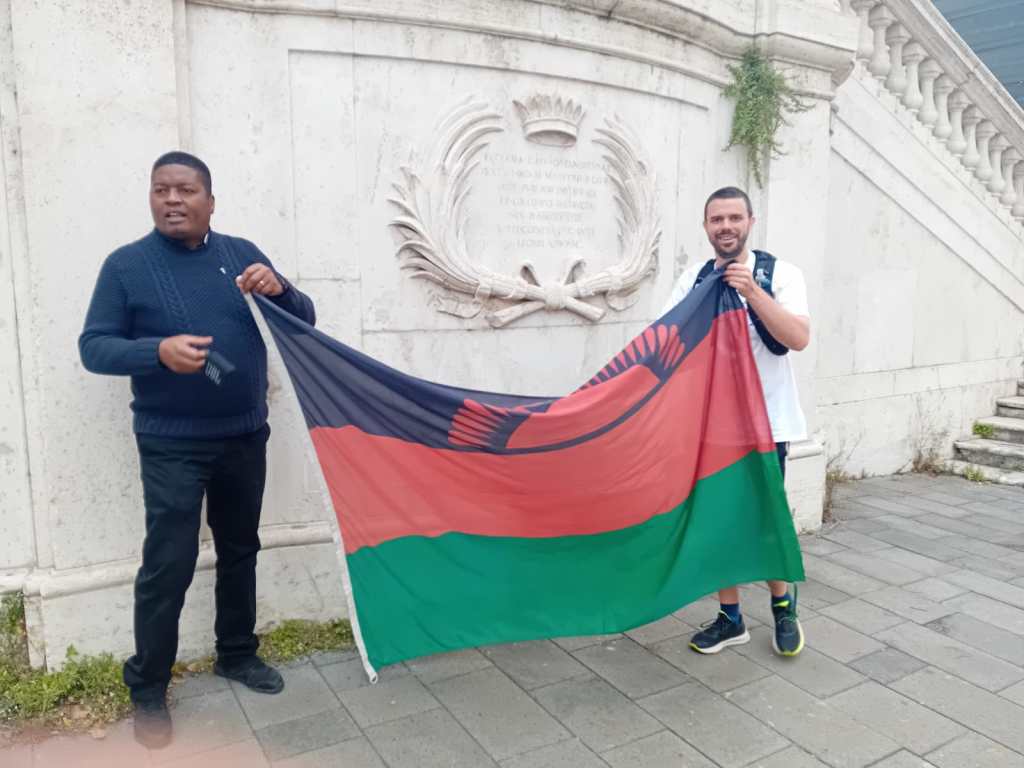
The energy at the starting line was great. Fun. Plenty of friends, and some curious police as well who made us put our Malawian flag away for fear of a “manifestation.” (The starting line was at San Lorenzo in Panisperna, immediately next to the back gate of the Viminale, the Italian Ministry of the Interior.)

Malawi flag!

The moment arrived – “GO.”

After a small push of energy from the rush of adrenaline and a bit of showmanship, I settled into a plodding pace and began looking for the correct turns to get to the Porta Pia, the great northern gate of Rome. A friend linked up with me on a bike, and we cruised for a bit towards the northeastern limits of the city.

Exiting Rome.

After getting out of Rome, I really started to realize that this was happening. And that’s when the wild animals started to become a problem… First it was a family of boar, hanging around a farmhouse. I was deep in the dirt paths that crisscross the Roman countryside – there was not really a way around. I made a small retreat, considered my options, got a big stick, and walked carefully toward the mom… They all ran away! Huzzah! Then I booked it.

Later a wolf crossed my trail. Same thing. Step back, get a big stick, walk slowly, then bolt.

The checkpoints were a mixture of chaos and order. Arrive, be greeted, sit down, complain about the hills. Eat. Drink some Coke. Get a leg massage. Fill up my bag with what I need. Get a blessing. Off. Meanwhile everyone was trying to figure out the turns I needed to take, while calculating the time it would be to the next stop given the distance and elevation changes, trying to find the food and gear I needed… While getting enough of the right kind of footage to put together a nice documentary.

Lots of action at the checkpoints.

The evening came. Things were going much more slowly than I had expected. The hills were WAY worse than I thought they would be, and I had taken a seriously wrong turn at one point early on that went up an absurd hill and ultimately probably cost me close to an hour. But when I reached the famous Benedictine Abbey of Farfa, I was still feeling pretty good. Tired, but good.

All the while, my WhatsApp group was how I stayed plugged into the real world, and how my friends and fans stayed plugged into my world. It was exhilarating to take a picture of a hill and have 6 reactions within minutes, encouraging me. This was a huge deal for me psychologically. And I know the group enjoyed it too.

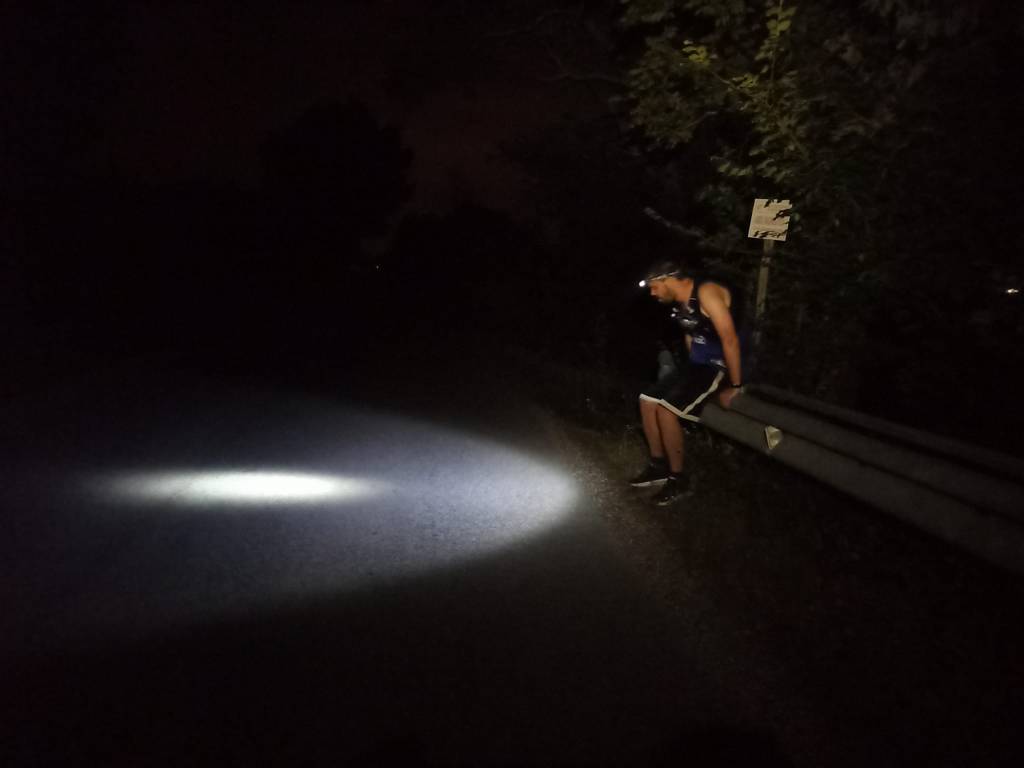
Night came. Fatigue came. Pain came.

A summary of the night.

The crossing into Umbria in the absolute dead of night was definitely the most intense part of the race. I brought my chaplain with me as a pacer for this stretch, after having had my medical assistant as a pacer a bit earlier on, when we were doing merely very difficult terrain at the tender hour of midnight. Around 2AM, there I was slogging through mud puddles in the middle of the forest between tiny farms on awfully maintained rocky dirt roads on large hills. We got turned around. We got barked at by angry dogs. We made jokes about my digestive system.

At the border of Umbria.

We emerged back into civilization, and my chaplain got to take a well-earned nap. Then it was off to the checkpoint at Stroncone. This was where things started to become very, very difficult physically and psychologically. Thankfully, the daylight was gracing the sky as I sat down for a while after around 22 hours or so of running.

The run from Stroncone towards Terni was uplifting in some ways, because the sun was out again after one of the roughest nights I’ve ever experienced, but it was also brutal. Every step was like being stabbed in my feet. By that point I think my digestive issues were reducing – it had been like every part of my body was angry with my stomach, and every movement made my stomach scream at each part of my body individually. Now it was just my feet telling me that they were on fire. Here’s a few clips of that section:

PAIN.

I almost quit at Terni, when I was told about the climb that I had right in front of me. 300 meters of elevation in a short stretch. Nope, wasn’t happening. But with some strategic thinking, I rearranged my planned shuttle for then rather than later. (I had about 10 miles of shuttle to use… Bringing the 110 mile course down to 100 miles.)

After Terni was when the heat started to become a real issue. I was continually being told about how little I was drinking. And I continually thought, “Yeah. Ok. It’s true. But they don’t understand what my stomach thinks about that.” (Though, oddly, I was never sick. That is still incredible to me.)

The mantra at that point in my head was so firmly rooted that it was like breathing… “If I get to Acquasparta, I will get to Massa Martana. If I get to Massa Martana, I will get to Assisi.” Repeat the phrase. Repeat. Repeat. Repeat.

I got to Acquasparta. We were 30 or so hours into the race at this point. And I had around a marathon left to run.

Just a marathon.

Off to Massa Martana I went.

At the checkpoint in Massa Martana. Some girl was walking by in the field. She took this nice picture of my and my team!

At Massa Martana, some of my team had to go back to Rome. Only my main driver and chaplain remained.

The evening started to come, and it hit me that I was really going to make it. Not just in my head, but really. A few small logistical hurdles jumped, and there I was, up on the hills overlooking the valley near Assisi. The song that I remember Spotify hitting me with was OneRepublic’s “Better Days.”

I was bawling. You have no idea what it is like until you’ve been there. 35 or so hours into a run. Seeing the place next to the finish line from afar. After dreaming about this for years, it was happening. It was real.

The valley near Assisi. It doesn’t look like much on the screen. It was everything to me in that moment.

One of the weirdest things, which some of my crew apparently also experienced, was that my sense of time really just went out the window. When I was coming up to the last checkpoints of the run, over 30 hours in, if you had told me that my starting line was yesterday, it would have seemed like nonsense. It felt like a month had passed. And I was having a kind of out-of-body experience, like I was just attached somehow to this man who kept running, wishing he would stop. It was very weird.

The final leg of the run was not without its challenges. It got dark, which was unhelpful for smooth movement over the rocky dirt roads in the fields below Assisi. Then my phone battery was dangerously low, and there was a serious scare from my team that I’d taken a major wrong turn – but it was my GPS glitching. I was able to pull off something like a 10-minute mile to get within a navigable distance just in case my phone died. Oh, and it was starting to rain.

Assisi in the distance – along with some rain clouds…

At long last, I came to the base of the hill. It was easy by that point, despite some hallucinations starting to creep in. My crew was there, along with my Malawian priest friend who had given me a blessing at the starting line. We approached the basilica, and then I touched the outer wall of the upper sanctuary at 12:15 AM on May 17, 2024… 40 hours exactly.

The run was finished. And so was I. Off to sleep.

The documentary drops on August 10. Here’s another teaser:

We’ve raised around $8,000 so far for St. Patrick’s Health Centre, a small Catholic clinic in Malawi. (We are still raising funds here until October.) But this is just the beginning. I have a lead now for tobacco exports, and we are already setting up my next event.

I am heading off once again into the unknown, albeit a little wiser than I was before. I will be doing more crowdfunding, both for straight-up donations and also for investments to help build businesses in the Catholic missions. Part of that will continue to be based on athletics – we will do the 100-mile again, along with other events TBA – but I am also setting up some media projects.

The first thing is that I will be launching a kind of weekly “training vlog” for my upcoming athletic event, in November. (It will be in Corsica – a “pedal-paddle,” bike and kayak, around the whole coast.) It will also be for the events that follow. You can watch me as I plan the event logistics, suffer through countless hours of physical pain, and also give thoughts on fundraising, philanthropy, Catholic social teaching, economics, entrepreneurship… all of that kind of stuff. If you want to subscribe, here is the door. BE ADVISED: it is not free… The truth is that I need a bit of income, and so does my company, Pro Fide. The funds help me to put on these events in the first place, and ultimately the cashflow helps us to build businesses in the Catholic missions together. (The group for watching the athletic events themselves remains free. That group is here.)

I’m also now preparing to host the world’s only show on Catholic history. Ever wanted to have a personalized and interactive tour of Roman basilicas while you sit on your couch? Well, now you can. We start in September when I get back to Rome. Here is that group, and here is the trailer:

That’s enough for today. I’m coming back now to more regular writing – and no, not just promotions of my stuff, though that’s coming too, sorry not sorry.

Thanks for being a reader!

The St. Francis 100 is ON!

Dear Readers,

I am making a direct appeal for assistance with my ongoing fundraiser. Wednesday morning, I will run 100 miles to raise money for a Catholic medical clinic in a small town in Malawi.

No – it is not “over a few days.” It will probably take about 26-27 hours… Small breaks, no “stopping for the night.” This is the REAL THING. After a year of training, and a successful 50-mile run some weeks ago, I am ready for the challenge.

If you want to sponsor a whole mile, it is $250 – well over a year’s salary for many Malawians. I will give you a shout out on the course if you donate $250 by 7AM Rome time on Wednesday morning! It’s a, “This mile’s for you” kind of thing…

The page is here:

Even a $50 donation goes a LONG WAY.

My goal is for $1,000 to come from THIS blog post. Will you be part of that accomplishment?

There is also a WhatsApp group you can join for live race updates, including a live location tracker (only visible from your phone) – this is where you’ll get the shout-out:

https://chat.whatsapp.com/JvNWvWhVRt8FEcD6aZZ1OA

I hope to return to more normal blogging after the run. It has been an unbelievable experience to plan this whole thing… And it is just the beginning of some bigger things… I’m glad you’re along for the ride.

God bless you,
-Eamonn

My fundraiser is LIVE!

Dear Readers,

If you can spare the time, please check out my experimental fundraising campaign. The link is here, and the promotional video which was released today is below. I really hope you are able to make a small donation – or a large one! I am all set after a year of training to run my 100-mile ultramarathon, 2 weeks from today. To clarify, it is not a stage-race, over a few days… It is a “go until you finish” race. If that doesn’t get you hyped, what will??? Are you willing to sponsor a mile, or even a few yards?

We will be producing a full-length feature documentary on all this. The release date is October 4. I hope I can include you as a donor in the credits.

God bless you,
-Eamonn

The “Ius Gentium Dei” – Towards contextualizing some current crises in ecclesiology and law

Below is the text of a paper I delivered today at this year’s “Student Theology Conference” at the Angelicum in Rome. It is just the start of the articulation… More work (especially research in older legal commentaries/authors) needs to be done.

I neglected to mention as an example in this talk that the Pope “qua” Bishop of Rome is something which would also arguably fit in my “novel” category of law.

-Eamonn Clark, STL


On September 21 of 687, Pope Conon died after a reign of several weeks – not enough time for rivalries to cool and dissipate. Conon had been a compromise candidate between the Roman clerical faction and the Roman military faction. Paschal, a former contender and now Archpriest at the Lateran Basilica, vied for the throne of St. Peter once again. His supporters, however, were less numerous than those of the Archdeacon, Theodore. After sending a bribe to the Exarch of Ravenna John II Platyn, the Emperor’s main legate in Italy, to have his papacy affirmed by Constantinople, Paschal attempted to take up residence in the Lateran with his supporters – as did Theodore with his. What followed was a nearly three month long armed conflict between the two parties inside the Lateran complex. By mid-December, the Romans had had enough, as had the Exarch. When John II Platyn was arriving in Rome, Paschal sent another bribe, which the Exarch happily took, but then he confirmed a separate candidate who had been acclaimed by politicians, soldiers, clergy, and normal civilians who were gathered on the Palatine Hill. Pope St. Sergius I was elected. Theodore relaxed his grip, and Paschal was eventually thrown into monastic prison on suspicion of witchcraft.

So goes one of several wild stories of the early medieval papacy. Of particular further note is the accession of the infamous Pope Vigilius to the Throne – who not only flirted with Monophysitism and was effectively excommunicated by the Second Council of Constantinople, but also seemingly colluded with the Emperor’s General, Belisarius, to force his predecessor Pope St. Sylverius into exile and took up the papal office while his predecessor was still alive. At least when Sylverius died, all of the Roman clergy began to treat Vigilius as pope…

Such irregularities could no doubt be multiplied – similar skirmishes surrounding the pontificates of Benedict IX immediately come to mind. This raises an important question – where does accession to the papacy fit into the broader world of law? Is it merely a matter of ecclesiastical law? This seems impossible, as there are certain qualities which one must possess to be pope, such as being baptized. Or is it a matter purely of Divine positive law? This too seems untenable, as we clearly have a manmade process today which has produced valid popes for centuries, namely, the conclave process. How do we deal with the fact that the papacy has often been treated much like the Roman imperial throne – where “might makes right” – that is, if you get enough power that is somehow related to the office – like by dominating the Lateran Palace with your army, or by forcing your predecessor into exile – you can somehow enter the office by that very fact? To drive it home, had Paschal the Archpriest successfully crowded out Theodore the Archdeacon, and the Exarch had not arrived, we would almost certainly have had Paschal as Bishop of Rome. This is, in fact, how Benedict IX regained office at least once, with respect to Clement II, seizing the Lateran in November of 1047, and perhaps also previously when expelling Sylvester III in April of 1045. Pope Damasus II ended Benedict’s third papacy when he invaded Rome with his army from Germany and forced Benedict into pious retirement in Grottaferrata.

In this paper I will present a hypothesis that there sits in between Divine positive law and ecclesiastical law a third kind of law which is analogous to the category of law which fills the gap between the natural law and civil law, namely, the “ius gentium,” the law of nations. This kind of law, which I will refer to as the “ius Gentium Dei,” the “law of the People of God,” is relevant not only for solving difficult problems related to papal succession – which topic is not simply historically interesting but increases in pastoral importance in direct proportion to the growing crisis of sedevacantism – but also to topics like rights over the use of liturgies, unjust episcopal depositions, and lay governance… perhaps even doubts about the role or importance of subjective intentionality in the dispensation of the sacraments. All of these are topics on the minds of many. I will argue that collapsing these issues into Divine positive law or ecclesiastical law is a mistake, which is part of why the discussions related to these topics have proven somewhat fruitless. The task, then, is to contextualize these controversies and others like them.

The natural law is man’s participation in the Eternal Law. From the natural law, man devises artifices which provide the structure of distributive justice in civic life – ordinances of reason for the common good promulgated by one with the authoritative care for the community. This is the civil law, which can positively create moral duties, insofar as it squares with the nature of law and has within itself a legitimate presumption of morally preceptive force.

Divine positive law is, one might say, the Church’s participation in Eternal Law, which is preceptive data known through faith. Revealed precepts are given either directly or indirectly – baptize with water, confess your sins, love your enemy, pray the Our Father, and so on – and the practical life of the Church is built around these preceptive pillars. Ecclesiastical law, which essentially tracks the definition of civil law, with the qualification that faith informs the ordinance of reason, must be in accordance with Divine positive law (while also, of course, not violating natural law).

Ecclesiastical law moderates all manner of property and offices which are “possessed,” as does Divine positive law. As already mentioned, the papacy is a good example of these two kinds of law working together. This is unlike natural law, which only indicates a social order based on some kind of common life and the pursuit of truth. Civil law moderates myriad aspects of property ownership, yet we can perceive rather intuitively that it must respect the logic of the ius gentium or else become unjust. One does not acquire possession of a house merely by writing his name on the wall, for example, regardless of whether this is legislated.

Ecclesiastical laws regarding the possession of some spiritual good or authority obviously must accord with Divine positive law, but it seems they must also be in accord with something which “interprets” Divine positive law by extending it to the whole Church as a society, yet without being properly contained therein.

What I am calling the “ius Gentium Dei,” the “law of the People of God,” is the wise application of reason working through faith of the Divine positive law towards the ordering of the whole Church as a perfect society as such. It is, as the ius gentium, as conclusions drawn from premises, rather than particular determinations of higher law (cf. ST I-II q. 95).

Perfect societies, for example, have a visible head, at least habitually. The papacy is important enough that, even were there to be some crisis, such as with Sergius I or Sylverius and Vigilius or other similar cases, the fact will always remain that the Church needs a pope – the need for a successor of St. Peter is indicated by Divine positive law and by lived experience – one need only think of the extended periods during which deadlocked papal elections dragged on for months or even years, such as in the late 1200’s. Yet given that ecclesiastical law, which typically moderates this office, cannot provide for all cases, just as civil law cannot provide for all cases, sometimes appeal must be made to a higher law. Further, given that God, despite being a perfect Legislator, for whatever reason did not actually provide procedural law of any kind for the accession to the papacy, as is evidenced by the vast diversity with which real accession has occurred, no appeal can be made to Divine positive law to settle the matter. The answer lies with the wise application of reason working through faith of the Divine positive law towards the ordering of the whole Church as a perfect society as such, the ius Gentium Dei. We can accept that Sergius I was Roman Pontiff just as much as Vigilius, just as much as Benedict IX three times along with Sylvester III, Gregory VI, and Clement II, and so on. As Fr. Taparelli, grandfather of Catholic social teaching, would likely point out, the fact itself is what makes the society and allows for its contracts, not the other way around. Not to put too fine a point on it, we have a Church of popes, not a Church of the 1983 or 1917 Code of Canon Law.

In his book treating of political economy, the ghostwriter of Rerum Novarum Fr. Liberatore presents the ius gentium as a spectrum, with some items, like the very institution of private property, being closer to the natural law than other items. The papacy and its acquisition seem closer to the Divine positive law than something like rights over the use of particular liturgical customs, which is another item that very much seems not merely part of ecclesiastical law while nonetheless obviously largely subject to ecclesiastical law. The Church can legislate rather arbitrarily a lectionary, a calendar, various kinds of vestments and their colors, the kind, number, position, and use of candles, and so on. We can perceive that, beyond the proper minister and matter and form, there are in fact items which seem so fundamental to the right liturgical order that they are very likely indirectly indicated by Divine positive law; for example, that the readings precede the confection of the Eucharist – the way that Christ’s public teaching preceded His death on the Cross, the way that the prophets preceded the Incarnation, and the way that the Eternal Word of the Father precedes creation through that same Word. However, something like the attempt to introduce extra-Scriptural readings into the Mass would be less offensive but still, I think most would agree, would be illegitimate. The question is, offensive against what? It cannot be Divine positive law, as God gives no direct commandment about readings at Mass – it cannot be only against ecclesiastical law, if that law were actually to be changed. It is instead against the wise application of reason working through faith of the Divine positive law towards the ordering of the whole Church as a perfect society as such, in this case about how that society conducts acts of religion – how God is worshipped by outward, official, public acts of the Church.

No doubt, there is something which lawful authority possesses in the Church that matches the civil reality of eminent domain. One might think of Pope St. Pius V doing away with long-standing local liturgies after Trent, those of almost but not quite 200 years of age. But nobody thinks that the Roman Pontiff could, for example, legitimately (with morally preceptive force) do away with all the liturgies of the Eastern Churches simply at will, or even of a single Church. The Armenian Catholic Church, for example, has an acquired right to use their own liturgical books and rituals, within reason; the ratio for any meaningful intervention in the Armenian liturgy is and can only be what is fair with respect to the ownership of the same liturgy on the part of the entire Armenian Church. The analogy which comes to mind is that of children living under their father’s care in a common house – surely, the father owns the house in the absolute sense and exercises the fullness of authority – immediately, supremely, etc., as to domestic life and the governance of his family – but he cannot arbitrarily and indefinitely forbid the children to use the central rooms of the house, for it is their house too in a real way, albeit in a limited and participatory sense. While the supreme and immediate power of the Roman Pontiff over the whole Church is part of Divine positive law at least indirectly or even directly, the character of ownership over something like the use of particular liturgical customs, especially on the part of the faithful, is not part of Divine positive law. Rather, the articulation of that ownership, along with how it is suspended, modified, or removed, is in large part a matter of the ius Gentium Dei.

I leave aside other possible inhabitants of this category, including those already mentioned – the deposition of bishops, lay governance, and even the character of sacramental intentionality, for lack of time. Rather, I will address the problem which by now should be obvious: Who decides what is contained in the ius Gentium Dei, and, even more importantly, who decides what it demands?

My suggestion is that the answer lies with the whole Church, especially with clergy and the maiores, those who are educated. To reiterate my definition of the ius Gentium Dei, it is the wise application of reason working through faith of the Divine positive law towards the ordering of the whole Church as a perfect society as such. The key is wisdom, the knowledge of the causes of things, in this case knowledge of the causes of the flourishing of the whole Church. This principally belongs to local bishops and most of all to the Roman Pontiff. Yet the head cannot do without the foot. The various roles played by lower clergy and by educated and deputed laity to assist in the governance of the Church are critical, as is the movement of the Holy Spirit among the pious minores, the uneducated, who may by the Gift of counsel know that somehow, something is wrong about a decision about governance without fully or even significantly being able to explain why. When moving all together, problems or conflicts which are over things inside the scope of the ius Gentium Dei are normally figured out less by reasoning or acts of juridic power than by flesh and blood – over time, the solution simply appears because of the fact of the matter at hand. Such was the case with the abnormal papal accessions previously considered – so too it may be the case for various ecclesiological crises in our own day. God wants us to know that we have a pope – other than knowing someone is actually a baptized male, what else do we really need to say other than, “Well, he controls the Lateran and everyone calls him ‘Pope’”? Something similar could be said about lay governance, episcopal depositions, and even sacramental intentionality, if time allowed. The key question is something to the effect of – “Is this paradigm or set of expectations and practices workable for the whole Church with respect to Her good as a perfect society, in line with clearly revealed precepts?” This kind of argument is what needs to be taken up in the apostolate to the sedevacantists – we ought mostly to leave alone particular arguments about the 1917 CIC and the precise definition of “heresy,” let alone any particular historical questions, which, by the way, are seemingly never extended into the murky depths of the First Millennium; as if we really know anything about what men in the 700’s were teaching and preaching before their pontificates. The fact is that “they controlled the Lateran and they were called ‘Pope,’” and this is more or less everything we need to know. This is somewhat of a simplification, but it is not a very large one.

What remains to be said in this brief presentation is to insist that the ius Gentium Dei is not a “trump card” which can or should be “played” by anyone seeking some particular solution in a given conflict. Such an attitude would be the practical equivalent of the speculative error found in illegitimate appeals to the “sensus fidelium.” Just because a decision of a lawful superior seems unfair or ill-considered does not thereby render it invalid or even illicit, even though it may truly be immoral to have legislated on account of his own poor judgment, which because of his office he is specially bound to avoid. If anything, rather than simplifying particular courses of action which smack of disobedience and flippant impiety, this juridic resetting of major ecclesiological crises and questions, and the conflicts which unfortunately accompany them, is an invitation to more serious dialogue and discourse. Children should not simply disobey their father and harshly rebuke him, even when it is really the case that he is unfairly restricting their usage of the house, to return to my analogy – rather, the children must appeal to their father respectfully and plead with him (1 Timothy 5:1). Sometimes, the father lacks wisdom and thinks too much of his rights; however, this is more frequently true of the children who are bound to him in obedience.

In this presentation, which is only a sketch of an at least superficially plausible idea which requires more research and reflection, I have proposed that there is an analogous category of law in the order of revelation to the ius gentium in the order of nature, which category I have called the “ius Gentium Dei,” and I have shown how such a category could help to contextualize several pressing concerns which confront the Church today. Real solutions to these problems may yet be a long way off. However, it is no doubt extremely important both to avoid erroneously claiming one’s rights to be sanctioned directly by God and to avoid erroneously claiming that whatever such rights exist are subject entirely to the whims of the lawful superior. Instead, the via media ought to be more frequently considered, in the form of the ius Gentium Dei – in this case it is not the ”both/and” we are so accustomed to in Catholic theology but rather a rare “neither/nor.”

Roman Sunrise – Podcast Launch

As I mentioned a few weeks ago, I am launching a podcast. It will be the flagship production of my little company’s fledgling “Media Group.” There will be other shows coming down the line… hopefully sooner rather than later.

After years of waffling and delay, I am happy to announce the show and its title: Roman Sunrise.

I don’t normally talk much about my personal life on these pages, for various reasons. The truth is, I’ve been in a bizarre hurricane of professional and existential twists and turns in the past year or so especially.

In 2016 I wanted to come to Rome for two years, just to finish the STB. Well, it’s been almost eight years at this point. I finished the STB. I finished the STL. I’m almost done now with the STD. And I am now presuming to be in Rome for the long-haul – until something obviously better induces me to leave. I have tried to leave Rome 5 times now – to return to the USA, to go elsewhere in Italy, to go teach in a seminary in Nigeria, to move to France, and to move to Ireland. It has not worked. I am resigned to staying here, in this strange city, with its barely functioning bureaucracy, its gaggles of tourists, its absurd lunch hours… I am HERE.

I don’t mean to complain. There are obviously many consolations too, both natural and supernatural, and there are far worse places to be than Rome! In the end, I actually do love it here. It’s where I’ve really grown up. It’s where most of my important friendships have been made. It’s where I’ve learned the most about God and my own journey towards Him. It is home. But it is not the paradise that people might think.

Nor is it the cartoon-villainy that others think. All the keyboard warriors sitting nice and cozy in the USA (or wherever) who think that everything bad that happens in Rome is the outcome of some concerted plot by scheming cardinals playing 5-dimensional chess have an outsized presence in social media and pseudo-journalism, and they often get huge followings because the narrative is so simple and satisfying: “FRANCIS IS TRYING TO DESTROY THE CHURCH! ACT NOW!” And then, in the next breath, they will mock “NPC’s” for saying “Orange Man Bad!” Hot tip – don’t do that.

It’s true… Roman shenanigans are sometimes very wicked, and they are sometimes very calculated. Other times – most times? – failures are due to systemic mediocrity or cultural dispositions which allow bad things to go unchecked or be magnified. “Monsignor doesn’t want to make his best friend of 40 years look bad. He’ll try to make this go away, or pass it off to someone else.” “His Eminence has a lunch reservation in 15 minutes. Then he will not be back in the office today, and he’ll just want to start the weekend early after a hard couple of days and a busy travel schedule next week. So we’re just not going to have time to deal with this right now.” “The Archbishop is not in Rome at the moment, because it’s August. It will have to wait until September, but there are other files he needs to deal with first, because there is a bit of a backlog. So maybe October or November…” “Father is afraid that the Pope won’t like that decision, so he’s just going to let this sit and hope it kind of goes away or that someone else can deal with it.”

Not exactly inspiring stuff. But not jaw-dropping scandal either. It’s the epiphenomenon that is really bad – the stuff that comes as a grand result of all the little problems. Sure, there ARE very bad actors here, other than the Devil… who is really the Enemy we need to worry about… But until you understand that most guys are really just trying to go along to get along, or were literally asked out of the blue by chance to serve as some undersecretary in a dicastery whose mission they have essentially no special competence in, or can’t get a meeting with the Cardinal Vicar because they annoyed the wrong person in the Lateran 5 years ago… you don’t really understand Rome.

I’ve had it in mind to do this podcast for years. I’m glad I waited. I’m in a position to do this show precisely because of all the years I’ve been here, living in different communities, trying different things, getting to know different “layers” of the city. Now I’m a bit seasoned. I actually know some stuff… I have a bit of a feel for what things are really like. What I want to do with the podcast is bring out some more of the complexity of stories in the headlines. There are enough doomers and gloomers out there, telling you that everything is awful, the sky is falling, etc. If that’s what you’re into, then Roman Sunrise is not for you. This podcast will do the hard thing of being fair, even to people I personally find to be very annoying, stupid, and toxic. I want to respect the truth – which sometimes means not drawing conclusions but just laying out the story, giving some context and theological insight, and letting you decide. You can be a journalist or an activist, but you can not be both at the same time in the same way.

Can you be a journalist and a theologian? I think so. But one has to be careful not to cross the wires of objective orthodoxy and individual intentions, which happens all the time. The theological aspect of the show is going to be accessible but also deep. I am repeatedly told I have the gift of breaking down complicated topics into digestible pieces. Well, I’ll do a lot of that then and go light on the nerding out. We will cover many, most, or almost all stories from a theological angle (and sometimes a canonical one, when necessary). To be very clear, I am a pretty hardline Thomist, and in other things mostly what would be called “conservative.” I am not, however, in the “everything is MODERNIST!” camp, nor am I all that impressed with the attempts at promoting or theologically demonstrating something like the implausibility of evolutionary theory. No thanks.

We will normally have a 30-45 minute show covering three or four major news stories or other things which I personally find interesting that are going on in the world of theology and pastoral practice, in the broadest sense. Occasionally, we will do a human interest piece, or some kind of historical or cultural exposition. I’ll stash away a few episodes recorded way in advance to pull out when I can’t get around to recording a fresh one for whatever reason.

Almost every week I will have a co-host – regulars whom you will get to know a bit. Guests will be on every month or so. Part of the advantage of the approach the show will take is that a lot of different characters will possibly be open to talking to us… Not just the same handful of people, every time, with the same predictable opinions on the controversy du jour. At least, this is my hope.

My dream for Roman Sunrise is that it becomes the talk show where people go for serious, nuanced discussions about Church news from a deeply theologically informed perspective.

Mid-March will be the right time for this to launch. Your Friday morning commute on Tax Day (March 15 – YIKES, IT IS COMING!) will hopefully be accompanied by the inaugural episode of Roman Sunrise…

Why that title? Well, it evokes “morning talk show” vibes, which is nice. It has a hopeful feel to it, which is great. And anyone who has actually seen a sunrise in Rome knows that it’s something you wouldn’t mind seeing again. So, there you have it. And come on, do we need a show with a Latin title telling you that THIS is the show that will “save the Church” or whatever? Again, if that kind of thing is what you’re into, take a hard pass. Or, give it a chance, and maybe see that the clickbait stuff is the journalistic equivalent of junk food. Maybe my content won’t always taste the best, but deep down you will know that it’s healthier for you…

We will be the only English-language podcast in Rome covering both news and theology in any depth. I’m glad you can be part of this! I will post about how to find and follow us on various platforms in the days before the launch. (I might put up an “Episode 0” just to establish our active existence.)

If you would like to help with financing this project, or other upcoming projects in Pro Fide Media Group (which will be creating an independent “ground-up” Catholic communications empire, beginning in Africa), please contact me.