Some Art in Transylvania!

Have you ever heard of Cluj-Napoca? (Me neither until recently.)  Well, it’s the unofficial capital of Transylvania, the most famous region of Romania.

img_20161126_103948516

img_20161126_122038682_hdr
Yes, like that kids’ movie. But IRL.

I stopped by the other day for a visit, right after Thanksgiving.

img_20161125_184031519
Europe puzzles over America sometimes, and not without reason.

Transylvania has historically been the stronghold of Romanian Catholics (and Hungarian Catholics living in Romania), with most of the country being Eastern Orthodox. The Reformation took its toll on the region, with Saxon influences leaving most if not all of the countryside’s beautiful fortified churches Lutheran.

img_20161126_101801768
The Orthodox cathedral. By the way, Romanians apparently LOVE their flag. It was all over the place.

Anway. I popped into the Greek-Catholic cathedral, which happened to be having a service of some kind. It was PACKED – on a Saturday morning… Didn’t look like a funeral or wedding. No photos from inside, and no apologies for it!

img_20161126_102414915_hdr

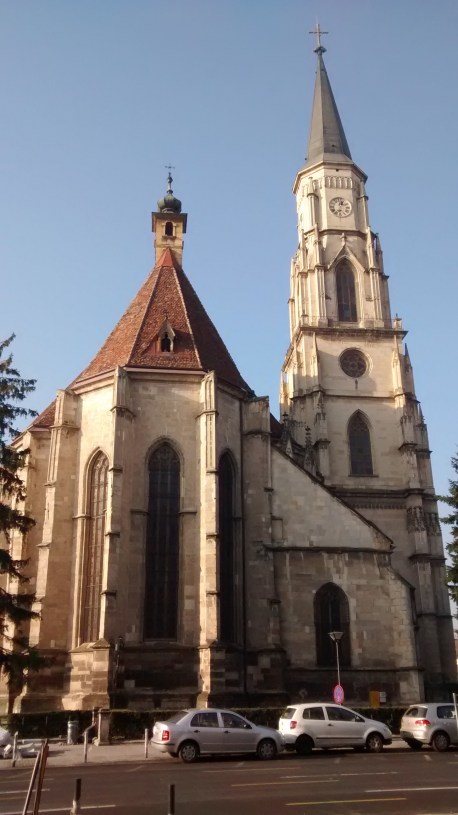
But now check out the Latin Catholic church in Cluj’s city center, Sfântul Mihail (St. Michael):

img_20161126_104523652

img_20161126_104755888

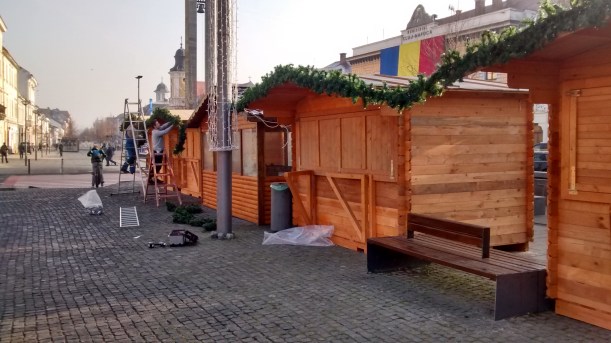
And yes, that’s a Christmas market going up in the corner.

img_20161126_104720137_hdr
Setting up a Christmas market in the square outside! How quaint, right?

The church – which is actually not a cathedral despite its size and its city’s cultural centrality in the region – has a checkered history. It was originally Catholic when it was built in the mid 1400’s, then became Lutheran during the Reformation. Shortly after that it was taken over by the Unitarians. Finally the Catholics recovered it in the early 18th century with the support of the Habsburgs.

And now, behold, the largest Advent wreath I have ever feasted my eyes upon…

img_20161126_112045083_hdr
Eastern Europe doesn’t have fire codes I guess. #awesome

The Gothic influence was as obvious on the inside as on the outside. It was also obvious that I would not be able to spend too long there staying still, since the place was not heated – cold enough to see your breath! And yet there were still people showing up to pray. Maybe there is a lesson here… Spend more resources on putting fire in people’s hearts than on putting fire in a furnace. (Really, every church I visited had people there PRAYING. Saturday morning and afternoon.)

img_20161126_115529627_hdr
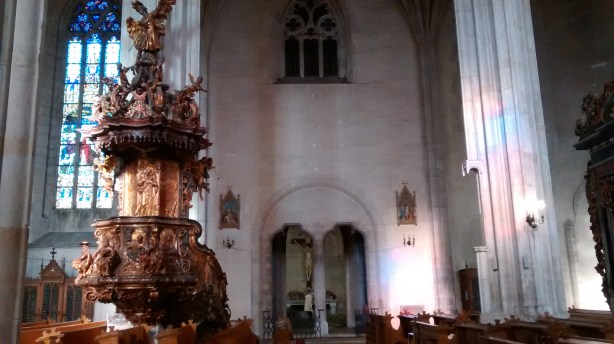
Looking over the Novus Ordo altar. You’ll notice the patron in the stained glass above the high altar. I’m generally not a fan of carpets in church, but this was done nicely.

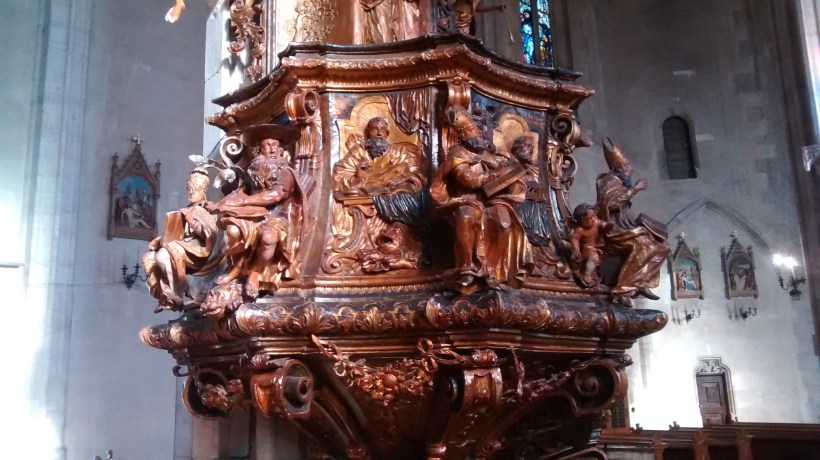
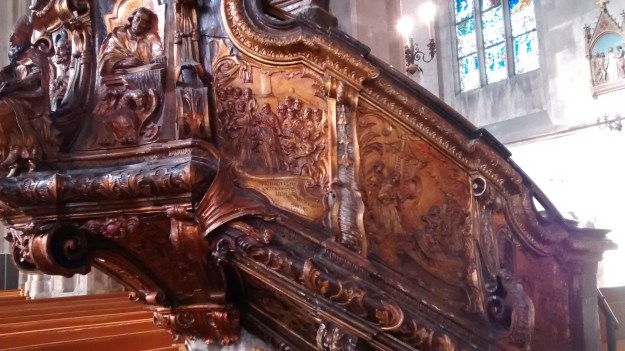
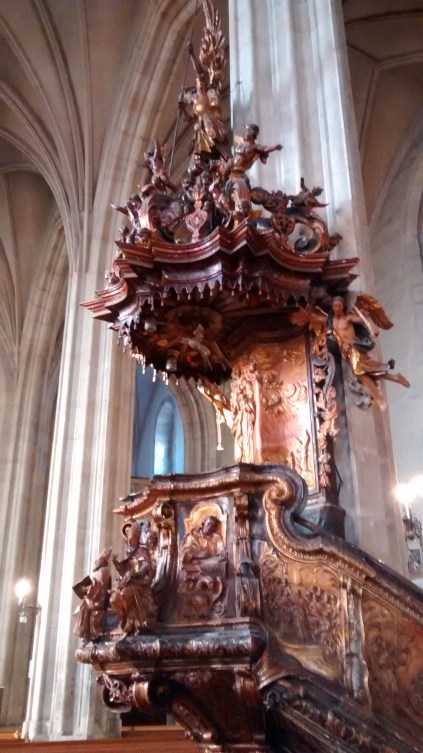
The ambo, on the left side of the nave, was a real treat. I really just couldn’t get enough of it. (It’s even the background on my phone now.) The detail was exquisite!

img_20161126_115404297_hdr


img_20161126_115433187


img_20161126_115826544

img_20161126_115809030

img_20161126_120005657

This little organ was cool too. Not sure if it’s functional, as there was also a set of pipes in the choir loft.

The wall used to be covered with frescoes, but if I remember correctly what I think I overheard someone saying during a private tour, they got messed up during the Reformation. Here’s part of what’s left:

img_20161126_162822820

Another look at the sanctuary (and the ambo!) before leaving:

img_20161126_120226326

Also there was this thing in the cramped antechamber before the nave:

img_20161126_120506997
Later I saw it in action. A narthex greeter never looked so official!

Off to the Franciscan church I went. The architecture of the city was a bizarre mix of old and new. For example, compare the buildings at this intersection (left) with the library (right):

The Modernism of course comes from the Communism that once infected Eastern Europe. There were some monuments around the city remembering that time and its characters.

No Commies in the Franciscan church. Take a look for yourself!

This was far more baroque or rococo (barocacoco?)… I enjoyed it quite a bit – despite having the same bone chilling temperature as St. Michael’s.

The royal blue, off-white, and gold color scheme definitely worked for me. The use of carpet did not.

img_20161126_130115136
Completely unnecessary stairs: devotional faux-pas or picturesque piety? You decide.

Back out into the city. Here are some other churches, probably all Orthodox (except for the clearly iconoclastic Reformed one):

Hey, what’s that thing with a Cross up on the hill?

img_20161126_130806577

Over the Someșul Mic River, and up the Cetățuia hill to find out…

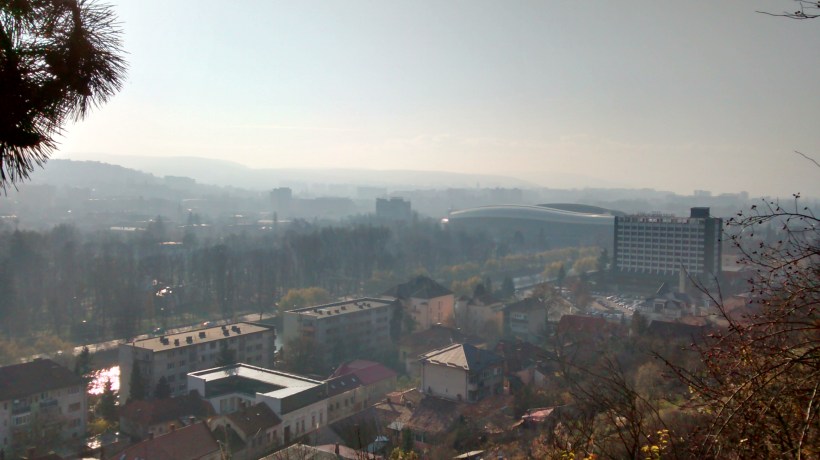
The monument was nothing too interesting, just another anti-Commie structure. But the view was fantastic.

img_20161126_132922676_hdr

img_20161126_133134604
And not a sparkling, angsty, hundred-year-old teenager in sight.

With not much left to do, I wandered through the suburbs down the side of the hill.

img_20161126_135045086
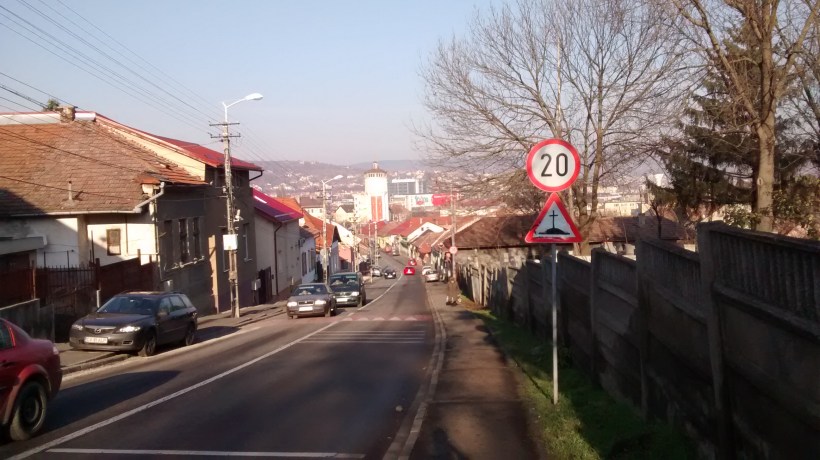
I don’t know what the triangular sign means, but I like it.

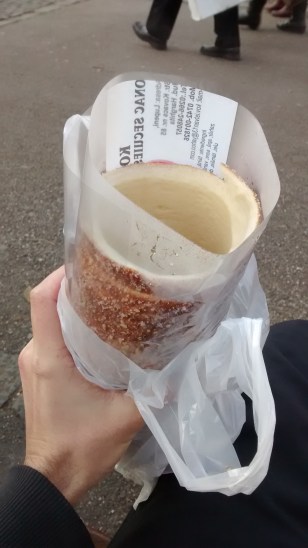
I wrapped up the day with a nice sit in the city’s central park and buried myself in an oversized helping of kürtőskalács. (Don’t worry if you can’t pronounce it, it means you’re normal. The lady serving it even gave me a funny look when I tried.)

img_20161126_150214828
This thing was HUGE. Tasted a bit like a churro, maybe not as sweet. Delicious.

That just about did it for me. Off to the airport the next day, where I was bombarded by the Duty Free shop with Dracula-you-name-it, including wines of every sort.

img_20161127_084437411
It kind of ruins the fun, like a girl who knows she’s beautiful.

While the outer part of the city (where I stayed) was pretty bleak, I found the center part of “Treasure City,” as it’s called, rather energetic and pleasant. And cold. But the religious spirit of the place was edifying. I was even asked for my last name and my “Christian name” when checking in at my hotel! Can you imagine? All in all, a worthwhile excursion.

And with that, I peaced out on Wizz Air. (It’s real, trust me.)

img_20161127_114207623


Post by: Eamonn Clark

Some art in the Roman Forum!

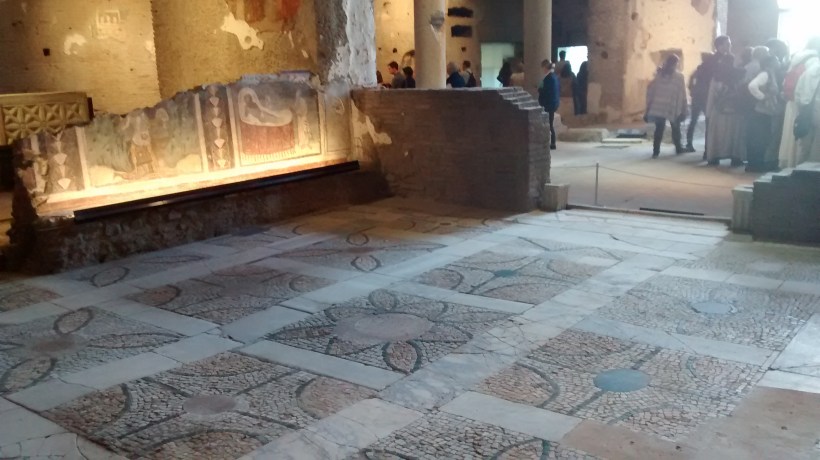
I was in the Roman Forum the other day to see Santa Maria Antiqua… It is the oldest church in the Forum, connects to the Imperial Palace, was the one-time seat of the Bishop of Rome, and it has some killer frescoes. Due to ongoing renovations and excavations, it is rarely open – this year it allowed visitors in for a few months, and the last time it did so was 1980. Sadly, as of tomorrow (Sunday, 10/30/16) it will be closed for who knows how long (the figure I heard was 20 years). Since you missed your shot, let me provide it for you!

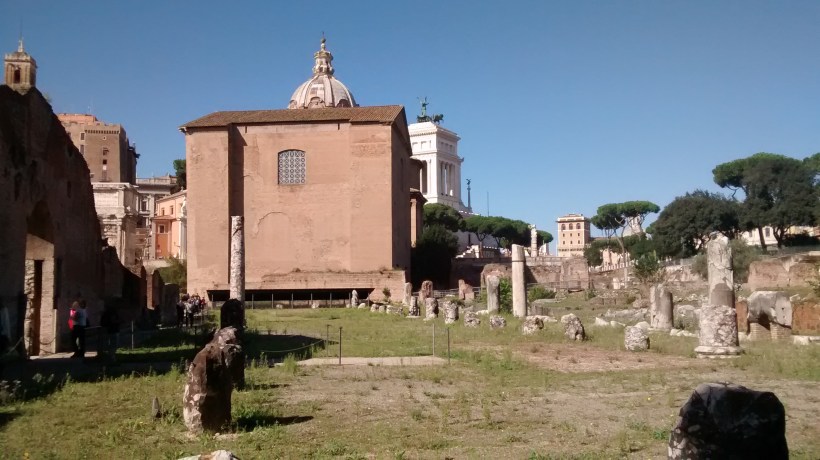
First things first… Behold, the first basilica in the world!

img_20161027_125102924
It has a sunroof.

No, it is not the brick building. That’s the old Roman curia – before it was a Church thing, it was a Roman thing. You are looking through the basilica, which is a ruin. You can see the pillars sticking up out of the ground. Once again, before it was a Church thing, it was a Roman thing. We baptized both ideas, and they stuck around.

Another first… Behold, the first real CCD classroom on planet Earth!

img_20161027_132427328_hdr
The church itself is to the right, and leads up towards the Imperial Palace and observation platform. Hold that thought.

Before there was coffee and donuts at RCIA, there was the Oratory of the 40 Martyrs. If you teach Sunday school, here you can go back to your roots. Let’s take a look inside, shall we? (Click to enlarge the photos.)

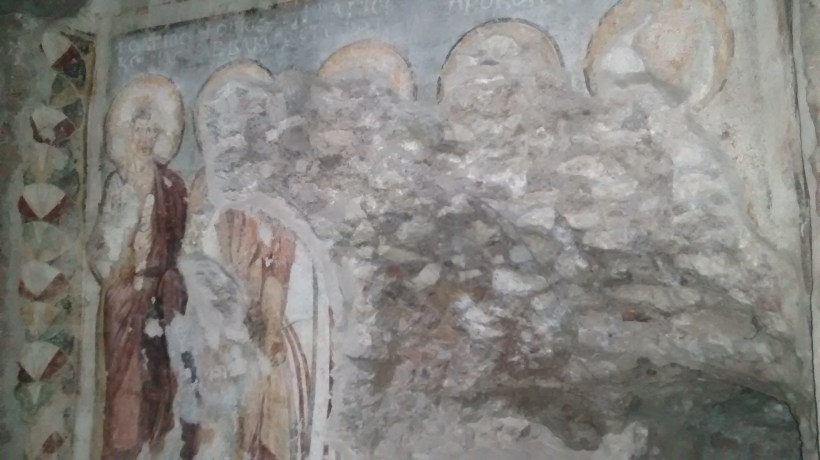
The Byzantine influence is almost as clear as the weathering. But all throughout the site there are slightly different styles, reflecting the fact that there were many different patrons and artists at work over the ages. Like the rest of the Forum, there are layers, and analyzing this site is made especially difficult by the unique character these frescoes have among contemporary Roman works.

Here’s the exterior of the church:

Santa Maria Antiqua is called “Antiqua” for a reason… She’s been around since the 5th Century! After Constantine, the Forum became more than just a safe place for Christians, it became an opportune place for worship.

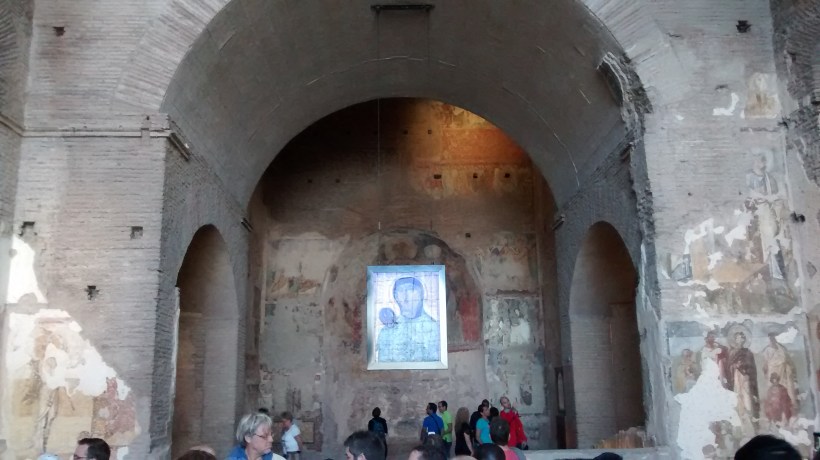
Into the church we go!

img_20161027_133015859

The hanging picture is called an “iconostasis.” Notice the use of arches, with the apse in the back (surrounding the iconostasis). Many of the frescoes are in rough shape, but we will look at some of the better preserved ones.

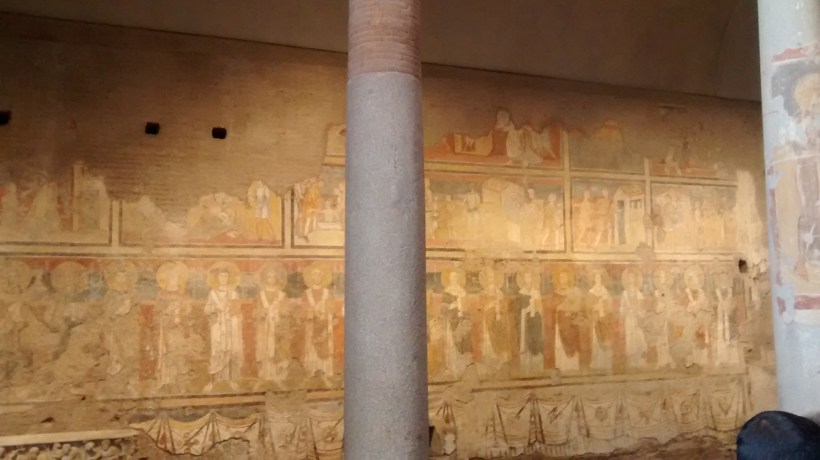
img_20161027_133024169
The left side of the nave.

Yes, even the pillars were decorated. See the one on the right there? This place was like stepping into an ecclesiastical coloring book. Every inch was covered, it seems.

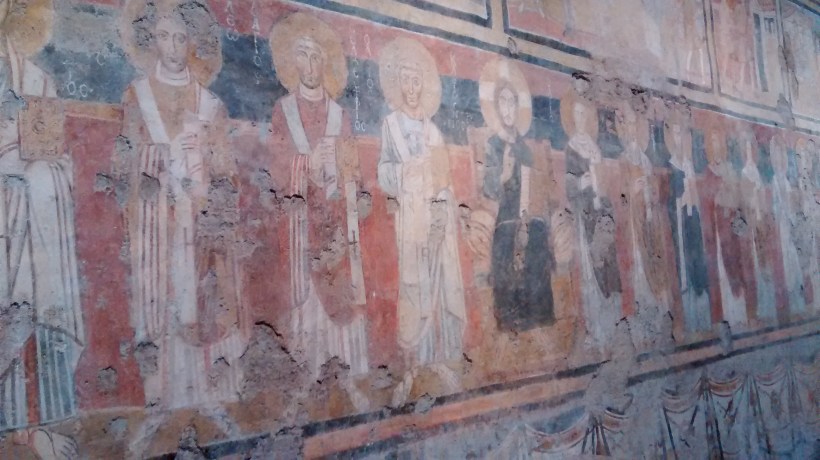
img_20161027_133613072
Close-up of the wall.

Here is an image of some the frescoes in one of two “corner chapels,” on the right side of the nave near the back… It is called the “Chapel of Physicians” (or the “Chapel of the Medical Saints”), where there would be constant intercession for the sick, whether the infirm were present or not. (The other is the “Chapel of St. Theodotus” on the left.) Apparently St. Francis visited this place, by the way, when he was in Rome.

img_20161027_134228834
The saints pray along too! They cover all four sides.

The apse has the earliest Roman image of Mary as a Queen, and the image of the Cross (in the Chapel of St. Theodotus) is notable as well…

Pope John VII was totally enamored with Santa Maria Antiqua. Not only did he commission a ton of work on the church, he also moved there, way back at the start of the 8th Century before there was an Associated Press to misunderstand why he might do such a thing. However, only about a hundred years later, an earthquake would cover much of the church, leaving it dormant for 1,000 years or so. (The Chapel of the Medical Saints apparently remained accessible, and somehow people forgot there was a church attached!)

img_20161027_135709585
Another view. This looks over where the ambo would have been toward the main altar.

Here there was a main altar and a “holy table” further back near the apse where the gifts would have been prepared.

img_20161027_133457223
From the holy table toward the main altar.

To make sure that everyone understood that Christianity was not ditching its Jewish roots, there was significant emphasis on the Old Testament. Here is a sarcophagus with stories of Jonah and some more frescoes of OT events:

It was lunch time in Rome, which beckoned, but in the end the platform won out. The long climb was definitely worth it. Panning left to right:

There’s just too much to point out. Sorry. But do notice that the corner of the church is on the top left. The rest of the view is mainly out towards the Quirinal Hill and Capitoline Hill (the Forum is on the Palatine).

Considering that you will probably never actually be inside this amazing church… you’re welcome for the quick glimpse inside!

Post by: Eamonn Clark

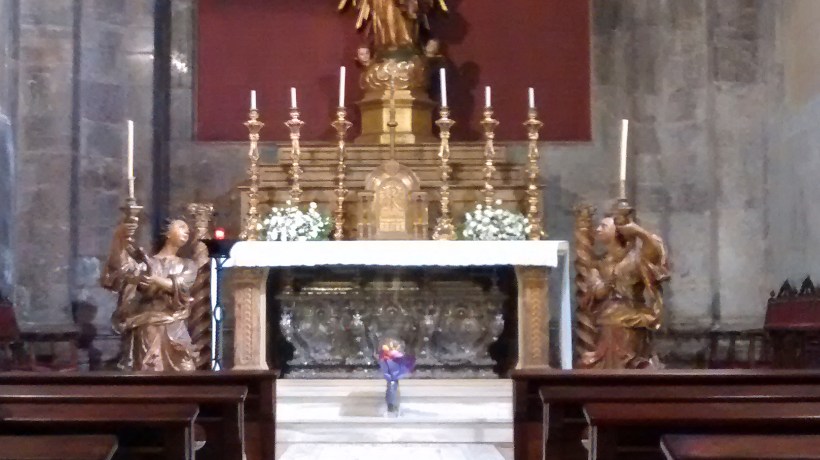
Some art in Spain!

Back when I was in seminary…

img_5003
Aren’t cameras the best?

…I found a book at our “free store” that really struck me. It was the autobiography of St. Anthony Claret (get it, especially if you are a “professional” evangelizer!), whose feast day is today. He was something of a mix between Fulton Sheen, John Vianney, and Oscar Romero – he conquered the art of mass media evangelization, worked non-stop to the point where he was manifestly aided by extraordinary graces, and in the meantime managed to build up industry wherever he went to support the impoverished and uneducated.

Well, this past weekend I hopped on a plane to Barcelona to pay the saint a visit.

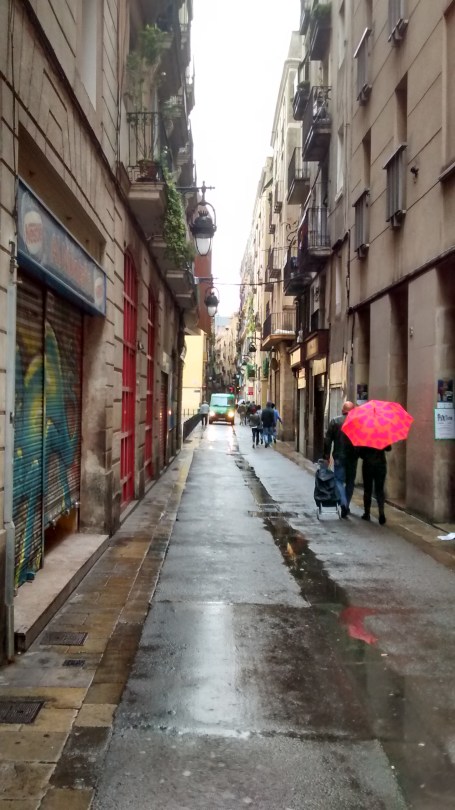
Barcelona is great. It is fun, not too expensive, and super Gothic. There is actually even a neighborhood called the “Gothic Quarter.” But we’ll come back to that.

img_20161022_101205443_hdr

After finally figuring out how the train station worked (which took over an hour), I headed out into the foothills of Catalonia toward Vic, the apex of my pilgrimage.

The architecture, as I described to a friend in the USA through some very expensive text messages, was “low medieval, quaint, and Catalonian,” but most of the structures in the old city are probably only early 18th century. It felt like I had gone through a time machine nonetheless. I mean, where else do you find a statue of St. Joseph and the Christ Child over a dentist’s office (left photo)?

img_20161022_141759403
Notice the similarity between this church and convent/rectory and the mission churches in the southeast of the USA.

The place was pretty packed with churches, but none were open Saturday except the cathedral. But not even a vigil there! I guess everyone gets up early on Sunday.

Alas! I had arrived. And sadly, this church too, would remain closed the whole of the day. Evening prayer outside would have to suffice. Horseshoes, hand grenades, and pilgrimages, right? And I have an excuse to return now, too!

I spent a good deal of time at the cathedral instead.

The Diocese of Vic has a pretty proud ecclesiastical history. They are actually even operating a whole episcopal museum near the cathedral.

The nave is large and dark, nothing too extraordinary, though the pillars are rather thick. What I found so distinctive about the interior was the mural of the stages of the crucifixion (as distinct from the Stations) which covers the entire upper wall, on all sides. Behold, a few samples.

It calls to mind El Greco, doesn’t it? But there is a touch of something else.

I discovered a new saint, buried in an exquisite side chapel: St. Bernat Calbó, 13th Century Bishop of Vic.

img_20161022_163636279

It turns out St. Michael of the Saints (17th Century Trinitarian priest) is also buried in Vic, which is his hometown. Double reason to go back… I only found out as I was writing this post!

img_20161022_164428636
Lettuce pray.

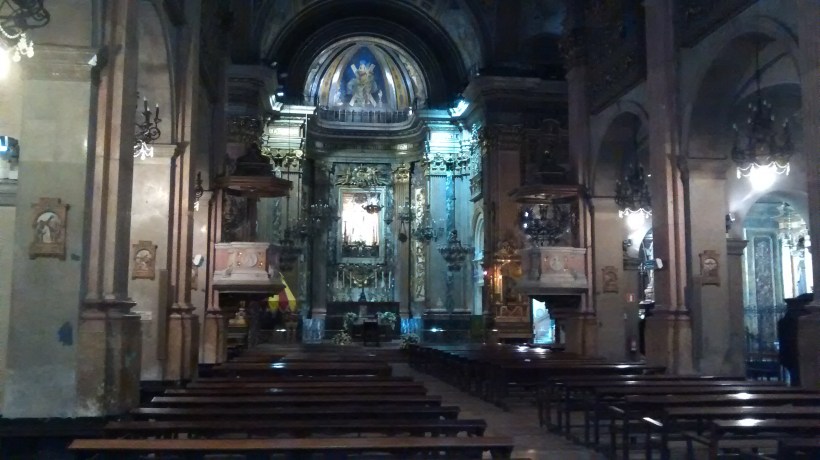
Back to Barcelona. Sunday morning I went to the cathedral for the 10:30 Mass, in Catalan (the main language of the region). But first I stopped in this church, which I think is the “Basilica de Mercé” though I could be mistaken. (Use your best Catalan skills to translate.)

img_20161023_100213389

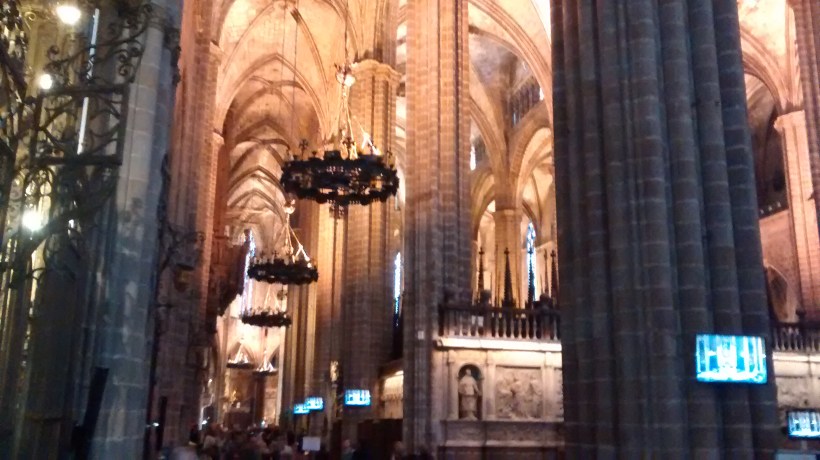
Finally I got to the cathedral, which is actually NOT Sagrada Familia, despite what you may have thought. More on that place in a bit. First, feast your eyes on this…

img_20161023_114436527

They were being persnickety about pictures in the main nave – which I approve of – but I snagged a real keeper of what are undoubtedly the coolest choir stalls I have ever seen.

img_20161023_113718593
The picture does not do these babies justice.

There were several side chapels, a few of which looked like this (pardon the tilt, I shot through a grille):

img_20161023_114421938

The cathedral is also home to St. Eulalia, a 3rd century martyr, aged about 13!

I went to the harbor for a bite to eat, then I was off to Sagrada Familia for a Holy Hour… On my way I bumped into a guy who saw me at Mass way back at the cathedral – I was wearing a shirt with my Alma Mater on it, and he recognized it. (A small, American, Catholic, liberal arts college is not usually an international attention-grabber, but this was not the first time this had happened to me, believe it or not.) Had a nice chat, in English!

img_20161023_131553749_hdr
The fact that construction is still ongoing since the 19th Century adds a touch of mystique.

Antoni Gaudi was a genius. We will have to do a whole article on him, or even just on Sagrada Familia. Take a look at just a little of what is going on in this place’s exterior:

Unfortunately, all visits to the main nave are ticketed, including for Mass, which is not on a schedule anyway. AND THEY WERE SOLD OUT OF TICKETS. I did go down for free to the lower church/crypt, but it was packed and Mass was going on (and without a chasuble… grrrrrrrr…).  So it was not very conducive to mental prayer, unless I was going to Mass for the second time. I went back upstairs for a walk around, then figured I’d go back to the cathedral for an hour – but THAT WAS NOW BEING TICKETED TOO. I’ve heard of “pay to play,” but “pay to pray” was a new one. Where is Pope Francis when you need him?

And with that, I returned to Rome, mostly a happy camper.

img_20161023_185338100

St. Anthony Claret, pray for us!

Post by: Eamonn Clark

A Call to Arms

Dear brothers and sisters,

Among the many crises we are facing today in the Church in the Western world is the obliteration of Christian art. One might immediately be inclined to ask, “How did we get here?” Indeed… How exactly did we go from Dante and Michelangelo and Mozart to having trouble differentiating churches from communist buildings?

As interesting as the answer might be, that is not the point here: the point is that however it happened, it happened – and now we have to fix it.

We can’t blame others for the void which we ourselves now allow to exist. No, it is NOT the “spirit” of Vatican II’s fault that we have not done more. No, it is NOT some inherent fact that Christian art can’t be popular today and so isn’t worth doing – good Christian art continues to be one of the major forces in global tourism, and since good Christian art always glorifies God, it is always worth doing. If you build it, they will come. Beauty is captivating in every generation. The human spirit is ever aspiring to the transcendent, and since we are in the unique position of having the fullness of supernatural truth, we are also in a unique position to reveal the fullness of supernatural beauty.

It is simply a matter of the diffusion of responsibility… “Someone else will do it.”

Well guess what? We are still able to complain because not enough people are doing anything about this crisis! You and I are the problem with the world of art, to paraphrase G.K. Chesterton.

Put on sackcloth and ashes over the fact that Tolkien and O’Connor are gone, and there hasn’t been anyone like them since. Well, if you are a writer, stop churning out fan fiction and start planning the next great Catholic epic – or short story.

Don’t like the Year of Mercy logo? If you draw or paint, what materials did you offer your parish to supplement (or replace) that image in flyers and the like?

Whine all you want about the Gather hymnal. If you are a musician, what are you doing to contribute to the solution? Do you at least help at your parish?

Moan and groan til the cows come home about the rock people in Noah, the liberties taken in Exodus: Gods and Kings, or, saints preserve us, the acting and writing in almost all films made “by Christians for Christians.” If you are a filmmaker and aren’t looking to break in to help, then guess what: you are part of the problem!

There is an interview with Barbara Nicolosi over at Aleteia. It is provoking – how exactly do we fix the mess of Christian film, both in Hollywood and in the indie scene? How do we raise the standard?

The answer is clear: good artists need to go there. The world of art, and film especially, is a 21st century mission territory. You don’t need to go to Sudan or Borneo to do the work of evangelization – you can just go behind a camera… or in front of a canvas.

In all this trouble, there is little more frustrating than the persistent “response” genre of Christian YouTube… What the digital world needs isn’t a couple of witty poems countering some kid’s mediocre ecclesiology or spiels about how wacked-out Buzzfeed’s idea of Christianity is. What the digital world needs is…

TO SEE THE GOSPEL FIRST.

If all the digital world gets from us is apologia and defense, there will never be a real kerygmatic moment… It is as if we have forsaken the sword to take up the shield alone. We need to be first, forcing the responses and defenses. This is especially true in the digital world, where few people bother to look into responses, as thoughtful and artsy as they may be. Clicking is hard, after all, and to click a second time so that you can actually be challenged to think? Whew, that is a lot to ask of the average millennial.

Our material needs to be seen before the Devil’s. And what we put out there needs to be worthy of the call.

The pen has always been mightier than the sword. So too has the paintbrush, and now the camera and microphone are as well. If we continue to allow the world to be polluted both with the dangerous art of secularists and modernists and with the even more dangerous art of untalented or misguided Christians who harm the Church’s credibility in the eyes and ears of those who so often encounter our art without knowing the soundness of our doctrine, we may as well have set loose the next great heresiarch. This is a real battlefield that we have been put on, and the law of the land is, “Fight or die.” Right now, we are dying.

If you are a struggling artist, you are finding out there’s not much money to be had anyway. Why not make all your non-money doing something for the Lord? He might just deign to bless you in this life and the next for your labors. If you are a successful artist, then why not turn your expertise toward God, the highest object of all? We are in desperate need of your talents… Don’t bury them in the world. Come join the fight!

Sincerely,
-CRM


Featured image: The Battle Between Israel and the Amalekites, Nicolas Poussin

Will the Real St. Matthew Please Stand Up?

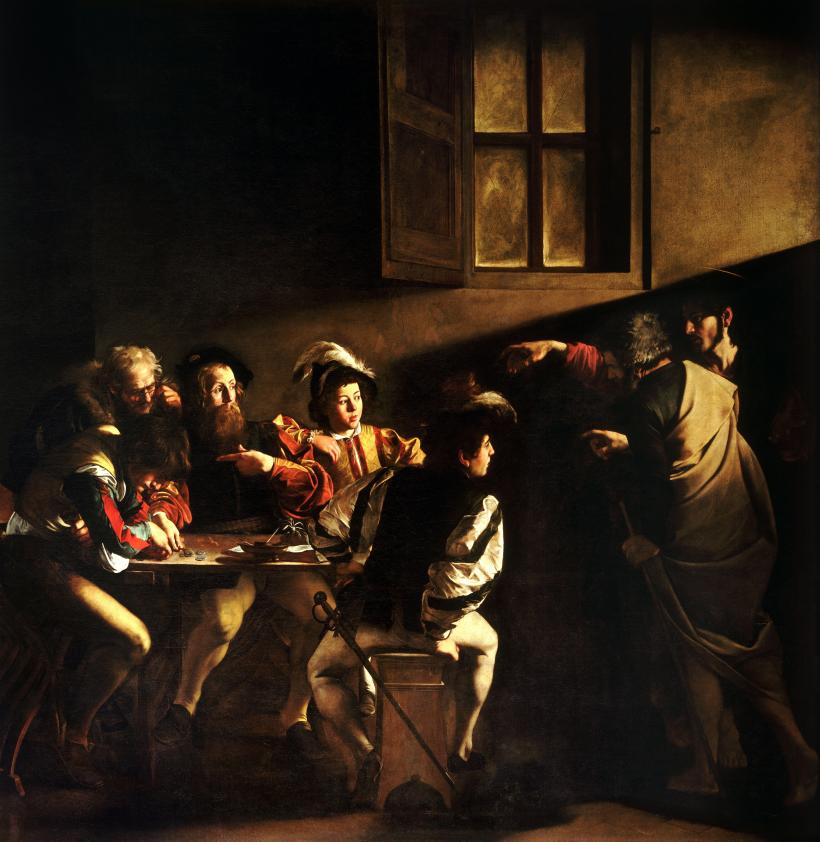
“That finger of Jesus, pointing at Matthew. That’s me. I feel like him. Like Matthew.” Pope Francis remarked in his 2013 interview with Fr. Antonio Spadaro, S.J.

“It is the gesture of Matthew that strikes me: he holds on to his money as if to say, ‘No, not me! No, this money is mine.’ Here, this is me, a sinner on whom the Lord has turned his gaze. And this is what I said when they asked me if I would accept my election as pontiff.”

In Caravaggio’s The Calling of St. Matthew, Pope Francis found the perfect image to express his own surprise at being uniquely called by Christ to serve the Church as supreme pontiff.

But, we have a problem. Which figure in the painting is St. Matthew?

(If you haven’t already done so, take a moment to give the painting at top a good look and try to figure it out for yourself.)

Besides the faintest loop over Christ’s head, there are no halos in this painting. Nor should there be – St. Matthew was only Matthew the tax-collector at this point. Here he is, in the midst of his sin, and in corrupt company. Matthew has just as much chance of being called out of this situation as any of the five guys in the tax office.

So, which one is he?


Option 1: The Bearded Man

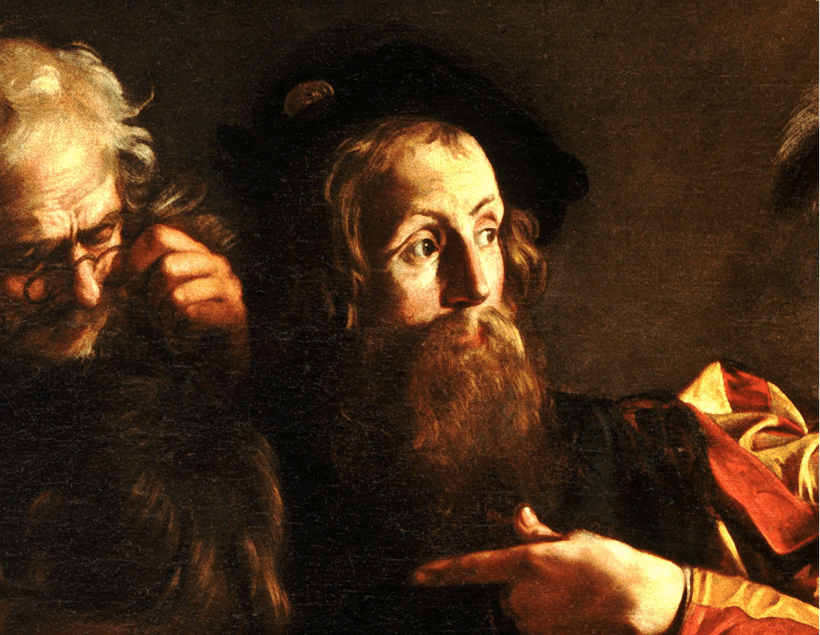
At first glance, Matthew appears to be the man with long beard. His eyes show surprise, his face is illuminated, his finger seems to point toward his breast. And, maybe just to help us out, he has a distinguishing coin in his hat and a right hand fingering money on the table. If there is anyone in this painting who is reacting as the one who is called, it’s this guy.

bearded-guy

There are two other reasons why the bearded man is the best candidate for Matthew.

First, Caravaggio did not paint The Calling by itself. With this painting in the Contarelli Chapel in the San Luigi dei Francesi Church in Rome, Caravaggio painted two other scenes from the life of St. Matthew: The Inspiration of St. Matthew and The Martyrdom of St. MatthewIn both of these adjacent paintings, Matthew is depicted as a man with a sizable beard.

The second reason concerns some of the interesting history going on at that point. Before this was painted, there was a passing fear that France might go the way of the Church of England. This fear partially subsided when the Huguenot (Protestant) Henry IV converted back to Catholicism upon taking the French throne in 1593. Caravaggio was commissioned six years later to paint three works for the church of San Luigi dei Francesi (St. Louis of the French). To flatter the now-Catholic king of France (and appease his patron), Caravaggio painted St. Matthew to resemble Henry IV. (You can see the bearded resemblance here.)

But that might not be the whole story.


Option 2: The Hunched-Over Man

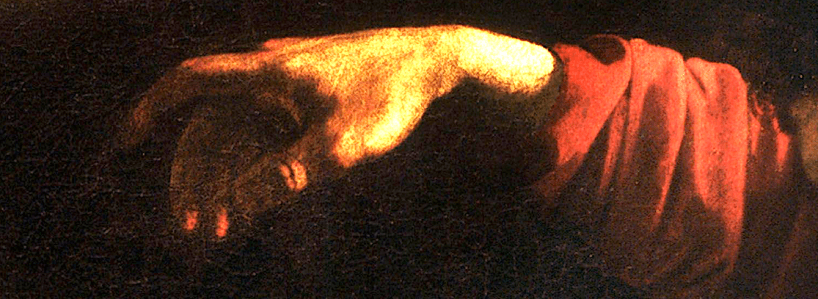
People make a big deal about Christ’s pointing gesture just below the window in the painting. His hand is unusually relaxed for a definitive signaling of direction. The reason for this is very likely that Caravaggio is alluding to a more famous painting: The Creation of Adam by Michelangelo.

finger-edited

fingers

Michelangelo’s Adam is depicted in the Sistine Chapel fresco in the moment just before his animation, with his finger less than an inch from that of God. Michelangelo, instead of showing an Adam already filled with life, depicts the precise moment prior to his ensoulment with all the drama of a limp wrist.

Like Michelangelo, Caravaggio is not capturing the moment of the calling of Matthew; he is capturing the precise moment before the calling of Matthew. The finger of Christ the New Adam has yet to be fully extended, the call is only just about to happen. The whole painting is in that dramatic tension of the moment before the call. If Matthew is the hunched-over man at the end of the painting, it almost would be more accurate to call it The Moment before the Calling of St. Matthew.

hunched-over-guy

And here, Matthew is still a sinner, still a tax-collector, still fingering his coins and gripping his money bag. The bearded figure to his left echoes the perceived direction of Christ’s soon-to-be-extended finger, pointing not to his own breast but to the hunched over man next to him. This man’s face, only half-illuminated by the light that comes from Christ’s entrance, still intently looks down to the table; he has but to lift his head an inch to make eye contact with Christ. Will his eyes meet the gaze that tests mortal men and will he remain the same? Will he respond to the call?


So, which one is Matthew?

It’s still not entirely clear.

But that’s probably how Caravaggio wants it to be. Caravaggio’s art was at the cutting edge of the subjective turn of modern thought. As a controversial artist of his time, he departed from the idea that art is exclusively at the service of the true, good, and beautiful, and turned instead toward an innovative realism. (Remember our earlier post on what makes art good.)

Part of Caravaggio’s goal is to pull the viewer into the painting. He wants this ambiguity; he knows that things are not so cut and dry in this world. Christ entered a world in chaos, a world engulfed in sin. He calls us out of that darkness and into His light.

Turning again to the painting, if we go to the source of Christ’s call and look above His outstretched right hand, we are at the foot of the cross (the fourfold window pane forms a cross). At that cross, at our Lord’s ultimate crucifixion, darkness appears to triumph over light, chaos over order, death over life.

But it is precisely at that moment when Christ conquers. It is from that cross that Christ calls His disciples, and it is to that cross that Christ calls His disciples. We are drawn up while we are still sinners into the cross, into the central mystery of our faith.

Pope Francis, without weighing in on the identity of Caravaggio’s Matthew, hits on what our response should be to Christ’s call: “I am a sinner, but I trust in the infinite mercy and patience of our Lord Jesus Christ, and I accept in a spirit of penance.”

Independent of who we decide Matthew to be in this painting, our response to Christ should be the same as that of Pope Francis. We are that sinner uniquely called by Christ. How will we respond to His call?


Main image: “The Calling of St. Matthew,” Michelangelo Merisi da Caravaggio, 1599-1600

Post by: Deacon Peter Gruber

Should Christians Dance?

A young priest sets out into the countryside to journey to his new assignment… He is not quite sure how to get there, but in the evening, while walking in a field he finds two boys. They tell him he has just crossed into the parish boundary. Father gets on his knees and prays in thanksgiving for being sent there and in preparation for the work he will do in the little country town. The first and most important job, he would find out, will be to eradicate “the scourge of dancing.”

Of course we are speaking of the one whom they called “the saint” even during his lifetime – St. John Vianney, the Curé of Ars. We are not speaking of Rev. Shaw Moore, the antagonist of Footloose… Although the two might have gotten along, ecumenical issues aside.

Dance is commonly assumed to be an art form and a generally good way to recreate. Such assumptions are in fact so deep that the suggestion that it might be better to do away with public dances is seen as rigid, cruel, “medieval,” etc. One can only imagine the reactions of North Dakota’s teens to then Bishop Aquila’s decision a few years ago to ban dances (and pajama days) in one of his Catholic schools in the Diocese of Fargo… Maybe even some parents and faculty were upset. But would they have told John Vianney that he had been “too rigid” after he finally conquered the last of the dancers in the tiny village of Ars, which by that point had become the brightest beacon of holiness and civility in all of France?

The Abbé Trochu, in his famous biography of the saint, notes that, while St. Francis de Sales “wore gloves” when treating the topic, Vianney did not. “Go on! Dance! Dance all the way down into Hell!” Thus spake the saintly curé from the pulpit, time and time again. After decades, Ars was perfectly obedient to its pastor and was much happier for it.

Imagine the efforts it would have taken to accomplish the same feat in a 21st American century town even of normal size by today’s standards.

The people of Ars were not having dainty upper-crust waltzes, but neither were they “grinding,” “twerking,” or doing any other kind of categorically pornographic actions, which no reasonable person would think to call morally acceptable. They were simply dancing like country folk, having some drinks, and then getting too familiar with each other. The saint saw that this was not an accidental relationship, and he thought “the dance” to be the single greatest occasion of sin in Ars.

Note that it was seen by him as an occasion of sin, not necessarily a sin in itself, except perhaps inasmuch as a certain recklessness therein could be an expression of a lack of due care to avoid offending God. So, the question remains: can a Christian dance?

It depends.

The downfall of dance is usually what is touted as its greatest quality – the ability to arouse and express the passions. It is violent, it is sensual, it is angry, it is sad, it is joyous, it is whatever you need it to be. It intensifies all these things and shows them to others, while “freeing the spirit.” That’s the point. And that’s the problem.

In expressing the passions haphazardly, one can lose a grip on reason and be drawn to wherever that passion leads. The main problem is with sensuality.

First of all, we can, without hesitation, discard the utterly obscene motions and actions that have no other purpose than to sexualize the participants. These are not only done out of inordinate desire for the pleasures of the body, but they are also scandalous. Scandal here means a “stumbling block” to the spiritual lives of others – to cause sin in them. We are bound to avoid causing sin in others inasmuch as it is possible while not neglecting other duties. Nobody has ever had a duty to do anything like one would find going on at the average American high school dance. And it can never be good art, if art is the good expression of something good to express.

Secondly, we must examine the motivations and circumstances of those dances which are less clear. Should a desperate bachelor engage in a romantic tango with a beautiful woman he’s just met? Perhaps this will be a real challenge to him interiorly, urging him to go further and further… The same may hold true for her, which he must be careful about as well. Such a dance loosens the foundation on which chastity rests.

But what about a professional dancer who is so used to these movements and is so concentrated on his craft that he is greatly fortified against temptations? It seems the difficulty begins to disappear. And if a man is dancing with his wife, certainly there is no problem.

The case becomes different according to the abilities and circumstances of those involved, and according to the capacity of a dance to evoke problematic urges.

What would John Vianney think of the teens of Bomont jumping on the Kevin Bacon rock-n-roll-will-free-your-soul bandwagon? If we are honest – which we are here to be – we must say that he would probably be just as indignant as he was when he arrived in Ars, if not more so. He would think Rev. Moore was a wuss and a bad leader for finally caving. He would go to his bedroom, scourge himself to a bloody pulp, not eat for a few days, then start preaching, if his approach in Ars is any indication.

While the final scene of the film doesn’t have anything too bad (especially since these kids who have apparently never danced before are actually professionals), it is the culture and ideas which are introduced by the habitual loosening of inhibitions in social settings with the opposite sex (that often also involve alcohol) which sends up red flags. It is the dark cloud on the horizon: there is not yet a storm, but one is coming.  Just as well, the spirits of angst and rebellion are not spirits from God, but they are exactly what Kevin Bacon’s character and the whole idea of rock-n-roll are about.

There are ways to “cut loose” and socialize that do not involve the dangers of “the dance.” Running, golfing, hiking, and yes, even spelunking are all appropriate alternatives. I simply can’t imagine John Vianney giving a sermon against spelunking… Can you?

“But wait!” some will say. “There is that scene where Bacon’s character goes before city council and throws down some verses from Scripture about how great dancing is! Ha. Game, set, and match, you Jansenist clown!” Unfortunately, we will have to save the detailed examination of the Scriptural treatment of dancing for another post. For now it will suffice to say that the Holy Bible decidedly does NOT encourage us to “kick off our Sunday shoes” so that we can do the worm to impress our friends.

Here is a challenge to those who have charge of Catholic schools: take a good, long look at the reality of what is going on at your dances, and whether it is worth the spiritual risk.


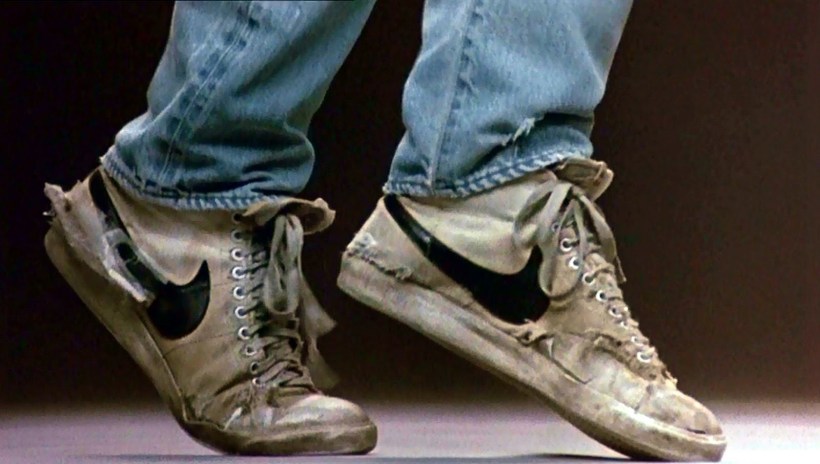
Main image: screenshot from “Footloose” (1984)

Post by: Eamonn Clark

How the Camera is Spoiling Religion

A while back a professor commented to my class about the cover of a recent edition of The Word Among Us. He noted that the title was “The Gospel of Encounter,” and yet it featured something rather opposed to such a notion… A woman who actually “turned away from the Vicar of Christ,” as he put it, to take a selfie. (It’s the June 2015 issue.)

You have no doubt experienced the frustration of such things before, if you’ve ever been to Notre Dame, the Holy Sepulchre, or any major church or shrine. A lot of people are there just to snag photos.

I was recently at the Holy Father’s Sunday Angelus address, which is held weekly in St. Peter’s Square. Yes, it makes sense that people would take a picture or two, yes, it makes sense to have two large television screens with live streaming due to how far away the Pope’s window is. But what I noticed was something very odd and disconcerting: many people were taking pictures of the screens.

They were taking pictures. Of pictures.

“Little Johnny, look at this photo here, it’s from 40 years ago.”
“Oh boy, what’s it of, grandpa?”
“It’s a picture of some footage of the pope.”
“Wow, golly gee, that must have been special. But can’t I just look up the real thing on YouTube?”
“That’s not the point – I saw this footage in person.”
“I can too, grandpa, here it is. If only you had seen the pope himself!”
“I did, but the screen was just as interesting.”

Why aren’t people satisfied with a postcard from a famous church? Certainly, it’s not the 50 cents it costs, because people are likewise not satisfied with the professional quality footage that is now taken at every papal event and then immediately uploaded for the whole world to see. Is it really necessary that it’s on YOUR phone? Why not just soak in the experience instead, so that it’s actually in YOUR brain?

“I just want to remember it,” people will say. Well, first of all, if you need to take a picture to remember something, it couldn’t have been that spectacular, so why do you want to remember it? And you can’t remember something you never really encountered in sincerity anyway. The “flesh and blood” of the experience must be primary, the digitized “word” of the experience must be secondary.

In focusing too much on getting a picture, one immortalizes a moment that he never had.

resphone

God can’t be experienced directly in this life, only in the next life in the fullness of the Beatific Vision, where we will behold the Divine Essence “face to face.” For now it is always, as St. Paul says, “dimly in a mirror.” (1 Cor 13:12) Why are we so intent on adding yet another piece of glass to hide Him from ourselves?

Many years ago I traveled to Quebec. I was in some reenactment Native American village (or is it Native Canadian?), where my group was told by the guide that absolutely no pictures were to be taken of the masks inside one particular hut – that if this law was broken, our cameras would be too. Why? Because there was a belief that developed that taking a picture somehow steals the soul away from the object… It desecrates it, profanes it, sucks its life out. While we know that masks don’t have souls, and that cameras don’t half-kill what they capture images of, perhaps this is not far off from the truth, but in the opposite direction: taking pictures of the sacred, if done irreverently, is bad for the photographer’s soul. It half-kills the experience he could have had. It has profaned and desecrated his relationship to it.

Now, there can be good photography of the sacred. There is plenty of it, actually. But good sacred photography is never done out of vanity, out of “touristic” motives, out of bandwagon-hype. Such would be, in some small way, a sacrilege. If a Catholic walks into one of the great churches of Christendom, forgets to genuflect, and starts grabbing pictures of the statues, hasn’t he sort of missed the point? And how much of an excuse does he really have?

Perhaps some person or place really speaks to you, and after having authentically encountered it you desire to catch a picture. That is quite a different phenomenon, as you have already genuinely engaged with what you now encounter through lenses, mirrors, and a screen. The Word became flesh, after all – He certainly did NOT become a digital picture.

In the meantime, let’s all sit back, relax, and actually experience the incarnational nature of our Faith, rather than neurotically re-immaterializing it.


Post by: Eamonn Clark

Main image: CTV’s coverage of the Papal audience of May 25, 2016

The Transfiguration and the Meaning of Christian Mystery

“Master, it is good that we are here; let us make three tents, one for you, one for Moses, and one for Elijah.” (Luke 9:33)

Peter had two options for approaching the event of the Transfiguration: he could see it as (a) a problem that needs to be solved, or (b) as a mystery.

When Jesus led Peter, James, and John up the high mountain, they woke up to a scene that seemed to defy all understanding. Jesus brings them up to the top of Mount Tabor and begins to glow unworldly bright. Then Moses and Elijah from the Old Testament show up and all three of them have a conversation.

Peter, thinking quickly on his feet, intrudes into their conversation and asks whether he should build three tents. For us, this sounds like odd, but for Peter, he must have thought he had solved the problem: this had to be the beginning of the end times. He might have picked up on how Jesus is fulfilling the Old Testament festivals. He knew of the Jewish tradition that Moses and Elijah would come again before the end of the world. Jesus, along with Moses and Elijah, was finally going to restore the kingdom of Israel and reap the much-anticipated harvest of souls. It was the Christological fulfillment of the Jewish Festival of Booths.

They needed tents.

However, Peter “did not know what he was saying.” He approached the Transfiguration as a problem to be solved, not as a mystery to be entered into. So while Peter was still speaking, a higher voice corrected him: “This is my beloved son with whom I am well pleased. Listen to him.”

The Limits of Science

When Christians use the word “mystery,” we do not mean a problem without an answer. No, for Christians, a mystery is something that is so intensely knowable that it exceeds the powers of human comprehension.

Let me give you an example.

Once, my five-year old niece told me, “Did you know that, when I’m in the car, the moon follows me? It really does!” My immediate response was to try to explain to her that since the moon is so far away, it only looks like it is following her. My impulse was to set up an experiment, putting her in one car and her sister in another car. They would go separate directions and observe how the moon follows both of them. Then I could prove to my niece that, since the moon cannot possibly be following both of them, there must be another explanation. That explanation would be in the reality of the great distance between the earth and the moon, a distance that can be observed and measured. Science would win out over childish naïveté.

But before I could thoroughly disprove her childish notion, she interrupted, “No. The moon really follows me.” With such opposition, I thus abandoned my attempt to scientifically disprove her childish perception.

For my five-year old niece, the moon was a mystery; it really did follow her. The moon was so beyond her that, rather than disconnecting her, it implicated her in its path. However mistaken her understanding of perspective, she approached it with wonder. And she rightly would not let that wonder be extinguished.

To me, the moon was a problem that needed to be solved; it could be measured and placed conceptually at a distance. I knew that its movements and phases are configured to a different pattern than my sporadic movements. Although technically more correct, the approach that reduced the moon to a problem prevented me from being gripped by the mystery of the moon and sharing in my niece’s wonder. To my niece, however, the moon was a mystery to be entered into.

Like my niece with the moon, a mystery is so beyond us, that we cannot help but be pulled into it. A mystery is so large that it necessarily involves the viewer. In this way, God Himself is a mystery, being so far beyond us that, at the same time, He embraces us and loves us in our very being.

Mysteries are not problems; they are not to be solved – they are to be entered into. A mystery is like a piece of art that pulls the viewer in; it is not a mere opportunity for scientific analysis.

The Mystery of the Transfiguration

It is in this way that the event of the Transfiguration is a mystery. Since mysteries overwhelm us, they implicate us – they require our response. Our response, then, to the mystery of the Transfiguration is not to solve the puzzle of Moses and Elijah’s appearance, but to enter deeply into the reality of what is before us. Through the mystery of the Transfiguration, we share in Jesus’ own prayer with the Father. By beholding the glory of Christ transfigured and listening to him, we become sons and daughters in the Son. By entering in to the mystery of the Transfiguration – by listening to God’s chosen Son – we become what we contemplate.

How do we enter in to the mystery of the Transfiguration? For us Christians, we go to the source and the summit of the Christian life – the Holy Sacrifice of the Mass. Like Peter at the Transfiguration, we can look at the Mass just as a problem to be solved, a ritual to be analyzed, a puzzle to be deciphered. Or we can enter into the mystery of the Mass.

In every celebration of the Mass, we ascend the mountain with Christ, and we encounter something that overwhelms our understanding: God incarnate – the second Person of the Holy Trinity – comes to us as bread and wine. So great is the glory of Christ in the Eucharist, so utterly beyond us, that we are pulled into the mystery. The altar is our Mount Tabor, where we see His glory, not with the eyes of flesh, but with the eyes of faith. Over the altar the Father’s voice mystically resounds, “This is my beloved Son; listen to him.” We who enter into this mystery by receiving the Body of Christ in Holy Communion are enveloped by the cloud of the Holy Spirit. At Mass, we enter in to the mystery of God’s glory. He gazes on us, and we gaze on Him, and we become what we contemplate.


Main Image: The Church of the Transfiguration