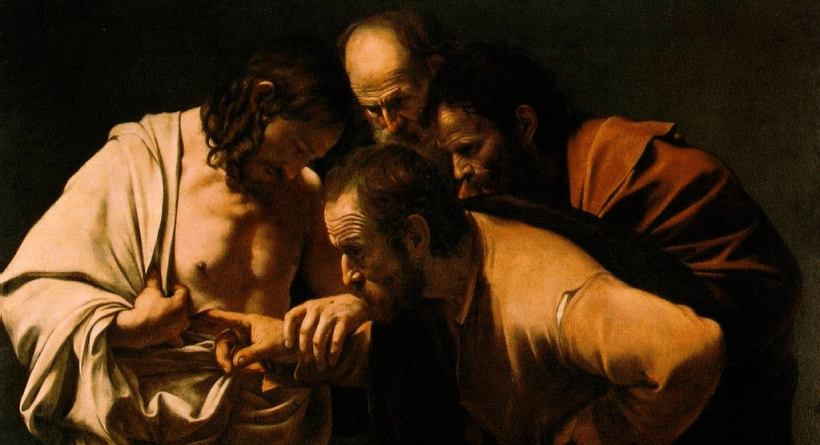
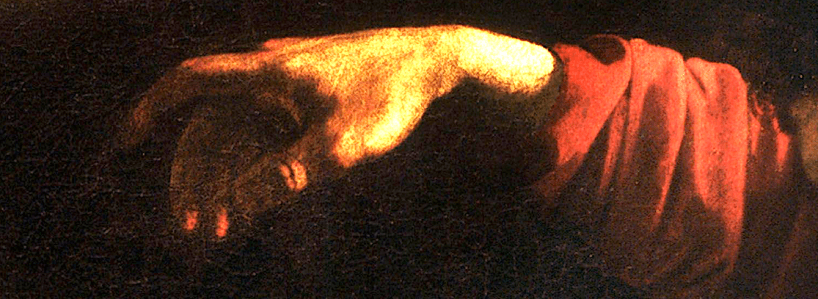
The Apostle St. Thomas Didymus (“The Twin”) was conveniently absent for the first Resurrection appearance to the rest of the Eleven. (Jn. 20: 24-29) Then he famously insisted on seeing and touching the wounds of Jesus, which he then got to do 8 days later. This reading comes to us every year at the close of the Easter Octave to commemorate the event. Let’s take a look.
Aside from “telephone” conspiracy theories (which ultimately don’t allow for any sensible understanding of what happened in 1st century Palestine nor of the text of the Gospels), there are usually three alternate explanations for the supposed Resurrection.
Mass delusion.
A spiritual resurrection proclaimed as if it were a physical one.
The body was stolen and the disciples lied about it (the story that “circulated among the Jews”).
Each of these have plenty of issues, of course. Leaving aside #3 (which has the largest problems of motivation among the 3, and it ultimately just destroys the trustworthiness of the entire text), #1 and #2 do not explain the skepticism of Thomas. Why was he not part of the delusion or vision of the spiritually risen Christ from the beginning? How was he incorporated into it? What sense does recounting Thomas’ separate physical encounter make given such scenarios? There is no good answer.
There is a fourth alternative. It is the scenario, in fact, which Thomas had in mind when he questioned the claims of his friends.
He clearly doubted that they had seen the Risen Christ… But he did not doubt that they had seen someone. It just does not make sense that he would think all his friends would lie.
The words of the Gospels are careful. If you see some little detail that is added, you can be sure it is an important detail… The author went out of his way to add it. Paper was expensive in the 1st century – no Kinko’s, remember – and drafting the Gospels would have involved the most serious attention to what was going into the text. And of course, this is all under the inspiration of the Holy Spirit. That being said, in this passage we do not find the Apostle called plain old “Thomas.” We also don’t find “Thomas the Scientist,” or “Thomas the Physician,” or “Thomas the Skeptic.” We find “Thomas called Didymus,” or “Thomas the Twin.”
Why add that detail?
Thomas thought Jesus had a twin who until that time had been in hiding. He figured the supposed Resurrection was part of a massive scheme of some sort, like the tricks he and his own twin brother would have undoubtedly played as children but with an agenda far larger. It may even be the case that Thomas’ brother had died, and that one time Thomas was confused for him, no doubt producing a similar effect of shock and confusion and joy in the mistaken person or persons.
This also makes sense of Thomas’ startling insistence on seeing and touching the wounds, as he knew that this would be the best way to show that it was actually the same person who died on the Cross. (There was a recent movie based on this theme. Spoiler alert.) No mere man could walk around with those wounds! The others had been shown the wounds (Jn. 20: 20), but it does not seem they had “double-checked” as Thomas wanted to do by completely verifying that they were the same kind of wounds that one would get from a crucifixion rather than being some serious paper cuts.
This incident with Thomas the Apostle, then, also preemptively answers the Muslim objection to the Resurrection, which is simply the “twin claim” in reverse: Jesus had a look-alike who was killed. (The Muslims, however, wave their hands over the inconvenient parts of the New Testament though, so it matters little. If every clear bit of evidence from the text is a corruption, then there can be no efficacious textual demonstrations.)
All this can also help shed light on the slight differences in Christ’s appearance before and after the Resurrection. Mary Magdalene and the men walking to Emmaus didn’t recognize Him at first. While identical twins can usually be told apart on close inspection, they are mistaken for each other easily. Jesus must have looked quite different indeed – unlike a twin, but close enough to His old appearance that one would be able to see that it is really Him. This is certainly not a twin – no one would dare try to pull off such a stunt unless he did indeed have an identical twin.
Perhaps seeing the Risen Christ was like running into a grown man you had been friends with in childhood… different, but the same. With the Risen Christ, the flesh-cloak of Adam’s sin has been shed so that the man Jesus, the New Adam, could be as glorious as the Divine Person He embodies. (See Gen. 3:21, Rom. 5:12-18) Yet He keeps the wounds, as if to be in solidarity with us and to remind us of His suffering, in addition to proving He has risen.
The Scriptures are wiser to objections than we are ourselves. That is not only because God understands us better than we do ourselves, but also because the Resurrection actually happened… That removes the need for creative thinking and gives the writer of the text the freedom simply to say what really happened.
St. Thomas Didymus, pray for us!
Post by: Eamonn Clark
Main image: The Incredulity of St. Thomas, Caravaggio, c. 1601-1602
Once in a while some zealous atheist, agnostic, or deist will throw down a challenge: “If God answers prayers, we should be able to prove it with an experiment. But we see no statistically significant difference between groups of sick people who are prayed for and groups who are not. Therefore: A) there is no God, or B) we can’t be sure if there is a God, or C) God does not involve Himself with us.”
It seems like a strong argument at first. If God really does respond to intercession, then we ought to be able to observe that response in contrast with a lack of response corresponding to a lack of intercession. Intercession is an action, healing or whatever response is or would be an equal and opposite reaction, while on the other hand whatever is in motion tends to stay in motion – those who are sick or in need will continue to be so unless they are helped.
There are some problems with this argument.
First, let’s take a look at the Temptations of Christ (Mt. 4:1-11)… It is Lent after all.
Turn stones into bread – Jesus could solve world hunger and win over all the crowds this way. (Jn. 6:26 – “Amen, amen, I say to you, you are looking for me not because you saw signs but because you ate the loaves and were filled.”) He responds, “One does not live on bread alone, but by every word that comes forth from the mouth of God.”
Fly around Jerusalem – Jesus could publicly manifest Himself with abundant clarity in a way that would leave everyone in awe. (Mt. 16:4 – “An evil and unfaithful generation seeks a sign…” And in the same chapter, v. 17 – “Flesh and blood has not revealed this to you, but my Father in Heaven.”) He responds, “You shall not put the Lord thy God to the test.”
Make a compromise – Jesus could rule over the Earth without the Cross, without the public ministry, and generally without much effort. (Jn. 18:36 – “My Kingdom is not of this world.” And Lk. 24:26 – “Was it not necessary that the Messiah should suffer these things and enter into his glory?”) He responds, “Get away, Satan! For it is written, ‘The Lord, your God, shall you worship and Him alone shall you serve.'”
Christ’s Temptations provide the first major counterpoint to the skeptic, which is that God is not primarily concerned with making this life easy for us. We are promised that we will receive whatever we ask in His Name (Lk. 11:9, Jn. 14:13), but we are also promised trouble and suffering, the acceptance of which is even a condition of discipleship (Mt. 10: 16-39). These two promises do not square with each other unless we see that Jesus does not mean we will be given whatever material convenience we want, like a genie would do for us, but that we will be given every spiritual gift truly suited for us for which we pray sincerely. Virtues are the goods which truly help us.
Furthermore, God is wise to our tests and designs (Jn. 2:24). And no, He does not care to play along. A mysterious kingdom needs a mysterious road to lead to it. The New Jerusalem is nothing like the New Rome. Citizenship in the one is gained by unyielding faith in a crucified carpenter as God Incarnate, while in the other citizenship would be gained by simple obedience to an opulent and benevolent dictator.
Let us consider another passage, Mk. 9:14-29, where Jesus heals a possessed child. The crowd gathers, and the boy’s father explains the damage the demon has done over the years… “But if you can do anything, have compassion on us and help us.” Jesus does not take kindly to the word “if”: “‘If you can!’ Everything is possible to one who has faith.” Then we are given the famous line, “I do believe, help my unbelief!” Jesus rebukes the spirit and tells his disciples that this kind of demon only comes out “through prayer.”
This episode gives us an insight into the project of the public ministry – it is not primarily about fixing people’s inconveniences, it is about fixing people’s souls. Jesus waited to do a good deed until the boy’s father manifested faith… This was His prerogative, since He came to draw people away from the world to Himself. The Christ did not open a miraculous hospital, or an infinite soup kitchen, or an infallible psychic hotline; rather, He told people to beg for God’s forgiveness (Mt. 4:17), to sin no more (Jn. 8:11), and to extend faith in God to Him as well (Jn. 14:1). Fixing people’s earthly problems were and are for Christ merely a means to an end: moving people to repentance, conversion, discipleship, and finally perfection in union with Himself and the Father. Just because we don’t get exactly what material convenience we want, when we want, how we want it, does not mean that God does not exist or concern Himself with us. When He doesn’t give worldly help, even when asked sincerely, it’s because He knows that to give us some particular opportunity to forsake the world and cling to Him in abandonment to His will is better than to give us what we’re asking for. (Remember the dichotomy of promises!)
We are not in the same position. It does not belong to us to help others conditionally to the same extent as God because we do not have the same privileged insight into people’s souls that He has, and even if we did we would not always know how best to use that knowledge. Sometimes we can be quite sure that withholding some help will be good for another – like when we allow a child to “learn the hard way” – but by and large we have a duty to provide basic goods for others we encounter and are able to help. We do need to open hospitals. We do need to run soup kitchens. (No psychic hotlines, however.) In fact, we would never be able to show love for each other without the opportunity to do these kinds of selfless acts.
So, can we test God’s response to prayer and prove with statistically significant results that He does indeed answer them? As it turns out, we actually can. Anyone who prays earnestly and frequently for help to become virtuous and holy will become virtuous and holy. And you can survey the lives of the saints and see that this is indeed how they prayed.
I will now teach you a short but powerful prayer which if you repeat often and with sincerity will change your life radically by changing you radically: “Oh Lord, help me to become a saint as soon as possible and at any cost to myself! Amen.”
Don’t be afraid to have this prayer answered.
Post by: Eamonn Clark
Main image: screenshot from the film Aladdin (1992)
As we read the Gospels, we can often feel that certain persons and events are such caricatures of prophetic fulfillment that there must have been some kind of embellishment on the part of some redactor with a theological agenda. Everyone’s heard it before – “Jesus gave the 5,000 the miracle of SHARING… You don’t have to believe the multiplication was real, that was probably something the Matthean community used to show that it was like God giving manna in the desert.”
Sound familiar?
Every word in the Gospels is chosen very carefully, yes. But it is not Catholic, and indeed, it is downright foolish to think that because some action “fits” with a prophecy, it must be untrue. (Suppose it didn’t “fit” – then doubt would be cast in the other direction.) So when the most obvious prophecies are clearly fulfilled, say, in the Lord’s Passion and Death, we cannot simply call it “too bad to be true.” Hear Paul address the Antiochenes: “The inhabitants of Jerusalem and their leaders failed to recognize him, and by condemning him they fulfilled the oracles of the prophets that are read sabbath after sabbath.” (Acts 13: 27)
Our eyes become accustomed to darkness. That does not mean that it isn’t still dark. The pupil dilates to allow more light to enter the eye so an image can be produced. We all know, though, that sometimes we see things in the dark that aren’t really there. The dark allows for illusions and distortions, no matter how well we think we have accommodated – there is no replacement for a truly well-lit environment. Therefore, ignorance of the content of prophecy is one thing, while ignorance of oneself in relation to it is quite another. The best example is Christ’s prophecy of Peter’s threefold denial which would come not centuries later but only hours. Can we really not understand how Peter could make that mistake, even given that prediction?
The eye of the soul can become accustomed to darkness just as the eye of the body. It is built to take in the brightest Light while fully opened, although it cannot for now… But it will open to find whatever light there is in the darkness, for it will always be drawn to light, as man always seeks the good even if he is mistaken about what the good actually is. The Western world has all but completely abandoned itself to liberality, consequentialism, and Modernism. It presents, therefore, a great pressure on the Church, and sometimes the world entices those in the Church most responsible for fighting against it, just as it does anyone else. They are drawn in by the shade of the zeitgeist, and their souls’ pupils dilate. This allows for errors which to many are plain to see. But the darker it becomes, the more difficult it can be to tell what one actually sees in the dim light still available.
We do well to remember this as the Amoris plot thickens, wherein we are seeing shepherds gently – even mercifully – picking up lost sheep and then carrying those sheep to the jaws of the wolf. The same scene is lit differently for different people, according to the light in their mind and heart, that is, in their soul.
It is easy for some to see the difference between a single adulterous act in some particular circumstance that might – just might – mitigate culpability for that act and deciding after taking counsel on the “internal forum” (presumably away from that mitigating circumstance) to continue doing that same adulterous act habitually.
It is easy for some to see the difference between a temptation, which can never excuse from sin, and a psychological disorder, which can. (1 Cor. 10:13… “God is faithful, and he will not let you be tempted beyond your strength, but with the temptation will also provide the way of escape, that you may be able to endure it.” Also, Council of Trent, Decree on Justification, Can. 18… “If anyone shall say that the Commandments of God are even for a man who is justified and confirmed in grace impossible to observe: let him be anathema.”)
It is easy for some to see the difference between the conscience of a minister of Holy Communion being bound (c. 915) and the conscience of a communicant being bound (c. 916).
It is easy for some to see the difference between the authentic development of doctrine combined with a fair use of the historical-critical method and the complete relegation of Christian truth not only to an impenetrable cloister of history but also to the shifting, subjective, and fallible consciences of individuals. (Jn. 18:38… “‘Everyone who belongs to the truth listens to my voice.’ Pilate said to him, ‘What is truth?'” Also, Decree of the Holy Office of July 3, 1907, “Lamentibili,” Condemned Proposition #4… “The magisterium of the Church, even by dogmatic definitions, cannot determine the genuine sense of the Sacred Scriptures.”)
It is easy for some to see the difference between the ideal presented by the Gospels (perfect poverty, chastity, and obedience together with the Beatitudes) and the ideal presented by defenders of Amoris (merely following the Commandments), which is not only a dreary and hopeless vision of humanity completely at odds with Catholic doctrine but is also as legalist as can be, seeing as for them following the law is the ideal, rather than the ideal being the transforming union, a life of heroic virtue, etc., things which only begin with the law. (Mt. 19:17-21… “‘If you wish to enter into life, keep the Commandments.’ He asked him, ‘Which ones?’ And Jesus replied, ‘”You shall not kill; you shall not commit adultery; you shall not steal; you shall not bear false witness;honor your father and your mother”; and “you shall love your neighbor as yourself.”‘ The young man said to him, ‘All of these I have observed. What do I still lack?’ Jesus said to him, ‘If you wish to be perfect, go, sell what you have and give to the poor, and you will have treasure in heaven. Then come, follow me.'”)
It is easy for some to see the difference between dioceses encouraging the faithful to follow the precept of the Church requiring material contribution to the Church for the good of their souls and holding that contribution as even more sacred than the Sacraments to which those dioceses grant access contingent upon that contribution being given… and then insisting on some kind of spiritual and intellectual primacy in the global Church.
But it is not easy for everyone to see these distinctions, especially if they are directly involved.
The tragedy, frustration, and irony, especially of the last example, can be overwhelming. We might sit and waste hours pondering how men who publicly read the words of Christ to the Pharisees, the Sermon on the Mount, etc., etc., “sabbath after sabbath” could obstinately walk into the same kind of pitfalls which the men of Jerusalem did, or at least into ones just as obvious. The answer lies in realizing the darkness which surrounds the eyes of the soul, crowding around the Church as it spills over from secular Western culture. The optic nerve has become accustomed to it, allowing for errors more easily. The amount of light by which the eye was supposed to be able to see, even after the Fall, is not the light by which it currently sees. That light is now painful, and it will be shunned. (See John 1.) This same darkness allowed the men of Jerusalem to think of themselves completely apart from the prophecies they knew by heart as they fulfilled them as clear as day.
Looking into the Gospels, as always, will help to reveal the deeper things of our current situation. In this case it is also true that our current situation will help us to understand the Gospels.
But let no one pride himself on his faith. (Eph. 2: 8-9)
Note: This will be CRM’s only post on Amoris Laetitia. This post is intentionally left void of links to the persons and groups responsible for these dangerous ideas. Let us use the time and energy we would spend investigating particular persons to pray for our clergy instead.
Post by: Eamonn Clark
Main image: Detail from Gustave Doré, “The Creation of Light,” 1866
In my time in parish work, and in my exploration of the world’s great (and little) churches, I have encountered many interesting phenomena. As you might imagine, that involves a spectrum, with the simply “good” on one end and the simply “bad” on the other, with plenty of ho-hum stuff in the middle. But there is also a category of things sort of “in the middle” which don’t really fit well into such a simple paradigm. They deserve their own little separate space.
In psychology, there is something called the “uncanny valley.” Here is a chart:
At this point, I’m not exactly sure how I would rearrange the variables on this chart to explain these experiences, but they are definitely of the kind that would fit into that valley which just feels “off.”
Electric candles – especially votive candles – are a big one.
Yes, it’s cheaper. Yes, it’s less dangerous. Yes, it’s cleaner. But isn’t that all part of what makes it not as good? It seems far “less human” than it should. All you do is put in a coin… Some electrons move… And there you go. That’s it. No careful management of the flame as you transfer it from a candle already lit, no satisfaction of getting your wick to light, no organic timeline for when it will go out, and nothing is actually burnt up and “wasted” on God. The last bit is probably the most important. Here’s 2 Sam. 24:22-24:
But Araunah said to David: “Let my lord the king take it and offer up what is good in his sight. See, here are the oxen for burnt offerings, and the threshing sledges and the yokes of oxen for wood.All this does Araunah give to the king.” Araunah then said to the king, “May the Lord your God accept your offering.” The king, however, replied to Araunah, “No, I will buy it from you at the proper price, for I cannot sacrifice to the Lord my God burnt offerings that cost me nothing.”
King David was worried about not spending enough himself for a burnt offering of oxen. One can only imagine the king’s reaction if Araunah had offered to put coins into a candle machine that just moves electricity in a circle.
This does not necessarily mean that the one using a candle machine is doing a poorer job praying, but perhaps over time it could have an effect on a person’s perception of worship, leading to the thought that what’s in your wallet is more important than what’s in your heart… After all, there are no “suggested donations” for a machine.
Another big one is recorded music.
We don’t accept lip-syncing at concerts. Why would God accept a recording from a CD at Mass? This can be especially prevalent at funerals, where a well-meaning family wants their loved one’s favorite song played, and while it is certainly difficult to deny a grieving family, the songs are often inappropriate and are never anything much more than a catharsis over memories when what the funeral rite is primarily for is prayer for the soul of the deceased.
Recorded music also shows up outside liturgies as “filler,” when silence is, I suppose, too unsettling. You will find this in many churches in Rome, Paris, and beyond. While the music is often “good,” the fact that it is an mp3 means that those voices and instrumentalists are not actually there praying with you – it just sounds like it. And to me that can be a bit more unsettling than silence.
Notice once again the lack of “waste” – it is a mere digital re-presentation of someone else’s work.
On the other hand, once I walked into Wieskirche in Bavaria and there was a magnificent little choral arrangement being sung by a small group. Wonder and joy, the opposite of the liturgical creeps?
Notice the real candles. The detached altar was nothing to write home about, but everything else was!
The “liturgical creeps” are then, I suppose, when something a little “fake” is helping mediate or ground prayer that reduces the “waste” of human effort. It’s a working definition, at least.
Perhaps you have had the experience yourself. What else fits into the liturgical uncanny valley?
Post by: Eamonn Clark
Main image: Opening title from the popular 90’s kids’ show, “Are You Afraid of the Dark?”
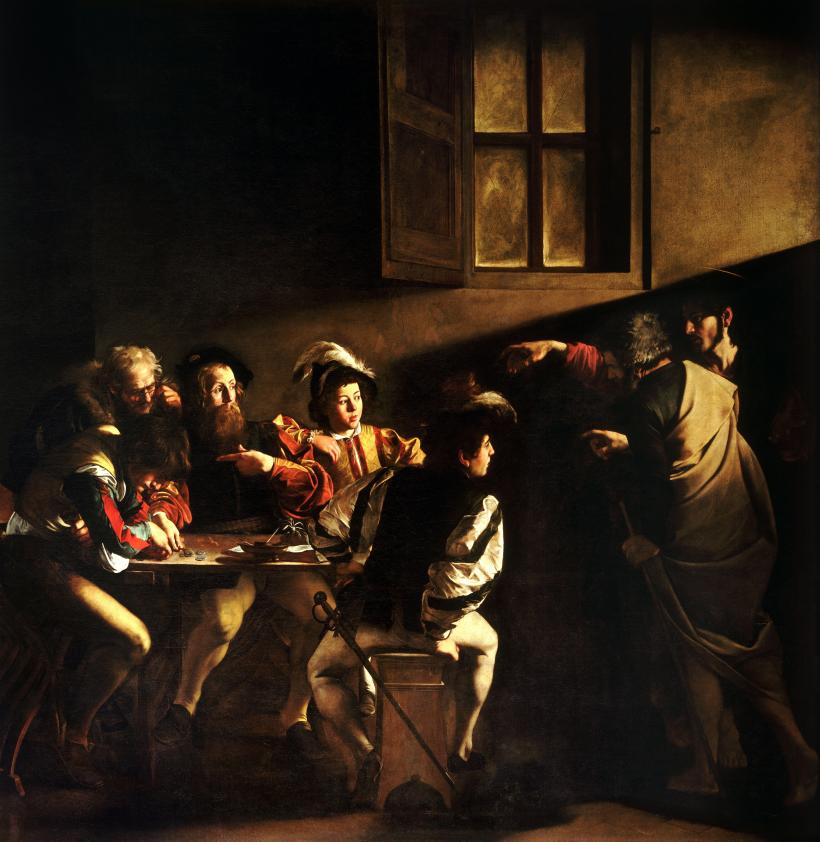
“That finger of Jesus, pointing at Matthew. That’s me. I feel like him. Like Matthew.” Pope Francis remarked in his 2013 interview with Fr. Antonio Spadaro, S.J.
“It is the gesture of Matthew that strikes me: he holds on to his money as if to say, ‘No, not me! No, this money is mine.’ Here, this is me, a sinner on whom the Lord has turned his gaze. And this is what I said when they asked me if I would accept my election as pontiff.”
In Caravaggio’s The Calling of St. Matthew, Pope Francis found the perfect image to express his own surprise at being uniquely called by Christ to serve the Church as supreme pontiff.
But, we have a problem. Which figure in the painting is St. Matthew?
(If you haven’t already done so, take a moment to give the painting at top a good look and try to figure it out for yourself.)
Besides the faintest loop over Christ’s head, there are no halos in this painting. Nor should there be – St. Matthew was only Matthew the tax-collector at this point. Here he is, in the midst of his sin, and in corrupt company. Matthew has just as much chance of being called out of this situation as any of the five guys in the tax office.
So, which one is he?
Option 1: The Bearded Man
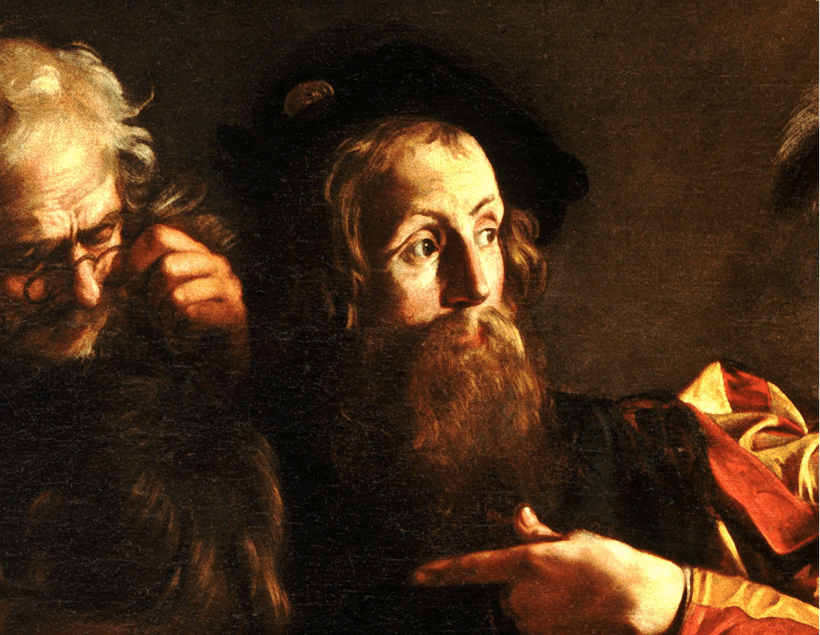
At first glance, Matthew appears to be the man with long beard. His eyes show surprise, his face is illuminated, his finger seems to point toward his breast. And, maybe just to help us out, he has a distinguishing coin in his hat and a right hand fingering money on the table. If there is anyone in this painting who is reacting as the one who is called, it’s this guy.
There are two other reasons why the bearded man is the best candidate for Matthew.
First, Caravaggio did not paint The Calling by itself. With this painting in the Contarelli Chapel in the San Luigi dei Francesi Church in Rome, Caravaggio painted two other scenes from the life of St. Matthew: The Inspiration of St. Matthew and The Martyrdom of St. Matthew. In both of these adjacent paintings, Matthew is depicted as a man with a sizable beard.
The second reason concerns some of the interesting history going on at that point. Before this was painted, there was a passing fear that France might go the way of the Church of England. This fear partially subsided when the Huguenot (Protestant) Henry IV converted back to Catholicism upon taking the French throne in 1593. Caravaggio was commissioned six years later to paint three works for the church of San Luigi dei Francesi (St. Louis of the French). To flatter the now-Catholic king of France (and appease his patron), Caravaggio painted St. Matthew to resemble Henry IV. (You can see the bearded resemblance here.)
But that might not be the whole story.
Option 2: The Hunched-Over Man
People make a big deal about Christ’s pointing gesture just below the window in the painting. His hand is unusually relaxed for a definitive signaling of direction. The reason for this is very likely that Caravaggio is alluding to a more famous painting: The Creation of Adam by Michelangelo.
Michelangelo’s Adam is depicted in the Sistine Chapel fresco in the moment just before his animation, with his finger less than an inch from that of God. Michelangelo, instead of showing an Adam already filled with life, depicts the precise moment prior to his ensoulment with all the drama of a limp wrist.
Like Michelangelo, Caravaggio is not capturing the moment of the calling of Matthew; he is capturing the precise moment before the calling of Matthew. The finger of Christ the New Adam has yet to be fully extended, the call is only just about to happen. The whole painting is in that dramatic tension of the moment before the call. If Matthew is the hunched-over man at the end of the painting, it almost would be more accurate to call it The Moment before the Calling of St. Matthew.
And here, Matthew is still a sinner, still a tax-collector, still fingering his coins and gripping his money bag. The bearded figure to his left echoes the perceived direction of Christ’s soon-to-be-extended finger, pointing not to his own breast but to the hunched over man next to him. This man’s face, only half-illuminated by the light that comes from Christ’s entrance, still intently looks down to the table; he has but to lift his head an inch to make eye contact with Christ. Will his eyes meet the gaze that tests mortal men and will he remain the same? Will he respond to the call?
So, which one is Matthew?
It’s still not entirely clear.
But that’s probably how Caravaggio wants it to be. Caravaggio’s art was at the cutting edge of the subjective turn of modern thought. As a controversial artist of his time, he departed from the idea that art is exclusively at the service of the true, good, and beautiful, and turned instead toward an innovative realism. (Remember our earlier post on what makes art good.)
Part of Caravaggio’s goal is to pull the viewer into the painting. He wants this ambiguity; he knows that things are not so cut and dry in this world. Christ entered a world in chaos, a world engulfed in sin. He calls us out of that darkness and into His light.
Turning again to the painting, if we go to the source of Christ’s call and look above His outstretched right hand, we are at the foot of the cross (the fourfold window pane forms a cross). At that cross, at our Lord’s ultimate crucifixion, darkness appears to triumph over light, chaos over order, death over life.
But it is precisely at that moment when Christ conquers. It is from that cross that Christ calls His disciples, and it is to that cross that Christ calls His disciples. We are drawn up while we are still sinners into the cross, into the central mystery of our faith.
Pope Francis, without weighing in on the identity of Caravaggio’s Matthew, hits on what our response should be to Christ’s call: “I am a sinner, but I trust in the infinite mercy and patience of our Lord Jesus Christ, and I accept in a spirit of penance.”
Independent of who we decide Matthew to be in this painting, our response to Christ should be the same as that of Pope Francis. We are that sinner uniquely called by Christ. How will we respond to His call?
Main image: “The Calling of St. Matthew,” Michelangelo Merisi da Caravaggio, 1599-1600
A young priest sets out into the countryside to journey to his new assignment… He is not quite sure how to get there, but in the evening, while walking in a field he finds two boys. They tell him he has just crossed into the parish boundary. Father gets on his knees and prays in thanksgiving for being sent there and in preparation for the work he will do in the little country town. The first and most important job, he would find out, will be to eradicate “the scourge of dancing.”
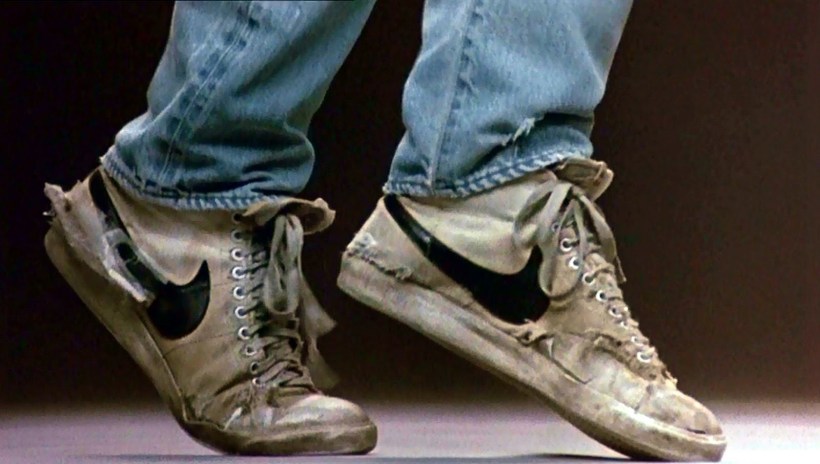
Of course we are speaking of the one whom they called “the saint” even during his lifetime – St. John Vianney, the Curé of Ars. We are not speaking of Rev. Shaw Moore, the antagonist of Footloose… Although the two might have gotten along, ecumenical issues aside.
Dance is commonly assumed to be an art form and a generally good way to recreate. Such assumptions are in fact so deep that the suggestion that it might be better to do away with public dances is seen as rigid, cruel, “medieval,” etc. One can only imagine the reactions of North Dakota’s teens to then Bishop Aquila’s decision a few years ago to ban dances (and pajama days) in one of his Catholic schools in the Diocese of Fargo… Maybe even some parents and faculty were upset. But would they have told John Vianney that he had been “too rigid” after he finally conquered the last of the dancers in the tiny village of Ars, which by that point had become the brightest beacon of holiness and civility in all of France?
The Abbé Trochu, in his famous biography of the saint, notes that, while St. Francis de Sales “wore gloves” when treating the topic, Vianney did not. “Go on! Dance! Dance all the way down into Hell!” Thus spake the saintly curé from the pulpit, time and time again. After decades, Ars was perfectly obedient to its pastor and was much happier for it.
Imagine the efforts it would have taken to accomplish the same feat in a 21st American century town even of normal size by today’s standards.
The people of Ars were not having dainty upper-crust waltzes, but neither were they “grinding,” “twerking,” or doing any other kind of categorically pornographic actions, which no reasonable person would think to call morally acceptable. They were simply dancing like country folk, having some drinks, and then getting too familiar with each other. The saint saw that this was not an accidental relationship, and he thought “the dance” to be the single greatest occasion of sin in Ars.
Note that it was seen by him as an occasion of sin, not necessarily a sin in itself, except perhaps inasmuch as a certain recklessness therein could be an expression of a lack of due care to avoid offending God. So, the question remains: can a Christian dance?
It depends.
The downfall of dance is usually what is touted as its greatest quality – the ability to arouse and express the passions. It is violent, it is sensual, it is angry, it is sad, it is joyous, it is whatever you need it to be. It intensifies all these things and shows them to others, while “freeing the spirit.” That’s the point. And that’s the problem.
In expressing the passions haphazardly, one can lose a grip on reason and be drawn to wherever that passion leads. The main problem is with sensuality.
First of all, we can, without hesitation, discard the utterly obscene motions and actions that have no other purpose than to sexualize the participants. These are not only done out of inordinate desire for the pleasures of the body, but they are also scandalous. Scandal here means a “stumbling block” to the spiritual lives of others – to cause sin in them. We are bound to avoid causing sin in others inasmuch as it is possible while not neglecting other duties. Nobody has ever had a duty to do anything like one would find going on at the average American high school dance. And it can never be good art, if art is the good expression of something good to express.
Secondly, we must examine the motivations and circumstances of those dances which are less clear. Should a desperate bachelor engage in a romantic tango with a beautiful woman he’s just met? Perhaps this will be a real challenge to him interiorly, urging him to go further and further… The same may hold true for her, which he must be careful about as well. Such a dance loosens the foundation on which chastity rests.
But what about a professional dancer who is so used to these movements and is so concentrated on his craft that he is greatly fortified against temptations? It seems the difficulty begins to disappear. And if a man is dancing with his wife, certainly there is no problem.
The case becomes different according to the abilities and circumstances of those involved, and according to the capacity of a dance to evoke problematic urges.
What would John Vianney think of the teens of Bomont jumping on the Kevin Bacon rock-n-roll-will-free-your-soul bandwagon? If we are honest – which we are here to be – we must say that he would probably be just as indignant as he was when he arrived in Ars, if not more so. He would think Rev. Moore was a wuss and a bad leader for finally caving. He would go to his bedroom, scourge himself to a bloody pulp, not eat for a few days, then start preaching, if his approach in Ars is any indication.
While the final scene of the film doesn’t have anything too bad (especially since these kids who have apparently never danced before are actually professionals), it is the culture and ideas which are introduced by the habitual loosening of inhibitions in social settings with the opposite sex (that often also involve alcohol) which sends up red flags. It is the dark cloud on the horizon: there is not yet a storm, but one is coming. Just as well, the spirits of angst and rebellion are not spirits from God, but they are exactly what Kevin Bacon’s character and the whole idea of rock-n-roll are about.
There are ways to “cut loose” and socialize that do not involve the dangers of “the dance.” Running, golfing, hiking, and yes, even spelunking are all appropriate alternatives. I simply can’t imagine John Vianney giving a sermon against spelunking… Can you?
“But wait!” some will say. “There is that scene where Bacon’s character goes before city council and throws down some verses from Scripture about how great dancing is! Ha. Game, set, and match, you Jansenist clown!” Unfortunately, we will have to save the detailed examination of the Scriptural treatment of dancing for another post. For now it will suffice to say that the Holy Bible decidedly does NOT encourage us to “kick off our Sunday shoes” so that we can do the worm to impress our friends.
Here is a challenge to those who have charge of Catholic schools: take a good, long look at the reality of what is going on at your dances, and whether it is worth the spiritual risk.
A while back a professor commented to my class about the cover of a recent edition of The Word Among Us. He noted that the title was “The Gospel of Encounter,” and yet it featured something rather opposed to such a notion… A woman who actually “turned away from the Vicar of Christ,” as he put it, to take a selfie. (It’s the June 2015 issue.)
You have no doubt experienced the frustration of such things before, if you’ve ever been to Notre Dame, the Holy Sepulchre, or any major church or shrine. A lot of people are there just to snag photos.
I was recently at the Holy Father’s Sunday Angelus address, which is held weekly in St. Peter’s Square. Yes, it makes sense that people would take a picture or two, yes, it makes sense to have two large television screens with live streaming due to how far away the Pope’s window is. But what I noticed was something very odd and disconcerting: many people were taking pictures of the screens.
They were taking pictures. Of pictures.
“Little Johnny, look at this photo here, it’s from 40 years ago.”
“Oh boy, what’s it of, grandpa?”
“It’s a picture of some footage of the pope.”
“Wow, golly gee, that must have been special. But can’t I just look up the real thing on YouTube?”
“That’s not the point – I saw this footage in person.”
“I can too, grandpa, here it is. If only you had seen the pope himself!”
“I did, but the screen was just as interesting.”
Why aren’t people satisfied with a postcard from a famous church? Certainly, it’s not the 50 cents it costs, because people are likewise not satisfied with the professional quality footage that is now taken at every papal event and then immediately uploaded for the whole world to see. Is it really necessary that it’s on YOUR phone? Why not just soak in the experience instead, so that it’s actually in YOUR brain?
“I just want to remember it,” people will say. Well, first of all, if you need to take a picture to remember something, it couldn’t have been that spectacular, so why do you want to remember it? And you can’t remember something you never really encountered in sincerity anyway. The “flesh and blood” of the experience must be primary, the digitized “word” of the experience must be secondary.
In focusing too much on getting a picture, one immortalizes a moment that he never had.
God can’t be experienced directly in this life, only in the next life in the fullness of the Beatific Vision, where we will behold the Divine Essence “face to face.” For now it is always, as St. Paul says, “dimly in a mirror.” (1 Cor 13:12) Why are we so intent on adding yet another piece of glass to hide Him from ourselves?
Many years ago I traveled to Quebec. I was in some reenactment Native American village (or is it Native Canadian?), where my group was told by the guide that absolutely no pictures were to be taken of the masks inside one particular hut – that if this law was broken, our cameras would be too. Why? Because there was a belief that developed that taking a picture somehow steals the soul away from the object… It desecrates it, profanes it, sucks its life out. While we know that masks don’t have souls, and that cameras don’t half-kill what they capture images of, perhaps this is not far off from the truth, but in the opposite direction: taking pictures of the sacred, if done irreverently, is bad for the photographer’s soul. It half-kills the experience he could have had. It has profaned and desecrated his relationship to it.
Now, there can be good photography of the sacred. There is plenty of it, actually. But good sacred photography is never done out of vanity, out of “touristic” motives, out of bandwagon-hype. Such would be, in some small way, a sacrilege. If a Catholic walks into one of the great churches of Christendom, forgets to genuflect, and starts grabbing pictures of the statues, hasn’t he sort of missed the point? And how much of an excuse does he really have?
Perhaps some person or place really speaks to you, and after having authentically encountered it you desire to catch a picture. That is quite a different phenomenon, as you have already genuinely engaged with what you now encounter through lenses, mirrors, and a screen. The Word became flesh, after all – He certainly did NOT become a digital picture.
In the meantime, let’s all sit back, relax, and actually experience the incarnational nature of our Faith, rather than neurotically re-immaterializing it.
Post by: Eamonn Clark
Main image: CTV’s coverage of the Papal audience of May 25, 2016
Check it out. Coming soon to a theater and/or film festival near you. It looks very good, don’t you think? These men are the real deal… no nonsense, not a shred of clericalism, and very pious yet available to those they serve.
There’s a bigger and better review for your hungry eyes here.
“Master, it is good that we are here; let us make three tents, one for you, one for Moses, and one for Elijah.” (Luke 9:33)
Peter had two options for approaching the event of the Transfiguration: he could see it as (a) a problem that needs to be solved, or (b) as a mystery.
When Jesus led Peter, James, and John up the high mountain, they woke up to a scene that seemed to defy all understanding. Jesus brings them up to the top of Mount Tabor and begins to glow unworldly bright. Then Moses and Elijah from the Old Testament show up and all three of them have a conversation.
Peter, thinking quickly on his feet, intrudes into their conversation and asks whether he should build three tents. For us, this sounds like odd, but for Peter, he must have thought he had solved the problem: this had to be the beginning of the end times. He might have picked up on how Jesus is fulfilling the Old Testament festivals. He knew of the Jewish tradition that Moses and Elijah would come again before the end of the world. Jesus, along with Moses and Elijah, was finally going to restore the kingdom of Israel and reap the much-anticipated harvest of souls. It was the Christological fulfillment of the Jewish Festival of Booths.
They needed tents.
However, Peter “did not know what he was saying.” He approached the Transfiguration as a problem to be solved, not as a mystery to be entered into. So while Peter was still speaking, a higher voice corrected him: “This is my beloved son with whom I am well pleased. Listen to him.”
The Limits of Science
When Christians use the word “mystery,” we do not mean a problem without an answer. No, for Christians, a mystery is something that is so intensely knowable that it exceeds the powers of human comprehension.
Let me give you an example.
Once, my five-year old niece told me, “Did you know that, when I’m in the car, the moon follows me? It really does!” My immediate response was to try to explain to her that since the moon is so far away, it only looks like it is following her. My impulse was to set up an experiment, putting her in one car and her sister in another car. They would go separate directions and observe how the moon follows both of them. Then I could prove to my niece that, since the moon cannot possibly be following both of them, there must be another explanation. That explanation would be in the reality of the great distance between the earth and the moon, a distance that can be observed and measured. Science would win out over childish naïveté.
But before I could thoroughly disprove her childish notion, she interrupted, “No. The moon really follows me.” With such opposition, I thus abandoned my attempt to scientifically disprove her childish perception.
For my five-year old niece, the moon was a mystery; it really did follow her. The moon was so beyond her that, rather than disconnecting her, it implicated her in its path. However mistaken her understanding of perspective, she approached it with wonder. And she rightly would not let that wonder be extinguished.
To me, the moon was a problem that needed to be solved; it could be measured and placed conceptually at a distance. I knew that its movements and phases are configured to a different pattern than my sporadic movements. Although technically more correct, the approach that reduced the moon to a problem prevented me from being gripped by the mystery of the moon and sharing in my niece’s wonder. To my niece, however, the moon was a mystery to be entered into.
Like my niece with the moon, a mystery is so beyond us, that we cannot help but be pulled into it. A mystery is so large that it necessarily involves the viewer. In this way, God Himself is a mystery, being so far beyond us that, at the same time, He embraces us and loves us in our very being.
Mysteries are not problems; they are not to be solved – they are to be entered into. A mystery is like a piece of art that pulls the viewer in; it is not a mere opportunity for scientific analysis.
The Mystery of the Transfiguration
It is in this way that the event of the Transfiguration is a mystery. Since mysteries overwhelm us, they implicate us – they require our response. Our response, then, to the mystery of the Transfiguration is not to solve the puzzle of Moses and Elijah’s appearance, but to enter deeply into the reality of what is before us. Through the mystery of the Transfiguration, we share in Jesus’ own prayer with the Father. By beholding the glory of Christ transfigured and listening to him, we become sons and daughters in the Son. By entering in to the mystery of the Transfiguration – by listening to God’s chosen Son – we become what we contemplate.
How do we enter in to the mystery of the Transfiguration? For us Christians, we go to the source and the summit of the Christian life – the Holy Sacrifice of the Mass. Like Peter at the Transfiguration, we can look at the Mass just as a problem to be solved, a ritual to be analyzed, a puzzle to be deciphered. Or we can enter into the mystery of the Mass.
In every celebration of the Mass, we ascend the mountain with Christ, and we encounter something that overwhelms our understanding: God incarnate – the second Person of the Holy Trinity – comes to us as bread and wine. So great is the glory of Christ in the Eucharist, so utterly beyond us, that we are pulled into the mystery. The altar is our Mount Tabor, where we see His glory, not with the eyes of flesh, but with the eyes of faith. Over the altar the Father’s voice mystically resounds, “This is my beloved Son; listen to him.” We who enter into this mystery by receiving the Body of Christ in Holy Communion are enveloped by the cloud of the Holy Spirit. At Mass, we enter in to the mystery of God’s glory. He gazes on us, and we gaze on Him, and we become what we contemplate.
“I heard there was a secret chord, that David played and it pleased the Lord.” But if you can’t figure out what that chord was, maybe just try singing. God made your voice, after all.
With roots going back to ancient Judaism, singing is an integral part of Christian worship. St. Paul tells us to “be filled with the Spirit, addressing one another in psalms and hymns and spiritual songs, singing and making melody to the Lord with all your heart” (Eph 5:17-19). One would guess that musical instruments would be helping to make this melody, adding another musical layer and aiding proper pitch, tempo, and rhythm.
Aulos Player
However, the Fathers of the Early Church came down very hard against the use of any musical instruments in the liturgy. For example, St. John Chrysostom says rather forcefully that “where aulos-players are, there Christ is not.” By exploring their reasons, we’ll uncover some theological underpinnings to the Church’s use of chant in her liturgy.
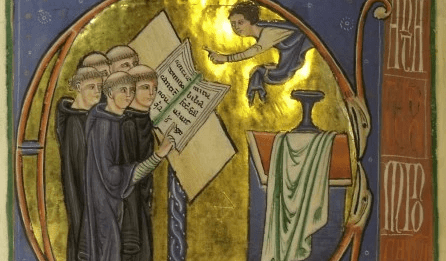
Hebrew Psalter, 15th century AD
Jewish Roots
“Praise him with trumpet sound; praise him with lute and harp! Praise him with timbrel and dance; praise him with strings and pipe! Praise him with sounding cymbals; praise him with loud clashing cymbals! Let everything that breathes praise the Lord!” (Psalm 150:3-6)
Although the Temple at one point was known for its loud instruments, Judaism itself cast aside musical instruments in the wake of the destruction of the Temple in 70 A.D. When the Romans left Jerusalem devestated, the Jews dispersed throughout the Roman Empire abandoned their harps and lutes, as they had once done in the Babylonian Exile 600 years prior:
By the rivers of Babylon there we sat and wept, remembering Zion; on the poplars that grew there we hung up our harps. For it was there that they asked us, our captors for songs, our oppressors, for joy. “Sing to us,” they said, “one of Zion’s songs.” O how could we sing the song of the Lord on alien soil? (Psalm 137: 1-4)
Like the Babylonian Exile, the destruction of the Temple fundamentally changed Jewish worship, and the “lute and harp” lost out.
Another reason musical instruments lost out was that pagan cults were known for playing musical instruments. And since the early Jews had a real fear of obfuscating the sacred and the profane, the association of musical instruments with paganism was enough to render musical instruments unclean.
When the Early Church looked for guidance in how to conduct their worship, they seemed to follow suit. But the Church Fathers didn’t stop with just condemning the use of musical instruments in the liturgy of the Church; they went on to condemn them in other aspects of secular life. For example, St. John Chrysostom calls musical instruments “the devil’s great heap of garbage.” St. Augustine adds: “The pipe, tabret, and harp here associate so intimately with the sensual heathen cults, as well as with the wild revelries and shameless performances of the degenerate theater and circus, it is easy to understand the prejudices against their use in the worship.”
Because of this great aversion to musical instruments, early Christian liturgical music was exclusively vocal. The liturgy would be sung but only in a subdued fashion, using a form of singing called “cantillation” that resembled speech more than song.
St. Clement of Alexandria (d. 215 AD)
Patristic Interiorization
“He who sings, prays twice” – this aphorism often attributed to St. Augustine is actually a distillation of his commentary on Psalm 73:
For he that sings praise, not only praises, but only praises with gladness; he that sings praise, not only sings, but also loves him of whom he sings. In praise, there is the speaking forth of one confessing; in singing, the affection of one loving.
Perhaps better distilled as “Only the lover sings,” singing adds to our praise the element of love, the internal disposition of the heart. The act of singing, involving the mechanisms of the human voice, expresses that love of God or, even, is that love of God. Something much more profound is happening in the song of the lover than a mere doubling of prayer.
But what about musical instruments?
Although Jewish and Christian worship changed, the Old Testament did not. How did the Early Church contend with the many instances of musical instruments in the Old Testament? The Church Fathers interiorized the external musical instruments featured in the psalter. Chief among the Church Fathers in that area, St. Clement of Alexandria writes on Psalm 150:
The Spirit, to purify the divine liturgy from any such unrestrained revelry, chants: ‘Praise Him with sound of trumpet,’ for, in fact, at the sound of the trumpet the dead will rise again; ‘praise Him with harp,’ for the tongue is a harp of the Lord; ‘and with the lute, praise Him,’ understand the mouth as a lute moved by the Spirit as the lute is by the plectrum; ‘praise Him with timbal and choir,’ that is, the Church awaiting the resurrection of the body in the flesh which is its echo; ‘praise Him with strings and organ,’ calling our bodies an organ and its sinews strings, for from them the body derives its coordinated movement, and when touched by the Spirit, gives forth human sounds; ‘praise Him on high-sounding cymbals,’ which mean the tongue of the mouth, which, with the movement of the lips, produces words.
Far removed from the “unrestrained revelry” of pagan culture, the human voice alone sufficed for authentic praise of God. All the references to musical instruments are made into allegories for the human body, each signifying different aspects of our physical anthropology.
But more than just our bodies, God made the whole human person – body and soul – in His image, capable of praising Him in melodious song. The early monk Cassiodorus writes that “the notes previously observed as issuing from musical instruments are now seen to emanate from the rational bodies of men.” Connecting this to the Incarnation, St. Clement of Alexandria writes:
The Word of God, scorning the lyre and cithara as lifeless instruments, and having rendered harmonious by the Holy Spirit both this cosmos and even man the microcosm, made up of body and soul – he sings to God on his many-voiced instrument and he sings to man, himself an instrument: “You are my cithara, my aulos and my temple,” a cithara because of harmony, and aulos because of spirit, and a temple because of the word, so that the first might strum, the second might breathe, and the third might encompass the Lord… The Lord made man a beautiful breathing instrument after his own image; certainly he is himself an all harmonious instrument of God, well-tuned and holy, the transcendental wisdom, the heavenly Word.
The Word of God became flesh – with human lungs, lips, tongue, and voice – and continued his eternal praise of the Father, now as one of those “beautiful breathing instruments.”
The definitive departure from “lifeless” Davidic musical instruments made room for such interpretations of the psalms. With this anthropologizing and allegorizing of the psalms with the elevated anthropology of the Incarnation, we have the beginnings of a theological foundation for liturgical chant.
Theology of the Unassisted Voice
When the Word became human flesh in the Incarnation, the study of human nature became a study of God – anthropology became a theology. Likewise, the study of the human voice reveals in some way the mystery of Christ. According to Dom Mark Kirby, the human voice in the Church’s liturgy prepares “in a kind of renewal of the mystery of the incarnation, an acoustical body for the Divine Word” (“The Psalmody of the Divine Office,” 17-18). In this way, liturgical chant is a participation in Christ’s mediation to the Father, as manifested in the Incarnation.
Here (with some help from Dom Kirby) are some theological musings on several aspects of the unassisted human voice.
Breathing: Within the Trinity, “the breath of God is indissociable from the word of God, and the word of God cannot be uttered save in a communication of the breath of God.” (“Toward a Definition of Liturgical Chant,” 15). Breathing thus images the action of the Holy Spirit in singing. In a cappella singing, pauses for breathing are left unfilled and exposed. Through the breathing necessary for supported singing, “the human person, fully alive, expresses likeness to God. Breath, life, and word constitute an inseparable triad in the divine economy of creation and redemption” (Ibid.). Together, the co-incidence of breath and word resonate in the human heart, the inner sanctuary of the temple of one’s body, where one prays to the Father in secret (Matt 6:6).
Memory: Unlike visual art which is stretched spatially, music is stretched temporally, requiring the human memory to link words across time into a coherent discourse. “Liturgical chant,” according to Dom Kirby, “being heightened discourse, engages the memory of both singer and hearer, becoming a disclosure, in time, of the timeless mystery, a contemplative unfolding of the Word” (“Toward a Definition of Liturgical Chant,” 14).
Communion: The prayer of the Christian is never solitary; every prayer is uttered in union with Christ and in communion with His Church. Chant captures this aspect of communion. The propers, antiphons, and psalmody chanted in the sacred assembly make present that communion of persons, all praying ecclesially with the voice of the Church. Chanting the prayer of the Church together leads to a uniformity without homogenization, a unity without loss of identity – each unique voice aids the others in a common song of praise. Even when chanted alone, the prayer of the liturgy is united with the prayers of all the faithful from the rising of the sun to its setting, stretching throughout space and time.
16th Century Chant Manuscript – Psalm 89: “I have made a covenant with my elect: I have sworn to David my servant. Alleluia.”
Silence: Chant begins and ends with silence: “the context of liturgical chant is, before and after anything else, silence. It originates, with the word, in silence. Like the Word, it ‘springs from the silence’” (Ibid., 20). More than merely assisting prayer, chant is prayer. In fact, chant is a participation in the highest prayer of Christ’s mediation to the Father. As such, chant should not feel rushed or busy, but must rather be irrigated with silence. The pockets of silence are little Mount Horebs wherein we hear the “still small voice” of God (1 Kg 19:12). This prayer does not need musical instruments filling in the gaps of singing and supporting the sound of the human voice with additional melodic layers. Rather, in liturgical chant, the exposed and vulnerable human person encounters the Father most authentically in silence.
What Next?
In chant, the human voice alone carries the word and expresses the fullness of the human person – body and soul. Chanting the text without accompaniment, one’s voice, one’s prayer – one’s whole person – is exposed to God. Chant is thus a full, conscious, and active participation in the prayer of the Church in the liturgy.
As the Church spread throughout Europe and the influence of paganism began to wane, musical instruments lost their negative associations. No longer seen as “the devil’s heap of garbage,” the Church began to reintroduce instruments into worship. With a little help from Charlemagne, the pipe organ became a prominent feature of medieval churches. As a “breathing” machine operated by bellows, the pipe organ was seen as an appropriate mechanical approximation of the human voice.
St. Cecilia (d. 230) anachronistically depicted playing the organ
But before the organ became a staple of church construction, the initial vacuum created by the Church Fathers’ opposition to musical instruments was filled by a theology of the unaccompanied human voice. Even though the Church no longer fears a connection to pagan worship, it was that initial aversion that occasioned the development of a robust theology of the unaccompanied voice – a theology whose praises are often unsung.
Such a theology became the basis for the great depositum orandi – deposit of prayer (to coin a phrase) – in Gregorian Chant. To this day, Gregorian chant is still “specially suited to the Roman liturgy” and “should be given pride of place in liturgical services” (Sacrosanctum Concilium 116).
Like the Early Church, the negative cultural associations of some contemporary genres of music ought to be taken into account in developing liturgical music fitted for the worship of the Father through, with, and in the incarnate Son. But more importantly, we ought not to turn our back on the larger theology of chant rooted in the Incarnation.










 Christian Renaissance Movement

#/media/File:The_Martyrdom_of_Saint_Matthew-Caravaggio_(c._1599-1600).jpg)
