Classical Showcase: Fra Angelico

Not to be confused with Frangelico, the popular liqueur, Blessed Fra Giovanni da Fiesole, AKA Fra Angelico (the Angelic Friar), was one of the highlights of the early Italian renaissance.

Fra_Angelico_portrait
Portrait of Fra Angelico, in a detail from “Deeds of the Antichrist,” by Luca Signorelli, c. 1501

Born at the end of the 14th Century, he entered the Dominicans around the age of 25, at which point he was already a practiced hand at the canvas. His work speaks solely to his devotion and piety.

Eventually taken under the wing of several popes and the famous Medici family, Fra Angelico produced numerous altar pieces, frescoes, and paintings for churches and convents around Italy. (Two sections of an altarpiece of his were recently rediscovered in the possession of a woman whose father had picked them up for £100 at a garage sale or some such nonsense.)

One of the most striking elements of the work of Fra Angelico is its incarnationality. By this I mean the weight that his figures usually have, instead of an ethereal airiness. This was in contrast to the predominant schools of religious art at the time, which were not as naturalistic. This naturalism became a characteristic element of Renaissance artwork.

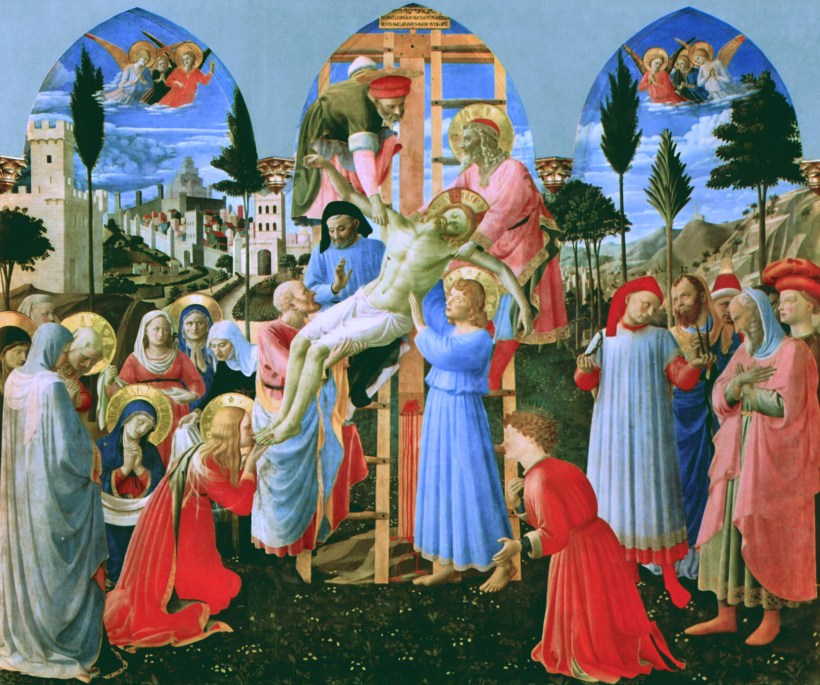
Fra_Angelico_073
The Deposition of Christ

Another interesting feature is the color – usually light pastels, with very few royal blues and golds (which symbolized wealth and human esteem, including for the patron who could provide such materials). This is again reflective of the inner life of the simple, pious friar.

Angelico,_niccolina_12
St. Lawrence Distributing Alms

Pope St. John Paul II said of him at his beatification: “Angelico was reported to say “He who does Christ’s work must stay with Christ always”. This motto earned him the epithet “Blessed Angelico”, because of the perfect integrity of his life and the almost divine beauty of the images he painted, to a superlative extent those of the Blessed Virgin Mary.”

He died in 1455 at a convent in Rome, poor, chaste, and obedient, leaving a legacy that would help to ignite the artistic soul of the Italian Renaissance, like a glowing ember that refuses to cool.

ANGELICO,_Fra_Annunciation,_1437-46_(2236990916) (1)
The Virgin of the Annunciation

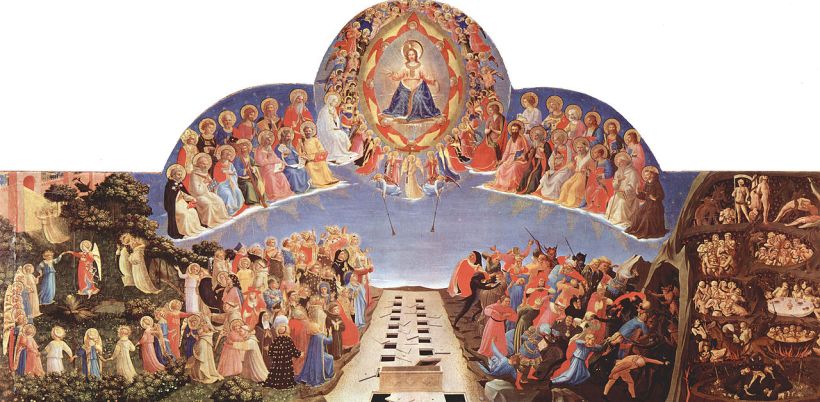
Main image: The Day of Judgement

Final image: By carulmare – ANGELICO, Fra Annunciation, 1437-46, CC BY 2.0, https://commons.wikimedia.org/w/index.php?curid=5446878

Science and Value: Why you can’t “just do science”

Science can never be “value-free.” If science in the broadest sense is “knowledge coming to be in us,” then it cannot help but be informed by one’s personal metaphysical schemata. To claim that a statement is objectively true is one thing, but to say that all have the same understanding of that statement is quite another. For the same word can represent different realities to different minds, so any kind of conversation about objective truths runs aground on the issue of “manifesting the essence” of what one intends to express the truth about. It cannot be done through human language (though perhaps it can be done through the Divine Word).

The empirical sciences do not by any means escape this problem, for they inherently involve a type of conversation: one collects data and re-expresses it. This is in no way different from any ordinary way of conversing. Saying that science is free of this “problem of expression” is like saying that truth can be told objectively and without any kind of interfering values in English but that it can’t be in French. The language of the most basic science consists in numbers representing quantity, and quantity is based on unity. The inductions made by those advancing to knowledge of such unities are pre-logical and can in nowise be considered as perfectly objective or “value-free.” The language of the more complex sciences is firstly based on the simpler sciences and consists essentially in words representing qualities, the original problem has in no way been avoided. Perhaps it has even been exacerbated.

However, the special place that “modern science” has earned is not wholly undeserved, and its (legitimate) practitioners are indeed to be given somewhat of an elevated authority. The relevant differentiae of “science” as a means of communicating truth is its rigor in observation, care in expression, and “plainness” of its object. By the latter I mean that the field of science generally extends to things that can quickly be made intelligible to the reasonable inquirer, whereas the truths of history or theology are less easily approached.

But that does not mean the less immediately intelligible sciences aren’t worthy of pursuit… theology in particular. Unfortunately, that is a popular attitude. Perhaps the occasional recollection that the whole project of “SCIENCE!” is dependent on more basic and invisible “values” would help correct this.


Main image: “Louis Pasteur in his Laboratory,” Albert Edelfelt, oil on canvas, 1885

Justice for Harambe? Sorry, not possible.

“What was that?”

“We just hit a raccoon.”

“Jonathan, don’t you think we should stop?”

“Oh trust me babe, that raccoon would not have stopped for us.”

I’ve had this hilarious exchange from Hot Rod in my mind recently.

There is a reason we say someone is “acting like an animal” when he’s doing crazy or immoral stuff… Animals have no real moral sense, no conscience, no supernatural end to which they are called. We don’t really think of them as guilty or innocent, except inasmuch as those words mean the existence or non-existence of some act.

To begin with, even asking the question sets one off on the wrong path: “Is there a morality gene?” All the dispositions of our bodies can ever incline us to desire are temporal goods (like pleasure or security), even if they are delayed in their acquisition in some way or are diffused among a community to which one belongs, UNLESS they are ordered somehow to the preservation of the species in such a way that it is altogether compulsory. Genetics, therefore, could only ever tell us why a person feels like doing x which will ultimately redound to his own temporal benefit in some way. And in animals, genetics are altogether compulsory, so the disjunction above is irrelevant for them.

In humans, these impulses can be intellectualized into rational selfishness, and certain kinds of structures of cooperation can indeed bring about a society that on its surface is stable and healthy. Read an Ayn Rand novel and you’ll get the idea.

But that’s not what real morality is. Real morality searches for the good in itself, not just for I me myself, even through others, but for others in themselves. Real morality moderates self-interest, while genetics can only incline one to seek his own good.

What about all those birds who are so committed to caring for their chicks? What about those elephants that cry for their dead? What about, etc., etc.?

If an animal does something we might call moral or right that does in fact only lend itself to the preservation of the species (which we would be tempted to call altruism), it is because it had an instinct to. Isn’t that the same as a morality gene? No, it is a gene that compels them to act in such a way, and the satisfaction for them lies precisely in the completion of an urge rather than “doing what is ‘right'” or something similar. There is no order to which a bear clings outside of itself when it protects its cubs – it has no reason for protecting them that it is aware of other than “because that’s what bears do.” We would call this a virtue if it was rationally chosen among other options, but the bear doesn’t have real rational options: it just has genes which force it to act in such a way. In fact, the very same impulse to protect its children would compel it to kill an innocent man, which we would NOT call virtuous.

“So what? It’s still bad to kill animals.” Well, while you chomp down on your burger tonight, think about what Cecil the Lion would have done to you (or your village) if given the chance. Think about what Harambe might have been about to do to that child. And so on.

We are not in a real community with animals, because they can’t communicate with us rationally. They can’t do that because they can’t reason. We are simply better and higher in the order of creation, as Genesis teaches. We have immortal souls, they do not. We can relate with God intellectually, they can not. We are called moral or immoral, they are not. This means that justice, with regard to animals, is nothing more than their proper temporal use as part of the goods shared among ourselves and God, and we expect absolutely nothing from them in return. The conclusion is this: unless you are killing animals for the sheer pleasure of destroying them, or the animal you kill is somehow important for human flourishing (like a cow that makes a family’s milk), or in killing them you are desensitizing yourself to human pain and death, you’re not doing anything wrong.

So there can’t even be such a thing as justice for Harambe. He’s owed nothing – especially since he no longer exists. But that won’t stop our culture from hashtagging more about a gorilla than about the innocent victims of abortion, or the news from covering Harambe’s death six times more than Christians recently killed by ISIS. As G.K. Chesterton famously opined, where there is animal worship, there is human sacrifice.

And anyway… Harambe would not have wanted justice for you.


Main image: By TKnoxB from Chemainus, BC, Canada – Flickr, CC BY 2.0, https://commons.wikimedia.org/w/index.php?curid=1826972

Logical Positivism & the New Atheists

The 21st century has very few well-known intellectual movements to its name thus far. In fact, perhaps the only one that the average American (or Brit) would even be vaguely aware of is the “New Atheism.” Characterized by evangelical unbelief – that is, the spreading of anti-religious/theistic sentiments in an attempt to destroy all belief in God – and an unwavering belief in the monopoly of empirical science on knowledge, the New Atheism is not particularly friendly toward some of the most predominant thoughts arising out of Western philosophy, especially the existence of God. Despite its relative popularity, the New Atheism comes on the heels of the utterly failed school of logical positivism, and it is not to be mistaken for a serious philosophical movement.

Before examining the New Atheism (which is really not all that new), it will be helpful to reflect on the school of thought which helped give rise to it: logical positivism. Two of the largest figures in what is perhaps the only school of thought ever to become truly extinct in university departments of philosophy were Bertrand Russell and A. J. Ayer. After being exposed to the New Atheism for just a short while, one will quickly come to realize that Russell is something of a hero of the movement. However, since Ayer wrote the book on logical positivism that Russell said he had wished he’d written, it will be more helpful to look at Ayer’s seminal work published in 1936, Language, Truth, and Logic.

Logical positivism is fiercely anti-metaphysical, such that it makes Kant look like kind of a sissy. According to Ayer, there are really only two kinds of truth-apt statements: tautologies and propositions directly available to verification by the senses. “We say that a statement is factually significant to any given person, if, and only if, he knows how to verify the proposition which it purports to express – that is, if he knows what observations would lead him, under certain conditions, to accept the proposition as being true, or reject it as being false” (LTL, 35). Such an attitude places metaphysics and questions of value, according to Ayer, completely out of the realm of significance. In line with this, Ayer also espouses the emotivist vision of metaethics: “But in every case in which one would commonly be said to be making an ethical judgment, the function of the relevant ethical word is purely ‘emotive.’ It is used to express feeling about certain objects, but not to make any assertion about them” (LTL, 108).

It is just intuitively obvious that there are some kinds of truths that are not verifiable by the senses. As is so often repeated, “Man is a metaphysical animal.” An appeal to intuition is perhaps something of a cop-out, but to anyone who has thought about “the thing in itself” or a universal conception of some particular thing, it is clear that non-material things have existence and that on the heels of that existence closely rides significance. The problem is that one who is stuck in the materialism-positivism-scientism bent will have too narrow an idea of what “existence” is. (But of course, that one can have such an idea at all proves the point once again.)

There were other well-known criticisms of logical positivism. The most obvious is that the main ideas in the system are themselves unable to be true by the system itself. How is it that we verify by sense that there are no meaningful metaphysical statements? And is the thought that there are no meaningful metaphysical statements itself supposed to be taken for a meaningful metaphysical statement? W. V. Quine offered a sharp criticism of the analytic/synthetic distinction in his earth-shattering paper, Two Dogmas of Empiricism, and soon enough, the school of logical positivism was completely dead. Or was it?

If there are any New Atheists involved in the serious practice of academic philosophy such as one would find at a university, they are few and far between and do not seem to make much noise. However, this does not mean that it is irrational to conclude that there has not been any influence of the logical positivists on the New Atheists, however difficult it may be to trace the course of the influence in its entirety. The sort of men involved in the work of logical positivism were heavily influential on 20th century philosophy of science, so the intellectual heritage might very well have cut through there and into the minds of philosophically-curious scientists like Richard Dawkins.

Whatever the case, there are clear similarities between the New Atheism and logical positivism. There is perhaps not an overt disdain for metaphysics like Ayer and Russell had, but there seems to be a level of distrust that prevents them from understanding it. For instance, there is a general incomprehension of major metaphysical ideas like the deduction of the existence of a simple God. There is little concern with value-reasoning (even though the leaders of the movement constantly find themselves dealing with questions of value, such as the worth of religion, or the moral goodness of eliminating religious belief), and there is really very little attempt to understand anything in terms of essences, formal causes, or anything indicative of or contingent upon teleology (the study of natural purposes).

The most classic example of their collective metaphysical inanity is perhaps the most fundamental to the entire project of the New Atheism in terms of a philosophical critique. Just as nearly all of St. Thomas’ work flows out of his “Five Ways,” almost the entirety of the philosophical dimension of New Atheists’ project rests on objections to the traditional proofs of God’s existence. The foremost instance is probably the cosmological argument.

Misunderstanding the cosmological argument is easy enough to do for the layman; it requires a critical mind that can grasp abstract ideas like “act” and “potency” and “simplicity.” It should not, however, be too difficult for the full-time philosopher to understand. Nor should it be dismissed so easily by the skeptic: there are possibly serious objections to the cosmological argument, but it does not appear that any such objections are on the radar of the New Atheists. Rather, they just plain misunderstand it. For example:

“If the universe’s existence requires an explanation in terms of an intelligent designer, then why doesn’t God, with all of his supreme and complex attributes, beg for an explanation in terms of yet another intelligent designer, ad infinitum? Indeed, who designed the designer? Alternatively, if God can simply exist without requiring an explanation, then why can’t the universe simply exist unexplained as well, thereby removing the need to posit a designer in the first place?”

philmeme1

The idea that this argument poses a serious threat to the cosmological argument is laughable, and indeed, it is almost embarrassing. Clearly, the God proposed in the cosmological argument does not possess “complex attributes,” or any “attributes” at all that are distinct from Himself. On the contrary, the universe is complex, thus necessarily implying a cause. Since there cannot be an infinite regression of causes (or else there would be no explanation for why there are any causes/effects at all), there must be some First Cause.

In his absolutely wonderful blog, Edward Feser notes that “most people who comment on the cosmological argument demonstrably do not know what they are talking about. This includes all the New Atheist writers.” The question is, why? Why is it that they do not understand it? Feser goes on: “[W]hile the basic structure of the main versions of the argument is fairly simple, the background metaphysics necessary for a proper understanding of the key terms and inferences is not.” Such “background metaphysics” might include a belief in or recognition of “actuality” being distinct from “potency.” This sort of language would be dismissed by Ayer as meaningless. Could a kind of hidden assumption of this thought account for the New Atheists having such trouble beginning to approach the cosmological argument? It is certainly a possibility.

God is not “a being” in the way that objects of empirical study are, although it appears that this is the current running through the entirety of the popular atheism generally fueled by the leaders of the movement. How else could the difficulties with the cosmological argument arise? This tendency to try to make something completely “beyond” the everyday kind of object to be very observable and even testable is indicative of distrust or even contempt for metaphysics. If the things of the immaterial world were really taken seriously by figures like Dawkins, they would not have such difficulties with the cosmological argument. Since the refutation of this argument is so critical, however, it is shameful that they do not even give a reasonably fair representation of it in their criticism.

Further evidence of this anti-metaphysical (and sharply anti-mystery) worldview is given in the widespread attempt to make “God” the object of scientific testing. After constructing a Bayes’ Theorem for God’s existence, Fishman concludes, “The fact that no devout Christian amputees have ever had their limbs grow back following prayers to the Christian God requesting limb re-growth is strong evidence that the Christian God does not exist.” Never mind that this is untrue – the deeper issue is that it is inconceivable to the New Atheists that perhaps God is wise to tests and chooses to abstain from participating in them, or that prayer is an altogether mysterious activity that will always escape science in some way. Instead, God is “a being” that can be measured, tested, and controlled just like any other being. This kind of God is not only rejected by the Bible, it is also rejected by Aristotle! It crams pre-conceived and wildly incorrect notions of benevolence, mercy, and intercession into the Christian (and Western) worldview.

Not only in the assessment of proofs for God’s existence is there a trace of logical positivism in the ideas of the New Atheism, but in the examination of value-claims as well. Dawkins writes:

“The question, ‘What is right and what is wrong?’ is a genuinely difficult question that science certainly cannot answer. Given a moral premise or a priori moral belief, the important and rigorous discipline of secular moral philosophy can pursue scientific or logical modes of reasoning to point up hidden implications of such beliefs, and hidden inconsistencies between them. But the absolute moral premises themselves must come from elsewhere, presumably from unargued conviction. Or, it might be hoped, from religion – meaning some combination of authority, revelation, tradition, and scripture.”

What is this “unargued conviction” he references? He does not say, but it is altogether likely that he means something very or indeed altogether subjective and/or arbitrary. He goes on to note that “some kind of liberal consensus of decency and natural justice that changes over historical time, frequently under the influence of secular reformists” provides us with most of our moral convictions rather than religion.

It might be shocking that Dawkins does not think that science can tell us about moral truth. It is maybe not that shocking that he does not appear to realize that he makes himself to be emotivist by this admission, if the foregoing explanation of “unargued conviction” is correct. If moral convictions are arbitrary or always subjective, and science can shed no light on the matter of moral principles, then we are left with an emotivist constructivism, since it does not seem that Dawkins would want to say that there can be “many moral truths” along the popular relativist line.

In the final analysis, both logical positivism and the New Atheism rest on turf highly unsympathetic to metaphysics and all things related. Being such, they both draw out the skeleton in the philosopher’s closet: science-envy. There are obvious remnants of Ayer and Russell in the work of the New Atheists, so regardless of how the influence came about it is clear that there exists one at least to some degree.


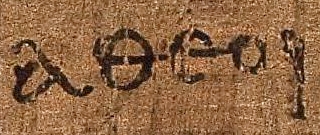
Main image: “atheos” from Ephesians 2:12

What’s a God Particle, and where can I get one?

The Higgs-Boson has caused a lot of ruckus throughout the past decade. From being featured in multiple specials on cable TV, making headlines in several major newspapers, and even being involved in the plot of a Hollywood film, it is safe to say that the so-called “God particle” has entered deeply into the subconscious of semi-scientifically informed Americans.

But what is a Higgs-Boson?

Time for some ¡HARDCORE SCIENCE!

Here’s a quick rundown of the background. In the 1970’s, the project of creating a “Standard Model of Particle Physics” came to fruition. It was an attempt to account for how subatomic particles interact the way that they do (through radiation, electromagnetism, and binding) and to explain what each known particle actually is, as well as what other kinds of particles ought to exist based on what was already known. The particles we speaking of are things like electrons, gluons, leptons, quarks… You know, really, really small things.

The challenge is so large in part precisely because the stuff is so small. To confirm the whole Standard Model, you would have to find each particle, where it’s supposed to be, doing what it’s supposed to be doing, when it’s supposed to be doing it. This is expensive, time consuming, and sometimes very frustrating… But it’s wicked cool.

Additionally, the Standard Model still has some kinks to work out… The challenge on the theoretical level is to reconcile this internally consistent theory with what we know about gravity, cosmology, and a few other things.

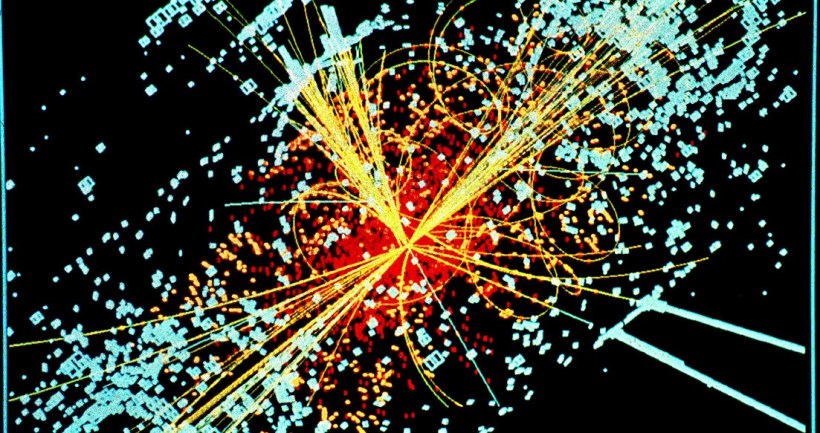
One of the biggest observational challenges for the Standard Model, which is usually tested by experiments done with particle accelerators (like the Large Hadron Collider) , has been the Higgs-Boson. It should be there, if the model is correct, but it is elusive. Not only is it super small, it’s got a lifespan of about 1.56×10⁻²² seconds – that’s about one and a half sextillionth of a second – after which it decays into other particles. Maybe it would feel at home in Manhattan.

The Higgs-Boson would basically be the thing that allowed certain particles to have mass. (And I do not mean unlocking the sacristy door.) The Higgs-Boson IS NOT what makes ALL particles have mass. This is a common misconception.

Here’s an analogy to help get the idea. When light goes through a prism, there is refraction… Photons, which were in “symmetry,” or acting the same as each other, all of a sudden begin to behave differently, with higher and lower frequency waves splitting apart to make all those pretty colors we know and love. The symmetry is disrupted. Well, when boson particles encounter a Higgs field, (think “gravitational field,” “electromagnetic field,” etc.) something similar happens… the massless particles can lose their symmetry, and some gain mass.

So what is the whole “God particle” schtick about? Well, if you ask that sad camerlengo from Angels & Demons, who clearly did not pass a single philosophy class in seminary, the Higgs-Boson is a threat to God’s claim on the act of creation.

The_Camerlengo

“If science is allowed to claim the moment of creation, what is left for God?”

The title “God particle” comes from a book written in 1993. It is just a way of pointing out how basic, important, and elusive the Higgs-Boson is. The “God particle” is clearly a mixture of act and potency (more potency than act you might say, seeing how quickly it pops in and out of existence) and, while we’re at it, it must in some way be composed of other stuff more basic than itself. It’s a composite, so it must be caused, since things can’t put their essential parts together (or else they would have already existed).

Unfortunately, many people think that the Higgs-Boson actually is some kind of threat to religion. Or something.

Once again, from the film, Angels & Demons:

Vittoria Vetra: It’s a way of studying the origins of the universe, to try to isolate what some people call the God particle. But there are implications for energy research.

Man: The God particle?

Vittoria Vetra: What we call it isn’t important. It’s what gives all matter mass, the thing without which we could not exist.

Robert Langdon: You’re talking about the moment of creation.

Vittoria Vetra: Yes. You know what? I am.

Lolz. They didn’t even get the SCIENCE right.

Fifty Shades of Cray

Crazy, but true: the male orb-weaving spider is very picky about what female to mate with, but 4/5 times he’s going to be eaten by her anyway.

116506_web
Credit: Yip et al. The sexual cannibalism of the cyrtophorus criticola

The carnal pleasures, when detached from the higher ones, ultimately leave one sad and desperate for more lest he become even sadder. As St. John of the Cross teaches, there is a bitterness in not doing our own will, but there is a double-bitterness in doing it. You would think that people would learn from this mistake, but hey, that’s concupiscence for ya… We’ll just stay going down the same road frantically looking for that next big rush, that next high, that next whatever it is, even though it is likely to eat us. How aware is the male cyrtophora criticola that he’s about to have his abdomen punctured and his insides sucked out by his new-found lady-friend? Maybe a little bit, in some very dim way. He’s probably seen it happen to others like him. But he is driven by his urges alone, by his instinct alone, by his body alone. His desires distract him from the horrifying and sticky end he is likely to meet. The drug addict knows that what he’s doing is bad for him – sorta. But he needs it, so he allows himself to be swallowed up… and the zeitgeist is always hungry.

What is so peculiar about this spider is that he is incredibly discerning of which female to approach: should I buy the new Lexus, the new Lamborghini, or the new Ferrari? Eventually though, he’d probably take whatever he could get. He’s enticed by the mere shadow of real pleasure, which is the satisfaction of his primal urge, not unlike one finds in the pages of that dreadful novel by E. L. James… although, granted, this is a little bit crazier…

But at least the spiders are open to new life!


Main image: By Taken byfir0002 | flagstaffotos.com.auCanon 20D + Canon 17-40mm f/4 L – Own work, GFDL 1.2, https://commons.wikimedia.org/w/index.php?curid=599586

Scientific Realism vs. Instrumentalism: A Primer

From the outset, it’s clear who lost the “name game” here.

The scientific realist posits that it is the job of scientific theories to explain the causes of observable phenomena in terms of whatever may cause them. He includes unobservable entities in his consideration, as he believes firstly of course that such things may exist, and secondly that science does not consist only in predicting similar phenomena by forming a “law,” but also about knowing what it is that is occurring in such a transaction between the objects of study. In other words, it’s about finding out the whole truth.

truth1
“YOU CAN’T HANDLE THE TRUTH!” (A Few Good Men, 1992)

Quite on the contrary is the position of the instrumentalist. However, the instrumentalist view does not go so far as the anti-realist, who says that there just plain aren’t any unobservable entities. Rather, the instrumentalist is agnostic as to whether or not there are such entities, and he avoids them in theorizing. He believes that it is enough for science merely to be able to predict the effects of observable events. Any statements made about things that cannot be sensed are regarded by him as almost altogether meaningless in themselves. Instead, they hold only an “instrumental” meaning for him; that is to say, he may see them as being useful for grounding a theory in. This might remind one of the pragmatism of William James, which said that “truth” is whatever is useful for thinking.

An example will help to illustrate these differences. The Higgs-Boson particle has not yet been directly observed, despite those successes in 2012 and 2013. The existence of this particle would provide an account for why certain particles have mass. The scientific realist is greatly interested in knowing whether or not there is such a particle, and it is these sorts of people who tend to want to build particle accelerators and telescopes. The instrumentalist is content with the “idea” of the Higgs-Boson, but he does not care if it really exists. It fills a gap that did not need to be filled. What the instrumentalist cares about is collecting enough data to understand that there is mass in certain kinds of things.

Instrumentalism is antithetical to the spirit of Christianity (and classical philosophy) as it bears on the motivation for natural scientific knowledge. We ought to want to know “what lies beneath,” because it reflects the beauty and wisdom of God… It is good for the soul to seek this kind of knowledge for its own sake, since that is one of the highest purposes of our existence. The “speciating principle” of man is his ability to reason and possess speculative knowledge, which therefore becomes primary in the determination of how he flourishes. Instrumentalism shucks this virtue and turns it into about gaining what is useful rather than what is good in itself.


Main image: The Very Large Array
By John Fowler – Flickr: VLA, CC BY 2.0, https://commons.wikimedia.org/w/index.php?curid=23385127

Contemporary Showcase: Extraordinary Music Workshop, Krakow, Poland

Folks, if you want an example of how to revive church music, look no further. (Seriously, watch the whole thing.)

The Extraordinary Music Workshoprun by the Polish Dominican Liturgical Centre, has got it all: devout youth, a rich expression of a deep cultural patrimony, excellent instruction, tons of energy…

It makes for a great time and great liturgical music, from what the trailer shows.

THIS IS EXACTLY THE KIND OF THING WE NEED MORE OF. Hopefully they will consider doing it every year, or even establishing a full conservatory. Maybe this year’s World Youth Day, which is being held in Krakow, will bring the grace to inspire such an endeavor.


Main image: By FotoCavallo – http://www.flickr.com/photos/cecphotography/6281990824/, CC BY 3.0, https://commons.wikimedia.org/w/index.php?curid=17653028

Can’t Spell “Cannabis” Without “Can I”

So guess what? Turns out some researchers in the Netherlands think more countries should legalize pot.

captobv
Captain Obvious, of Hotels.com fame

For those who think flying to Amsterdam (or Colorado, etc.) to indulge in the herb is just fine and dandy, let’s do some thinkin’.

Principle 1: Creation is good.
Principle 2: Not all creatures are equally good.
Principle 3: We ought to avoid evil.
Principle 4: Rastafari is a false religion.

Humans are ontologically higher than rocks, plants, and animals. We can use them, even to their detriment, if they are beneficial enough to us. Jesus was not a vegetarian. And yes, Brother Carrot and Sister Lettuce are okay to kill, unless it is out of sheer disdain and spite for their existence as creatures of God.

But Uncle Bud is a little different, because when we harvest him, it’s usually for the sake of affecting our bodies in a way that suspends our intellect.

Eat-ay ad Thomam:

The sin of drunkenness, as stated in the foregoing Article, consists in the immoderate use and concupiscence of wine. Now this may happen to a man in three ways. First, so that he knows not the drink to be immoderate and intoxicating: and then drunkenness may be without sin, as stated above (Article 1). Secondly, so that he perceives the drink to be immoderate, but without knowing it to be intoxicating, and then drunkenness may involve a venial sin. Thirdly, it may happen that a man is well aware that the drink is immoderate and intoxicating, and yet he would rather be drunk than abstain from drink.

That’s from the Summa TheologicaII-II, Q. 150, art. 2. Wine stands here for any intoxicating substance… One might not know a substance to have intoxicating effects, and so there is no sin in such drunkenness (unless its use was immoderate for other reasons). But if one knows something to be potent, it is another story. But just how drunk is “drunk?”

[The third kind of man] is a drunkard properly speaking, because morals take their species not from things that occur accidentally and beside the intention, but from that which is directly intended. On this way drunkenness is a mortal sin, because then a man willingly and knowingly deprives himself of the use of reason, whereby he performs virtuous deeds and avoids sin, and thus he sins mortally by running the risk of falling into sin. For Ambrose says (De Patriarch. [De Abraham i.]): “We learn that we should shun drunkenness, which prevents us from avoiding grievous sins. For the things we avoid when sober, we unknowingly commit through drunkenness.” Therefore drunkenness, properly speaking, is a mortal sin.

So there is still a mystery… How intoxicated must one be before he “deprives himself of the use of reason?” Let’s remember a few things though before we shame the Angelic Doctor for being obscure. First, he expects a student to have read all the text which precedes this Article. That would give one a better idea of what he means. Second, the Summa really is just a beginner’s crash-course. It is not meant to be exhaustive. In some articles, this is more evident than in others. Third, it’s unlikely St. Thomas had much firsthand experience with drinking to provide us with more subtlety… When Albertus Magnus is your professor and Bonaventure lives on your hall, you’re inspired to “rise above the influence,” as it were.

tumblr_m0o7czl36O1rrutr7o1_500
“Bonaventure Shows Thomas Aquinas the Crucifix,” Francisco Zurbaran, 1629

However, we know that some of the more austere saints occasionally indulged, such as Charles Borromeo and John Vianney. And of course, the Lord did as well, as He so famously pointed out in Matthew 11:19. Since potent substances will technically have some effect no matter how little is taken of them, we can say from this alone that it is not evil in itself to use intoxicating substances.

Then there is the principle of totality to keep in mind. Later in the same Question, Thomas alludes to this by saying a physician might tell one to use drink to induce vomiting – but since lukewarm water works too, that should be used instead. However, if it didn’t (and we hadn’t discovered Ipecac) then it would be fine. This is because the greater health of the body is worth the temporary loss of reason… That’s also why it’s not a sin to plan on going to sleep each night! And while there is violence done to the body and soul when, for instance, a gangrenous limb is removed, it is for the sake of the entire person. But this too should be moderated by wisdom, since not every ailment is worth doing violence to yourself. If you get occasional leg pain, that doesn’t mean you should cut off your leg.

So anyway, how drunk is drunk? How high is high? It is so difficult to say because of the problem in trying to quantify a quality. “It’s when you feel like… you know, drunk.”

captobv
There he is again!

We won’t solve the issue of exactly where “the line” is today – maybe another post with some ¡HARDCORE SCIENCE! – but perhaps we can lay down some guideposts based on Thomas and basic research.

Certain drugs act far more quickly than others. THC (the active ingredient in marijuana) acts more quickly than alcohol, based on the popular conventions of consumption. That is a big deal.

Reason helps us to distinguish the true from the false. Once you have trouble doing that, it’s time to call it a day… If sober people around you start laughing at everything you say, it’s probably not because you’re witty and charming, it’s because you’re diminishing your material brain’s capability to interact with your immaterial intellect (AKA you’re becoming drunk). And so on.

If you’re starting to forget stuff that you shouldn’t forget, then that’s another sign your faculties are slipping. So put it down.

When you feel like doing something really dumb that you normally wouldn’t, STOP and don’t do that much again. Once you know that tequila makes your clothes fall off, then kiss it goodbye. It’s better to enter into life without a bottle of Patrón than into Gehenna with all you could ever drink. (And Tequila burns even without being on fire…)

If you can’t walk right and are slurring words, then your brain is shutting down. Same story.

So no hard answers here today, but basically the faster and stronger the drug, the less morally safe it is to use. AND, if one uses any substance for the pleasure of changing his mental state in a way that diminishes its capacity to execute its proper function, as distinct from some some other effect, this too is a red flag… We should not delight in an unnatural state!

All this would make the average consumption of pot pretty bad.