Some art in the Roman Forum!

I was in the Roman Forum the other day to see Santa Maria Antiqua… It is the oldest church in the Forum, connects to the Imperial Palace, was the one-time seat of the Bishop of Rome, and it has some killer frescoes. Due to ongoing renovations and excavations, it is rarely open – this year it allowed visitors in for a few months, and the last time it did so was 1980. Sadly, as of tomorrow (Sunday, 10/30/16) it will be closed for who knows how long (the figure I heard was 20 years). Since you missed your shot, let me provide it for you!

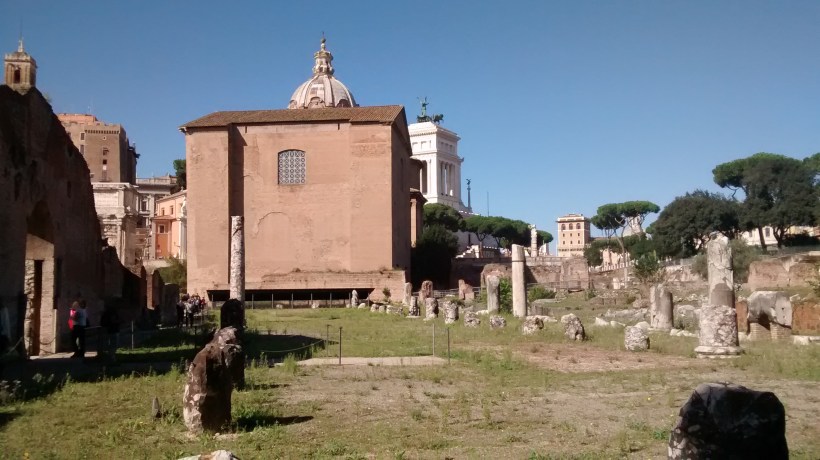
First things first… Behold, the first basilica in the world!
img_20161027_125102924
It has a sunroof.

No, it is not the brick building. That’s the old Roman curia – before it was a Church thing, it was a Roman thing. You are looking through the basilica, which is a ruin. You can see the pillars sticking up out of the ground. Once again, before it was a Church thing, it was a Roman thing. We baptized both ideas, and they stuck around.

Another first… Behold, the first real CCD classroom on planet Earth!

img_20161027_132427328_hdr
The church itself is to the right, and leads up towards the Imperial Palace and observation platform. Hold that thought.

Before there was coffee and donuts at RCIA, there was the Oratory of the 40 Martyrs. If you teach Sunday school, here you can go back to your roots. Let’s take a look inside, shall we? (Click to enlarge the photos.)

The Byzantine influence is almost as clear as the weathering. But all throughout the site there are slightly different styles, reflecting the fact that there were many different patrons and artists at work over the ages. Like the rest of the Forum, there are layers, and analyzing this site is made especially difficult by the unique character these frescoes have among contemporary Roman works.

Here’s the exterior of the church:

Santa Maria Antiqua is called “Antiqua” for a reason… She’s been around since the 5th Century! After Constantine, the Forum became more than just a safe place for Christians, it became an opportune place for worship.

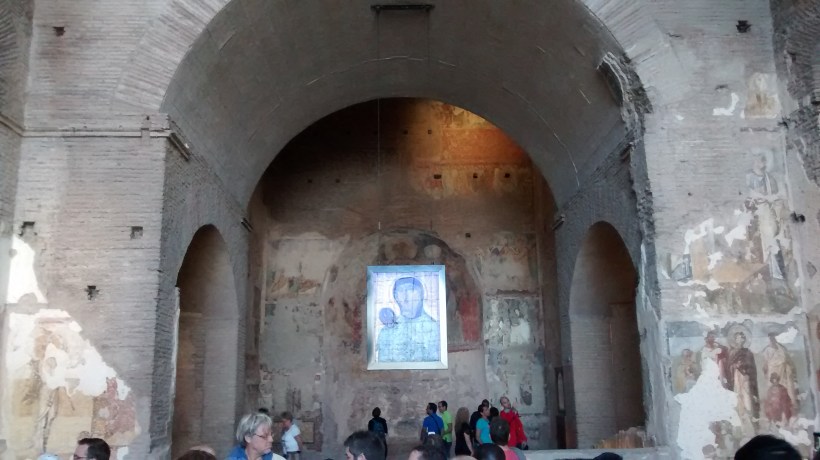
Into the church we go!
img_20161027_133015859

The hanging picture is called an “iconostasis.” Notice the use of arches, with the apse in the back (surrounding the iconostasis). Many of the frescoes are in rough shape, but we will look at some of the better preserved ones.
img_20161027_133024169
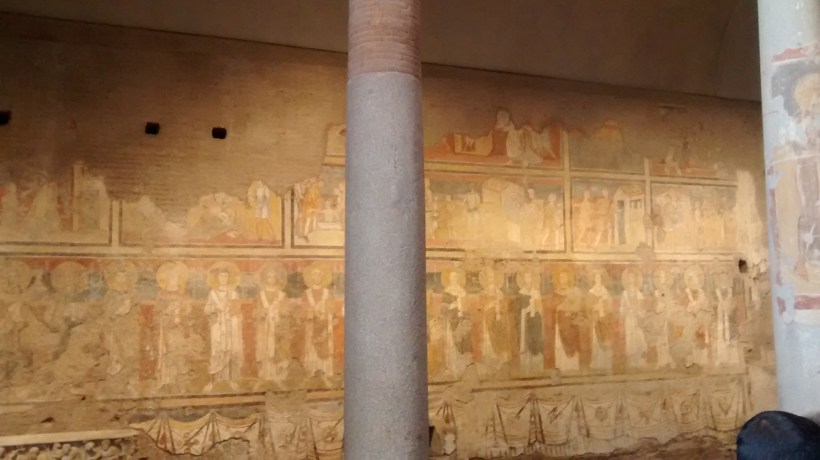
The left side of the nave.

Yes, even the pillars were decorated. See the one on the right there? This place was like stepping into an ecclesiastical coloring book. Every inch was covered, it seems.
img_20161027_133613072
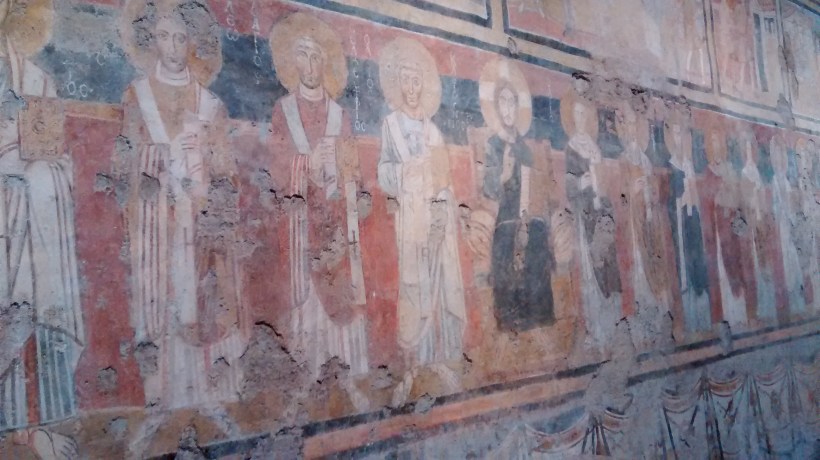
Close-up of the wall.

Here is an image of some the frescoes in one of two “corner chapels,” on the right side of the nave near the back… It is called the “Chapel of Physicians” (or the “Chapel of the Medical Saints”), where there would be constant intercession for the sick, whether the infirm were present or not. (The other is the “Chapel of St. Theodotus” on the left.) Apparently St. Francis visited this place, by the way, when he was in Rome.
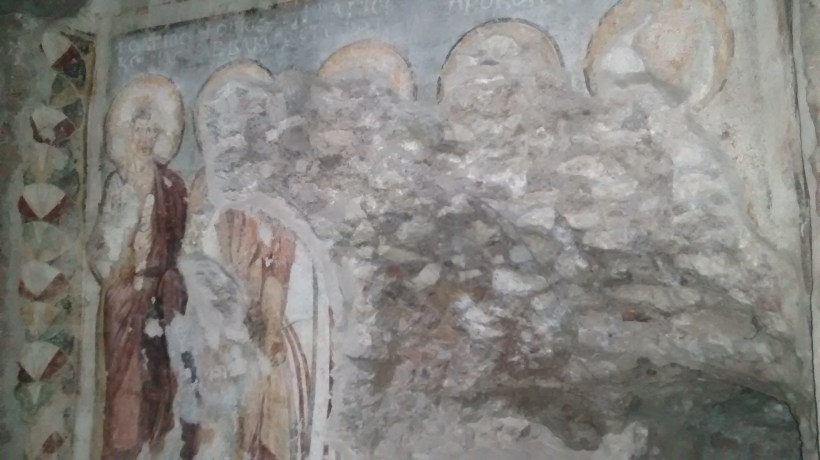
img_20161027_134228834
The saints pray along too! They cover all four sides.

The apse has the earliest Roman image of Mary as a Queen, and the image of the Cross (in the Chapel of St. Theodotus) is notable as well…

Pope John VII was totally enamored with Santa Maria Antiqua. Not only did he commission a ton of work on the church, he also moved there, way back at the start of the 8th Century before there was an Associated Press to misunderstand why he might do such a thing. However, only about a hundred years later, an earthquake would cover much of the church, leaving it dormant for 1,000 years or so. (The Chapel of the Medical Saints apparently remained accessible, and somehow people forgot there was a church attached!)

img_20161027_135709585
Another view. This looks over where the ambo would have been toward the main altar.

Here there was a main altar and a “holy table” further back near the apse where the gifts would have been prepared.
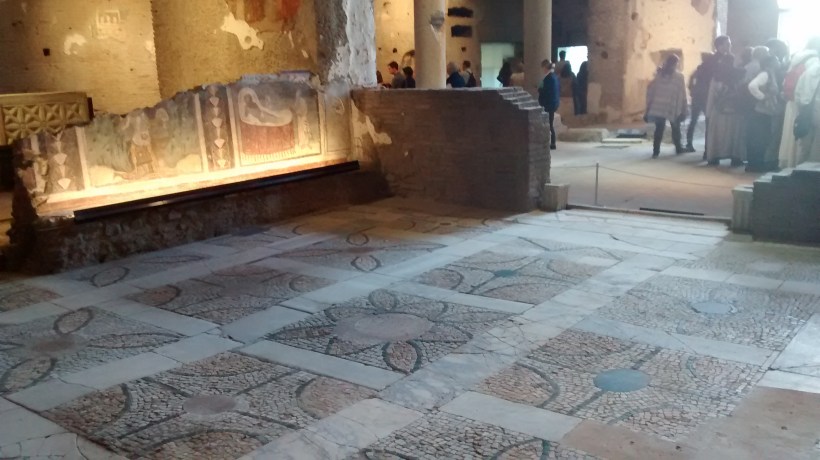
img_20161027_133457223
From the holy table toward the main altar.

To make sure that everyone understood that Christianity was not ditching its Jewish roots, there was significant emphasis on the Old Testament. Here is a sarcophagus with stories of Jonah and some more frescoes of OT events:

It was lunch time in Rome, which beckoned, but in the end the platform won out. The long climb was definitely worth it. Panning left to right:

There’s just too much to point out. Sorry. But do notice that the corner of the church is on the top left. The rest of the view is mainly out towards the Quirinal Hill and Capitoline Hill (the Forum is on the Palatine).

Considering that you will probably never actually be inside this amazing church… you’re welcome for the quick glimpse inside!

Post by: Eamonn Clark

How the Camera is Spoiling Religion

A while back a professor commented to my class about the cover of a recent edition of The Word Among Us. He noted that the title was “The Gospel of Encounter,” and yet it featured something rather opposed to such a notion… A woman who actually “turned away from the Vicar of Christ,” as he put it, to take a selfie. (It’s the June 2015 issue.)

You have no doubt experienced the frustration of such things before, if you’ve ever been to Notre Dame, the Holy Sepulchre, or any major church or shrine. A lot of people are there just to snag photos.

I was recently at the Holy Father’s Sunday Angelus address, which is held weekly in St. Peter’s Square. Yes, it makes sense that people would take a picture or two, yes, it makes sense to have two large television screens with live streaming due to how far away the Pope’s window is. But what I noticed was something very odd and disconcerting: many people were taking pictures of the screens.

They were taking pictures. Of pictures.

“Little Johnny, look at this photo here, it’s from 40 years ago.”
“Oh boy, what’s it of, grandpa?”
“It’s a picture of some footage of the pope.”
“Wow, golly gee, that must have been special. But can’t I just look up the real thing on YouTube?”
“That’s not the point – I saw this footage in person.”
“I can too, grandpa, here it is. If only you had seen the pope himself!”
“I did, but the screen was just as interesting.”

Why aren’t people satisfied with a postcard from a famous church? Certainly, it’s not the 50 cents it costs, because people are likewise not satisfied with the professional quality footage that is now taken at every papal event and then immediately uploaded for the whole world to see. Is it really necessary that it’s on YOUR phone? Why not just soak in the experience instead, so that it’s actually in YOUR brain?

“I just want to remember it,” people will say. Well, first of all, if you need to take a picture to remember something, it couldn’t have been that spectacular, so why do you want to remember it? And you can’t remember something you never really encountered in sincerity anyway. The “flesh and blood” of the experience must be primary, the digitized “word” of the experience must be secondary.

In focusing too much on getting a picture, one immortalizes a moment that he never had.

resphone

God can’t be experienced directly in this life, only in the next life in the fullness of the Beatific Vision, where we will behold the Divine Essence “face to face.” For now it is always, as St. Paul says, “dimly in a mirror.” (1 Cor 13:12) Why are we so intent on adding yet another piece of glass to hide Him from ourselves?

Many years ago I traveled to Quebec. I was in some reenactment Native American village (or is it Native Canadian?), where my group was told by the guide that absolutely no pictures were to be taken of the masks inside one particular hut – that if this law was broken, our cameras would be too. Why? Because there was a belief that developed that taking a picture somehow steals the soul away from the object… It desecrates it, profanes it, sucks its life out. While we know that masks don’t have souls, and that cameras don’t half-kill what they capture images of, perhaps this is not far off from the truth, but in the opposite direction: taking pictures of the sacred, if done irreverently, is bad for the photographer’s soul. It half-kills the experience he could have had. It has profaned and desecrated his relationship to it.

Now, there can be good photography of the sacred. There is plenty of it, actually. But good sacred photography is never done out of vanity, out of “touristic” motives, out of bandwagon-hype. Such would be, in some small way, a sacrilege. If a Catholic walks into one of the great churches of Christendom, forgets to genuflect, and starts grabbing pictures of the statues, hasn’t he sort of missed the point? And how much of an excuse does he really have?

Perhaps some person or place really speaks to you, and after having authentically encountered it you desire to catch a picture. That is quite a different phenomenon, as you have already genuinely engaged with what you now encounter through lenses, mirrors, and a screen. The Word became flesh, after all – He certainly did NOT become a digital picture.

In the meantime, let’s all sit back, relax, and actually experience the incarnational nature of our Faith, rather than neurotically re-immaterializing it.


Post by: Eamonn Clark

Main image: CTV’s coverage of the Papal audience of May 25, 2016