Sancti Obscuri – St. Porphyrius (September 15)

Jacob Gruber

​If you were asked off the top of your head to name five saints of the Catholic Church, who would come to mind? St. Therese of Lisieux, St. Padre Pio, or St. Francis of Assisi? Perhaps St. John Paul II or Mother Teresa? But what about St. Euphemia or St Paphnutius? Surely St. Iphigenia made it somewhere on the list?

​If these latter names don’t ring any Church bells for you, this new column may be right for you. It’s no secret that we have “saint celebrities.” If you’ve lost an item, you think to pray to St. Anthony, not St. Abundantius. If you want help in discernment, you probably prefer St. Therese’s roses to St. Rosalia’s. But what about these other saints? Don’t they have something to teach us, to inspire us with, to remind us?

​This new column, “Sancti Obscuri,” will look at different saints who, for one reason or another, have become obscure to the modern Catholic imagination. The posts won’t be exhaustive, considering how historical obscurity tends to coincide with a paucity of source material. But if these forgotten men and women have received the crown of sainthood, then they have a story worth hearing. (They know something of Thomas Jefferson’s exasperation in this old “Simpsons” episode, “Mr. Lisa Goes to Washington.”)

Our first “sanctus obscurus,” St. Porphyrius, shares a feast day with Our Lady of Sorrows on September 15. In his life, however, he would not have known what to do with a celebration of a “Lady of Sorrows.” By profession, he was a comedian, a mimic, a famous jester. He was a prevailing voice of the remnant of paganism in the post-Constantine Roman Empire, offering to those who hadn’t accepted Christianity a sufficient mockery of its tenets. People expected comedy and corruption from him, certainly not conversion. Yet, as we will see, he was a man who, within a day, went from mimicry to martyrdom, profanation to profession. Before we tell his story, some background is in line.

His story begins best with the story of Julian the Apostate, who, given the spoiler alert in his name, didn’t care for Christianity very much. In the years following the death of Constantine the Great in 337AD, a barrage of complicated politics had plagued the leadership of the vast Roman Empire. Fast forward a couple of decades, and in 361AD one “Flavius Claudius Julianus,” a nephew of Constantine, arose as sole emperor. His reign was to be short (only 20 months), but not without activity.

Although Christianity for almost 50 years had enjoyed political freedom and support from the emperor, the rule of Julian loomed as a serious threat. Though he was a Christian for the first 20 years of his life, he came to reject the Lord and choose instead the “way of Helios” (see his Letter 47). Julian the Apostate envisioned a return to the Roman paganism of old, a religious atmosphere marked by highly syncretistic polytheism, unified, as it were, under the banner of being ‘not Christian.’

When Julian heard of the fame of Porphyrius the Mimic whose specialty was mocking Christians, he had him brought in to entertain the royal court. Everything was set up for a successful show. The audience was eager to be entertained at Christianity’s expense, and Porphyrius had put together a special play; he was going to mock the Mystery of Baptism.

The show was a riot, eliciting raucous laughter to be sure. Things seemed to be lining up perfectly. The climax of the action involved a mock-baptism scene with fake clergy dressed in liturgical garb immersing the “catechumen,” Porphyrius, into some water.

He ceremoniously pronounced that he would now be a follower of Jesus Christ, “in the Name of the Father and the Son and the Holy Spirit” before being immersed. But something happened when Porphyrius entered the water. Submerged in that moment, Porphyrius felt the summons of actual grace, a call to serious conversion. Coming out of the water, he announced his decision to all present that he wished to be a Christian and would no longer mock the Living God. But, while he had his metanoia, the emperor was simply annoyed. The Roman Martyrology sums up best what happened next:

“Forthwith, by order of the emperor, he was struck with an axe, and thus crowned with martyrdom.”

​Struck with the extraordinary work of divine grace, he managed to get struck also by the work of human anger. Having given over his heart to Jesus, he gave his head to the emperor. Thus is the story of the great Martyr Porphyrius. Once a jester before secular courts, he was to become a martyr in the heavenly courts.

​As for Julian the Apostate, his hopes for a revival of Roman paganism would not find widespread success. In 363AD, following Julian’s military death, Emperor Jovian took the emperor’s throne and restored the faith of the Roman Empire to Christianity.

​Suppose St. Porphyrius hadn’t slipped into obscurity in modern spirituality. Comedians and performers would have a ready patron, and the whole Church would have a better sense of God’s poetic justice. As it is, let us at least take the lesson to have sincere reverence for the truth and all holy things even when it puts us in rather difficult situations. Don’t forget to invoke his intercession every September 15!

May St. Porphyrius pray for us, and teach us true reverence for the Lord!

The Very Bad Christology of Fr. James Martin, S.J.

Eamonn Clark

UPDATE (4/12/18): There could be some subtlety added to this discussion, such as whether God could intentionally withhold some knowledge from the human nature of Christ for plausible deniability or a capability of identifying with humanity more. See here for a filmed, in-depth, and orthodox exploration of this topic. Most of the post still stands.

*Charity Goggles required*

No doubt most readers will be aware of the furor surrounding Jesuit Fr. James Martin’s latest book, Building a Bridge: How the Catholic Church and the LGBT Community Can Enter into a Relationship of Respect, Compassion, and Sensitivity. Since the issues with the book have been beaten to death – though not to a definitive conclusion – they will not be treated here. An item which has gone nearly undetected by comparison, though perhaps deserving much more treatment than his very bad book, is the very bad Christology which Fr. Martin has been publicly espousing recently.

This past Holy Week, Fr. Martin preached on the 7 Last Words of Christ prior to the Good Friday liturgy at the Cathedral of St. Matthew in Washington D.C. The Archdiocese reported as follows:

The sixth phrase, “It has ended; it is finished,” is usually interpreted by scholars to be the fulfillment of God’s will, said Father Martin, but he suggested that it can also be interpreted as a resignation, with Jesus saying, “I have done all I can do.” He may have wondered whether the apostles would carry on His work after He died, and be unsure if the great project of His ministry was coming to an end, Father Martin explained. But even if Jesus didn’t yet know how His project would continue, “The Father had other plans,” Father Martin said.

Further on:

Lastly, Jesus said, “Father, into your hands I commend my spirit.” Father Martin said his favorite theological question to think about is whether Jesus knew what was going to happen on Easter Sunday before He died. While the answer to the question is a mystery, “the one thing we do know,” said Father Martin, is “He desires only to do the Father’s will,” and in the Garden of Gethsemane, He reached the “ultimate decision point.”

Anyone who has read the Gospels will at this point be reaching for an explanation. Doesn’t Christ speak many, many times about His Resurrection and what will happen after He leaves the Apostles? Doesn’t He show He has foreknowledge in other instances as well? Yes, but it is not for no reason that Fr. Martin has taken his position. He has seen a true difficulty and is attempting to resolve it.

LifeSiteNews ran an article which originally commented on the content of the Good Friday talk (although it has since been edited). Fr. Martin decided to attempt to defend himself in the combox.

He is fully human. With a fully human consciousness. (Which means he would have had knowledge only of what a human person could know.) And fully divine. With a fully divine consciousness. (Which means he would have had the knowledge of the Father.) It’s a great mystery of how those two natures participated together. But to imply that I was denying his divinity is absurd. Feel free to read “Jesus” and “Seven Last Words.”

I don’t want to be too hard on Fr. Martin’s comment, as it was only in a combox, but there is a lot to investigate here. Why does he say “consciousness” and not “nature,” or “intellect,” or “hypostasis”? “Consciousness” is very vague and could lend itself to various interpretations. Also, why does Fr. Martin use the phrase “human person” and then make a contradistinction with “the Father”? Surely, he would admit that Christ is not a human person, but a Divine Person (the Son, not the Father) with a human nature, yes?

Now let’s add one more piece to this puzzle.

Fr. Martin recently took to Twitter (on August 20th, 2017) to explain the interaction between Christ and the Canaanite woman (Mt. 15: 21-28, Mk. 7: 24-29), which was the Gospel reading of the day:

Gospel: Today we see Jesus’ human and divine natures: he learns from the woman that his ministry extends to all, and he heals her daughter.

And then later that day, after receiving numerous rebukes from people who did not agree that Jesus learned about the scope of His salvific mission – the very purpose of His existence – from a mere creature, Fr. Martin responded with:

The most popular heresy in the Catholic Twitterverse is Docetism. It betrays a fundamental fear of any indication that Jesus was fully human

Seeing as Fr. Martin here uses the “h-word” as a defense against people who disagreed with his exegesis, do we not have the right to examine what he is saying in as serious a way as he treats the matter of an accusation of heresy?

But it was an exchange with Massimo Faggioli, a well-respected church historian, during which Mr. Douthat randomly tweeted “Own your heresy,” which sent things over the edge…

Calling [a theologian] a “heretic” is like calling a journalist a plagiarist.  These aren’t funny punchlines to be taken lightly.  They are attacks on one’s faith, and for theologians possible career-enders…

I’m disgusted with the facile use of words like “heresy” and “schism” and “apostate,” passing itself off as defenses of the faith.

All this from the same piece – and these are just some highlights.

Seeing as Fr. Martin is not tolerant of the lax use of these words, even in Twitter fights, shall we investigate what is at stake in his recent comments?

The Council of Ephesus proclaimed Mary as “theotokos,” or “God-bearer” – the Mother of God. This was defined against the doctrine associated with Nestorius (whose relationship with the doctrine is actually quite complicated), which was that Christ was both a human person and a Divine Person loosely united together. This meant that there are really two separate beings or “whos” in Christ: Jesus the human person, and the Person of the Son. Nestorianism was condemned again 20 years later at the Council of Chalcedon. In short, Nestorianism is definitely a heresy, and no Catholic can argue otherwise.

A view which splits Christ into two persons – not merely two natures – could account for several puzzling items. (After all, heresy usually makes matters simpler than they really are.) How is it, for instance, that a woman could really be “the mother of God” if Christ is fully human and is being born according to His humanity by which He is her son? Are His divinity and humanity the same? Of course not (although Eutyches, condemned at Chalcedon, tried something like that solution to this problem). Nestorius could easily explain this – Jesus the human person was born, God the Son was not, even though He was united with Jesus. A similar solution might be given to the problem of the death of Christ. How can God the Son die? The Nestorian answer is that, in every sense, He did not. There is no need for the complex subtleties of the communicatio idiomatum on this account.

Some kind of Nestorian Christology could also explain a strange verse in Scripture which is, frankly, very confusing and frequently misunderstood. It is Mark 13: 32, where Christ speaks of His return: “But of that day and hour no one knows, neither the angels of Heaven, nor the Son, but the Father alone.” (Matthew 24: 36 is identical, although many ancient Matthean manuscripts lack “nor the Son,” for what it’s worth.)

How to explain this? Certainly, we would not say that the Person of the Son does not know “the day nor the hour,” as He is God in the same sense the Father is God. Could the Gospel writers be suggesting that there are future contingent things that Jesus “the Son (of Man?)” just does not know as a human being and needs to learn, even if God the Son knows them as God? What else would account for this strange utterance of the Lord? Perhaps Fr. Martin’s comments are not so off-base…

Fortunately, this exact issue was settled a long, long time ago, in the year 600 A.D. to be precise. There had been folks – the “Agnoetae” – who picked up on exactly this verse and ran with it. They suggested that Jesus, in His humanity, did not possess the fullness of knowledge He possibly could, as if God the Son had held back some secrets. Pope St. Gregory the Great thought this to be problematic and weighed in on the matter (Denzinger 248). Shall we go through the text?

(But) concerning that which has been written: That neither the Son, nor the angels know the day and the hour [cf. Mark 13:32], indeed, your holiness has perceived rightly, that since it most certainly should be referred not to the same son according to that which is the head, but according to his body which we are . . . . He [Augustine] also says . . . that this can be understood of the same son, because omnipotent God sometimes speaks in a human way, as he said to Abraham: Now I know that thou fearest God [Gen. 22:12], not because God then knew that He was feared, but because at that time He caused Abraham to know that he feared God. For, just as we say a day is happy not because the day itself is happy, but because it makes us happy, so the omnipotent Son says He does not know the day which He causes not to be known, not because He himself is ignorant of it, but because He does not permit it to be known at all. Thus also the Father alone is said to know, because the Son (being) consubstantial with Him, on account of His nature, by which He is above the angels, has knowledge of that, of which the angels are unaware.

Gregory suggests that perhaps Christ is speaking figuratively, just as we figuratively attribute some characteristic to a thing on account of that thing causing that characteristic in us. His non-Scriptural example is a “happy day,” which is happy because it makes us happy. On this account, Christ “does not know” because he does not make us know. Christ attributes the knowledge to the Father, since God the Father does have the knowledge, but since God the Son is consubstantial with the Father, this would also mean God the Son has the knowledge. Basically, Christ is condescending to the disciples’ poor understanding of His nature – they don’t know him as God the Son, consubstantial with the Father. (cf. Mark 10: 18, Luke 18: 19 – “Why do you call me good? None is good but God alone.”)

 Thus, also, this can be the more precisely understood because the Only-begotten having been incarnate, and made perfect man for us, in His human nature indeed did know the day and the hour of judgment, but nevertheless He did not know this from His human nature. Therefore, that which in (nature) itself He knew, He did not know from that very (nature), because God-made-man knew the day and hour of the judgment through the power of His Godhead. . . . Thus, the knowledge which He did not have on account of the nature of His humanity – by reason of which, like the angels, He was a creature – this He denied that He, like the angels, who are creatures, had. Therefore (as) God and man He knows the day and the hour of judgment; but on this account, because God is man.

Here, Gregory gives a better explanation. He says that Christ knew “the day and the hour” in both His human and Divine natures, but He did not know from His human nature. This account would lead a reader (or listener) to understand that “the day and the hour” are not able to be known by natural inference. In other words, “flesh and blood will not reveal this to you” (cf. Mt. 16: 17). Also, as with the first explanation, Christ is speaking to the disciples according to their present understanding of His nature (and in this case His knowledge specifically) – they think He has a human knowledge derived from human learning, sometimes supplemented by Divine inspiration such as the prophets had. They do not yet have a full Christology – that must wait until Pentecost. Of course, we must be careful to avoid an implication of dishonesty in Christ’s words. Rather, He uses a rhetorical device which simply allows the truth to remain obscure.

Finally, we have a startlingly aggressive condemnation of Agnoetism from Gregory:

But the fact is certainly manifest that whoever is not a Nestorian, can in no wise be an Agnoeta. For with what purpose can he, who confesses that the Wisdom itself of God is incarnate say that there is anything which the Wisdom of God does not know? It is written: In the beginning was the Word, and the Word was with God, and the Word was God. . . . All things were made by him [John 1:13]. If all, without doubt also the day of judgment and the hour. Who, therefore, is so foolish as to presume to assert that the Word of the Father made that which He does not know? It is written also: Jesus knowing that the Father gave him all things into his hands [John 13:3]. If all things, surely both the day of judgment and the hour. Who, therefore, is so stupid as to say that the Son has received in His hands that of which He is unaware?

Gregory draws out an implicit Nestorianism in the Agnoetist doctrine. If there is really one being and Person, Jesus Christ, the incarnate Person of the Son, with two distinct natures united in that one subsistent being, then the knowledge of the Son must overflow into the knowledge of the human intellect due to the unity of subsistence which obtains. That knowledge would of course be gradually bestowed according to the natural capacity of the human faculties of Christ, which is why Luke can say, “And Jesus grew in wisdom and stature, and in favor with God and man.” (Luke 2: 52) As an infant, the human Jesus really did not know “the day and the hour,” but once His natural capacity to receive this knowledge grew, it immediately accessed that knowledge (cf. CCC #472).

The Catechism also has something to say about Agnoetism, though it does not condemn it by name (#473-474)… The letter from Pope St. Gregory the Great is also cited in the footnotes:

But at the same time, this truly human knowledge of God’s Son expressed the divine life of his person. “The human nature of God’s Son, not by itself but by its union with the Word, knew and showed forth in itself everything that pertains to God.” Such is first of all the case with the intimate and immediate knowledge that the Son of God made man has of his Father. The Son in his human knowledge also showed the divine penetration he had into the secret thoughts of human hearts. By its union to the divine wisdom in the person of the Word incarnate, Christ enjoyed in his human knowledge the fullness of understanding of the eternal plans he had come to reveal. What he admitted to not knowing in this area, he elsewhere declared himself not sent to reveal.

Here we have a fine summary of everything wrong with Fr. Martin’s Christology. There is clarity of language, first of all, and there is also an affirmation of the fullness of Christ’s human knowledge due to His human nature’s union to the Person of the Son. This human knowledge consists, then, not only in what a human being could know from experience and study. It also contains, as far as is possible for Christ’s human nature, all that God the Son knows, including the secrets of human hearts, the meaning and extent of His own visible mission (contra Fr. Martin’s exegesis of the interaction with the Canaanite woman), all that pertains to the truth of God and His laws and His Scriptures, the “day and the hour” (contra the original application of Agnoetism), that He would rise from the dead and successfully send out the Apostles (contra Fr. Martin’s Good Friday sermon), and all other future contingent events. While a Jesus who walks by faith and not by sight is more relatable, that is not the Christ of reality.

What can we say of our Jesuit? I too, like Fr. Martin, am concerned with the rash use of words like “heresy.” (I suggest that a general resurgence in the use of the classical terminology of theological censures is appropriate, and I will apply some of that language here.) In the strictest sense, Agnoetism seems not to be heretical (hæretica), as it does not immediately contradict a divinely revealed and defined dogma (like Nestorianism itself does), but it is erroneous (erronea) or next to error (errori proxima), as the truth it contradicts is immediately or at least eventually deduced from a defined dogma (contra Nestorius) and a certainly known natural truth (that Christ’s unglorified human nature was capable of knowing “the day and the hour,” and such like particular things). An Agnoetist must either deny what is clear from the dogma defined against Nestorius, or he must deny the natural truth about the possibility of Christ’s human knowledge. For this reason, it is not strictly appropriate to call an Agnoetist a heretic, even though it is difficult to conceive that what is being denied is the naturally certain truth. (Gregory of course thought Nestorianism was much more likely to be the root.)

I do think, however, that Fr. Martin has made it clear that he is indeed an Agnoetist.

I would certainly welcome a response from him denying this accusation and explaining his position with more clarity than he has done in the texts I have quoted.

We need to pray for our high-profile priests. Clerics who gain fame live a constant high-wire act even more than the average parish priest. If the downfall of Fr. Corapi has any lesson for celebrity priests, of whom Fr. Martin is the contemporary paradigmatic example, it is this: a priestly ministry which is more about conferences, books, and special events than it is about the sacraments and other characteristically priestly acts is in big trouble. Recall then-Father Corapi’s very sad words when he announced he would be leaving priestly ministry…

I didn’t do very much of that [sacramental work] quite honestly in the twenty years that I did minister . . . 90 percent of what I did in the past did not require ordination. Speaking through social communication—radio, TV, so forth—that’s not ministry, strictly speaking. My particular mission was speaking, writing, and teaching—not so much in the sacraments, but outside of them, in conjunction with them. So what I’m going to be doing in the future is pretty much the same thing.

I do not know if these words ring true with Fr. Martin, but I do sincerely hope he goes “back to basics” to avoid a similarly disastrous end. That might mean sacrificing some of the limelight – or all of it.

Comments are closed.


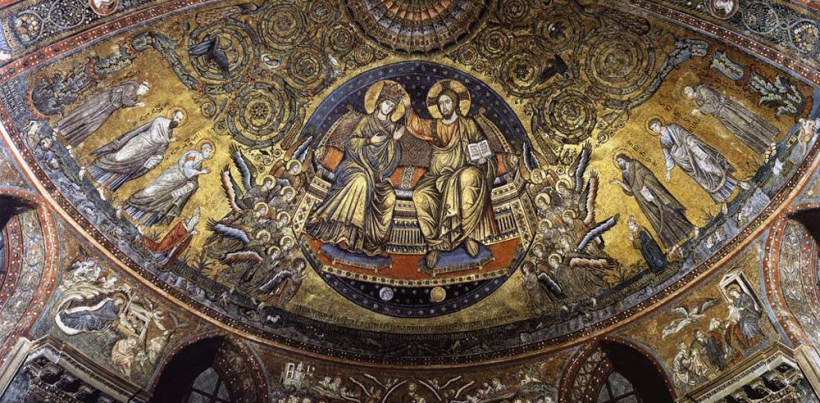
Main image: a fresco in Santa Maria Maggiore (Rome), a papal basilica built in honor of the Council of Ephesus (source: https://www.touritalynow.com/italy-travel-guide/rome/basilica-di-santa-maria-maggiore)

“Shallow Entry Point” – The Youth Dilemma

I recall quite clearly an encounter I had shortly after having been accepted as a diocesan seminarian at the tender age of 18. One of the older brethren was describing to me our upcoming annual retreat and convocation. He noted it would be pretty laid back, not too intense, and that there would be “more serious retreats” in seminary. “Okay,” I thought, “that should be no problem. I’ve been on plenty of retreats before.”

What I experienced was something quite at odds with what I was expecting… Sure, there was plenty of recreation, but every day also had Morning Prayer, Mass, Day Prayer, Holy Hour, Evening Prayer, Night Prayer, conferences, private meditation, and sometimes a rosary or extra Holy Hour… All that was a bit overwhelming at the time, as the retreats I’d been on in high school contained very little prayer by comparison, and yet this was “not too intense,” etc. “What then,” I wondered, “will the serious retreats be like? And do priests really have to pray this whole breviary thing every day? Oh my goodness!”

Well, I survived, and looking back I can definitely agree with the older seminarian’s description. For the average man in formation or clerical ministry, basically all those disciplines should constitute a normal day. Mass, rosary, the breviary, maybe some study, Holy Hour… In fact, it is not realistic to expect oneself to persist in celibacy or to be effective as a physician of souls without such a regimen. A “serious retreat” then, should consist of mostly silence, prayer, and possibly some extra mortification. It should be a time to focus exclusively on fellowship with God and the improvement of one’s spiritual life, not strengthening your volleyball serve, learning to play the guitar, or finally making a move on your crush, as good as these goals might be.

This brings me to the issue at hand: the amount of prayer and silence at many, or even most, youth retreats and conferences, or even regular events at the parish. Some are so incredibly noisy and chaotic one must wonder if the point is to traumatize kids into practicing the Faith, as if the louder the keynote speaker says something, the more the Holy Spirit is there. This is not really what is going on, of course; the point is to make the Gospel and prayer accessible by providing a “shallow entry point” to largely unchurched kids coming from a noisy and hostile culture, and “breaking in” can be done effectively with such means.

Okay. There is merit to this. But how shallow is too shallow? And how do you gently push the “big kids” into the deep end?

I suppose I am, to some extent, a product of “shallow entry-point” praxis, and I have known it to reap lasting fruit in others as well. On the other hand, I have also seen the growth spring up and wither away with the sun. (Matthew 13:6, 20-21)

It might be helpful to take a look at St. John of the Cross for a moment.  A few tidbits from the beginning pages of Dark Night will be enough to get a clear sense of the problems which inevitably come with a one-size-fits-all shallow entry-point praxis.

“Sometimes they are anxious that others shall realize how spiritual and devout they are, to which end they occasionally give outward evidence thereof in movements, sighs and other ceremonies; and at times they are apt to fall into certain ecstasies, in public rather than in secret, wherein the devil aids them, and they are pleased that this should be noticed, and are often eager that it should be noticed more.”

“Furthermore, they burden themselves with images and rosaries which are very curious; now they put down one, now take up another; now they change about, now change back again; now they want this kind of thing, now that, preferring one kind of cross to another, because it is more curious.”

“These persons, in [receiving Holy Communion], strive with every nerve to obtain some kind of sensible sweetness and pleasure, instead of humbly doing reverence and giving praise within themselves to God. And in such wise do they devote themselves to this that, when they have received no pleasure or sweetness in the senses, they think that they have accomplished nothing at all. This is to judge God very unworthily; they have not realized that the least of the benefits which come from this Most Holy Sacrament is that which concerns the senses; and that the invisible part of the grace that it bestows is much greater; for, in order that they may look at it with the eyes of faith, God oftentimes withholds from them these other consolations and sweetnesses of sense. And thus they desire to feel and taste God as though He were comprehensible by them and accessible to them, not only in this, but likewise in other spiritual practices.”

One can only imagine what this great Doctor of the Church would say about the average American youth conference – surely, his tongue would be as a whip. In fact, John would argue that the violent noise and flashy lights are exactly the opposite of the way out of the beginning stages of spirituality for someone already accustomed to such things. What the beginner needs is a calm introduction and encouragement into small mortifications and deprivations of the senses which their charity is already prompting them to make. Staying up all night in Adoration is certainly a good thing – on a retreat. But such an experience might prove rather fruitless without some firm resolution to grow in a reasonable way in the practice of daily prayer, mortification, detachment from some creature or even from some sin. So-called “retreat highs” constitute a serious obstacle to such discipline, as they soothe one’s senses and trick the soul into thinking itself to have grown on account of feeling consoled, while there has often been no earnest commitment made to rise higher in the spiritual life. In fact, a person who allows himself to be satisfied with feeling holy and therefore does not seek to purge himself of sin and vice is actually likely to be regressing. In other words:

Sincere and interested kids might be allowing themselves to be fooled by their own emotions. (Would it really be a surprise that this happens in the spiritual life as well as in natural affairs?) Teens (and adults, by the way,) who are already intrigued and present a modicum of commitment ought to be led away from self-serving spirituality into a more disciplined and moderate spirituality ordered toward a careful generosity. (I say the generosity should be “careful” because all too often a person moving out of the early stages of the spiritual life will want to make big commitments which are often the product of an earnest explicit desire to be generous with the Lord but which rest upon a secret pride or simple ignorance of what the sacrifice they are making actually entails. This sets the person up for bitterness, despair, or, worst of all, hubristic pride in their spiritual disciplines. Unlike a normal, merely human relationship, we must never give the Lord more than what He wants.)

On the other hand, many kids showing up for retreats or youth group are not being prompted by charity to move forward because, tragically, they do not have charity: they are in mortal sin and are often attached to it. They are there because their parents made them go, and they want to leave as soon as possible. They have not even really begun the spiritual life in earnest. Trying to lead them into silence, solitude, and mortification would likely be a total overload and utterly repel them. Even kids who have made a break with grave sin are often still so overwhelmed by the frantic quest of the senses for satiation that the thought of a whole day without human communication or any entertainment would be enough to crush their spirit to the point of making the whole exercise a waste or even a damaging experience. This reality shows the sense of Paul’s approach with the Corinthians: “I gave you milk to drink, not solid food, for you were not ready for it…” (1 Cor. 3:2) It seems that the quickest way to “hook” such kids might be to use the pleasant things they are already familiar with – loud noise, novelty, emotion, etc. There are, however, plenty of kids who will be even more repelled by such an attempt, especially if some imitation of the world is a bad imitation. They sense the lack of authenticity and figure that there couldn’t be something so great behind the mask, otherwise whatever it really is wouldn’t be pretending to be something it’s not. And these kids are on to something, aren’t they…

What to do? Here are some options which present themselves, arranged (in my opinion) from the most challenging to the least, though they are not mutually exclusive.

  1. Separate the kids who are more advanced, and give them more “solid food.” But how to go about this… What criteria would be used? Where are the human and economic resources for this? What social tension could be caused? What temptation would there be to “get into the holy group?” Etc. Perhaps something like this could be done informally and/or discreetly.
  2. Provide more variety at retreats and conferences. This is often difficult because of resources… Time, money, space, chaperones (!), etc. However, it might sometimes also be a function of a lack of expressed interest. Might there be some designated “quiet areas” at some larger youth conferences? Options for talks on more “difficult” subjects, like mortification? Perhaps…
  3. Provide different voluntary opportunities for more serious spiritual experiences throughout the year. Some high school kids really could benefit, for example, from an 8 day silent retreat, doing the Ignatian Exercises. Perhaps this number is small, and these things can be expensive, but the option ought to be there periodically. A lot of kids don’t even know that such opportunities exist – why are they not being informed? Even something communal could be done in a more seriously contemplative mode.
  4. Teach more about the spiritual life throughout the course of the year. This is practical, but those responsible for youth would have to put in the effort to learn and teach the basics of ascetical theology (in addition to other relevant things, like Scripture, fundamental morals, Sacraments, and so on). For the fringe kids who are only showing up to check the box to make Confirmation, this education would need to be extremely tactful but also assertive and frequent. Having a teen a grade higher give a talk before everyone goes on a Confirmation retreat is good; a series of letters to parents and those preparing for Confirmation which then are followed up with a one-on-one meeting with the pastor about their understanding of those letters and the spiritual life both in general and as it relates to their preparation for Confirmation might be better.
  5. Actively and tirelessly encourage kids to go to confession on a regular basis. Get Father to come by youth group once a month just for this reason. Seeing as not every kid could have a real spiritual director, as there are not enough clergy for the task (at least in America), this is the next best thing. Oh and they will have their sins forgiven too, making sure they are in grace and ready to make the most of whatever else is going on in youth group that day.
  6. Increase the use of neutral methods of attracting kids which lend themselves more easily to showing and providing the depth of the spiritual treasures of the Church, and decrease the use of other methods. For example, take the youth group hiking… This is basically what Our Lord did for three years with the Twelve. Get the kids involved with service to their own community (maybe not some far off land where their perceived use will far exceed their actual use)… Feed the homeless, visit the sick, etc. Have them step up to help with the parish’s broader life, especially liturgy. And so on. These are all activities that would satisfy a Borromeo or a Vianney but would also not be too much for the average 9th grader. In the meantime, try to strip away some of the kitsch and imitation of secular life that tend to deter (in the short term and in the long term) more than they attract.

Shepherding teenagers from various backgrounds and with differing levels of interest, maturity, and sensibility is undoubtedly a massive challenge which only grows with the numbers, and youth ministers are often under appreciated for all the work they do. But we ought to be able to admit that a monolithic (and therefore less work-intensive) “no child left behind” policy, where the lowest common spiritual denominators are always catered to, tends to stunt the growth of kids who are looking to go further but find no exterior means to do so; and this can sometimes result in their own eventual drifting away, as they see nothing beyond what they have already experienced and realize one day that what they have experienced is not as great as they once thought. Who wants to stay in the shallows forever? People will eventually look for a deep end to swim in, whether those waters are safe or not. There need not be a “youth dilemma” – we are a both/and kind of Church, after all. The pool should have a shallow end, but it can and should have a deep end too.

These are my thoughts and suggestions from my limited perspective. Please add your own in the comments!


Post by: Eamonn Clark

Main image source: http://www.sparhawk.info

The Grotesqueness of the Mass and the Problem of Evil

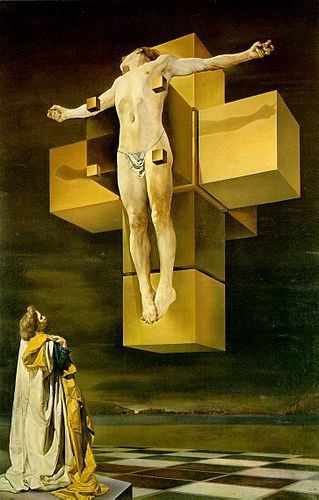
Dali_Crucifixion_hypercube.jpg

I would like you to imagine the classic love story. You know the one: The daring knight rescues the damsel in distress from the fiery dragon. The details really don’t matter. All the story needs, seemingly, is a knight, a dragon, and a princess. However, it seems that there is one other element needed in the story, and that is the element of danger. For the story to work, the knight must triumph in the end, but only after a battle in which he might have lost. And this seems to be true, not just from our perspective, but from the perspective of the princess as well.

I mean, if the story is to be believed, the princess loves her knight, and love seems to include a desire for the beloved to be safe from harm. Yet, imagine how the princess would feel if the daring knight, instead of facing the dragon in hand to hand combat, camped a mile away from the castle with a sniper rifle, killed the dragon from a safe distance, and then waltzed in to pick up the princess. A bit anticlimactic isn’t it? Don’t we all feel, as much as we might not like to admit it, that if we were the princess, we’d prefer our beloved risking it all to save us? Don’t we, in a secret place in our heart, want our knight to be scarred?

Now, I’m not going to try to understand the motivation for this desire. I don’t know where it comes from, I only know that it seems true that we have it. But, I do think it has to do with what comes after the knight’s daring rescue. While the knight and princess gallop away on a snow white stallion, isn’t there already a natural bond forged by their shared experience of the dragon? If the knight had faced no danger and suffered no injury in his battle with the dragon, wouldn’t the princess, as much as she loves her knight, feel estranged from him? Wouldn’t she ask herself, “Does he understand what the dragon did to me?”

I have often had that question about my relationship with God. Knowing how much my sin has hurt me and made me despicable to myself, and reflecting on the glory and perfection of God, I sometimes have asked myself, “Does He understand what sin did to me?” The answer God gave me at the cross, and continues to give me every day in the Mass is, “Yes, because sin has done it to me too.” There seems to be a deep psychological reason that the bread and wine are consecrated separately in the mass: We want a God who knows what it feels like to have his blood separated from his body, in the same way that we have spilled our blood living in a broken world. Of course, we want a God who is all-powerful, who triumphs over sin and death, no denying that, but we also want a God who bleeds in the process. We want our God to carry the same scars we do.

That is “the grotesqueness of the mass.” In the mass, as a continuation of the eternal sacrifice of Christ on the cross, God makes himself vulnerable to us, so that He can share in our weakness. Our suffering becomes the point of encounter with God. In the mass, God enters our brokenness, our loneliness, our anger, our numbness. That is the horrible beauty of the Mass and the cross: that the hour of good’s triumph over evil is when good is weakest. It is when God looks most like a man. God suffers with us, in order to make Himself capable of being understood by His creatures who have so long suffered under sin, that they are unable to comprehend a life of love without suffering.

the_body_of_the_dead_christ_in_the_tomb-copy-300x45.jpg

And yet, we know that this is not the end. God chose to suffer not just to meet us in our suffering, but to bring us out of it. We have hope that there is a love that transcends suffering, and though, in our broken human condition, we can’t experience it now, (or at least, our experience of it is limited,) our hope in God is that some day we will. That is why the problem of evil (Why does a good God allow suffering in the world) is not so much a problem as it is a recognition of our broken selves. As fallen men and women, our experience of our own brokenness makes us want others to have experienced our suffering. This is not because we are evil and sadistically want others to suffer, but because we want to know we are not alone. The cross not only gives us that reality, but also the hope for something more: something we cannot fully comprehend now, but something we know we’ve been missing. Evil exists because in our broken state, we need evil to help us recognize the good. In the evil of the cross, we see the ultimate good, and that ultimate good gives us hope for a good without evil, a love without pain, a final victory over sin.

jesus_returns-300x225.jpg

Post by: Niko Wentworth

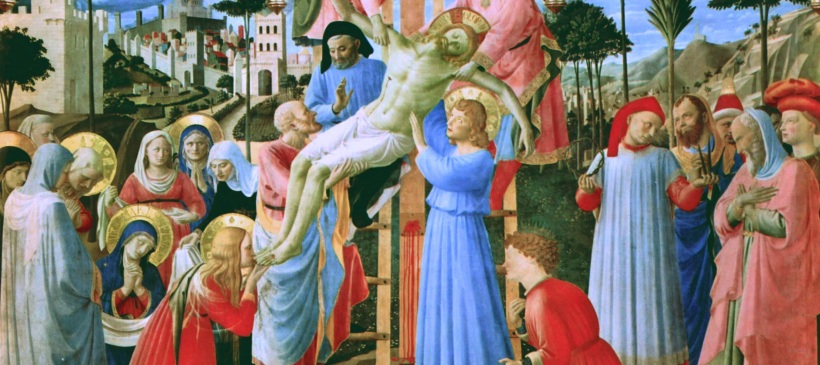
Main image: The Deposition from the Cross, Bl. Francis Angelico, 1434

Adventures in Liturgy: Funeral, or Celebration of Life?

Recently, I was distributing Holy Communion during a Mass of Christian Burial. The coffin was to my immediate right, and the family of the deceased to my immediate left. The Communion Procession was moving in an orderly fashion, when suddenly there was a bottleneck. When I looked up to see what was happening, I couldn’t believe my eyes: having just received Our Lord in the Blessed Sacrament, people were greeting members of the immediate family who were sitting in the front row. I was stunned! I whispered quietly, “Please keep moving, you are blocking the other communicants.”

How did we get here? Answering this question is simultaneously simple, and equally complex. While one may say people no longer know how to act properly in public, I propose that there are other realities at work as well.

The General Introduction to the Order of Christian Funerals states, Christians celebrate the funeral rites to offer worship, praise, and thanksgiving to God for the gift of a life which has now returned to God, the author of life and the hope of the just.[1] Our worship, whether at a funeral or many regular parish Masses, has become so anthropocentric, that we have lost a grip on the reality that we gather to worship, praise, and thank God; instead we often make ourselves the source, center, and end of our liturgical celebration. At a funeral, we gather not for a celebration of life, but to encounter the mercy of God and the promise of eternal life found only in Christ.

Secondly, we live in a world without sin. To admit that there is sin in the world and that we are sinners does not mean that we are bad people. To admit that we are sinners and that there are acts that are objectively right or wrong, proclaims that we are human beings who need to be redeemed through the Paschal Mystery of Christ. Death is a consequence of sin. The Church through its funeral rites commends the dead to God’s merciful love and pleads for the forgiveness of their sin.[2] To admit that we are sinners is to acknowledge that the deceased, and all those present, is truly human, and that God alone is the healer of our pain, and the source of forgiveness.

Death is very hard, and the reality of separation from those we love most dearly is heart wrenching. At the rite of final commendation and farewell, the community acknowledges the reality of separation and commends the deceased to God. In this way it recognizes the spiritual bond that still exists between the living and the dead and proclaims its belief that all the faithful will be raised up and reunited in the new heavens and a new earth, where death will be no more. [3]We have come from God and we are returning to God: our origin is a reality, and to return to God our goal. Is this basic reality present to the minds and hearts of believers today? While life is to be lived and lived to the fullest of the potential God has given us, do we keep before us that our time on earth is not what gives us meaning, but rather that we are destined for God? The preaching, life, liturgy, and catechesis of the Church needs to proclaim loudly that our citizenship is in heaven, and from it we await a savior, the Lord Jesus Christ.[4] A celebration of life fails to lead us to embrace our true citizenship.

If the Liturgy truly forms our faith and shapes our living, our approach to death and the Rites of Christian burial may reflect more accurately that we believe that all the ties of friendship and affection which knit us one throughout our lives do not unravel in death.[5]

Post by: Fr. Jordan Kelly, O.P.

Main image: A Funeral at Ornans, Gustave Courbet, 1850

[1] Order of Christian Funerals, hereafter OCF, #5.

[2] OCF, #6.

[3] Ibid.

[4] Philippians, 3:20.

[5] OCF, # 71.

A Forgotten Sin

There is a strange and subtle fault that plagues human hearts. It is strange because it is committed only with other sins, and it is subtle because one already has forgiveness on his mind when he commits it and so is likely not to think it needs repenting from. What is this sin?

Presumption.

Presumption is opposed to the virtue of hope, whereby we desire and expect God’s forgiveness and help in obtaining Heaven. It is the contrary of despair… The presumptuous person throws aside the moral law on account of the excessive character of his hope. He expects too much from God: he expects a thing not promised. Salvation has not been promised to those who merely fulfill a formula (viz., announcing one’s sins in sacramental confession, for example) but rather to those who exhibit perfect contrition, which is the rejection of all to do with sin – its evil effects, its evil content, and its evil motivation – out of love for God (with the assumption of making confession soon, if not presently making one), and to those who at least have true “attrition” (fear of punishment) within the sacrament of confession itself. Presumption is a special kind of motivation… a “meta-sin” if you will. One is in danger of not having adequate repentance for the sacrament of confession to receive absolution if he fails to mention presumption, as he brings his lack of the fear of God into the confessional with him. For a valid confession, one must at least have true attrition – fear of punishment. The presumptuous person does not have this fear with regard to himself. (If you have just become aware of this sin in your life, you should assume that your prior confessions were valid unless you have a clear certainty that you were not really trying that hard to examine your conscience. Simply mention presumption in your next confession.)

To help understand this sin, here’s a natural, human form of presumption. Imagine a child who stays out well past his curfew. When he comes home, his parents are upset, but he apologizes for his lateness and they forgive him. Then, on their way to bed, they hear their son talking on the phone to a friend – “Yeah they were mad but they forgave me. I knew they would, that’s why I did it.”

Ouch. What parent wouldn’t then proceed with an even more severe punishment than what mere lateness merited?

Unlike an unsuspecting parent, God is wise to this game. A person has “too much hope” if he thinks that “God will forgive me” is an excuse for doing whatever he wants and then only confessing the faults he commits because of his expectation of forgiveness. He must also confess his motivation – presuming upon God’s mercy. In this sense, presumption is “an inordinate conversion to God,” as St. Thomas puts it. This is strange to our ears, but it is indeed what this sin is; a person hopes so much for forgiveness that his servile fear is entirely demolished and replaced not by filial fear but by disobedience.

Presumption is a daughter of pride. One who thinks he is so great as to deserve Heaven is likely to fall into halfhearted repentance, or even into no repentance at all. What a calamity! Pride can also lead to another kind of presumption, namely, the rash assumption that God has blessed one’s endeavors in such a way that failure will be impossible or at least improbable in the project one has undertaken. For example, a man decides to become a missionary in China. He prayed, but he did not seek the approval of any ecclesial authority nor take counsel with a prudent spiritual director. How does he know that this is really God’s will? He does not. He would be guilty of this secondary kind of presumption. So too would a person who thinks himself to have “the gift of healing” and so goes about laying hands on people without authentic discretion. This is presumptuous of God’s grace and also exposes the Gospel to ridicule.

Knowing you have committed this sin is not always so easy. There is a difference between the hope of forgiveness motivating a sin and the hope of forgiveness occasioning a sin… I have given an example of the former in the context of human relationships. An example of the latter would be something more like a child who has become used to his parents forgiving him and so loses some respect and fear of punishment. He does not consciously choose to violate their legitimate demands on him because he knows they will forgive him, but a kind of vicious habit has been ingrained nonetheless. Where is the line between these two cases? It might not always be so clear. What we can say is that a person who consciously makes forgiveness a condition of his sinful action has certainly committed this sin, and a person who has lost respect and fear of punishment is in serious danger of committing this sin.

To reiterate, presumption requires its own mention in confession, as it is its own distinct sin. Often a person will know he has done something seriously wrong by using “God will forgive me” as a motivation for sin but will not have the vocabulary to explain himself in confession. The word is “presumption.”


Post by: Eamonn Clark

Main image: Pope Francis goes to confession – via Catholic News Agency

Lord, It Is Good That We Are Here

“Lord, it is good that we are here. If you wish, I will make three tents here, one for you, one for Moses, and one for Elijah.” (Matthew 17:4)

I’ve seen people give Peter a hard time for not “getting” what was happening in front of him at the Transfiguration. Mark’s Gospel says parenthetically “he hardly knew what to say – they were so frightened.” But I think we need to give our first pope some credit where credit is due.

Peter was thinking quickly on his feet. So he intrudes into the conversation and asks whether he should build three tents. For us, this sounds odd, but for Peter, he must have thought he had solved the problem: this had to be the beginning of the end times. He might have picked up on how Jesus is fulfilling the Old Testament festivals. He knew of the Jewish tradition that Moses and Elijah would come again before the end of the world. Now, since they’ve come, he was hoping Christ was finally going to restore the kingdom of Israel and reap the much-anticipated harvest of souls. It was the Christological fulfillment of the Jewish Festival of Booths.

They needed tents.

The Festival of Booths (Feast of Tabernacles / Sukkoth) is one of the three major feasts in the Jewish calendar (Leviticus 23:39). For a week, they would dwell outside in tents (“booths”) for seven days, reminiscent of their time dwelling in tents during their exodus sojourn. The timing of the Festival of Booths corresponded with a yearly grain harvest, wherein whole communities would work day and night (with the aid of a full moon) to gather in the harvest and do the work of threshing the grain. Removed from its initial agricultural context, the Festival Booths still looked forward to the harvest that was to come at the end of time. Although Peter’s exclamation of “Lord, it is good that we are here” is a fitting expression of eschatological rest, the tent-building suggestion might have been a little too much.

Peter figured out pretty well what was going on. However, Peter still did not know what he was saying. Where Peter erred was not his analysis – the event of the Transfiguration is the fulfillment of the Jewish Festival of Booths – but his approach.

Peter approached the Transfiguration as a problem to be solved, not as a mystery to be entered into.

The Meaning of Mystery

So when Christians use the word “mystery,” we do not mean a problem without an answer. No, for Christians, a mystery is something that is so intensely knowable that it exceeds the powers of human comprehension. A mystery is so great that it encompasses the subject.

With a little help from the French personalist philosopher Gabriel Marcel, we should distinguish between “mystery” and its misused synonym “problem.” For Marcel, something is a mystery when the self is implicated in it. A mystery cannot be studied from a distance, but is experienced by entering further into it. Openness to mystery is openness to the whole of a reality.

Screen Shot 2017-08-05 at 2.46.57 PM
Gabriel Marcel, French Catholic Philosopher, 1889-1973

A “problem,” on the other hand, is something that “is placed in front of me, blocking my way.” To treat something as a problem is to purposely exclude yourself from it. It is a purely notional engaging of a situation, wherein one can find objective and finite answers with universal implications.

Problems are the stuff of scientists. Mysteries are the stuff of mystics.

Let me give you an example.

Once, my five-year old niece told me, “Did you know that, when I’m in the car, the moon follows me? It really does!”

Infected as I was by the spirit of abstraction, I told her, “It only looks like it is following you because it’s so far away.” I thought I could maybe explain to her how perspective works at such distances. To prove this, I thought I could set up an experiment, putting her in one car and her sister in another car. They would go separate directions and observe how the moon follows both of them. Then I could prove to my niece that, since the moon cannot possibly be following both of them, there must be another explanation. That explanation would be in the reality of the great distance between the earth and the moon, a distance that can be observed and measured. Science would win out over childish naïveté.

But before I could get anywhere to disprove her childish notion, she interrupted, “NO. The moon really follows me.”

In the face of such opposition, I thus abandoned my attempt to scientifically disprove her childish perception.

For my five-year old niece, the moon was a mystery; it really did follow her. The moon was so beyond her that, rather than disconnecting her, it implicated her in its path. However mistaken her understanding of perspective, she approached it with wonder. And she rightly would not let that wonder be extinguished.

To me, the moon was a problem that needed to be solved; it could be measured and placed conceptually at a distance. I knew that its movements and phases are configured to a different pattern than my sporadic movements. Instead of encountering the moon with her, I abstracted. Although technically correct (the moon does not follow you), my approach prevented me from being gripped by the mystery of the moon and sharing in my niece’s wonder.

Like my niece with the moon, a mystery is so beyond us, that we cannot help but be pulled into it. A mystery is so large that it necessarily involves the viewer.

In this way, God Himself is a mystery, being so far beyond us that, at the same time, He embraces us and loves us in our very being.

The Mystery of the Transfiguration

It is in this way that the event of the Transfiguration is a mystery.

Since mysteries overwhelm us, they implicate us – they require our response. Our response, then, to the mystery of the Transfiguration is not to solve the puzzle of Moses and Elijah’s appearance, but to enter deeply into the reality of what is before us.

Although technically correct, Peter’s approach prevented him from being gripped by the mystery. So while Peter was still speaking, a higher voice interrupts him: “This is my beloved son with whom I am well pleased. Listen to him.”

Through the mystery of the Transfiguration, we are meant to share in Jesus’ own prayer with the Father. By beholding the glory of Christ transfigured and listening to him, we become sons and daughters in the Son. By entering in to the mystery of the Transfiguration – by listening to God’s beloved Son – we become what we contemplate.

How do we enter in to the mystery of the Transfiguration? For us Christians, we go to the source and the summit of the Christian life – the Holy Sacrifice of the Mass. Like Peter at the Transfiguration, we can look at the Mass just as a problem to be solved, a ritual to be analyzed, a puzzle to be deciphered. Or we can enter into the mystery of the Mass.

In every celebration of the Mass, we ascend the mountain with Christ, and we encounter something that overwhelms our understanding: God incarnate – the second Person of the Holy Trinity – comes to us as bread and wine. So great is the glory of Christ in the Eucharist, so utterly beyond us, that we are pulled into the mystery. The altar is our Mount Tabor, where we see His glory, not with the eyes of flesh, but with the eyes of faith. Over the altar the Father’s voice mystically resounds, “This is my beloved Son; listen to him.” We who enter into this mystery by receiving the Body of Christ in Holy Communion are enveloped by the cloud of the Holy Spirit. At Mass, we enter in to the mystery of God’s glory. He gazes on us, and we gaze on Him, and we become what we contemplate.

It is good that we are here.


Post by: Fr. Peter Gruber

Main Image: The Church of the Transfiguration, Mount Tabor

First Fridays: Leviticus 23

“The LORD said to Moses, ‘These are the festivals of the LORD which you shall celebrate at their proper time with a sacred assembly.’”

So begins the Old Testament reading for today. Following this introduction, the reading continues with God pronouncing the major feasts that would make up the Jewish calendar: The Sabbath, the Passover and the Festival of Unleavened Bread, the Offering of First Fruits, Festival of Weeks, the Festival of Trumpets, the Day of Atonement, and the Festival of Tabernacles. It may seem that this list of Jewish festivals may not appear to be particularly relevant to the modern Christian. After all, we don’t celebrate these feasts; so why did this passage and others like it make its way into our lectionary? What can we take away from them?

One reason why these readings are important to us is the historical background which they provide us about our ancestors in faith and the religious culture into which our Lord was born. The present is shaped by the past, so learning about the lived experience of those who preceded us and how they kept their traditions alive gives us a blueprint for doing the same today. For example, that the Festival of Weeks is a celebration commemorating the wheat harvest in Israel does not seem to be of utmost importance to the modern Christian. However, knowing that the Festival of Weeks was also known as Pentecost because it fell 50 days after Passover, in the same way as the Christian Pentecost follows 50 days after Easter, and that apart from being a harvest celebration, it commemorates the giving of the law at Mt. Sinai, allows us to enter into the liturgical importance of this festival. Understanding the relationship between the giving of the law at Sinai, and the giving of the Holy Spirit at Pentecost allows us to see the gradual fulfillment of salvation history and the slow unveiling of God’s love throughout time.

But for this post, I don’t want to talk about the rich theological insights a close study of each of these festivals would give us. There are others who have done a much better job than I could. Interested readers could do no better than to check out the Berit Olam commentaries published by The Liturgical Press. Rather, I want to focus on the general theme present throughout the entire narrative, (which in the reading is presented in a redacted form.) That is, the elements of time and space, and how they are ordered to the worship of God. If you look at Leviticus 23:1-44, there are several phrases that you would find repeated multiple times. “The Lord said to Moses, speak to the Israelites,” “The appointed festivals” or “sacred assemblies,” “Do no regular work,” and “lasting ordinance for generations to come” and “Wherever you live.” I want to concentrate on these repeated phrases as revelatory of the kind of relationship God wants the children of Israel to have with Him and with each other. Finally, after looking at these, I want to address the seemingly out of place verse of Leviticus 23:22 which I think is central to the passage.

To begin, it should be noted that Leviticus 23 begins a new “section” in the book of Leviticus. The previous “section” dealt with the conduct of the priests, and now we have seemed to move on from that to norms of general conduct for all the Israelites. How fascinating that the first directive God gives to His people is a calendar! Even before the seemingly paramount sections on rewards for obedience and punishments for disobedience (Leviticus 26), God gives very specific instructions for when to celebrate liturgical feasts. Furthermore, the passage makes it clear that this is a divine command. “The Lord said to Moses, speak to the Israelites,” is repeated several times, reiterating how the giving of the calendar of feasts comes from God Himself. In fact, the chapter ends with God saying, “I am the Lord your God,” using the divine “I am” with which he first identified Himself to Moses to underline the sacred nature of the festivals just commanded. Furthermore, the repetition of “lasting ordinance for generations to come” and “wherever you live” reflect the universality of these commands. These commands hold true, not just for the small group being spoken to, but for all of God’s people, wherever and whenever they are.

It is because of this that we hear repeated the command to do “no regular work” (in other translations, servile or laborious work). Is this command given because God disapproved of the work they Israelites did? Of course not. God commands that sacred days be days of rest as a reminder that these are not normal “work days.” They are days that we rededicate ourselves to the work of the Lord, that is, prayer. Just as God “rested” on the seventh day after the work of creation, we rest after our participation in that unfolding work of creation to remind ourselves of what that work is ordered to – God.

And that is what I think this passage reveals the most about God and about ourselves. Our work is ordered to our rest, which is itself ordered towards our relationship with God. As human beings, we are transcendent creatures. We have limited needs like any other animal; we eat until we aren’t hungry anymore, we sleep until we aren’t tired anymore, we seek shelter from the elements, and all the other basic necessities. But we also have unlimited transcendent desires. We have a desire for beauty, for companionship, for wholeness, for infinite joy. That is, we have a desire for God. God led the Israelites out of Egypt and he gave them the calendar of feasts not to satisfy their basic animal needs, but their transcendent human needs. God gave the Israelites a calendar of feasts and directions of how to celebrate them even before He finished leading Israel into the Holy Land because it was given to them for the purpose of worship, and so their time in the land and their use of it must be ordered to that purpose.

Do we find this to be the reality in our lives today? Do we order our time and our space to that reality? How often do we find our work encroaching into our time with God? How often are we tempted to skip prayer or even just healthy social activities in order to get work done because we think that is what is expected of us? Could you imagine what kind of a society we would be if our calendars were arranged around preserving the sacredness of the day of rest? Imagine if employers arranged work schedules in a way that not only provided employees with sufficient “days of rest” but also such that they could participate with dignity in community activities (both religious and other healthy communal gatherings.)

It is to that point which I think the, seemingly out of place, verse of Leviticus 22:23 is ordered. “‘When you reap the harvest of your land, do not reap to the very edges of your field or gather the gleanings of your harvest. Leave them for the poor and for the foreigner residing among you. I am the Lord your God.’” This is the “gleaning law” of ancient Israel, which essentially stated that those who owned and worked farmland ought not be so exacting in their harvest that those without land wouldn’t be able to find food should they glean from the field. In a passage about liturgical feasts, why would this command be placed in the exact middle? It’s true, the Festival of Weeks is a harvest festival and so making a point about harvesting is not completely out of place here, but it still seems a little strange.

However, reflecting on the idea that our time and resources are ultimately ordered to the service of God, we might find religious significance in the gleaning law. In some sense, the gleaning law made it possible for the poor to participate in the festival. It ensured that there would be food available after the harvest for those who begged in order to fulfill their basic needs. The poor would not have to worry if taking time off from their job for the festival would impact their ability to fill their needs. Just as a farmer has a right to collect the fruit of his labor from his field but not be so exacting that there is none left for others, an employer has a right to his employees time (for a fair wage of course,) but not to be so exacting in his demands that an employee does not have time or energy left for religious and community oriented activities in a respite from “regular work.”

As a reflection, we might ask ourselves, do we keep the “gleaning law” in our own lives? Do we ensure that every day we have several periods of time protected from the encroachment of our daily demands, our regular and laborious work? Do we use that time to concentrate not on our basic animal needs, but our transcendent human needs? What “mini-festivals” do we have planned in our day in which our focus is on prayer to God and charity towards our neighbor? Is our time away from the office ordered towards these higher things, or is it only a brief respite to prepare for the next day on the job? Essentially, do we work to live, or are we living to work? With these thoughts in mind, thanks be to our God, who takes care of our needs so that we can use this time on Earth to grow closer to Him!


Post by: Niko Wentworth

Main image: The Gleaners, Jean-François Millet, 1857, oil on canvas

Shame of Thrones

Jesus said two of the three following things. See if you can tell which one doesn’t belong: “If your eye causes you to sin, pluck it out.” “Anyone who looks at a woman with lust has already committed adultery with her in his heart.” “Fear not to watch people have gratuitous amounts of violent sex and graphically kill each other, for I say unto you, it is artistic.”

I refuse to apologize for the following rant.

Lately I’ve seen a few pieces critiquing Game of Thrones. One from The Week had a particularly good presentation of the reality of this show’s content. If you are unfamiliar with the show, first of all, what rock have you been hiding under? Second of all, can I join you? It sounds nice there – a place where you don’t know that a show replete with sadistic wizard porn and comically graphic violence is touted by countless critics as so “meaningful” and “artistic” that to date it has received over 600 nominations for major awards and has won over 200 of them. This includes winning 38 Emmy’s – the most ever.

It is perhaps not that shocking that it’s a critically acclaimed show. What is shocking, or at least should be, is that so many Catholics try to make a defense for it, which is the sin of scandal – and I mean scandal in the sense of “leading the little ones to sin,” not in the sense of offending sensibilities. After running across the articles mentioned above, I did some research. To my dismay, there is an entire tradition of Catholic GoT apologia and artistic intrigue.

Good riddance.

“Game of Thrones isn’t really pornographic.” Except for all the scenes which remove “real or simulated sexual acts from the intimacy of the partners, in order to display them deliberately to third parties.” (CCC #2354) The big counter is, no, pornography necessarily means the creator has an intention of “manipulation towards the end of sexual arousal.” Never mind that one of the main actors thinks its pornographic. Never mind the tangential nature of many of these scenes to the plot. Never mind the disproportion of graphic depictions of women compared to men. (I could go on, but I won’t.) What really matters is that it’s obvious that such a high percentage of viewers are going to use these images for self-abuse and lustful thoughts, and the producers of the show know this and definitely exploit it for viewership, that it boggles the mind that someone would try to defend this garbage as – wait for it – “intended to elicit [a] heightened awareness of humanity.” I have a word for that so-called “heightened awareness” – lust.

“Game of Thrones presents a meaningful search for virtue.” Why is this, you ask? Because some characters occasionally do something self-sacrificial or heroic, and one character reads a lot. The author admits, however, “Unfortunately we don’t get a lot of learned intellectual discussion in Game of Thrones. . .” What we do get a lot of is rape, torture, incest, and meaningless nudity. If these characters are searching for virtue, they need to search harder. The producers of the show, however, are definitely searching for viewership to make money and advance their careers. Guess what sells? Vice, and one vice in particular.

“Game of Thrones has good writing.”  Let’s say that it does – which is disputable. So what? Maybe you like the writing in the Koran or the Communist Manifesto or the latest Dawkins screed. Does that mean it’s good for your soul? Would you go to the strip club because you like the music they play, even though you are imperiling your soul? That’s what this is like.

Sources could be multiplied, but why bother? I should add, however, that there are loads of people deeply enamored by the fact that one of the religions in the show is based off Catholicism. Great, just what we need. Are you really of the opinion that Our Lord thinks that’s “cool”?

I can hear the voices calling out… “But it IS artistic! There IS good writing! You just don’t GET IT! Look at the way – ”

I know. I’m a filmmaker. I get that there are some neat artistic devices, and I can appreciate that. But again, to say that justifies everything else is ludicrous. It would be like saying that since Jack the Ripper had style, it would have been worth letting him run free. As I’ve argued before, otherwise good art can be ruined by distractions.

“But there’s violence and sex in the Old Testa-”

And that’s written down, it’s not dwelt on, it’s true, and it’s relevant to our salvation history and therefore to understanding the Life of Our Lord and the meaning of His Church. So no, that does not work.

“But it’s not necessarily a sin to -”

And walking on the edge of a cliff is not the same as falling off. But sheep walk off cliffs. We are spiritual sheep, and watching a show like this is a spiritual cliff of dizzying heights. Pretending that we can relive the state of Eden before the Fall is nothing short of a delusional rejection of the reality of our wildly disordered concupiscence. Where is our shame? The Lord and His saints are with us while we watch these things, which should disgust us. Shame is exactly that virtue which alerts us to the threat or reality of such self-debasement.

Game of Thrones is popular because so many people got bored with less “interesting” programming. It could only sell after the old stuff wasn’t fun enough. This is how drugs work, by the way… Where does this downward spiral end? Red rooms? One can only speculate, but it will not be pretty. It will be shameful, and we might not even have the integrity to admit it.


Post by: Eamonn Clark

Main image: iron throne from Game of Thrones (taken from vox.com)

Did God Really Try to Kill Moses?

Remember all those times in Scripture when God gets so upset with His chosen specially representatives that He actually tries to kill them? You shouldn’t… It is not a frequent occurrence, and it arguably doesn’t even happen when Moses departs from Midian on his way back to Egypt. Let’s see two translations of the relevant passage and then dig in:

24 At a lodging place on the way the Lord met him and sought to kill him.25 Then Zippo′rah took a flint and cut off her son’s foreskin, and touched Moses’ feet with it, and said, “Surely you are a bridegroom of blood to me!” 26 So he let him alone. Then it was that she said, “You are a bridegroom of blood,” because of the circumcision.[1]

24And it happened on the way at the night camp that the Lord encountered him and sought to put him to death. 25And Zipporah took a flint and cut off her son’s foreskin and touched it to his feet, and she said, “Yes, a bridegroom of blood you are to me.” 26And He let him go. Then did she say, “A bridegroom of blood by the circumcising.”[2]

When Moses departs Midian for Egypt, he is met at night by “the Lord,” who tries to kill “him.” Moses’ wife circumcises her son and touches Moses’s (or somebody’s) “feet” with it. She makes a declaration, and the Lord no longer seeks to kill Moses. This passage is so incredibly ambiguous and dense it is not possible to offer any definitive interpretation, but it is clear that it plays an important role in the Book of Exodus nonetheless by providing an example of how important covenants are to God.

These verses are incredibly peculiar for many reasons. One of these is the form of pronouns used. “Exodus 4:24 does not identify the direct object of the verbs ‘met’ and ‘kill.’”[3] Willis also explains that 4:25 does not say whose feet it was to whom she touched the foreskin. Is there some point to this ambiguous language, or is the reader somehow expected to know to whom the pronouns refer? Verse 26 repeats, seemingly unnecessarily, what was said in verse 25 about the bridegroom of blood.

Some more puzzles… Why would the Lord try to kill Moses or his son? If it is really the Lord, how could he fail? What is the nature and meaning of Zipporah’s actions and words? The questions are endless, and so too are the opinions of how to answer them.

At least it seems clear that the attack was related somehow to circumcision. But what exactly is the connection? What is the meaning of circumcision in the Old Testament?

“Great indeed is [the commandment of] circumcision, for there was not the slightest delay concerning it granted [even] to the righteous Moses.”[4] This rite was an all-important event. This cannot be understated. What baptism is to Christians, so circumcision was to the Jews. It began very early in their history and grew into a detailed ritual with manifold meanings. “Circumcision must have been widely practiced in the pre-exilic period. . . It was apparently in the period following the Babylonian exile that circumcision assumed great importance for the Jews, being one of their most distinctive religious rites, along with Sabbath observance.”[5] Eventually, it took on at least 3 distinct spiritual meanings, referenced elsewhere in scripture – circumcision of the heart, of the lips, and of the ears, which would indicate some spiritual good.[6]

However, in his whopping 214-page summary of the various positions on this passage, J. T. Willis points out that J. Coppens argues that while the most popular position regarding the text is that God wanted to slay Moses because of the failure to circumcise his son, it does not work.

“Coppens contends that this interpretation does not make sense, because (1) Moses had two sons; why would he have circumcised only one of them? (2) This son would be approximately forty years of age at this time, but the text presents him as an infant. (3) Why would Yahweh want to kill Moses, whom he chose and sent to deliver his people? Others understand this passage to mean that according to Midianite custom, Moses should have been circumcised just before his marriage; Yahweh wishes to kill him because he neglected this custom; Zipporah saves Moses by substituting the circumcision of their son for the father.”[7]

As will be shown, the ambiguity and strangeness of the passage allows it to elude any definitively authoritative interpretation. As Alter says, “This elliptic story is the most enigmatic episode in all of Exodus. It seems unlikely that we will ever resolve the enigmas it poses. . .”[8] Again: “Exodus 4:24-26 is among the most enigmatic verses in the entire book of Exodus. The episode is not framed in time or space, nor does it seem to be related to its context. Moses is “on the way,” but to where we do not know. The narrative concerns a meeting that seems to happen at night. This is no ordinary meeting but sounds not unlike the meetings of Jacob at Bethel (Gen 28:10-22) and Penuel (Gen 32:22-32).”[9]

24 At a lodging place on the way the Lord met him and sought to kill him.

The earliest Jewish commentators decided that it could not be God Himself trying to do the killing. “For, not only did that seem quite unlikely in the larger context, but it would have hardly been appropriate for God to ‘seek to kill’ anyone-if He sought to kill someone, then that someone would be killed!”[10] The Septuagint uses the expression “angel of the Lord,” and this is affirmed by several other ancient translations, including the Targum Onqelos, the Targum Neophyti, and the Fragment Targum (P), which refer to the assailant as “an angel of the Lord,” “the Destroyer,” and “the Angel of Death,” respectively. The Book of Jubilees also refers to him as a wicked angel.[11]

One ancient Jewish commentator says, “At the time that Moses had said to Jethro, ‘Give me Zipporah your daughter as a wife;’ Jethro said to him, ‘Accept this one condition that I will tell you and I will give her to you as a wife:’ He said: ‘What is it?’ Jethro said to him: ‘The son that is born to you first will be given over to idolatry [and, hence, not circumcised], those [born] thereafter can be given to the worship of [your] God:’ He accepted this condition … For that reason did the angel seek to kill Moses at the inn. . .”[12] This would seem to make some sense in light of the verse that just preceding which speaks of the firstborn being put to death as punishment for disobeying the Lord (4:23). “This dire threat [in verse 23], to be fulfilled in the tenth plague, also inducts us to the narrative episode that follows in the next three verses, in which the Lord seeks to kill Moses, and the blood of the firstborn intercedes.”[13]

The inn is specifically mentioned, and perhaps this is significant. “[In the inn or] ‘resting place,’ it probably does not mean a building, but the place where they rested for the night, whether under a tent, or in the open air.”[14] “And so, when, along the way, he [Moses] sought to take care of their lodgings and as a consequence neglected the matter of circumcising his son Eliezer, ‘… the Lord met him [Moses] and sought to kill him’ [Exod. 4:24] .”[15] Kugel opines in a footnote on this passage, “Why would the Bible mention that this incident took place ‘at the inn’ unless it was to hint that the inn had something to do with the reason for the attack? Hence, this interpreter reasons, Moses, in taking care of finding an inn, neglected something more important. Note further that the Hebrew word for ‘inn’ (malon) sounds like the verb for ‘circumcise’ (mill), perhaps suggesting a relationship between the two in the story.”[16]

Ancient Christian authorities also have diverse opinions on the correct interpretation of this passage, which is no surprise. “We must also inquire who that being was of whom it is said in Exodus that he wished to kill Moses because he was setting out for Egypt. And afterwards, who is it that is called the ‘destroying angel,’ and who also is he who in Leviticus is described as Apopompeus, that is, the Averter. . .”[17] Augustine asks, “. . . [Whom] did the angel wish to kill?”[18] Augustine’s answer to this question is Moses’ son. He does not say which one, Gershom or Eliezer. He solves the problem of the missing antecedent by a reference to another text that does the same thing. “For the [87th] psalm begins at that point and had not said anything about the Lord or about that city whose foundations were meant to be understood when the psalm said, ‘Its foundations are on the holy mountains.’ But because of what follows, ‘the Lord loves the gates of Zion,’ the foundations, either those of the Lord or of Zion – ‘of Zion’ yields the better sense – are understood as the foundation of a city.”[19] However, Augustine admits that anyone who states that it is Moses who is the object of the threat “should not be strongly opposed.”[20] He appears to have had a strange translation in front him though, for he says of the following verses, “She does not say that ‘he drew back from him’ because she circumcised the infant but that ‘the blood of circumcision stopped.’ Not that it flowed but that it stopped – in a great mystery, if I am not wrong.”[21] We may say, without shame, that it is very possible that the great Augustine is indeed wrong.

Ephrem the Syrian has something to say about the circumcision, or lack thereof, that precedes the episode. “From the day [the Lord] spoke with him on Horeb, he had not been united to his wife, who was distressed; and she was under judgment because she had not put full faith in his word. [Moses] blamed her for keeping his son from being circumcised.”[22] These two reasons are why the angel appeared, he argues. If Moses had returned to the Hebrews, who had continued circumcision even in such perilous conditions for their children, he would be ridiculed for not having circumcised his son who was safe. Ephrem also states that it was the angel’s feet to which Zipporah held the freshly cut foreskin. Ephrem further comments, “He married Zipporah who bore him two sons: one he circumcised, but the other she did not let him circumcise. For she took pride in her father and brothers [who were uncircumcised], and although she had agreed to be Moses’ wife, she did not wish to adopt his religion … She thus allowed one to continue on the circumcision of Abraham, while forbidding the other [to be circumcised], through whom her father’s tradition of the foreskin would be preserved.”[23]

25a Then Zippo′rah took a flint and cut off her son’s foreskin, and touched Moses’ feet with it…

Jerome and Augustine both see typological significance in the second verse of the passage. “As regards Moses, it is clear that he would have been in peril at the inn, if Zipporah, which is by interpretation ‘a bird,’ had not circumcised her son and cut off the foreskin of marriage with the knife which prefigured the gospel.”[24] It is to him then, a sign of celibacy. Augustine sees circumcision not just as a sacrament of the Old Law, but a prefiguration of baptism.[25] Even more specifically, he sees the flint as Christ. “Christ was the rock whence was formed the stony blade for the circumcision, and the flesh of the foreskin was the body of sin.”[26]

There are still many questions in this verse to be answered, or at least to be asked. “Whose feet are touched with the bloody foreskin? Perhaps Moses’s, but it could be the boy’s, or even the Lord’s. The scholarly claim, moreover, that ‘feet’ is a euphemism for the genitals cannot be dismissed.”[27] (The translation “touched Moses’ feet” is indeed a dynamic translation which has chosen an interpretation to help solve the ambiguity.)

25b – 26 …and said, “Surely you are a bridegroom of blood to me!”So he let him alone. Then it was that she said, “You are a bridegroom of blood,” because of the circumcision.

Regarding specifically the exclamation “bridegroom of blood,” Cohen offers some thoughts. “Her thrusting of the foreskin at the feet [vatagga’ leraglav] of her husband is indicative of the fearful haste she felt impelled to employ and her profound anger at Moses for having endangered their son’s life. She verbalizes this anger in the problematic cry, ‘ki hatan damim attah li [literally: For a bridegroom of blood you are/were for me].’”[28] Cohen says that this condemnation was probably the expression of Zipporah’s anger that by threatening the life of their child (either Gershom or Eliezer) he acted irresponsibly. This could have been the last straw in what she had already seen as a strained marriage due to their differing religions. Her exasperated exclamation would be somewhat more understandable if this is so.

A very important question that has not yet been asked is: what is the meaning of physically touching the “feet” with the foreskin? Was it not enough to remove it? Perhaps there is some connection between this action and Abraham’s request in Genesis 24:2, which is followed by an oath about marriage. This is especially possible if “feet” really is a euphemism. Could Zipporah be indicating something of an oath by her action? Could she be atoning for some failure to uphold her marriage oath (which would presumably at least implicitly indicate the adequate provision for the protection of potential children), either on her part or on Moses’, as has been discussed? The 26th verse certainly requires that marriage be considered in the interpretation of the pericope.

As for the oddly repetitive language between vv. 25-26, the Anchor Bible offers a relatively simple solution. “The redundancy of vv. 25-26 should not disturb us. De Groot (1943: 14) compares 1 Sam. 4:21-22… So Exod. 4:26 should probably be translated ‘then she said’ or ‘that was when she said.’ The repetition in vv. 25-26 may simply put an emphatic end to the narrative, like 1 Sam 4:22.”[29]

Circumcision was one of the most sacred rites and responsibilities of the Jewish people during the time of the Exodus narrative. Eventually it became a distinctive mark of a Jewish man that he was circumcised on the eighth day. If Moses, the one who would become the prophet to whom there has arisen no equal after his lofty vocation was given to him at the burning bush, would neglect somehow in fulfilling this obligation to his own son then certainly there must be some kind of punishment, or at least an attempt or threat of punishment. Exactly how that punishment was enacted and exactly what Zipporah’s reaction was will be left open for interpretation until the end times. However it came to pass though, it is clear that such an enormously perplexing event is important, precisely because it is so perplexing. There would not be nearly as much interest in an ambiguously worded pericope were it a relatively boring one. Instead, there is immense attention paid to it by Biblical scholars since before the time of Christ because it seems that God would have His chosen servant – or that servant’s son – be put to death. (We see here a parallel with Abraham’s own son coming close to death because of his human father.) It is possible that the rest of salvation history, let alone the Exodus narrative, depends on Zipporah’s swift action. On this reading, God takes the sign of His covenant with Abraham so seriously that He is willing to put the “convenience” of His previously designed plan for salvation at risk.

Perhaps, not unlike the Abrahamic sacrifice of Isaac prefiguring the Cross, this episode may do the same. Just as God allowed for Isaac to be spared and had some other sacrifice made instead, here God allows for Moses’ son (or for Moses himself) to be saved but accepts the foreskin of his son in his place. Eventually, Jesus will accept his Father’s sacrificing of him, and he will let the Angel of Death attack him, with nobody able to make any other fitting sacrifice to take his place.

A final take away… Promises are important. When we marry someone, for example, we make a solemn promise with that person to love them as a husband or wife ought to. When God makes a promise, it is always of the most serious kind. It is even more serious than human life, as our reading from Exodus today shows: God would take the life of his servant Moses, or perhaps Moses’ son, to show just how much he meant what he swore to Abraham about circumcision when He said that one who was not circumcised on the eighth day would be cut off from His people. God would even risk the liberation of the Hebrews from slavery for this consistency and fidelity to His own word. This should inspire us not only to take our own promises more seriously, but it should tell us to take God’s promises more seriously. How lucky was the world that Zipporah cut the foreskin in time? How much more prudent would it have been though, for Moses to have made sure his son was properly circumcised according to the law. We must take the New Covenant seriously and abide not only by the Church’s moral teachings which articulate the New Law in the Spirit but also by the precepts of the Church: attending Mass every Sunday and on all holy days of obligation, providing for the financial needs of the Church as we are able, receiving Communion at least once a year during Easter, and going to confession once a year as well. If we neglect these things, are we counting on luck to save us just before we die? Perhaps we will have time to repent at the end of our life, but perhaps not. Do not count on the swift action of a Zipporah, count on fidelity to the New Covenant starting right now.


Post by: Eamonn Clark


[1] The Holy Bible: Revised Standard Version, Catholic Edition. New York: Oxford University Press, 2008.

[2] Alter, Robert. “Exodus.” The Five Books of Moses: A Translation with Commentary, 330-332. New York: W.W. Norton &, 2004.

[3] Kugel, James L., and James L. Kugel. 1998. Traditions of the Bible a guide to the Bible as it was at the start of the common era, 518. Cambridge, Mass: Harvard University Press.

[4] The New Interpreter’s Dictionary of the Bible, 629. “Circumcision.” Vol. I. Nashville, TN: Abingdon Press, 2006.

[5] Ibid., 630-631

[6] Willis, John T. 2010. Yahweh and Moses in conflict the role of Exodus 4:24-26 in the book of Exodus, 69. Bern: Peter Lang.

[7] Alter, Robert. “Exodus.” The Five Books of Moses: A Translation with Commentary, 330. New York: W.W. Norton &, 2004.

[8] “Exodus.” In The New Interpreter’s Bible, 718. Nashville: Abingdon Press, 2005.

[11] Kugel, James L., and James L. Kugel. 1998. Traditions of the Bible a guide to the Bible as it was at the start of the common era, 517. Cambridge, Mass: Harvard University Press.

[10] Ibid., 518

[12] Ibid., 519

[13] Alter, Robert. “Exodus.” The Five Books of Moses: A Translation with Commentary, 330. New York: W.W. Norton &, 2004.

[14] Bishops and Other Clergy of the Anglican Church, and F. C. Cook. The Holy Bible: With an Explanatory and Critical Commentary, 268. Vol. I. London, 1871.

[15] Kugel, James L., and James L. Kugel. 1998. Traditions of the Bible a guide to the Bible as it was at the start of the common era, 518. Cambridge, Mass: Harvard University Press.

[16] Ibid.

[17] Oden, Thomas C. “Exodus.” In Ancient Christian Commentary on Scripture, 31. Downers Grove, IL: InterVarsity Press, 1998.

[18] Ibid.

[19] Ibid., 32

[20] Ibid.

[21] Ibid.

[22] Ibid.

[23] Kugel, James L., and James L. Kugel. 1998. Traditions of the Bible a guide to the Bible as it was at the start of the common era, 519. Cambridge, Mass: Harvard University Press.

[24] Oden, Thomas C. “Exodus.” In Ancient Christian Commentary on Scripture, 33. Downers Grove, IL: InterVarsity Press, 1998.

[25] Ibid.

[26] Ibid.

[27] Alter, Robert. “Exodus.” The Five Books of Moses: A Translation with Commentary, 331. New York: W.W. Norton &, 2004.

[28] Cohen, Jeffrey M. 2005. “HATAN DAMIM– THE BRIDEGROOM OF BLOOD.”. Jewish Bible Quarterly, 12433 (2).

[29] “Exodus.” In The Anchor Bible, 220. Garden City, NY: Doubleday, 1964.

Main image: Mount Horeb… By Mohammed Moussa (Own work) [CC BY-SA 3.0 (http://creativecommons.org/licenses/by-sa/3.0)%5D, via Wikimedia Commons