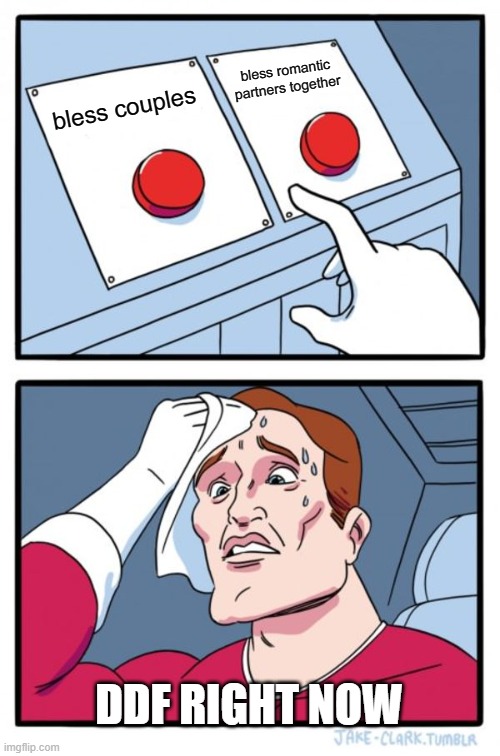
Catholic Meme Friday – DDF shenanigans

We should make fun of what is ridiculous, with due respect for people and their office.

The DDF is an absolute clown car right now, putting out seriously harmful nonsense.

I remind you the WORST thing, which went relatively unnoticed, was the Prefect strongly implying a few weeks ago in that document on cremation that Catholics can believe in reincarnation…

I’ll release my own thoughts on “Fiducia Supplicans” in a few more days. It’s good to take time to think before reacting.

Towards Constantinople…

…then to Rome.

In honor all that is good in the legacy of Constantinople (now Istanbul), read Universalis’s description of the saint who penned today’s second reading from the Office of Readings, St. Maximus the Confessor. (Then maybe give the reading itself a shot.)

And, since I am still in America, it is most appropriate to celebrate the first American saint, Elizabeth Ann Seton, so close to my own heart because of her foundation in Emmitsburg, where my alma mater Mount St. Mary’s University is, the legacy of which is intertwined with her own. It is her feast today. Check out her story!

A domani…
-Eamonn

The relevance of Africa

Most of my readership is American, and a small chunk is from Europe. A smattering of readers in Asia from time to time.

So let me tell you that what matters right now in the Church is Africa.

Everyone is seeing the African response to a certain DDF text. Okay. The energy and orthodoxy, by and large, is south of the Sahara these days.

There are certainly problems with some of the way things are done “down there.” Many men enter seminary for the wrong reasons. There are some odd ideas about chastity. There is a certain kind of chaos.

But that is where the Finger of God has come down in this age. Recall that the center of Christendom used to be in what is now Algeria, Tunisia, and Egypt… It has taken some 1600 years for that energy to move across the desert, after a European vacation.

I joke with my many African priest friends sometimes – “Africa is a big country.” They know I am joking but rush to correct me… “AFRICA IS A CONTINENT!” How many times they’ve heard an American or other Westerner something like, “Oh, you’re from Africa? Do you know Fr. XYZ? He’s from Africa too!”

In some places, a diocese will have several hundred seminarians. The bishops have so many men they hardly know what to do with them. And so plenty find their way to a parish near you. And you get their preaching, teaching, confessing, management, leadership. And that will be more and more frequently the case. So why are you not more interested in African Catholicism?

There ARE ways to find out about Catholic Africa without actually going there. But they are either very “formal,” like CNA Africa, or they are so local as to be totally uninteresting to a wide audience unless there is some particular crisis or major event – like the sudden rush of interest in certain bishops and dioceses after Fiducia Supplicans, for example.

There needs to be a news service that is both local and detailed enough to be interesting and informed while still being broad enough to be of interest to all of Africa and beyond. It needs to be run differently than the traditional cable-style news channels, with their bulky and slow-moving systems. We need something more agile and in-depth, something more creative… Something which informs on current events but also goes deeper, something which will give non-Africans a perspective on what exactly is going on in that “big country” so that we are all a little less ignorant.

So that’s another project for 2024.

If investing in or otherwise working on an African Catholic news service interests you, get in touch with me. I have already begun the initial conversation, and I hope things will move forward significantly in the summer or fall. More details to follow.

Pius XI and his chasuble

Today is the Feast of Ss. Basil the Great and Gregory Nazianzen. I posted once a great speech of Gregory – his farewell address at First Constantinople, after he abdicated from the patriarchal throne after a few weeks’ time… First Constantinople was one of the craziest ecumenical councils we’ve ever had (while Chalcedon is probably the craziest, the most dramatic, and even the most important). You can also read some of Gregory’s letters to Basil here

Today, a different act of filial piety – I found some footage of Pius XI which I had never seen before. That’s unusual. I recently held some photographs in my hands that have not been published, and I am also now in possession of a copy of his handwritten notes on the (in)famous paragraphs in Quadragesimo Anno which almost provoked a civil war. I also discovered his seemingly unpublished diaries about his time as nuncio in Poland.

Speaking of Poland…

I return to Rome in a few days. Next week I begin work in the Jesuit archives, looking at things going on there during Pius XI’s papacy… He was very close to the Superior General (Polish!), whose family was enormously impressive – more on that later.

Saints Basil and Gregory, pray for us!

The Cave of Revelation

On the little island of Patmos in Greece, where it is said that the apostle St. John lived out his last days (dying around the year 100), there is a revered cave where it is believed he lived and wrote the Book of Revelation (and presumably his 3 other letters as well – but perhaps not the Gospel bearing his name). The part that is fenced off is where John rested his head to sleep at night.

It is always helpful to remember the flesh and blood history of our Faith. Sites like this are so important to know about and to see – even if only on a screen.

Happy Feast of St. John!

Herod the Great – Even less great than you thought

Pharaoh is the archetypal bad guy. All the other bad guys in Scripture are to be measured against him. (Even poor King Solomon becomes like Pharaoh… A post for another time.)

Herod the Great is very much like Pharaoh… A great builder of monuments, a paranoid egomaniac desperate to cling to power, and a panick-stricken child-killer. He exceeds Pharaoh in that he doesn’t even have scruples about destroying his own bloodline, and deliberately so… Oddly, given his tribal background, in a twisted desire to prove just how much of a real Jew he is. It’s some kind of neurosis that is driving him…

It is important to be aware that the situation of things in ancient Israel was alive and real. The way we talk about current political, theological, and social controversies is not so different from the way people spoke in Jerusalem and its environs. Cartoonish ideas about a bunch of illiterate goat-herders with a few kings in castles need to be left behind… This was a complex world full of clever and tough people.

Here’s an excellent breakdown of what we know about the Herodian dynasty. It turns out we know quite a bit. Happy reading.

Wisdom from Lateran IV

I am doing an on-and-off study of the Ecumenical Councils. We ARE the Councils. We are MORE than the Councils, but they are somewhat of the backbone for our history as a Church.

I just thought I would share the following paragraphs, without commentary. Lateran IV is probably one of the most important Councils we have ever had. Notably, St. Dominic was there.

23. Churches are to be without a prelate for no more than 3 months

Lest a rapacious wolf attack the Lord’s flock for want of a shepherd, or lest a widowed church suffer grave injury to its good, we decree, desiring to counteract the danger to souls in this matter and to provide protection for the churches, that a cathedral church or a church of the regular clergy is not to remain without a prelate for more than three months. If the election has not been held within this time, provided there is no just impediment, then those who ought to have made the election are to lose the power to elect for that time and it is to devolve upon the person who is recognized as the immediate superior. The person upon whom the power has devolved, mindful of the Lord, shall not delay beyond three months in canonically providing the widowed church, with the advice of his chapter and of other prudent men, with a suitable person from the same church, or from another if a worthy candidate cannot be found in the former, if he wishes to avoid canonical penalty.

24. Democratic election of pastors

On account of the various forms of elections which some try to invent, there arise many difficulties and great dangers for the bereaved churches. We therefore decree that at the holding of an election, when all are present who ought to, want to and conveniently can take part, three trustworthy persons shall be chosen from the college who will diligently find out, in confidence and individually, the opinions of everybody. After they have committed the result to writing, they shall together quickly announce it. There shall be no further appeal, so that after a scrutiny that person shall be elected upon whom all or the greater or sounder part of the chapter agree. Or else the power of electing shall be committed to some suitable persons who, acting on behalf of everybody, shall provide the bereaved church with a pastor. Otherwise the election made shall not be valid, unless perchance it was made by all together as if by divine inspiration and without flaw. Those who attempt to make an election contrary to the aforesaid forms shall be deprived of the power of electing on that occasion. We absolutely forbid anyone to appoint a proxy in the matter of an election, unless he is absent from the place where he ought to receive the summons and is detained from coming by a lawful impediment. He shall take an oath about this, if necessary, and then he may commit his representation to one of the college, if he so wishes. We also condemn clandestine elections and order that as soon as an election has taken place it should be solemnly published.

25. Invalid elections

Whoever presumes to consent to his being elected through abuse of the secular power, against canonical freedom, both forfeits the benefit of being elected and becomes ineligible, and he cannot be elected to any dignity without a dispensation. Those who venture to take part in elections of this kind, which we declare to be invalid by the law itself, shall be suspended from their offices and benefices for three years and during that time shall be deprived of the power to elect.

26. Nominees for prelatures to be carefully screened

There is nothing more harmful to God’s church than for unworthy prelates to be entrusted with the government of souls. Wishing therefore to provide the necessary remedy for this disease, we decree by this irrevocable constitution that when anyone has been entrusted with the government of souls, then he who holds the right to confirm him should diligently examine both the process of the election and the character of the person elected, so that when everything is in order he may confirm him. For, if confirmation was granted in advance when everything was not in order, then not only would the person improperly promoted have to be rejected but also the author of the improper promotion would have to be punished. We decree that the latter shall be punished in the following way: if his negligence has been proved, especially if he has approved a man of insufficient learning or dishonest life or unlawful age, he shall not only lose the power of confirming the person’s first successor but shall also, lest by any chance he escapes punishment, be suspended from receiving the fruits of his own benefice until it is right for him to be granted a pardon. If he is convicted of having erred intentionally in the matter, then he is to be subject to graver punishment. Bishops too, if they wish to avoid canonical punishment, should take care to promote to holy orders and to ecclesiastical dignities men who will be able to discharge worthily the office entrusted to them. Those who are immediately subject to the Roman pontiff shall, to obtain confirmation of their office, present themselves personally to him, if this can conveniently be done, or send suitable persons through whom a careful inquiry can be made about the process of the election and the persons elected. In this way, on the strength of the pontiff’s informed judgment, they may finally enter into the fullness of their office, when there is no impediment in canon law. For a time, however, those who are in very distant parts, namely outside Italy, if they were elected peaceably, may by dispensation, on account of the needs and benefit of the churches, administer in things spiritual and temporal, but in such a way that they alienate nothing whatever of the church’s goods. They may receive the customary consecration or blessing.

27. Candidates for the priesthood to be carefully trained and scrutinized

To guide souls is a supreme art. We therefore strictly order bishops carefully to prepare those who are to be promoted to the priesthood and to instruct them, either by themselves or through other suitable persons, in the divine services and the sacraments of the church, so that they may be able to celebrate them correctly. But if they presume henceforth to ordain the ignorant and unformed, which can indeed easily be detected, we decree that both the ordainers and those ordained are to be subject to severe punishment. For it is preferable, especially in the ordination of priests, to have a few good ministers than many bad ones, for if a blind man leads another blind man, both will fall into the pit.

28. Who asks to resign must resign

Certain persons insistently ask for permission to resign and obtain it, but then do not resign. Since in such a request to resign they would seem to have in mind either the good of the churches over which they preside or their own well-being, neither of which do we wish to be impeded either by the arguments of any people seeking their own interests or even by a certain fickleness, we therefore decree that such persons are to be compelled to resign.

The Scylla and Charybdis of Priestly Vocations

When one reads St. Thomas Aquinas on entrance into the religious life, one realizes the immensity of the gap between the 13th century and our own time. Thomas has a Nike solution to the question… “Just do it.” He basically rejects the opinion that one needs to consider the matter very carefully… It is not so important. And you do not need to be particularly virtuous, either. Religious life is a ministry TO the religious. It contains the healing salve for the three sources of sin (the world, the flesh, and the Devil), and the three movements which come from them (concupiscence of the eyes, concupiscence of the flesh, and the pride of life). Our Lord faced these three temptations in the desert. And His advice to overcome these temptations is poverty, chastity, and obedience. The mortification of the roots of sin will move a soul closer to Him more quickly – one will become more perfect in a safer way. At least this is the general rule, the general arc, the general invitation.

As for the ranks of the clergy, Thomas thinks this requires more consideration, but it chiefly comes down to a question of virtue. “Is this man able to give a credible and inspiring witness to the Gospel by his way of life, and is he competent to rule over the spiritual affairs which are to be entrusted to him prudently?” If the answer is “yes,” then if he possesses a sufficiently good name among men, and he can study sufficiently to acquire what he needs to know to do what will be put in his charge, then why should he be turned away?

Vermeersch (one of the major moral theologians at the turn of the last century) adds a few conditions, in his explanation of ecclesiastical (“priestly”) vocation in the Catholic Encyclopedia. First, that there be no evident problem which the candidate has in relation to the diocese or province – i.e., that his race will cause the people to distrust him, or that his personality, opinions, and background will cause great distress to the local clergy, or some such thing. Second, that the candidate is honestly presenting himself from a firm resolve to serve the Church as an ecclesiastic for the good of souls, rather than for some worldly or selfish motive. It seems Thomas takes this for granted, as it is somehow contained in the quality of “virtue” or “goodness” which he insists upon. Yet Thomas is minimally descriptive – he quotes a lofty description of the character requisite given by Jerome and also Dionysius, and he then explains that this is why it is a mortal sin to be ordained when conscious of mortal sin, which means that one must therefore be holy to be rightly ordained – free of the shackles of any vice. Presumably, he thinks that a good deal of virtue is nonetheless needed for a viable candidate, but he does not explain exactly what that is except in somewhat negative terms.

For them, that’s it. That’s all that is required, other than the actual fact of such a vocation being confirmed in reality by ordination. Obviously, if one is never able to achieve ordination in a moral way, God did not actually want it.

You will notice that neither Thomas, nor Vermeersch (just read the article!), are particularly interested in “having certain feelings about being called,” either on the part of the candidate or the superior/evaluator. They do not really seem to believe in that, or even really in such a thing as “discernment” in the way we now speak of it and hear of it – endlessly hear of it, in every vocations film, book, talk, retreat, and program, and in every seminary in the modern West. It is used so much that it means everything and nothing. The word “discernment” does not appear at all in the Catholic Encyclopedia article. A greater study is necessary to reveal just how the idea of “discernment” entered into such popular usage in the Church – it is a recent phenomenon, with distant roots in the writings of St. Ignatius of Loyola, but it is perhaps far from his own understanding.

Vermeersch pulls no punches. He writes, “A reaction set in against this abuse, and young men were expected, instead of following the choice of their parents, a choice often dictated by purely human considerations, to wait for a special call from God before entering the seminary or the cloister. At the same time, a semi-Quietism in France led people to believe that a man ought to defer his action until he was conscious of a special Divine impulse, a sort of Divine message revealing to him what he ought to do. If a person, in order to practice virtue, was bound to make an inward examination of himself at every moment, how much more necessary to listen for the voice of God before entering upon the sublime path of the priesthood or monastic life? God was supposed to speak by an attraction, which it was dangerous to anticipate: and thus arose the famous theory which identified vocation with Divine attraction; without attraction there was no vocation; with attraction, there was a vocation which was, so to speak, obligatory, as there was so much danger in disobedience. Though theoretically free, the choice of a state was practically necessary: “Those who are not called”, says Scavini (Theol. moral., 14th ed., I, i, n. 473), “cannot enter the religious state: those who are called must enter it; or what would be the use of the call?” Other writers, such as Gury (II, n. 148-50), after having stated that it is a grave fault to enter the religious state when conscious of not having been called, correct themselves in a remarkable manner by adding, “unless they have a firm resolution to fulfill the duties of their state”.”

Gury’s treatment is bizarre… He also introduced, in the same book, the modern and almost completely dominant resolution (and a false resolution, in my opinion) of the “solam voluptatam” debate about marriage which emanated from Innocent XI’s condemnations… It is a kind of weird overextension of the power of the human will to make things good and right, in both cases. Anyway, I digress; I hope to treat the latter point in an upcoming book on marriage.

The fact is that we have strayed quite far from the robust discussion and objectively grounded understanding of priestly vocations from 100 or so years ago. Men today are left with little to go on other than a vague instruction to “figure it out” – some combination of prayer and experience and emotions… And loads of interviews, psychological evaluations, and so on. “Come and see,” “try it out,” and so on. Certainly, many such men who come and see, and try it out, really feel very strongly called to the priesthood, they enter seminary, all is well, and then one day their emotions change because it is a cold and dreary February, they are stressed from schoolwork, there is some trouble in their family, and that pretty girl from the parish back home wrote them a nice text with a heart emoji about how wonderfully spiritual their example is and that they can’t wait to talk to them this summer over coffee. If they’ve not been given an objective and emotionally minimalist framework for understanding what vocation is, and what it is not, how will such men endure? They will likely not. They will “discern out,” as we hear it said. Nonsense. They either never should have been there in the first place, or they should have persevered, despite their feelings, all else being equal.

Maybe it is time we move away from the Scylla of pickiness and human emotion, and yet without going over to the Charybdis of “warm-body syndrome,” where everyone who shows up and perseveres gets ordained – an even worse ill, where the Devil swallows up whole swaths of men, but which is not really a wide-spread problem in the West, thank God. (It is in other places.)

The Devil will get fewer men through pickiness and emotional trustfulness, through an arbitrary and even capricious process of self-evaluation and exterior evaluation wherein a bishop or superior does, in fact, infallibly determine that they do not have a call to enter their diocese or community; even despite a poor process of evaluation, God does not want what is impossible. And yet processes of this kind can leave men seriously jaded, sometimes (even frequently) pushing them into a downward spiral of depression and anger, sometimes even to heresy, apostasy, and atheism. One can say, “See? I told you so. They were bad.” And sometimes that is true. St. Ambrose was able to turn away two men from Holy Orders prudently, just based on how they walked – and they each went off to various kinds of perversity which he had foreseen, the proud, slow walker to heresy and schism, and the quick, feminine walker to all kinds of odd sexual vice, or something similar, if my memory serves. (I will need to find the text of this account later.)

But sometimes a bad experience of the Church makes a good man into a bad one. It’s not clear to me that this is appreciated so well by those with the charge to intake men for formation. Bad evaluations, bad formation, bad dismissals… all in the face of someone’s generosity and vulnerability. It takes real spiritual grit to keep on moving.

But keep on moving such men must.

In the end, perhaps too many bishops and superiors don’t really appreciate that the fact of a man knocking on their door is itself a very good sign already that he has a vocation. So what if he wasn’t what you expected, or doesn’t fit into your idea of what sacerdotal ministry is? Does he meet the objective criteria, or not? Is he going to be a walking scandal in the diocese or province, or not? There is always the risk of a bad outcome – but bishops and superiors are not held to an impossible standard. All that is required is some decent prudence, in addition to trusting that the same God Who presumably moved such a man to present himself has some sensible plan to make good come out of it, even if it isn’t the good the bishop or superior had been expecting or seeking.

Surely, we cannot go back to the days where a man could knock on the door of Santa Sabina and be clothed in the habit of St. Dominic a few hours later. Much less should one rashly administer Holy Orders to anyone who petitions. But it is time that we pick up this discussion again seriously, in the midst of such immense bewailing of a supposed “lack of priestly vocations.” Is that really what is happening, or is it a lack of sound evaluative processes, possibly undergirded by a lack of sound theology about entrance into different states of life?

To my readers thinking about possible dissertation topics -see above. This is a good one. Go check out the “sources” section of the Catholic Encyclopedia article. It is really interesting in its own right.

St. John Vianney, pray for us. St. Ignatius of Loyola, pray for us.