
Not sure if I’ll comment further.
Happy weekend.
-Eamonn
Not sure if I’ll comment further.
Happy weekend.
-Eamonn
I am doing an on-and-off study of the Ecumenical Councils. We ARE the Councils. We are MORE than the Councils, but they are somewhat of the backbone for our history as a Church.
I just thought I would share the following paragraphs, without commentary. Lateran IV is probably one of the most important Councils we have ever had. Notably, St. Dominic was there.
23. Churches are to be without a prelate for no more than 3 months
Lest a rapacious wolf attack the Lord’s flock for want of a shepherd, or lest a widowed church suffer grave injury to its good, we decree, desiring to counteract the danger to souls in this matter and to provide protection for the churches, that a cathedral church or a church of the regular clergy is not to remain without a prelate for more than three months. If the election has not been held within this time, provided there is no just impediment, then those who ought to have made the election are to lose the power to elect for that time and it is to devolve upon the person who is recognized as the immediate superior. The person upon whom the power has devolved, mindful of the Lord, shall not delay beyond three months in canonically providing the widowed church, with the advice of his chapter and of other prudent men, with a suitable person from the same church, or from another if a worthy candidate cannot be found in the former, if he wishes to avoid canonical penalty.
24. Democratic election of pastors
On account of the various forms of elections which some try to invent, there arise many difficulties and great dangers for the bereaved churches. We therefore decree that at the holding of an election, when all are present who ought to, want to and conveniently can take part, three trustworthy persons shall be chosen from the college who will diligently find out, in confidence and individually, the opinions of everybody. After they have committed the result to writing, they shall together quickly announce it. There shall be no further appeal, so that after a scrutiny that person shall be elected upon whom all or the greater or sounder part of the chapter agree. Or else the power of electing shall be committed to some suitable persons who, acting on behalf of everybody, shall provide the bereaved church with a pastor. Otherwise the election made shall not be valid, unless perchance it was made by all together as if by divine inspiration and without flaw. Those who attempt to make an election contrary to the aforesaid forms shall be deprived of the power of electing on that occasion. We absolutely forbid anyone to appoint a proxy in the matter of an election, unless he is absent from the place where he ought to receive the summons and is detained from coming by a lawful impediment. He shall take an oath about this, if necessary, and then he may commit his representation to one of the college, if he so wishes. We also condemn clandestine elections and order that as soon as an election has taken place it should be solemnly published.
25. Invalid elections
Whoever presumes to consent to his being elected through abuse of the secular power, against canonical freedom, both forfeits the benefit of being elected and becomes ineligible, and he cannot be elected to any dignity without a dispensation. Those who venture to take part in elections of this kind, which we declare to be invalid by the law itself, shall be suspended from their offices and benefices for three years and during that time shall be deprived of the power to elect.
26. Nominees for prelatures to be carefully screened
There is nothing more harmful to God’s church than for unworthy prelates to be entrusted with the government of souls. Wishing therefore to provide the necessary remedy for this disease, we decree by this irrevocable constitution that when anyone has been entrusted with the government of souls, then he who holds the right to confirm him should diligently examine both the process of the election and the character of the person elected, so that when everything is in order he may confirm him. For, if confirmation was granted in advance when everything was not in order, then not only would the person improperly promoted have to be rejected but also the author of the improper promotion would have to be punished. We decree that the latter shall be punished in the following way: if his negligence has been proved, especially if he has approved a man of insufficient learning or dishonest life or unlawful age, he shall not only lose the power of confirming the person’s first successor but shall also, lest by any chance he escapes punishment, be suspended from receiving the fruits of his own benefice until it is right for him to be granted a pardon. If he is convicted of having erred intentionally in the matter, then he is to be subject to graver punishment. Bishops too, if they wish to avoid canonical punishment, should take care to promote to holy orders and to ecclesiastical dignities men who will be able to discharge worthily the office entrusted to them. Those who are immediately subject to the Roman pontiff shall, to obtain confirmation of their office, present themselves personally to him, if this can conveniently be done, or send suitable persons through whom a careful inquiry can be made about the process of the election and the persons elected. In this way, on the strength of the pontiff’s informed judgment, they may finally enter into the fullness of their office, when there is no impediment in canon law. For a time, however, those who are in very distant parts, namely outside Italy, if they were elected peaceably, may by dispensation, on account of the needs and benefit of the churches, administer in things spiritual and temporal, but in such a way that they alienate nothing whatever of the church’s goods. They may receive the customary consecration or blessing.
27. Candidates for the priesthood to be carefully trained and scrutinized
To guide souls is a supreme art. We therefore strictly order bishops carefully to prepare those who are to be promoted to the priesthood and to instruct them, either by themselves or through other suitable persons, in the divine services and the sacraments of the church, so that they may be able to celebrate them correctly. But if they presume henceforth to ordain the ignorant and unformed, which can indeed easily be detected, we decree that both the ordainers and those ordained are to be subject to severe punishment. For it is preferable, especially in the ordination of priests, to have a few good ministers than many bad ones, for if a blind man leads another blind man, both will fall into the pit.
28. Who asks to resign must resign
Certain persons insistently ask for permission to resign and obtain it, but then do not resign. Since in such a request to resign they would seem to have in mind either the good of the churches over which they preside or their own well-being, neither of which do we wish to be impeded either by the arguments of any people seeking their own interests or even by a certain fickleness, we therefore decree that such persons are to be compelled to resign.
When one reads St. Thomas Aquinas on entrance into the religious life, one realizes the immensity of the gap between the 13th century and our own time. Thomas has a Nike solution to the question… “Just do it.” He basically rejects the opinion that one needs to consider the matter very carefully… It is not so important. And you do not need to be particularly virtuous, either. Religious life is a ministry TO the religious. It contains the healing salve for the three sources of sin (the world, the flesh, and the Devil), and the three movements which come from them (concupiscence of the eyes, concupiscence of the flesh, and the pride of life). Our Lord faced these three temptations in the desert. And His advice to overcome these temptations is poverty, chastity, and obedience. The mortification of the roots of sin will move a soul closer to Him more quickly – one will become more perfect in a safer way. At least this is the general rule, the general arc, the general invitation.
As for the ranks of the clergy, Thomas thinks this requires more consideration, but it chiefly comes down to a question of virtue. “Is this man able to give a credible and inspiring witness to the Gospel by his way of life, and is he competent to rule over the spiritual affairs which are to be entrusted to him prudently?” If the answer is “yes,” then if he possesses a sufficiently good name among men, and he can study sufficiently to acquire what he needs to know to do what will be put in his charge, then why should he be turned away?
Vermeersch (one of the major moral theologians at the turn of the last century) adds a few conditions, in his explanation of ecclesiastical (“priestly”) vocation in the Catholic Encyclopedia. First, that there be no evident problem which the candidate has in relation to the diocese or province – i.e., that his race will cause the people to distrust him, or that his personality, opinions, and background will cause great distress to the local clergy, or some such thing. Second, that the candidate is honestly presenting himself from a firm resolve to serve the Church as an ecclesiastic for the good of souls, rather than for some worldly or selfish motive. It seems Thomas takes this for granted, as it is somehow contained in the quality of “virtue” or “goodness” which he insists upon. Yet Thomas is minimally descriptive – he quotes a lofty description of the character requisite given by Jerome and also Dionysius, and he then explains that this is why it is a mortal sin to be ordained when conscious of mortal sin, which means that one must therefore be holy to be rightly ordained – free of the shackles of any vice. Presumably, he thinks that a good deal of virtue is nonetheless needed for a viable candidate, but he does not explain exactly what that is except in somewhat negative terms.
For them, that’s it. That’s all that is required, other than the actual fact of such a vocation being confirmed in reality by ordination. Obviously, if one is never able to achieve ordination in a moral way, God did not actually want it.
You will notice that neither Thomas, nor Vermeersch (just read the article!), are particularly interested in “having certain feelings about being called,” either on the part of the candidate or the superior/evaluator. They do not really seem to believe in that, or even really in such a thing as “discernment” in the way we now speak of it and hear of it – endlessly hear of it, in every vocations film, book, talk, retreat, and program, and in every seminary in the modern West. It is used so much that it means everything and nothing. The word “discernment” does not appear at all in the Catholic Encyclopedia article. A greater study is necessary to reveal just how the idea of “discernment” entered into such popular usage in the Church – it is a recent phenomenon, with distant roots in the writings of St. Ignatius of Loyola, but it is perhaps far from his own understanding.
Vermeersch pulls no punches. He writes, “A reaction set in against this abuse, and young men were expected, instead of following the choice of their parents, a choice often dictated by purely human considerations, to wait for a special call from God before entering the seminary or the cloister. At the same time, a semi-Quietism in France led people to believe that a man ought to defer his action until he was conscious of a special Divine impulse, a sort of Divine message revealing to him what he ought to do. If a person, in order to practice virtue, was bound to make an inward examination of himself at every moment, how much more necessary to listen for the voice of God before entering upon the sublime path of the priesthood or monastic life? God was supposed to speak by an attraction, which it was dangerous to anticipate: and thus arose the famous theory which identified vocation with Divine attraction; without attraction there was no vocation; with attraction, there was a vocation which was, so to speak, obligatory, as there was so much danger in disobedience. Though theoretically free, the choice of a state was practically necessary: “Those who are not called”, says Scavini (Theol. moral., 14th ed., I, i, n. 473), “cannot enter the religious state: those who are called must enter it; or what would be the use of the call?” Other writers, such as Gury (II, n. 148-50), after having stated that it is a grave fault to enter the religious state when conscious of not having been called, correct themselves in a remarkable manner by adding, “unless they have a firm resolution to fulfill the duties of their state”.”
Gury’s treatment is bizarre… He also introduced, in the same book, the modern and almost completely dominant resolution (and a false resolution, in my opinion) of the “solam voluptatam” debate about marriage which emanated from Innocent XI’s condemnations… It is a kind of weird overextension of the power of the human will to make things good and right, in both cases. Anyway, I digress; I hope to treat the latter point in an upcoming book on marriage.
The fact is that we have strayed quite far from the robust discussion and objectively grounded understanding of priestly vocations from 100 or so years ago. Men today are left with little to go on other than a vague instruction to “figure it out” – some combination of prayer and experience and emotions… And loads of interviews, psychological evaluations, and so on. “Come and see,” “try it out,” and so on. Certainly, many such men who come and see, and try it out, really feel very strongly called to the priesthood, they enter seminary, all is well, and then one day their emotions change because it is a cold and dreary February, they are stressed from schoolwork, there is some trouble in their family, and that pretty girl from the parish back home wrote them a nice text with a heart emoji about how wonderfully spiritual their example is and that they can’t wait to talk to them this summer over coffee. If they’ve not been given an objective and emotionally minimalist framework for understanding what vocation is, and what it is not, how will such men endure? They will likely not. They will “discern out,” as we hear it said. Nonsense. They either never should have been there in the first place, or they should have persevered, despite their feelings, all else being equal.
Maybe it is time we move away from the Scylla of pickiness and human emotion, and yet without going over to the Charybdis of “warm-body syndrome,” where everyone who shows up and perseveres gets ordained – an even worse ill, where the Devil swallows up whole swaths of men, but which is not really a wide-spread problem in the West, thank God. (It is in other places.)
The Devil will get fewer men through pickiness and emotional trustfulness, through an arbitrary and even capricious process of self-evaluation and exterior evaluation wherein a bishop or superior does, in fact, infallibly determine that they do not have a call to enter their diocese or community; even despite a poor process of evaluation, God does not want what is impossible. And yet processes of this kind can leave men seriously jaded, sometimes (even frequently) pushing them into a downward spiral of depression and anger, sometimes even to heresy, apostasy, and atheism. One can say, “See? I told you so. They were bad.” And sometimes that is true. St. Ambrose was able to turn away two men from Holy Orders prudently, just based on how they walked – and they each went off to various kinds of perversity which he had foreseen, the proud, slow walker to heresy and schism, and the quick, feminine walker to all kinds of odd sexual vice, or something similar, if my memory serves. (I will need to find the text of this account later.)
But sometimes a bad experience of the Church makes a good man into a bad one. It’s not clear to me that this is appreciated so well by those with the charge to intake men for formation. Bad evaluations, bad formation, bad dismissals… all in the face of someone’s generosity and vulnerability. It takes real spiritual grit to keep on moving.
But keep on moving such men must.
In the end, perhaps too many bishops and superiors don’t really appreciate that the fact of a man knocking on their door is itself a very good sign already that he has a vocation. So what if he wasn’t what you expected, or doesn’t fit into your idea of what sacerdotal ministry is? Does he meet the objective criteria, or not? Is he going to be a walking scandal in the diocese or province, or not? There is always the risk of a bad outcome – but bishops and superiors are not held to an impossible standard. All that is required is some decent prudence, in addition to trusting that the same God Who presumably moved such a man to present himself has some sensible plan to make good come out of it, even if it isn’t the good the bishop or superior had been expecting or seeking.
Surely, we cannot go back to the days where a man could knock on the door of Santa Sabina and be clothed in the habit of St. Dominic a few hours later. Much less should one rashly administer Holy Orders to anyone who petitions. But it is time that we pick up this discussion again seriously, in the midst of such immense bewailing of a supposed “lack of priestly vocations.” Is that really what is happening, or is it a lack of sound evaluative processes, possibly undergirded by a lack of sound theology about entrance into different states of life?
To my readers thinking about possible dissertation topics -see above. This is a good one. Go check out the “sources” section of the Catholic Encyclopedia article. It is really interesting in its own right.
St. John Vianney, pray for us. St. Ignatius of Loyola, pray for us.
Eamonn Clark, STL
What’s hot with the young kids right now is learning Irish.
Maybe it’s part of the search for some kind of identity “qua” Irish. Now that the English aren’t oppressors, and the Church isn’t “status quo” as a point of reference for Irish culture, it is a bit difficult to nail down precisely what it is to be Irish, other than simply being born here, of a certain stock, etc. The language is one of the only major things mooring the country to itself.
Most Irish don’t speak the language. Sometimes (and somewhat incorrectly) called “Gaelic,” Irish is a very hard thing to master, or even get a grip on.
It’s a challenge, and a unifying cultural symbol which connects people to the past, in view of the future.
I think this is also why young people in general are drawn to the older forms of the liturgy. It’s a challenge, and a root which ties one to something whence one comes. There is interest in this in Ireland, albeit in a different form from the major hot-spots of motion on the old mass, namely, the USA and France. I am still getting familiarized with that situation, so I will just point out that the note is there in the song, not quite as a refrain but more as something of a leitmotif. It’s in the background, but it’s noticeable, and it means something.
I’ve been getting around to different events and places these past two weeks. The time flies – like a carpet being pulled out from my feet. A wedding, a wake, a monastery… All things that Irish do typically rather well historically.
Irish also do hospitality very well. I’ve been made quite welcome during my stay. My picture’s even been featured in a national newspaper. A story for another day…
A story I must tell is of Declan’s Rock – or, more specifically, the time a bishop tried to destroy it back in the 1800’s. St. Declan, whose feast day was two days ago, was mentioned in an earlier post. There is a whole charming narrative about this particular rock floating ashore, a connection to a bell, and the prophetic claim that connected the rock to where Declan would rise to meet Christ on the last day. Well, the local bishop some centuries ago thought all this was a load of crap. “The people with their superstitions. They need to wake up. It’s clearly from an ancient glacier, the science is obvious.” This was the attitude.

But in a country of fairy forts and Mass paths (a topic for another post), the bishop should have known better. Having found two adolescent boys to help him crush the rock down, the Bishop arrived in Ardmore to find the whole town standing up on the hill overlooking the beach where the rock sits. Staring the three of them down, silently. The kids turned to His Lordship the Bishop, and handed him the hammers, saying, “You first.” A strange reversal of the incident of the Woman Caught in Adultery! It was, in fact, the Bishop who needed to wake up. He walked away.
The people kept their rock. The initiation ritual into “Irish Catholicism” as such, which I will perhaps do myself one day, and which the Bishop was likely especially annoyed by, involves walking out to the rock, getting down on one’s stomach, and shimmying through the hole underneath to emerge from the other side. Just be sure the tide is right – or you’ll drown, as I’ve recently been informed.
Weddings, wakes, and the cloister. All kinds of death to self to be reborn in a greater way, and, thus, all kinds of initiation. All traditions which connect us to our past, despite the struggle, pain, and change involved. And all involve – hopefully – the right kind of hospitality.
Ireland does it particularly well.
Naomh Declan, guigh orainn!
(St. Declan, pray for us!)
Eamonn Clark, STL
Dublin is a city of contradictions.

It’s a place where there are churches and bars on every street. You can see a pious old woman on her way back from mass and a gaggle of girls with the most vulgar tastes in dress standing on the same corner waiting for a bus. You can find rabble-rousers and men of the most refined manners in the same shop. There goes a priest, there goes a trans-rights activist.
It’s a city at war with itself.
In truth, Ireland is a complex country. It’s not complex like America – America (and Americans) are complex because of parts… lots of “things to do.” Ireland (and Irish) are complex because of layers… lots of “things going on in there.” (Yes, yes, it’s an oversimplification. Got it.) The subtle and amiable wit of your average Irish gentleman is counterbalanced by a charming habit of self-deprecation or at least humility. (Irish tend not to brag.)
Even the Irish flag symbolizes a conflict, represented by the layers of the tricolor – the Orange and the Green… Protestants and Catholics. White in the middle as an aspiration of peace.
Ireland is just barely big enough to be really anonymous if you want to be and small enough to be a well-known figure without being some kind of phenom. Though it’s not quite like the Middle East or Iceland, where everyone knows exactly how they are related to everyone else, there’s nevertheless only ever a few degrees of separation between any two people. Major public figures – musicians, politicians, athletes, prelates – they are just kind of part of the family, and part of the story.
Everyone is sort of in it together, in a tangible way. That means all the tensions and wounds of poor old Ireland are shared collectively somehow, too. So is a lot of the unwillingness to talk about it all. This extends from the relatively recent violence (late 1960’s-1998) between North and South during the Troubles, to the ecclesiastical abuse crises (plural) that unfolded on everyone’s watch – and in which therefore basically the whole of Irish society was complicit, in one way or another, to some degree. It’s not polite table conversation. Or polite conversation anywhere else, even on a blog. But the prolonged failure to wrestle with these important collective memories only serves to bury them deeper. What does that do to a soul, of an individual and of a country? Perhaps forms some kind of neurosis?
This theme of repressed pain over the abuse crises in particular was explored and driven home very well by Derek Scally in his recent book “The Best Catholics in the World,” a must-read for anyone interested in the Irish situation. It’s not an entirely balanced take, but it’s an important one.
Dublin, the cultural and political capital of the Republic of Ireland, is something of a symbol of the Irish psyche. There’s some kind of neurosis that is manifesting itself there. No doubt, most Irish would resent that. And that’s kind of the point. In Dublin there are plenty of “normal people,” but there is also a very vocal minority of well-funded and coddled extreme leftists, a large number of ruffians and other kinds of low-culture individuals, and now a significant influx of immigrants (many of them seemingly economic opportunists rather than refugees). Then there is also the undercurrent of the echoes of the strong piety that once animated the city, just barely hanging on, with approximately 1% mass attendance any given Sunday. Now, all that does not represent Ireland. And yet it does, because that’s a major part of what Dublin is, and Dublin is, well, Dublin. So there’s tension between what is most culturally and internationally identifiable about Ireland, and the greater part of the country, or “real Ireland.” All this gives Dublin a uniquely charged energy which is rather hard to describe. And that energy sits on top of the rest of the country, at odds with it.
Layers and contradictions.
These thoughts came to me (in a less-developed form) at the Dublin Rally for Life the other day. It was a good crowd, maybe 8,000-10,000 or so, from all over the country. I already found myself running into people I’ve met during my stay, and that without trying to meet up. It’s not the same as D.C. – smaller, yes, and also lacking the “organizational splendor” that comes with the sort of funding and personnel involved in the March for Life. It’s a much quainter operation. But it has heart.

The constitutional referendum on abortion in Ireland passed by a very slim margin a few years ago (2018). Dubliners would have been the outsized supporters of this. So there were some unfriendly onlookers as we went down one of the main thoroughfares of the city, ending up next to the River Liffey. But there were also people walking by who were openly supportive. A mix. More layers and contradictions to explore.
Like the Troubles or the abuse crises, abortion by this point has touched just about everyone in Ireland somehow. Will the awful reality of 31,000 unborn being killed be yet another deep wound to leave alone for now and later psychologically bury? Or will this tragedy be too much to ignore and suppress, something that runs up too hard against the deeper cultural values which “real Ireland” still possesses deep down? Only time will tell. In the meantime, the Liffey keeps on flowing, and Dublin keeps on changing.

Eamonn Clark, STL
Nobody knows what the round towers were for.
Were they defense towers, or some kind of refuge for monks hiding from Viking raiders? Unlikely, but possible. Were they watchtowers? Belltowers? Astronomy towers? Communication towers? Maybe some of all of this? Who knows. These towers, so distinctive to Ireland, are a mystery.
On my last visit to this island, I had an extended visit to Ardmore, which boasts one of the most well-preserved round towers in the country.

Ardmore is where organized Christianity really began in Ireland. There had already been a small smattering of Christian presence on the island when St. Declan was born, as he was baptized by a priest. But there was no real structure yet, just individual Christians here and there. The bishop Palladius had been sent on a mission by the pope in 431, but no real apostolic efforts seem to have meaningfully penetrated what was then a thick forest covering essentially the entire land.
Declan was educated in Rome and ordained a bishop by the pope, and he returned to Ireland as perhaps its first proper missionary, after meeting with and agreeing to a strategy with none other than St. Patrick, who would follow behind him in some time. (There are four pre-Patrician saints of Munster, each a bishop.) The legend of the return of Declan is its own fascinating tale, nestled in the murky gap between fact and fiction. I’ll save the story for another time, as well as the anecdote about the local bishop in the 1800’s who had a different take on the popular piety associated with “Declan’s Rock” and his comical endeavor to destroy it.

The site of Ardmore became homebase for Declan, where a monastery was built according to Patrick’s instructions. Eventually he retreated into the wilderness nearby, where he lived in a small house as a hermit. Ardmore overlooks the sea, where Declan made his famous landing.

The “pattern” at Ardmore involves walking around some of these locations while reciting certain prayers, and, most distinctively, marking the wall near “Declan’s Well” (very likely the same spring he used, next to his house) with crosses by using a small stone. This has been going on for hundreds and hundreds of years.
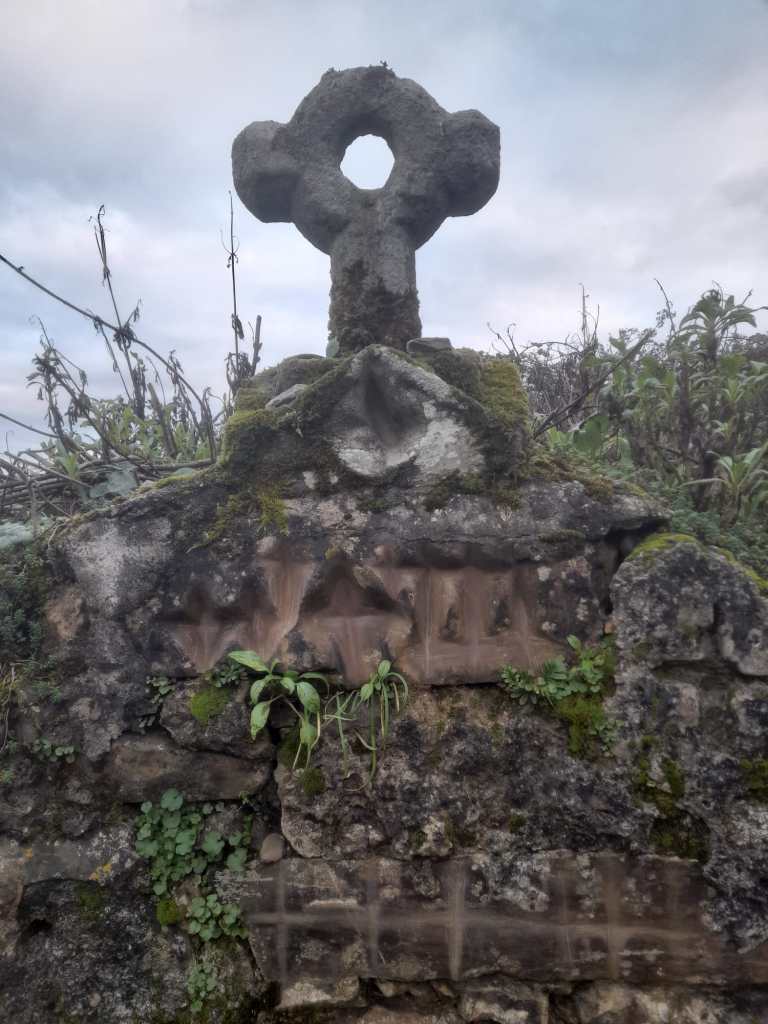
Soon after Declan came Patrick, whose missionary endeavors were more successful and thus more famous. You’ll notice, however, that Patrick concentrated his efforts in the northern part of the island – that’s because Declan had already been quite successful in the south.
St. Declan is now buried in a small tomb adjacent to the monastery which was for centuries the center of perhaps the most powerful ecclesiastical territory in Ireland. Now the monastery is in ruins, and the Diocese of Ardmore has long been swallowed, not even memorialized by a hyphenated name, as so many such dioceses are… it’s just gone.


The ground around it is host, most likely, to approximately 10,000 graves, almost all of them unmarked, and many of them likely quite ancient.

It’s a mesmerizing place. Haunting, almost.
I find myself increasingly fascinated both with graveyards and with archaeology. There is something so existentially alarming about old things and people, and the markers that indicate them. We stand on top of an entire world that has come and gone, and one day others will stand on top of ours. No doubt, there will be “digital archaeology” in a thousand years… But there will still be a need to dig stuff up and touch it. I’ve been privileged this past year to get my hands on some very interesting texts in various archives around Rome… the thrill of holding a manuscript or book that you know you are the first to handle in 50, 100, 200 or more years, is just really special. And I have a tactile mindset about even my own past – I want to be in this place and that, just to feel connected with my own life, to help make sense of it, and somehow thereby to see what it means. I’ve noticed that not everybody cares about that the way I do. I guess this same sort of impulse is at least part of what attracts me to the older liturgy… It connects me to those who’ve gone before, makes them alive again in some way, helps me to understand where I am from – and where I am to go.
I was at a gathering of priests a few days ago; the men were celebrating various major ordination anniversaries. I sat in on the mass. It was pointed out that there were a few hundred years of priesthood between them all. While contemporaneous, the cumulative experience of priests is nevertheless a bit like Ardmore. How many secrets held under the Seal… dead things, which are hidden underground now – finished, out of sight, out of mind. How many words or encounters which for them were not significant enough to remember, but were so powerful for others that they changed someone’s whole life and even saved their soul. How many repetitive but intentional rituals done, over and over, prayers and signs repeated on and on, to the edification of the faithful who devoutly attend to them. How many unique and always somewhat mysterious ministries – whatever they are, always reaching up towards God in service of His people… like a round tower.
And a saint lies buried within each one.
St. Declan of Ardmore, pray for us.

Eamonn Clark, STL
So, for reasons I’m not quite yet ready to share on these pages, (though maybe my more perceptive readers can piece things together,) I’ve moved to Ireland for the summer. I’m staying down in the southern countryside for about 3 months. I arrived a week ago.
In this series, I’ll be breaking down my understanding of the situation of the Church in Ireland on these pages every Monday. This week I’ve just been settling in, so I’m passing the first serious post to next week. I’ll share details about events I attend, people I meet, and places I go, all with due discretion. I will not reveal where I am staying until after I’ve left.
Yes, there will be loads of pictures. And cool stories.
Ireland’s situation is very, very unique in the global Church. The overall thesis that I would offer is one I’ve been giving to people already – Ireland is doing better than it sounds, but it is doing worse than it looks. I look forward to unpacking that in the weeks and months to come.
St. Patrick, pray for us.
Image: Alberto Loyo/Getty Images
Eamonn Clark, STL
It is in the news that Pope Francis is enrolling 21 men who were killed by ISIS some years ago into the Roman Martyrology.
Here are some questions and my own (quick but hopefully not sloppy) answers, and there are also some “arrows” for more reading.
What happened?
The basic story is that 21 Christian men were executed by ISIS on a beach in Libya in February of 2015. Some of them were calling on Christ as they were put to death. 20 of them were known to be Coptic Orthodox, one man, from Ghana, is less clearly identifiable as Coptic. It is not actually totally clear that the executions were strictly motivated by the religion of the men, nor is it so clear that each of the men went to their deaths voluntarily – these are two of the normal requirements for being recognized as a martyr. If anyone can help me with more details on this, I would be thankful.
Who are the Coptic Orthodox?
The story is very long. In short, the Coptic Orthodox Church is a schismatic group that split from Rome in the wake of the Ecumenical Council of Chalcedon (451) over the doctrine of Dyophysitism, which is the teaching that Christ is “in” or “has” two natures, a human nature and a Divine Nature, rather than being “of” these same two natures. This may seem unimportant, until you realize that we are talking about the fundamental character of Who and what exactly it is that we are worshipping – which is automatically a big deal. There were 13 Egyptian bishops who refused to accept the Chalcedonian formulation, protesting that the recently deceased bishop St. Cyril of Alexandria (Egyptian), had condemned those who held to this position in his 3rd anathema. (The issue here comes down to the precise meaning of the word “physis.”) In the end, the Egyptians were not persuaded by the other Fathers of the Council that Cyril was not a “Miaphysite” but was actually a Dyophysite using vague language. You will have to do the hard work of reading the history in detail to get more of the story, sorry.
Have there been attempts to reconcile with the Copts?
Yes, many. The issue of the Coptic schism was an agenda item of the Ecumenical Council of Florence (1431-1449). The Copts ultimately did not want to come back on board, despite their representatives at the Council wanting to do so. Pope Eugene IV wrote a “Bull of Union with the Copts” called “Cantate Domino,” which it turns out is very relevant for our consideration and which we will look at later. There is also a group of Coptic Catholics, who have reunited with Rome, and there were several joint declarations between the Holy See and the Coptic Orthodox some decades ago on Christology – and though they are significant steps toward unity, they did not use the magic words, “in two natures.”
What is the Roman Martyrology?
This is the Catholic Church’s official list of martyrs. It is not a list of all Catholic saints. However, one who is in the Martyrology is usually also revered liturgically as a Blessed or a Saint.
Have there been non-Catholics treated as saints before?
Yes. I know of a few, thanks to this article by Fr. Ed McNamara: St. Stephen of Perm (1340-1396), St. Anthony of Kiev (983-1073), St. Theodosius of Kiev (1029-1074), St. Sergius of Radonezh (1314-1392), and St. Gregory of Narek (950-1003). The latter has also been named as a Doctor of the Church. In these cases, as Fr. McNamara explains, given the complex historical circumstances and the time in which these men lived, union with Rome was not necessarily as clear-cut an issue as it is today. So maybe the better answer is, “No, but sort of.”
Are canonizations infallible?
This is a deeply disputed question. There is a whole book of essays recently published on this matter, which I have not read myself but can nevertheless recommend based on what I have read about it, here. The opinion which I take myself is, “No.” However, nobody will sin by venerating someone held up by Rome as a saint, including in the liturgy.
What about Eugene IV?
The Bull “Cantate Domino” does not mince words on the issue of non-Catholic martyrs. It says they don’t exist. Again, without getting into the settled debate over Feeneyism (yes, it is possible to be “in the Catholic Church” without necessarily manifesting this explicitly by outward signs), here is the relevant part of the text: “The most Holy Roman Church firmly believes, professes and preaches that none of those existing outside the Catholic Church, not only pagans, but also Jews and heretics and schismatics, can have a share in life eternal; but that they will go into the eternal fire which was prepared for the devil and his angels, unless before death they are joined with Her; and that so important is the unity of this ecclesiastical body that only those remaining within this unity can profit by the sacraments of the Church unto salvation, and they alone can receive an eternal recompense for their fasts, their almsgivings, their other works of Christian piety and the duties of a Christian soldier. No one, let his almsgiving be as great as it may, no one, even if he pour out his blood for the Name of Christ, can be saved, unless he remain within the bosom and the unity of the Catholic Church.” This echoes St. Augustine’s teaching on the same question, along with a host of other Fathers.
What about Feeneyism?
Feeneyism is indeed wrong, that’s settled. But the entire point of canonizations is to hold up individuals as extraordinary examples of heroic Christian virtue. It strains credulity to think that this would be appropriate of anyone who has at least dubious Christology, and openly rejects the primacy of the See of Peter (the Pope of Rome).
Is this the only strange thing going on at the moment relating to canonizations in Rome?
No. But we will cross that bridge if and when we get there.
Aren’t you just being mean and nasty?
Maybe, but I am concerned with the integrity and meaning of canonizations and ultimately of their purpose, which is the proposal for the imitation of the lives of those who are canonized. To drive the point home: nobody should be Coptic Orthodox. And sure, it is possible that God could have worked an extraordinary grace in the souls of these individuals and brought them to Himself with a high amount of merit (awesome!), but that does not mean that they are fit for public veneration as saints in the Catholic Church. If you think I’m being mean and nasty, go read the link above on the Fathers and this question. I’ll stick with those guys.
End of Q and A.
There’s more to the story, and I hope the readership will point out if I am getting any details wrong. But this at least gets the discussion moving in the right way. There is plenty of good ecumenism going on, but I fear that this is not an example of it. The lines need to be very clear. This will mostly just confuse people in the long-term, it seems.
My own question is rhetorical, and I hope it’s not too biting… How is it that people who like the 1962 Roman Missal are “too divisive,” but people who openly reject the entire idea of Petrine primacy can be put into the Roman Martyrology?
St. Josaphat, Thief of Souls, pray for us! St. Mark the Evangelist, pray for us!
Below is a talk I gave at the Angelicum’s annual student theology conference last week. Enjoy!
Eamonn Clark, STL
A fallen away Lutheran’s Kantian appropriation of Platonic forms hardly seems like the place to look for shocking insight into Christology, but today I will make the case that it is.
In this paper I will argue that psychologist Carl Jung’s theory of archetypes gives us tools for deepening our understanding of Christ as a Person within the narrative given to us in Sacred Scripture, in particular by examining two archetypes which have been well-treated in mythological and psychological literature: the hero and the trickster. I take all of the classical definitions of the Councils for granted – Jesus Christ is truly God the Son, and fully a man born in Bethlehem. There is much to talk about within the paradigm of Chalcedon and the Alexandrian-Antiochene controversies which occasioned the advent of our cherished credal formulas – but since we do indeed possess revealed data, we have solid ground from which to jump into areas yet unexplored. We can be like Theseus – not running into the labyrinth and becoming lost, food for the minotaur, but not simply staying safe and sound outside either. We can take hold of the cord of tradition and bring it with us to keep ourselves oriented – we can slay the minotaur.
An archetype for Jung is a kind of impression of deeply meaningful symbols upon the collective unconscious – a sort of echo of Averroist anthropology that has somehow taken in data and leaves its mark within us. Jung rejects entirely the “tabula rasa” of St. Thomas and Aristotle. We are born with these ideas already deep within our psyche, and their use in stories or encountering them in our life moves us in particular ways. We expect certain things from certain kinds of characters – a witch-queen is altogether different from a wizard-king, whether they are good or evil. Most people automatically perceive this, even if they can’t articulate it, which is normally the case.
While I am not an Averroist, there is something to be said for the observation that so many peoples across time and space seem to use extremely similar kinds of characters and tropes in their great myths – everything from wise old men to floods to heroes who go on quests.
One might be inclined to dismiss the Jungian thesis outright by saying, “It’s just the way that stories work.” But why is it that we want these kinds of characters and these kinds of stories? We can’t say it’s coincidence. We could try to chalk it up to cultural conditioning, but again, this elides Jung’s main premise: we see these patterns in practically every story-telling culture across time and space, and it is unlikely that all of our common ancestors were telling stories which were sufficiently advanced and powerful to populate our minds with this amount of similar ideas so profoundly. One might also posit that we experience life, and life has its rhythms and structures which our emotions and imagination correspond to in such a way that we are attracted to particular sorts of narratives. This is not wrong, but it still doesn’t get to the heart of the problem, as our emotions and imagination receive the world and process it in a particular way with identifiable patterns which do not explain themselves. We simply return to the same question with different terms: why these kinds of emotional responses, and these imaginative structures? There must be something deeper.
I would suggest the following limited analogy: Christ is to our perception of Him as mathematics is to music. Music has certain rules, which, if violated, create a kind of dissonance which we find jarring; these rules can be laid out in mathematical formulas. The classical liberal arts proceeded from mathematics to music, just as it proceeded from geometry to astronomy and from grammar to rhetoric: the latter studies are of the object of the former studies put into motion, that is, music is mathematics in motion, astronomy is geometry in motion. Christ is the Word, the eternal Logos, the Wisdom of God, through Whom all things are made. Our encounter with Him flows from the “rules” found within Him, the natural law and law of grace finding their origin in Him, the Eternal Law, and thus our encounter with Him is the Logos “in motion,” just like music. However, musical taste is much more deeply informed by culture than is our relationship with Christ – this is where the analogy begins to break down. For example, Westerners intuitively find minor chords “dark,” but this is not the case for others. The rules for our encounter with Christ, where not totally individual, are totally universal, that is to say, a culture does not get to tell us Who Christ is or what He wants, despite shaping the style and circumstances in which we approach Him to some degree; and yet, of course, because charity is a personal friendship with God, its pursuit and activity will also have a dynamic unique to each person.
Because our journey with the Lord is the Word “set in motion,” we can easily see how this puts us into a narrative, a story, which is more literally “words in motion,” so to speak – as from grammar to rhetoric. The fact is that the sacred story of which we are a part has rules. This means that good attempts to reach out to the sacred narrative which imbues the world with its ultimate meaning will track these rules, using particular symbols in the form of characters, tropes, and events. And indeed, we see in the narrative of Sacred Scripture the same threefold operation upon profane myth which grace has on nature: healing, elevating, and perfecting. As a result, it should not be surprising that we are somehow ourselves marked with an intuitive sense of the symbols which fill the great myths, and which even fill normal kinds of good literature. We want to tell certain kinds of stories because we are part of a story whose Divine Author is telling us to do so, whether in our nature somehow, or through the promptings of universal sufficient grace, or some combination of both. Here is not the place to explore how such a theory might respond to the theses of someone like Dupuis, but I simply note that this is a possible way to understand the “logos spermatikos,” the seeds of the Word, among the nations. The conclusion is that our mind is shaped in such a way as to recognize the hints of Christ’s truth, beauty, and goodness as hints – a point I am taking and appropriating from Fr. Pierre Rousselot.
I am concerned here with Christology – the entrance of the Author of the story into the story itself. I will focus exclusively on two great archetypes, which I think give us the beginnings of a psychological Christology: the hero and the trickster. I propose that we can understand Christ as a hylomorphic unity of these two opposing archetypes, with the hero as form and the trickster as matter. I will begin with the trickster archetype.
Claude Levy-Strauss posits that tricksters in mythology are frequently animals which eat carrion, that is, meat which is already dead. They are therefore not hunters, but they are not herbivores – they are something in-between, neither this nor that. We are inclined to be uncomfortable with figures like ravens or coyotes or vultures or snakes (and many snakes do in fact eat carrion) – we’d prefer things that we know do this or that, peaceful plant eaters or vicious hunter-killers. In fact, it is the object which they approach that unsettles us first: the corpse, the dead thing which was living. The trickster is one who cannot be trusted: he is the one who lies, who has petty motives, who will harm others for his own selfish gain, who wants to attain power over us, often by leading us into taking his own unfortunate place, such as by trapping us in a hole while climbing out of it himself. Certainly, this is not how Christ is, but we will return to this description momentarily.
Non-dietary ritual purity laws in Israel related to the state between life and non-life, or death. Thus anytime something seems to be related to crossing the divide between the two “worlds,” it is considered impure – neither this, nor that, something in between, something different. Things which cannot be categorized easily into the world of the living or the world of the “non-living” are to be rendered clearly one thing or the other. If a person becomes impure, such as through contact with a corpse, he or she must go through the symbolic stages of re-entering the world of the living. There is more to be said, but this will have to suffice – I simply point one to the thought that such a lens for studying the Passion and Resurrection could be quite illuminating.
Here are some actions of Christ which correspond to the trickster type: Shapeshifting (the Incarnation as the invisible taking a shape, the Eucharist as the visible becoming hidden in a new shape, the Resurrected Christ’s body changing into a glorified shape); Riddle-telling (parables, rhetorical responses); Gatekeeping (“I am the narrow gate,” etc.); Dwelling on the outskirts and going to the “in-between places,” which Levy-Strauss points out of coyotes, ravens, etc. (Christ does this during much of the public ministry, and especially in Bethany, just before and during Holy Week, the Garden of Gethsemane and the Mount of Olives, Golgotha, all just outside of Jerusalem; in-betweenness is found especially in the Baptismal site, which is in between “life and death”: Israel and the nations, the Sea of Galilee and the Dead Sea, in the jungle surrounded by desert, and then going down into water which gives and takes life, in the place which is in fact the lowest point on the planet by several hundred meters); Physical evasiveness (“He passed through the crowds,” etc.; tricksters are slippery and quick, like serpents); Touching impure things (i.e. the lepers, the woman with the hemorrhage, the dead girl – “Talitha koum” – just like eating carrion, but it is a spiritual eating); Working through chaos and shadow (in particular the miracles, which are always somehow hidden, whether by the confusion of a crowd as in the multiplications of loaves, or by the weather, as in the walking on the water, or by a wall, such as in the raising of Lazarus, and so on – it is not like jumping off the parapet of the Temple and being protected by the angels, there is room left for both doubt and for a deeper encounter with the mystery being revealed on account of the need for faith to understand its proper meaning).
All of this symbolizes Christ’s space in our psychological weak spot – the uncanny valley, which is of course maxed out in the Resurrection, as exemplified by the fear which the Apostles experienced when they first saw Him in the Upper Room, thinking they were seeing a ghost. (Luke 24:37) He is the apex, the climax of the story, the way to the happy ending through an unsettling doorway called death. We are unsettled because we do not know what is there – we must ask, “What is it?” “Manna?” We learn in John 6 that Christ is in fact the true Manna, the true “what-is-it,” the real Mystery which provides the bridge between our deathward bios and the zoe of Heaven which shocks our psychology on account of the space whence He comes to us – but this fear is replaced by Paschal joy, when we see that He is not a ghost, or some kind of zombie, but Life itself come to us as a Friend Who will carry us safely across the divide, as our Viaticum.
But Christ is not a trickster, except in a material sense. By this I mean that it is how He works out His program among us, in particular among His contemporaries – our experience is quite different in that we have nice Chalcedonian definitions by which to understand Him. Not so for the Eleven gathered in the Upper Room, and yet in some way they understood Him much more. Christ uses these uncomfortable techniques to shake us out of the comfort of our present modus vivendi and drag us across the divide between bios and zoe – life here, and life in Heaven. He is the way there, and He is the life, zoe. But He is also the Truth, so that leaves us wondering about the significance of Him qua trickster. In fact, the hero archetype, the formal part, gives us an entirely different lens by which to understand His trickster part. The heroic element inverts the entirety of the meaning of the trickster in Christ: instead of lying to gain power over us out of petty and selfish motives at our expense, He makes Himself weak, giving us power over Him, even to harm Him unto death, and His motive is grave, namely, to help us, especially freeing us by taking on our sorry lot Himself and revealing to us the truth. That’s a complete inversion.
Yet Christ still has and always had power over us. This is because He is God, but, in the narrative sense, He is first and foremost a hero. Heroes are powerful. This is his formal part. Christ qua hero is a theme much more explored than the trickster element, so I will only briefly examine it before returning to a consideration of the question of power.
I pass over Raglan’s 22 points of the heroic “mythotype,” though this is worth its own investigation, and I go instead directly to the “hero’s journey.” This “monomythic” narrative structure has been described by several authors, including most famously Joseph Campbell in The Hero With a Thousand Faces, where it was pioneered, but also by other more recent authors. The hero’s journey essentially consists in a departure from the home, where one is born and raised, to go on a quest of some sort; next, there is some kind of initiation or trial; finally, there is a return home. The quest is always successful – the enemies are thwarted, the magic sword or golden fleece is obtained, or some object which is too powerful is destroyed, like a ring or a sorcerer’s stone. Then the hero returns home triumphant. The parallels with Christ are almost too obvious to point out: it is the entire story of the Incarnation, the Public Ministry, the Cross, the Resurrection, and the Ascension.
It is important for Campbell, at least, that the hero begins in the ordinary world, and is then called to adventure, in a world of mysterious forces and challenges, only to return home to normalcy. Odysseus is a great example. But Christ is very unlike Odysseus – and I speak here just of the “call to adventure” which the Lord receives. His real call to adventure is summed up by St. Paul: “Not deeming equality with God something to be grasped at, He emptied Himself, taking on the form of a slave.” The visible mission of the Son in the Incarnation is the call to adventure. The world of men, unlike the normal hero stories, is not full of mysterious forces, it is full of mundane forces which are perfectly comprehended by the hero and are completely under His control. Then the Lord ascends into Heaven – Nazareth is not really His home.
The journey continues after the call to adventure, with its various stages, which Christ fulfills par excellence, and which for the sake of time I will pass over. The point is that the “hero” is His formal part – He is the one who can rescue us and bring us home with Him safely.
I wish to return to a consideration of power, specifically the power of Christ over our minds as a narrative figure. I note that Christ as a narrative figure has three modes – a mode which is inaccessible to us, another which is partially accessible to us, and another which is totally accessible to us. The first mode is as a flesh-and-blood historical figure during His earthly life and ministry. The second is as a figure who is spoken of by those who had encounters in the first mode, and of course for us this comes especially in the form of the Gospels and Acts. The third is as one with whom we live out our own lives now, and to whom we pray and make sacrifice. In each of these three modes, Christ exercises a unique kind of psychological power.
The first kind of power over humanity is as an uncategorizable figure. In the Public Ministry He was somehow “not this and not that” – again, “manna,” “What is it?” This ambiguity gave Him a power over His interlocutors, both the friendly ones and the unfriendly ones. We are threatened by what is ambiguous, what is “impure,” because we do not know how to treat it… We don’t know what to expect; everything is surprising. This is the trickster element coming to the fore.
The second kind of power is as the Hero which emerges as intellectual and spiritual keystone of human history. The story itself of the Gospels is compelling because it is the story our minds were built to receive and recognize as the “right narrative.” Here we see the hero most on display.
The third kind of power is as the Lord, our God, Who has ascended into Heaven, body and soul, and Who wants now to save us if we let Him. By encountering through prayer and the sacraments the One described in our creeds and in our liturgy, prescinding from the reading of the Scriptures, we get the doctrine of His salvific power. We are utterly helpless before the gaping maw of the abyss which stands beyond death. Only He can help us. To do this, those who are capable of human acts must in fact make the choice to invite Him into their lives. They must walk with Him, in a strange and sometimes very confusing way. He is here, there, everywhere, hiding… He plays a kind of game with us, a game which is ultimately ordered to our salvation if we “play along” and follow the rules. The hero and the trickster reveal themselves here together as a unity most forcefully. He is in hiding, changing shape, touching the impurities of our souls – but he is mighty to save, using that very hiddenness and ambiguity to our advantage and the ultimate advantage of all Creation and God’s own glory.
More research is called for into the Jungian psychological paradigm as a tool to sift through the Scriptures, taking the revealed data as “the story which God wants told,” the narrative which heals, elevates, and perfects pagan narratives – including, of course, the actual historical fulfillment of those stories and their figures. This kind of approach to Scripture is becoming more popular, but this seems to be primarily the case among non-Catholics, and non-theologians; we ought to take our cue from the popularity and power of these kinds of analyses as an opportunity for evangelization, in addition to an opportunity for deepening our own speculative understanding of Christ and our relationship with Him.
Below is a talk I gave at the recent conference on “ius” in St. Thomas at the Angelicum’s Thomistic Institute. It is a synthesized “slice” of my doctorate that I am working on. Enjoy!
-Eamonn Clark, STL
April 22, 2023
The year is 1824. Two young brothers, Giuseppe and Giacchino, had come to Rome to be present to their dying mother. The two boys, only adolescents, have been enrolled in the Collegio Romano, which had been reopened the autumn of that same year shortly after the re-establishment of the Jesuit order. The new rector is a Jesuit himself, Fr. Luigi Taparelli d’Azeglio – an eclectic thinker with deep roots in the highly charged political scene of the Italian peninsula. Dissatisfied with the deeply “modern” curriculum at the seminary, the rector was scheming. In the evenings, outside of the normal curriculum and schedule, Taparelli would take Giuseppe and Giacchino – the Pecci brothers, Giacchino later becoming Leo XIII – into a small and semi-clandestine circle of likeminded students to read an all-but-forgotten author: St. Thomas Aquinas. The Neothomistic revolution was underway.
Taparelli’s career proceeded with various obstacles – first, he was sent out of Rome to Naples, then from Naples all the way to Palermo; he was not much of an administrator, and his decreasingly hidden affinity for St. Thomas, when combined with his controversial political thought and political significance due to family ties in Piedmont, left him vulnerable to being sidelined. In his “exile” in Sicily, he developed a course in something like moral and political philosophy for the novices there entrusted to him. Out of these lectures came a text – the “Saggio teoretico del dritto naturale appoggiato sul fatto” (“Theoretical wisdom of natural law resting on reality”). This was finished in 1843.
The “Saggio,” a somewhat frustratingly rhetorical text, presents a vision of society where realities matter, so to speak; that is to say, contracts do not make societies, people do, with all of the circumstances which make those people to have the powers which they actually possess regardless of any contract which they might enter into. For Taparelli, there is hierarchy written into the very DNA of human civilization – in fact, there is practically no equality among us at all, after basic human nature and sacramental dignity are accounted for. Wealth, strength, skill, virtue, family ties, health, human favor, intelligence – all of these are different in each one of us, and this matters for how our society will flourish. Classes form, and this is not something to work against but rather to embrace, as it is inevitable; furthermore, associations of those in various industries or with common social interests ought to be allowed to form under the higher associations of city, state, and nation. Not only should they be allowed to form, but their protection and empowerment is the very purpose for which the higher strata of social organization exists in the first place, and so on down the ladder to the family unit and finally the individual. To violate the legitimate autonomy of a lower stratum of society, for example, a town mayor who busies himself writing laws to rearranging people’s furniture in their homes, destroys what Taparelli called “subsidiarity.” Even if the mayor has a much better idea of where to place a table in a family’s home, it is not his prerogative to do so, unless it is somehow violating civic or moral order in some extraordinary way, for instance, it’s on the edge of the roof and is liable to fall onto the public street below where there might be pedestrians.
Rather than meddling in the affairs of the family home, or of the neighborhood council, or the various workers’ unions or other clubs and societies which exist in the town, the mayor and his administration have the task to equip those groups to fulfill their legitimate purpose. This empowerment of the lower strata by the higher strata by the normative legal order and even perhaps to some extent the act which flows from it is what Taparelli calls “social justice.” Taparelli went on to develop his economic and political thought in countless articles as a co-founding editor of La Civilta Cattolica, a project personally supported by Pius IX – it became the Pontiff’s unofficial means of publishing his ideas.
Some scholars say that this text is the earliest use of the phrase “social justice.” It is not. The first known significant academic usage of the term was by a different priest in the Italian peninsula, a contemporary of Taparelli – Blessed Antonio Rosmini-Serbati.
Alessandro Manzoni, the acclaimed author of the Italian novel, I promessi sposi, said that his friend Rosmini was the only contemporary author on the peninsula worth reading. Manzoni and Rosmini shared a dream, or a hope, for a united Italy under a liberal regime that yet preserved the flavor of the older ways. They were close collaborators and friends.
From what we can tell, it seems that Rosmini had actually inspired Taparelli to take an interest in St. Thomas, and for a while they shared some correspondence. However, as Taparelli grew more and more conservative, the relationship broke down. Rosmini ended up being the target of plenty of articles in the early editions of CC. Liberatore was his fiercest philosophical opponent, Rosmini’s metaphysics and epistemology being considered too much based on illumination, even though not as far “out there” as Fr. Vincenzo Gioberti, another friend of Manzoni, who was the head of the ontologist school and eventually became Prime Minister of Sardinia, during the uproars of the revolutions of 1848.
It is important not to underestimate the significance of politics for understanding developments in theology and philosophy – the most cursory glance at the situation of Catholic thought in the 19th century will convince one of this. Rosmini’s greatest contribution to political philosophy actually comes to us in the form of a proposed constitution for the emerging Italian nation, “The Constitution Under Social Justice,” written in 1848 – the year of years, the year of revolution – a year so bad that the Italians call a large mess “un quarantotto,” a 48. While it was just a little too late to get to the hands of the Pope to be made use of, it marked Rosmini in the eyes of Pius IX as someone worth having close to him. He was offered the position of Prime Minister of the Papal States, which he declined. Nevertheless, the Pope took Rosmini with him in his flight to Gaeta just before the establishment of the short-lived Roman Republic. However, the papal court proved too unfriendly to Rosmini’s liberalism, causing him to retreat for some time to Naples. Upon his return, he found several of his works on the Index of Prohibited Books, including the “Constitution.” He was shattered, and went to Stresa. He was slightly rehabilitated during his life, but only in recent years have we seen a real vindication of Rosmini’s thought – in “Fides et Ratio,” and in a memorandum from Cardinal Ratzinger which defended his work. Taparelli, and his main protégé, Matteo Liberatore, had been attacking him as well, Taparelli on political economy and Liberatore on metaphysics and epistemology.
The doctrine of “The Constitution Under Social Justice” is, as all of Rosmini’s work, brilliant and engaging, even if one ultimately disagrees with it. For our purposes, I limit myself to the main topic, the role of “social justice,” which at this point in Rosmini’s mind has clearly changed to a definite formulaic principle which is easy to summarize: legislative representation proportionate to taxation on income from landed property. To Rosmini, it makes no sense to give the same control over the use of the public treasury to a man who pays little or nothing into it as to a man who pours enormous sums into it every year. This taxation is a flat tax – nothing else would be fair – and it is only drawn on property, not on mere wages; in Rosmini’s era, one who merely takes a wage would have normally been the sort of person who depends on his wage for his daily sustenance, hand-to-mouth. He would undoubtedly adjust this principle today, but I digress. This means that the poor and certainly the destitute do not get to vote on representatives in the legislature, as it would be unfair, seeing as they pay nothing into the treasury which the legislature makes use of. They do, however, get to vote on the representatives in the “political tribunal,” the organ which judges about fundamental rights, where all are equal before the law.
Don Bosco said he had never seen anyone celebrate Mass as reverently or devoutly as Blessed Antonio Rosmini. Quite an endorsement. Rosmini likewise founded a religious order, the Institute for Charity (better known as the “Rosminians”) dedicated to the service of the poor. It cannot be said that Rosmini lacked empathy or was unmerciful – he was simply a shrewd political thinker. He gives many reasons for why his system, resting on the principle of “social justice,” makes sense, putting it in special contrast with the universal and indiscriminate suffrage system of the hyper-liberal French regimes, of which there had already been over a dozen by Rosmini’s time of writing, a point he notes with searing derision. Unlike St. Jerome, when Rosmini makes fun of you, same as St. Thomas, you are certainly doing something wrong.
The birth of the Italian nation was finally complete with the capture of Rome on September 20, 1870, and the annexation of Rome and Latium into the Kingdom of Italy on October 2.
At this stage, we turn our attention to a then-13-year-old seminarian in Milan, who had grown up in the aftermath of the complex revolutionary tensions of that city and its surrounding area. His childhood had been rather peaceful, growing up early on in the small town of Desio, with his father running several silk factories and for a time a small hotel. The young seminarian was no doubt already developing his lifelong affection for the poetry and prose of Manzoni, whose work featured the area around the Brianza quite prominently, and soon he would be one of the major admirers of Rosmini’s person and thought as well. In his clerical formation, he ultimately came to favor two theologians above all others – St. Thomas, and Taparelli.
The seminarian is Achille Ratti, the future Pius XI.
In the years around Leo XIII’s attempt to implement the Taparellian program, both in terms of social doctrine principally through his 1891 encyclical Rerum Novarum (which Liberatore drafted), and the study of St. Thomas through Aeterni Patris, Ratti came up in Rome, arriving the same year as the latter text was published (1879). He studied here under Liberatore at the newly created Pontifical Academy of St. Thomas Aquinas which was then granting degrees – it was coincidentally inaugurated on the day Ratti arrived in Rome for studies. He was, together with one other student, its first graduate, and he scored perfect marks and was invited immediately to be a member of the Academy.
Ratti’s careers as a librarian and diplomat – and much less as a prolific alpinist – are not so relevant for us. What is relevant is his major social encyclical, Quadragesimo Anno, published in 1931. This was not the first time a pope used the phrase “social justice” – there had been a one-off usage by Pius X in his 1904 encyclical Iucunda Sane, lauding St. Gregory the Great’s virtue as a legate in Byzantium, and another usage earlier on in the acts of the Sacred Congregation of the Council, referring to the restitution of what had been stolen as an act of social justice. The real meat, however, is in Quadragesimo Anno.
In the encyclical, written by a young German Jesuit, Fr. Oswald Von Nell-Breuning, another student of Liberatore, social justice is a heavy theme. Unfortunately, while it would be satisfying to have had a nice bow to tie together Rosmini and Taparelli under the auspices of perhaps their most significant promoter, admirer, and interpreter, more questions than answers come to us out of Quadragesimo Anno. It is not so clear if social justice is a personal virtue, or a state of affairs in society. It is not clear if social justice is supposed to be part of already pre-existing Thomistic categories – which we would think that Ratti, a hardline Thomist would want – or if it is supposed to be something else entirely, something that doesn’t quite fit into either commutative, distributive, or legal justice.
There is no clear way out. Instead of trying to pick apart various lines from the encyclical, I wish to present briefly my own synthesis, which, while perhaps not providing for every usage, I think manages to gather together most threads in a sensible way, or at least serves as an axis around which most usages can turn.
I do, with most interpreters, including the great Cardinal Höffner, whose work on this topic is mandatory reading for anyone interested in the subject, take the view that social justice fits into “legal justice.” Legal justice, unlike distributive and commutative justice, is a general virtue for St. Thomas, This means that it is present in every virtue. The object of legal justice is the common good. One’s virtuous acts are acts of legal justice simply insofar as the virtuous act is done for the sake of the common good, whether explicitly willed as such or not. This is the “social ius,” one might say, not the ius proper to distribution (hierarchical acts of giving what is due to individuals as such) or to commutation (transactions merely among equals).
The common theme which cuts through the basic usages of Rosmini, Taparelli, Pius XI, and, indeed, even modern post-Rawlsian usages of the phrase “social justice” which one finds on signs at left-wing marches, is a kind of empowerment of a group by some kind of help given which that group is due somehow from society in general rather than from some particular individual. The Taparellian foil of subsidiarity all of a sudden becomes very striking – it gives us a framework for seeing how far such help should go, as seen earlier with the example of the furniture. Not every kind of group having difficulty is owed help by society simply because they are having difficulty.
However, we can already see a shift away from the idea of “legal justice” as a broad category. It seems that legal justice has several species, of which social justice is one. Social justice is the species of legal justice which proceeds from above to below. It is a general virtue, present in all virtuous acts, which has for its object the common good as liberating others beneath oneself precisely insofar as oneself owes others, not based on a commutative debt but based on the welfare of the social whole that cannot provide for its own natural flourishing to such a degree that it is not merely charity to assist, as with almsgiving, but it is actually justice. That is to say, if one is not acting generally in favor of the empowerment of those who require help “from above” to pursue their ends as individuals and especially as groups, one does something unjust. This position is strengthened by the point which Thomas makes about legal justice in the person of the ruler, who he says possesses it as a kind of “master craft.” It belongs most especially to the one with the care for the whole community. Yet those who have superior natural means, whether economic, intellectual, social, physical, and so on, are in a secondary and informal sense “rulers” over those with less of the same goods, insofar as they are higher than those with less according to the very good which is unequal, and so they are in some sense able to help those with less. God, lest we forget, made creation a hierarchy of beings, and He wants hierarchy in human civilization – it is not a product of the Fall, a fact which St. Paul’s exegesis of the creation of Eve so bluntly informs us of. Those are engaged in social justice who are engaged in any virtuous act at all, insofar as it redounds in any way towards the liberation or empowerment of others to pursue basic human ends as individuals, such as basic education, housing, food, and what are, in my opinion, unhelpfully labeled as “human rights,” or to pursue basic ends as groups, such as forming associations to begin with, or administering their own goods, or engaging in intragroup communication, or intergroup communication. Those who are more consciously and intentionally working on such things are simply acting more like the ruler acts with general legal justice – they are taking it up more as a master craft.
There is yet more to articulate, more distinctions to make, and alternative positions to consider, especially in light of the forest of ideas connected with this phrase “social justice.” Unfortunately, I must end my reflections here. But I believe that this paradigm of social justice as a personal but general virtue pointing toward the social ius, specifically being a species of legal justice which has for its special object the common good as liberative of those who are lower and in need of assistance to pursue their basic ends as individuals and as groups, both protects the strong anti-egalitarian spirit which both Rosmini and Taparelli possessed and makes sense of the more structural treatment of justice which we find in Pius XI’s use in Quadragesimo Anno and which we find in later usages, however distorted they may have become in the past 90 years. The primary question which those who wish to use the phrase “social justice” for their “cause” must then be – “How does this program correspond to the true common good as empowering and liberating for the sake of others pursuing what is truly good without replacing others’ own responsibility for themselves?”

