Covenant Communities, PART I: The Beguinage Option

Eamonn Clark

Your husband has just left with his buddies… Not for the bar, not for the bowling alley, but for the Crusade. He will probably never return – the territory is unfamiliar and the enemy fierce. The organization of the ranks is questionable, too. You are left alone in your little Belgian village. A few years pass, and some wearied soldiers come back into town after the failed campaign. The Mr. is not one of them: you are off to the local Beguinage.

There, the organization of the ranks is questionable as well – just as most of the crusaders were not professional soldiers, the superior is likely ill-equipped: she is not a professional ecclesiastic (viz. a priest) or even a proper religious. The other women are only half-invested, since they can own their own property and leave at any time to get married. The local bishop is aware of the institution, but he has other, more pressing affairs to attend to. Many of the women bring tons of money with them after the sale of their land, so the community is overflowing with wealth.

What could go wrong?

A lot, as it turns out. The Beguines (and Beghards, the male version) were suppressed by the little-known Ecumenical Council of Vienne in 1312. These semi-monastic communities, mostly centered in the Low Country, had amassed enormous wealth and slipped into very bizarre spiritual doctrines. (Basically, their errors amounted to the thought that one was able to attain, in this life, their twisted vision of spiritual perfection. For the condemned propositions, see Denzinger 471-8, older numbering.) It is also difficult to imagine there were no “power issues,” given the nature of the structure of the communities and the strange ideas that eventually pervaded them. (The “no kissing rule” was especially weird… Yes, go on click that Denzinger link. You know you want to see what infallible statement the Church has made on kissing.) If you think you are perfect, and your inferiors think you are perfect, when you are definitely not, how would that not occasion terrible abuses? Even though the Beguines did not share property (unlike the Beghards) or take vows, there was still a superior of the community, and how could a perfect superior not wield undue control? (Coincidentally – or not – Vienne also dissolved the Knights Templar, who had begun a similar downfall into wealth, power abuse, lax membership requirements, and heresy. One is reminded of the Church in present-day Germany.)

The Beguinages did attract pious women who did plenty of good work for each other and their towns, but in the end they didn’t work in many important ways, namely in cultivating a mature spirituality among the members. (There are, however, still a few active Beguinages around… The suppression on the Beguines – not the Beghards – was lifted 9 years after the Council, but eventually, the need disappeared and so membership declined.) When wealth, power, and gross spiritual imperfection are mixed in an ill-defined religious community with limited ecclesiastical oversight, one should expect mayhem to ensue. This is the lesson which Church history teaches us, and I fear it is a lesson not being well-learned today. That means the error will be repeated… Let us turn now to the so-called “Benedict Option.”

thevillage1
Some critics might have M. Night Shyamalan’s “The Village” lurking in their memory.

A million articles have now been written in response to Rod Dreher’s book on the need to duck out of postmodern society and form intentional Christian enclaves – which, he opines, is sort of the point of Christianity anyway (made obvious in part by the comical slew of “original” variations on the theme – the “Marian Option,” the “Augustine Option,” etc.). The idea is basically that Western society is so bad that it should just be left to destroy itself while we preserve our faith and morals amongst our own rather than risk more bleeding by living out “in the wild,” and we can draw people into the Church by leading attractive lives and with some occasional missionary activity overflowing from the enclave.

While most critics of this idea are concerned with the abandonment of wandering souls to the Zeitgeist, which is a legitimate (although in my opinion overblown) concern, my critique is focused on the interior life of an “intentional Christian community” rather than its exterior missionary activity. We don’t always need to preach to Gehenna (Jesus didn’t bother!), but we do always need to know who is in charge, where the money goes, how the hierarchical Church is involved, and in general how the community lives its life together.

There is a chasm between the domestic church and the hierarchical church. It is easy to fall into it.

I could not give you an ecclesiology of an “intentional Christian community,” though this is now the primary buzzword, closely followed by “covenant community,” although these are distinct (albeit not mutually exclusive) realities. An “intentional Christian community” is just that – people who intentionally associate with one another to aid their discipleship. A “covenant community” involves signing a contract that pledges certain things for the good of the group… Like “obedience to the leadership.”

Let’s ask some questions.

First, is this or that community even specifically Catholic? If not, how will the Catholic Church be presented by non-Catholic members and leaders? Will there be requirements or “suggested opportunities” for members that don’t square with Catholic doctrine and morals? Is there a non-denominational-ish church which the community is obliged or semi-obliged to support, financially or otherwise? What is being preached and taught there? What about a school? Same questions. What kind of spirituality will the community develop and encourage that is not founded in or ordered to the Mass and the confessional? How exactly does one’s local parish pastor involve himself in the lives of Catholics in such a community? How do members relate to their parish in general? Is the leadership tempted to use the group’s ecumenical nature as a means of dodging episcopal oversight? How can a Catholic member in good conscience follow a non-Catholic spiritual leader, precisely insofar as he or she is a spiritual leader? These are serious questions, some of which don’t have easy answers. It can sometimes happen that, as far as the Church is concerned, what happens in such groups is more communism than ecumenism.

There are many other questions to be answered by any community, especially the ones that require signing a contract or “covenant” to join… Will the community be at the service of the parish and hierarchical church, or vice versa? How will a poorer family support both the community and the parish? What are the details of the “covenant” (viz. what is actually required, and why)? How does one opt out of the community, if it is possible at all? If it is not possible, why? How is personal information treated within the community? How are relationships between men and women monitored? Where does the money go, and how is transparency guaranteed? Are there inordinate pressures to take or leave certain jobs? Is there any restriction of relationship with people inside or outside the community for arbitrary reasons? What is required to become a member of the community? How does the community relate with the diocese and bishop? In whose name does the community exercise its ministries and evangelization projects – their own, the diocese’s, the parish’s, the individuals’? If priests or deacons are members, how does their membership and activity relate to their official ecclesiastical role wherever their bishop or superior has actually assigned them? Exactly what role does the leadership of the community play in the life of the group? What is required to become a leader in the community? Does all of the leadership rotate periodically? If no, why not? What is the understanding of the “grace of state” among the leaders?

This last one is huge. Grace of state is a gift that comes with occupying a certain office. In some cases, it can, in a sense, involve an infallible discernment of the will of God, which would imply obedience to that person’s demand under pain of sin. A few examples will suffice… The president of a country signs legislation that people must drive on the left side of the road. The local bishop chooses not to allow a tabernacle to be put in a certain rectory. The parents of a child tell him that he will go to the parish school. Who would argue that obedience in these examples is not a matter of moral precept? However, this does not mean the decisions were necessarily made for the right reasons… Perhaps the president is hoping that his new law will cause catastrophe for tourists. Maybe the bishop is jealous of the piety of the priest who lives in that rectory. It could be that the parents would actually do better to homeschool their child, but they are just lazy. It doesn’t matter: it is still the will of God precisely because these people have the right to demand these things of those under them in virtue of their offices – offices which ultimately derive from God, either through nature (like the government or the family) or through grace (like the hierarchical church).

In covenant communities, there is often an ambiguous commitment to “obey” the leadership. One could be shamed and thought of as impious or disobedient (or even Satanic) for not falling in line with whatever the leaders require. After all, don’t they have the grace of state to determine God’s will for the community?

No. There is no office of nature or of grace which authentically interprets the will of God for such a community which comes from within the community itself. That is the job of the pastor and/or bishop, or a duly appointed delegate. Even then, the scope of obedience only goes so far – the bishop, for instance, does not have the right to tell parents they must enroll their child in the parish school. The pastor does not have the right to demand a certain amount of tithing from his parishioners. Etc. These things can frequently be items of “discernment” in covenant communities which then become “suggestions” or “opportunities.” Pity the member who does not go along with the will of their leaders! In fact, it seems that all that a duly appointed ecclesiastical representative could really authentically interpret is how to relate the community to various real authorities, such as the pastor, the bishop, the government, families, and so on, according to those authorities’ proper roles. What one finds instead is often one or several people at the top, who were self-appointed, who never rotate, and who claim to be authentic prophetic voices for the community which is centered around their wills; in other words, cult leaders.

Signing a contract is an important action, and it should not be done lightly. However, we must realize that humans are not angels – they do not perfectly understand all the implications of their actions – and therefore, vows can (and sometimes must) be broken for the good of the individual or commonwealth. Unlike marriage, association with a community is certainly something “intrinsically dissoluble” – that is, either party can choose to step away once it becomes clear that it is best for either of them, so long as any inordinate injury is avoided… It does not require an intervention of a third-party, like the Pauline or Petrine privileges in the dissolution of non-sacramental marriages. A vow to a merely human society is not a vow to God, and so it is far less serious, though it is still a matter of justice insofar as the reckless abandonment of the promise can bring damage to either party… One does owe something to the person or persons to whom a vow is made simply by the nature of the vow itself.

But let’s examine the nature of private vows made to God. (See the relevant canons here.) Vows to God are much more serious (as a matter proper to the virtue of religion), such that the complete release from them requires a dispensation or commutation from the Church (or the time elapsing). And yet even here, one who undertakes a vow to God with insufficient understanding of what he is committing himself to by that vow can’t be morally bound to it. (Think of a pious 5th grader who, in a fit of religious fervor, promises to God after Mass one day that he will never marry. He is unquestionably not bound by this vow! Of course, determining what is “sufficient” is a difficult matter.) What’s more, a vow made to God must actually be possible (obviously) and for the sake of a better state or action than what one would otherwise be in or do without the vow, or else the vow does not bind. (A person who promises to God that he will not go to Mass except on Sundays is not bound by this vow unless he would really be doing harm to himself or others by going to Mass during the week. A person who promises to God that he will tie his left shoe before his right shoe is also not bound by the vow because it is not better to do this. Vows like this are vain and sinful, in fact, and rash or hasty vows can be sinful as well.) It must also be the case that the “better state or action” must really continue to be better for the one who made the vow in order for it to remain binding. (If a husband vows to spend several hours each week in private prayer, this would cease to bind if his wife became very sick and needed his constant attention.) In general, when more fundamental obligations become more serious, the obligations based on vows begin to decrease in gravity.

Given all this, it should be easy to see that the “covenant” part of covenant communities involves a serious but not that serious kind of promise. The public vows made when entering proper religious communities, or private vows made directly to God, are much more serious – and yet there are many qualifications and ways out. I wonder how well the nature of vows is understood by leaders in various covenant communities – and how well they explain that nature to aspiring members. Once it becomes clear that a community is bad for one’s children, isn’t it incumbent upon the parents to remove themselves from that community? If it is becoming harmful to one’s psychological, emotional, spiritual – or financial – welfare, isn’t it a duty to leave? As a person slowly realizes that he got himself into something he didn’t really understand the details of, doesn’t his obligation to stay begin to diminish? Of course. And all the while, the leaders of these communities will still not be authentically interpreting the will of God, because they are only appointed or elected for the good of a merely man-made and non-fundamental collective to which people can freely come and from which people can freely go, usually without sin. This is unlike the government, this is unlike the Church, and it is unlike the family.

The “Beguinage Option” is not the right way – but clearly, the desire for intense communal discipleship is good. How can it be fulfilled in the lives of lay people who can’t enter or don’t want to enter religious life?

In the next post of this 3 part series, I will look at a few specific examples of covenant communities as case studies (including one with which I have some personal connection), and then finally I will propose a model or two of my own.

See PART II


Main image: The Beguinage in Bruges, Belgium. By Navy8300 (Own work) [CC BY-SA 3.0 (https://creativecommons.org/licenses/by-sa/3.0)%5D, via Wikimedia Commons
Apolog-etc. – Episode #1

Eamonn Clark

I often come across articles on WordPress (the platform this site uses) which don’t quite seem to get “the Catholic thing.” Usually, they fight strawmen (caricatures or weakened versions of a position), and many times the authors are former Catholics, which is very sad. Quite recently, I ran across a post, which I commented on, and which prompted a whole post of its own on the author’s part. With that, I’ve decided to start an ongoing series of posts on apologetics (etc.) – thus the strange title. I will dissect such articles (at least in part) and try shed some light on the matter.

The link to the article in question. From here on, comments in red.

[BEGIN QUOTE]

In response to one of my posts here, I received a comment which says:

I’m interested to know where exactly you think the “Bible” comes from? How do we know “these” books are in it, and others are not? Who and what is responsible for determining that? Why and how can there be disagreements about this?

The question is actually four questions, and the second and third ones can be answered together in a single response.  The question is “How do we know ‘these’ books are in [the Bible] and others are not, and who and what is responsible for determining that?

The books included or excluded from the ‘finished’ Bible as we know it were compiled, curated, or determined – generally – by a group of individuals who ‘authorized’ that particular version of the Bible.

They then go on to describe the history of several versions of Bibles – the KJV, Tyndale, Coverdale, Vulgate, etc., most of which was just ripped straight from Wikipedia… And this, of course, does not answer the question at all – who cares where this version comes from – where did the right version come from, and how, and why? Then we have this gem:

Tyndale’s Bible was an affront to the Roman Catholic Church because it challenged many of the Church’s established doctrines and – by giving access to God’s word to everyone – would have negated the Church’s position that only the Church (and its priests/bishops) could properly ‘interpret’ God’s word and act as intercessory agents between mankind and God.

Nevermind the translation issues with the Tyndale Bible – as the Italians say, “traduttore, traditore,” there is no perfect translation, though Tyndale did try to target buzzwords of Catholic doctrine – but there is a very persistent Protestant myth that the Catholic Church used to keep Bibles away from laymen for “intellectual safety” or something like that. Given the fact that trying to interpret Scripture without a good education is often extremely dangerous, this is plausible. This did happen once in southern France in the 13th century, because Albigensians were handing out Bibles with a little “extra” stuff thrown in there to make converts for their sect, but by and large it was simply too expensive to buy a Bible (which would have been handwritten), and literacy was not that widespread anyway.

Who is responsible for determining what books are chosen for each different version of the Bible?  A question I did not ask. The group, agency, organization, entity, or individual responsible for publishing the version is the ‘who’ that selected what books to include.

How do we know that these versions, book selections, and translations are official or authoritative or correct? Another question I did not ask. Unless we can read and have access to the original texts, we don’t know. We make a leap of faith and let our belief in the word be guided by the Holy Spirit. Interesting – so there is some trust put in the operation of God through human beings who preserved the text down to our own time? Did God really give mere human beings His own authority in this way? Curious… This sounds very Catholic. But the questions remain – which version and why?

Where do I think the Bible comes from?

If you ask 100 different people this question, you will likely get at least a dozen different answers.

According to scholars, which ones? why should we listen to them? isn’t the devil a Scripture scholar too? the authors of the individual books of the Bible were from all walks of life – kings, tax collectors, poets, farmers, priests, and others – and that the texts created by these people were divinely inspired by God.  In other words, they were writing about ‘religious’ subjects while under the influence of God through the Holy Spirit.  This point of view (the scholars’ presumption) is the belief I hold regarding ‘where’ the Bible comes from. Ok… Still no answers.

Why and how can there be disagreements about all this?

That’s the easiest question of all to answer. We’ll see… No matter what the subject is, there can always be a disagreement if two or more people are present and discussing it.  People can even argue about the color of the sky (sky blue, cerulean, robin’s egg blue, bright blue, milky blue, etc.) or which direction the sun rises from (east, slightly northeast, a bit more southerly than easterly, etc.). … Okay, so we disagree about which particular shade of blue the sky is, and also the categories of written content of the definitive revelation of Almighty God which is supposedly the only means of accessing the truth which can save us from everlasting torment – got it. But there seems to be a confusion about the question… Obviously, people disagree, but how can that be so? Are there no means of determining the matter? How strange that God would leave us to our own devices on such an important matter… What if I don’t like the Gospel of John, especially chapter 6? What if I disagree with the 10 Commandments, can I take out the books which talk about them? What if it’s too hard to believe some things in the Book of Acts – I can just say it’s not from God, right? Luther pulled exactly this kind of stunt… His theology was at odds with some books (especially James), so he discarded them.

Unless God himself personally appears and declares that he ‘instructed’ the writing of the Bible via the Holy Spirit, which He has, through the visible Catholic Church… there WILL be disagreements about it. And perhaps there would still be even if he did appear and unequivocally inform us of where the Bible comes from. Which there is, among non-Catholics…

As always, seek your own understanding, meaning, and interpretation of the intention behind God’s word by reading it for yourself.  Don’t believe others, because we are all only human, and none of us is more qualified to discern a revelation from God’s word meant for you other than you yourself. So now, not only do we have no idea how to know what is really inspired by God, but even if we did, we should just try to figure its meaning out all by ourselves… Because each individual is less fallible than the next, or something like that? If only there was some kind of teaching authority which God gave the Church which could help with all of this…..

[END QUOTE]

OKAY: So, there was no satisfying answer to my questions – and there can’t be any from a Protestant or non-denom. The conclusion is inescapable… Either God gave an authority to the Church to define what is contained in Scripture, and therefore the Church “as such” has, in some way, authority to teach in God’s Name (viz. infallibly), or we are essentially left as orphans with a bunch of ancient texts with no way to know for sure what God has inspired or to interpret what we think He has inspired. See my post on sola scriptura here.

I enjoyed a friendly exchange with this author, and I gave them a heads up that I would also take a look at some of their claims in the original post which sparked my questions. (I often come across tragic and sometimes downright weird misconceptions about Catholicism, many times from former Catholics – including this individual. It is very unfortunate.) However, I usually talk about the authority of Scripture, because inevitably the discussion will turn to: “Where is that in the Bible?” Now, I can play that game quite well (and I will play it here in this post a bit), but it is, at bottom, a game… I do not have the authority to explain definitively what Paul means about grace and law, nor does the interlocutor – all there can be is suggestion. It is a cat-and-mouse “gotcha” paradigm which can and does lead to pitting one part of Scripture against another. This shows the need for an authority, visible and living, to intervene and settle the matter. Anyway, my friend found some “list of infallible dogmas” (which I think is probably some blogger’s summary of Denzinger or Ott), and here are the sorts of things that they were on about, all the while claiming (rather arrogantly) that the Catholic Church needs to read the Bible… Yikes. I will just look at some of it.

A link to the article.

[BEGIN QUOTE]

#106 states that ‘after the birth of Jesus, Mary remained a virgin.’  There is no foundation whatsoever for this in the Bible, and the Bible actually goes on to refer to the brothers of Jesus (which some people say is a general ‘mankind’ reference).  In a day and age when large families were common and Jesus’ Earthly family was a ‘common’ one, why wouldn’t Mary and Joseph have had other children after the birth of Jesus?

That’s the whole argument. Forget that we should not expect such a statement in Scripture, for various reasons. Forget the perennial tradition among the early Church about Mary’s virginity. Forget the puzzling question of Mary at the Annunciation about how she will conceive (if she is getting married like a normal person, she would not have been wondering how she will become pregnant). Forget the widespread use of the word “brother” to refer to non-biological family (perhaps cousins). Forget the internal problems with such an interpretation, which I believe Sheen so masterfully described in his book on Mary. Rather, we should just think that Mary did all the same things that other women did, because, after all, she is only the mother of the Incarnate Son of God… not like that would require anything special of her. 

Moving on, item #133 says that ‘grace can be increased by good works.’  No, no, no.  You cannot ‘work’ your way into heaven, you cannot ‘work’ your way into a higher state of grace, you cannot ‘work’ your way into becoming more saved or more blessed or more beloved of God.  God has NO respect of persons (Acts 10:34, Romans 2:11, Ephesians 6:9, 1 Peter 1:17), which means we are all saved, blessed, loved, and granted grace on equal footing with each other.  Sure, good works make you feel better – but they won’t make God love you more, give you more grace, or bestow upon you a higher ‘status’ than anyone else.  Items #135 and #136 on this list also deal with how ‘good works’ can improve your status with God.  The Catholic Church really needs to READ the Bible, instead of trying to create it for themselves.

This is one of the big ones. The myth is: Catholics are Pelagians (viz. they think that trying really hard to be good, by our own efforts alone, earns us grace). On the contrary, the Catholic Church teaches, with Paul, that even the mere desire to do something good (for a right reason) is preceded by the movement of grace in the soul. Grace which is sufficient for following the Commandments is given to all, (at least to all the baptized,) and resisting that grace results in sin, which, if serious enough, destroys friendship with God (charity), reordering the soul away from Heaven, though possibly with the person remaining a believer who hopes for salvation (thus continuing to enjoy a kind of justification). When a good work is done, whether to follow the Commandments or even to go beyond them (see the dialogue with the Rich Young Man – we can do better than simply not sin!), then God has given even more grace than was there originally, called efficient grace. This is how some enter the Kingdom ahead of others, this is why there are many mansions in the Father’s house, this is why the better servant who humbles himself more will be called the greatest, this is how the division of talents among the stewards translates to the spiritual life, etc., etc., etc. Perhaps my friend ought to READ the Bible, instead of Googling anti-Catholic apologetics. It all fits together… Both grace AND works. (By the way –  some of the “works” that Paul talks about are the works of the Mosaic law, perhaps including the established rabbinic interpretation among his own Jewish sect, the Pharisees… It is certainly true that doing your dishes a certain way will not save you. Nor will even circumcision save you. You must follow the Commandments, which, as John says, is how we first love God. Read the letters.)

Item #153 says ‘the Church founded by Christ is unique and one.’  That is true, but Jesus did not create the Catholic Church.  He didn’t create a church of any denomination.  We are one body in Christ with many members, which means we are non-denominational, and any division into denominations is a violation of Biblical edict.

Here is the “non-denominationalist error.” By choosing to be one who rejects doctrinal clarity in various ways, and by choosing a certain kind of ecclesiology (an understanding of what “the Church” is), one separates himself from other Christians who disagree. In short, to be “non-denominational” is to be in a denomination. The word “denomination” literally means “what you are named.” Because there is division within Christianity, one simply must make choices about “sides” once one is faced with the options. Division in the Church is the result of doctrinal, liturgical, and sometimes political disputes – finding the “authentic Church” is not done by simply ignoring these entrenchments, nor is it done by denouncing them all as “divisions.” The former is like an awkward family reunion where everyone pretends that the serious problems which exist between various members don’t exist, for the sake of having a good time – it is superficial and unsustainable in the long-run. The latter is like sawing off the branch which one is sitting on, as was already explained. This topic deserves its own post at a later date, but this will suffice for now.

Items #205 through #209 discuss the Catholic Church’s power to remit (forgive) sin, whether it was committed before or after baptism.  Once again – wrong!  The only ‘power’ that exists to remit or forgive sin is the power of Jesus’ blood shed on the cross at his crucifixion.  Jesus did not bestow upon anyone or anything the power to forgive sins.

So… John 20:23? I guess we are ignoring that instance. The apostles understood it well enough, and so did their successors, and their successors, etc. In the meantime, the New Testament was being written. We can see, then, that Christianity is not based on Scripture – it is the other way around. The Word did not just become more words… He became a man and dwelt among us – and those with whom He dwelt bore Him witness, first by speech, and then later by writing. The authority rests in the lineage of the apostles, then, especially with Peter, who was privileged with preeminence by the Lord and by the other apostles in many ways. And these men understood themselves to have power, in the Lord’s Name, through His saving work which they were chosen to participate in by the Lord Himself, to forgive sins. Solus Christus has its own post coming too – it is an even bleaker doctrine than sola scriptura. We indeed are called to share in His own ministry and life in various ways, according to His own action within us. In this case, it is through priestly ordination. There are now many Joshuas whom God will obey, as He did when the sun stood still…

Item #212 claims that the confession of sins (to a priest) is necessary for salvation.  Wrong again.  The only thing necessary for salvation is faith in Jesus (2 Timothy 3:15).  The Bible also tells us that our transgressions should be confessed to God, not to another fallible human being (and does not specify that it is necessary for salvation!).

So……. James 5:16? But what authority does James have anyway… Luther threw out that book because it says: faith alone does not suffice for salvation (James 2:14-26). James is not talking about sacramental confession, of course, but it seems my friend is simply poorly read in Scripture (or is missing this book in their Bible – which goes back to the original question).

[END QUOTE]

That is enough of a look at these posts. Hopefully, this will suffice to show what kind of misunderstandings can be out there – and I hope my new friend does not mind a bit of my rhetoric, but rather embraces a little correction. There are so many more things to say, but perhaps a good perusal of the wonderful site of Catholic Answers would be better than me blabbing on. It is not hard to find good explanations of this stuff…

Have you encountered similar objections and misunderstandings? Share in the comments below – but be charitable!

10 Reasons to Enroll in a Roman Pontifical University

Eamonn Clark

Almost 2 years ago, I decided to leave the United States and move to Rome to study. There were, and probably still are, people who thought I was crazy for doing so. I can understand the sentiment, but it was an excellent decision. In this post, I want to demystify the “Roman Schools” a bit and give 10 reasons why taking the leap is totally worth it for anyone who wants a good theological or philosophical education.

First, a distinction. The universities are not colleges, and the colleges are not universities. If your seminarian friend goes to the North American College, that does not tell you what university he attends – it could be one of a dozen or so. A college is where a student (especially a seminarian) lives and would usually receive mostly non-academic formation, like help with personal growth or practicums on how to celebrate the sacraments. Some students live in religious houses (convents, monasteries, etc.) or in their own apartments and are therefore not at any college whatsoever.

There are many kinds of degrees that can be earned at the universities, though the three which are probably most pursued here are the theology degrees: the S.T.B., the S.T.L., and the S.T.D. Respectively, they are the Roman versions of a Bachelor’s, a Master’s (“Licentiate” or “License”), and a Doctorate. To study for the S.T.L., one must have the S.T.B. – a normal Bachelor’s in theology will not cut it, though some courses might be accepted for credit. The S.T.D. requires the S.T.L. The S.T.B. requires having a sufficient background in philosophy, although this can sometimes be made up for while studying for it.

A Pontifical University is a school which is accredited by the Holy See, and the degrees conferred (especially the S.T.L.) give one a heightened professional freedom within the Church. There are many such universities around the world, but here are 10 reasons why any prospective pontifical student should consider moving to Rome to go to school.

  1. It is cheap as dirt. I first approached a former professor who had done studies in Rome to ask about some of the basic things. One of them was money – it must be pretty expensive to go to some of the most storied schools in Church history, right? Wrong. Plan to spend about $2,000 on tuition… Not per class, not per semester, per year. There are not many extra fees thrown in either, and the ones that are added are reasonable and also relatively low. For example, a final comprehensive degree examination might cost 250 euro, a pre-requisite Latin class might cost 300 euro, etc. (Fun fact: when Fr. Karol Wojtyla finished his doctorate at the Angelicum, his diocese was so poor it couldn’t pay for the degree, so he technically did not receive it. When he became John Paul II, he made a visit to the university. Unsurprisingly, his degree was finally conferred!) Cost of living is the only hurdle, as it is impractical (and illegal) for most students to work a full-time job. However, part-time work is possible, and there are scholarships available. Private fundraising is possible as well, which is how I obtained most of my funding. Parishes and individuals are very generous with students coming here.
  2. You will get admitted. This was another concern I brought to my professor. I’ll never forget his response when I asked what was required for admission: “A pulse.” As long as you can gather the paperwork and pay tuition, you’ll be good to go. Every university has open seats which they are looking to fill, and they will gladly take your money and let you sit in class. It doesn’t matter how many intellectual giants, saints, and popes went to the Gregorian – you do not have to be any of these to get in. Low admissions standards may be the reality at some other pontifical universities, but given the tuition rate, it is especially true in Rome.
  3. You will pass. The entry-level degree programs (like the S.T.B.) are designed to be easy enough that the vast majority of students can pass. The difficulty might vary somewhat from university to university and from professor to professor, but in general, it is quite hard to fail a class in the entry-level degree programs. (To go on to the next degree level, you do need to get a good G.P.A.) Attendance policies are also quite lenient.
  4. There is real, meaningful diversity in the student population. At the larger universities, there will be students from around a hundred different countries or more. The networking alone is worth the price of tuition.
  5. You will learn Italian. Yes, most universities are taught exclusively in Italian, (with the notable exception of the Angelicum, which also teaches in English,) but most other students are in the same boat. There are ways to learn course material without knowing any Italian, such as note-taking systems, but with a little effort, immersion in the language will slowly render the fruit of fluency. Being able to add that to a resumé is a definite bonus.
  6. There are some of the world’s best professors here. Nowhere else is there such a concentration of competent Catholic intellectuals. And many of the big names who aren’t teaching here often visit to give talks at conferences.
  7. It’s Rome. Enough said…
  8. It’s Europe. If you want to go to France for the weekend, you can. If you want to take your spring break to go backpacking in Germany, no big deal. Etc. Everything is right next door.
  9. There are some extremely specialized programs, too. On top of your standard degrees, there are entire schools dedicated to Christian archaeology, oriental Christianity, scripture studies, patristics, and so on. (NB: Some of these might be pontifical institutes rather than full universities.)
  10. The degrees carry global respect. “You went to Santa Croce? Wow, you must know your stuff,” etc. It is a big advantage to go to a school which is known around the world for its high quality education.

It can be very intimidating to move to another country.  Family and friends from home will probably be very far away. And it is certainly difficult – sometimes maddeningly so – to deal with Italian bureaucracy. But there are so many people here who feel just as lost… Family and friends from home will want to visit… And as for the bureaucracy, well, you just have to suck it up!

I welcome any questions through the contact tab.

Ci vediamo…

Have You Heard the Bad News?

Eamonn Clark

We hear a lot about the Good News. The Good News is that God sent His own Son, Jesus Christ, who died for us and has risen from the dead, freeing us from the tyranny of sin and death. This is also called the kerygma.

The kerygma does not make sense to most millennials. Why? Because they don’t know the Bad News. There can no longer be much Western evangelization without first talking about the Bad News.

What is the Bad News? It is this: you are a sinner, you are going to die, you deserve to be punished by God forever, and there is nothing you or any mere human being can do to rectify this situation.

Post-modern millennials (PMM’s) do not believe in personal sin, that is, offending God in a meaningful way. They don’t even believe in God, or if they do, it is a God that is more like a soup than a person… He is not really more in one place than another, and He makes you feel good when you take a spoonful. PMM’s ignore death – they wrap it up as an occasion to celebrate the life of the deceased, thus avoiding significant grief over the horrifying reality of loss. Therefore, the thought that anyone could merit eternal punishment is incomprehensible to them, except maybe some Trump supporters, terrorists, and global-warming skeptics… Certainly, they deserve eternal punishment, right?

The faithful Jews of ancient Israel understood the Bad News very well – they knew sin, they knew death, they knew personal guilt. Particularly helpful in describing the sad state of affairs in which post-Eden humanity finds itself is the Book of Ecclesiastes… There is perhaps no book in Scripture which paints a clearer picture of the human condition. I submit that this text is a massively underused tool of evangelization, as it relies almost entirely on appealing to natural reason, and it very well disposes a person to feel the need for the Gospel message. Qoheleth just tells it like it is: the world is not fair, your wealth and pleasure, though good, are torturously fleeting and uncertain, people will not remember the good you do, and soon enough, you will die – all of the fruits of your labors will be lost to you, and you have no real way of controlling what will happen to them.

If that’s not a cold dose of reality, then nothing is.

And since we have to present the Gospel as real, it must connect with what is really experienced. A sincere appeal to life’s unfairness, the fleetingness of pleasure, etc., can open the door which He is always knocking on, even in the heart of a PMM. The Bad News is, in fact, the door itself which has blocked Him in the first place.

Is the Church Really in a Crisis?

Eamonn Clark

It has been said that the Church is in a crisis… Some have even said we are now in the “Fourth Great Crisis.” After all, it seems that about every 500 years the Church needs to face some massive doctrinal upheaval. First was Arius, next was the Great Schism of 1054 between East and West, then exactly 500 years ago was the Reformation. Aren’t we due? Isn’t the confusion over Amoris Laetitia the manifestation of a widespread sickness that has been plaguing the Church for some 50 years or more? We are facing serious novelties and ambiguities regarding the doctrine of grace, at least three sacraments, fundamental morals, the nature of the office of the papacy, and canon law. Indeed, there is a massive problem… But the Church is not in a crisis.

The Church is a crisis.

We, the Church on Earth, are no longer in Eden. This is the Bad News™ which makes sense of the Good News. We are caught in between the life of our corrupted nature and the life of Heaven, with the possibility but without the guarantee of making it to glory. The Church Militant is “militant” because of the continual working out of our salvation in fear and trembling… We must constantly fight against our weakened wills and darkened intellects. Either the battle is fought – with the help of God – or the battle is lost. If you are not fighting, you are dying… The one who stops fighting allows the Evil One to gain ground.

A city which is in a perpetual state of warfare would certainly be in nonstop crisis, but the Church Militant simply is the war itself on the part of the baptized. To be baptized is to have the power to fight for what the sacrament makes possible to obtain, namely, Heaven, and it makes one a special target of the Devil and the possible subject of a tragic fall into damnation. Therefore, the Church Militant is itself a war – or a crisis.

Yes, it is more than that. The Church is a communion of persons united with God through grace, it is the access to a supernatural storehouse of merit, it is the temporal participation in the Mystical Body of the Lord, and so on. But it is also essentially a dramatic fight for Heaven, where the Lord does battle with us and within us. Thus did Joshua enter Canaan, and so must we enter the true Holy Land. Our nature being what it is, however, there will be resistance to grace, and this will make a mess of what could have otherwise been an immediate victory – Joshua failed to purify the land of all its idols, which occasioned much trouble – and we have failed in much the same way. So long as there is sin within the Church, we have not yet succeeded, and this means that the war must continue.

There has always been widespread sin in the Church in every day and age. (Do you really think the pre-conciliar Church was that nice? Where, then, did the post-conciliar Church come from, I wonder?) However, there are moments where sin becomes more pronounced or more accepted as good among members of the baptized or even among the clergy. When this happens, it is something of a return to form… If you want to know how bad things can really get, reread the story of Our Lord’s Passion and Death, keeping in mind that the apostles are clergy – and one is the pope. (An attentive reading of 2 Kings 21 might also help – surely, you will have a legitimate complaint when your local bishop institutes the policies of Manasseh, King of Judah, and stays in power for 55 years.) Nonetheless, God made good on His promises then, and He will do so again. His own holiness and fidelity have the last word. He fights with us, and this is why the crisis – which is the Church in time – will not last forever. Until that day, let’s cultivate an eternal perspective on the failures of mere men who have a special office in Our Lord’s mystical body.

Let’s pray, too.

Sola Scriptura: 7 Fatal Flaws of a Bleak Doctrine

Eamonn Clark

“Sola Scriptura” means “only Scripture,” as in “Scripture alone is the authority for Christian doctrine.” It is one of the foundations of Protestant theology… It rejects the teaching authority of the Church as such. Given that this day marks the dreadfully unhappy 500th Anniversary of the beginning of Protestantism, shall we examine this idea and expose it?

I submit that there are at least 7 massive problems with Sola Scriptura.

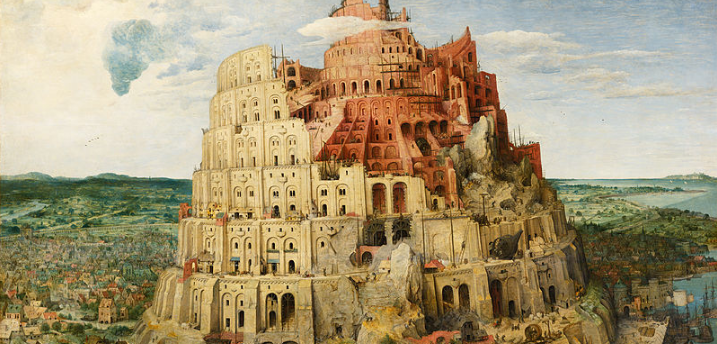
First: Sola Scriptura is anarchic. This is evident from the endless multiplication of divergent theologies and denominations within Protestantism. Without a unifying voice, namely, a bishop, pope, or something similar, one becomes his own definitive authority on the meaning of Scripture. Perhaps a pastor or teacher can help one form ideas, but it is I and I alone who am responsible for determining the true meaning of any given passage. Of course, I might say that the Holy Spirit is giving me the truth – which would mean that everyone must actually listen to me. In Protestantism, everyone is their own little pope. This same “bottom-up” approach to God existed once before, at the Tower of Babel. And there too did the languages multiply endlessly unto chaos, just as we see within Protestantism now, where there is splinter after splinter. Pentecost was the opposite – God came down to us (the Church as such, as represented by the Apostles and Mary in the Upper Room) and gave us a principle of unity from which to adapt to the many situations and needs of the day. Without a visible, living Pentecost among us, there can be no public unity around Christ. From the mere fact that there can be morally, liturgically, or doctrinally significant disagreement about the meaning of the same Biblical passage, it is evident that Scripture does not fit the bill of the “visible and living Pentecost”… Remember, the Devil knows Scripture too! (Mt. 4: 1-11) Unless one speaks about Scripture with the very authority of Christ, there is no end to disputation. As Peter says, interpreting Scripture can be very difficult and sometimes it ends badly, especially with Paul’s letters! (2 Pt. 3: 16) Would God really leave us orphans in this way? Did the Word really in practice just become more Words?

Second: Sola Scriptura is innovative. It did not exist until 500 years ago when Luther came up with it. Protestants often complain about “man-made traditions” infecting Christianity – well, Sola Scriptura is one of them. Would we not expect a Christian “God-made tradition” to have existed long before the 16th century? It sounds quite a bit like one of those “winds of doctrine” which Paul warned about (Eph. 4: 14). Of course, Scripture has been treated as authoritative throughout the ages, but it was not treated – or attempted to be treated – as the only authority until relatively recently. Did God let Sola Scriptura remain an obscure but correct practice and then even fall out of existence for centuries until Luther was inspired to revive it? This does not sound like the God of Christianity, does it… It sounds like a God Who did not remain among us but Who left us orphans instead – not only with no definitive interpreter of Scripture (see #1), but without the right doctrine about what Scripture is. And to think, He only left the children of Jacob in Egypt for 400 years…

Third: Sola Scriptura is historically impractical. This is not primarily due to illiteracy (though one might also wonder if that would be an impediment to being a good Protestant), it is due to the fact that for many years there simply was no such thing as Christian Scripture, let alone a collection of texts organized into “the Bible.” When Thomas the Apostle went to India, he did not bring with him the Gospel of Luke. When Peter went to Antioch, he did not bring Paul’s letters with him. When Matthew went to Alexandria, he did not bring the Johannine corpus with him. We can note that Paul in his missionary journeys, based on the whole Book of Acts and his own letters, is not using anything but Jewish Scripture in his disputations and preaching. How then could there be Christians in the wake of these evangelists? Doesn’t a Christian need a Bible? Obviously not. There were local churches set up in many places across the globe for a long time with little to no Christian Scriptures available, relying on the oral tradition and the authority of the Church as such, and it took even longer to form a real, authoritative canon (viz. “the Bible”) which allowed people to know what Scripture consisted of… Which brings us to the next problem.

Four: Sola Scriptura is conceptually impossible. We must know what actually is Scripture in order to use “Scripture alone,” yes? But how do we know what really counts and what doesn’t? The truth is that Scripture was defined by the Church, finally confirmed in a special way at the Council of Trent in response to the preaching and teaching of Luther, who wanted to throw out a few books which he didn’t think were really Scripture, but which most others did. Without descending into the minutiae of the history of the so-called “deuterocanon,” we can simply note that it was indeed widely regarded as Scripture from an early time, even though there was some controversy surrounding it. A Protestant response might be to fall back on the principle of St. Vincent of Lérins, that the faith is that “which has been believed everywhere, always, by all.” (Never mind that this was about faith in “the Catholic Church,” as Vincent says, nor that he only holds it out as a general rule for finding heresy rather than as a specific rule for formulating a biblical canon.) Universal acclamation of texts as Scriptural does not really work on its own… If there is a little disagreement, which there certainly was about non-deuterocanon, then one must begin to wonder, “How universal is universal enough?” There is no good answer. Instead, an authority must decide what is Scripture and what is not. Yes to 2 Peter, no to 1 Clement. Yes to Revelation, no to The Shepherd of Hermas. Etc. The New Testament itself does not and cannot provide a guide – nor does the New Testament provide a list of what belongs in the Old Testament. So the very existence of an authoritative canon which does not assemble itself or fall from the sky necessitates an authoritative compiler. That is the Church itself, which therefore must have its own special authority to speak for God. This guarantees the texts of Scripture are actually the ones which God inspired. (Let’s not even get into the bizarre and self-refuting theory that the Bible is a fallible collection of infallible texts…)

Five: Sola Scriptura is arbitrary. Of course, it makes sense that a revealed religion would involve a sacred text which has authority, but it is conceivable that it would not. And there is, therefore, no a priori need for “Scripture” as an authority at all, let alone as the sole authority. Let me be clear: I am not saying the Bible is not an authority, I am saying it is not clear that it automatically must be… And anyone who says that it is an authority has to appeal to something outside of Scripture. An appeal to Scripture to prove the authority of Scripture is perfectly circular. Why is Scripture an authority? Why not “Sola Papa” (the Pope Alone)? Why not “Sola Ego” (I Alone)? Why not “Sola Luther” (Luther Alone)? There must be an authority which supports Scripture as an authority, and that authority must derive from God. Seeing as Christ did not give us a biblical canon, He must have somehow given authority to mere human beings to decide what texts God actually inspired. In the end, men must cooperate in the governance of the Church, at least in this way. This brings us to problem #6…

Six: Sola Scriptura is self-contradictory. It is a teaching of Martin Luther, a mere man, and by those following him: also mere men. By obeying those who teach Sola Scriptura, the very doctrine is violated. To practice it on one’s own is also a violation, as one must listen to one’s own interpretation of passages (especially in cases of controversy), or one must say that the Holy Spirit is interpreting – Who is clearly not Scripture. And let us also note that Sola Scriptura is not taught by Scripture… So finally, we have the last and most problematic issue for the doctrine…

Seven: Sola Scriptura contradicts Scripture. The Bible does not teach Sola Scriptura, but it does teach the importance of the oral tradition which is not written down. Scripture also teaches the authority of the Church as such. Two verses will suffice. The first is 2 Thessalonians 2: 15 – “So then, brothers and sisters, stand firm and hold fast to the teachings we passed on to you, whether by word of mouth or by letter.” (Other translations render παραδόσεις “traditions” instead of “teachings.”) This is enough to show that at least Paul thought that more than Scripture might be necessary for safeguarding Christian doctrine. What might the mechanism be? He describes it in the second verse for our examination, 1 Timothy 3: 15 – “…if I am delayed, you will know how people ought to conduct themselves in God’s household, which is the church of the living God, the pillar and foundation of the truth.” How can “the church” be a “pillar” for the truth unless it functions as a means of connection to God, whereby false doctrines are corrected with good authority? The truth is tied at least to this pillar, “the church.” And how can it also be the “foundation” for truth unless it has a special means of holding up truth in a special way? What else could be the foundation of truth except that which is first in announcing it in the world? The guarantee of truth – infallibility – rests upon “the church.” God corrects error and announces truth through “the church.” This is how the Catholic Church understands its role in condemning heresies and defining doctrines (including what is Scripture and what is not).

There we have it… 7 fatal flaws with Sola Scriptura. Protestant readers (if there are any) might object with many verses of Scripture (especially 2 Timothy 3: 16, which simply insists that Scripture is indeed important – I do not deny this!)… However, in so doing they will no doubt demonstrate the points above.

You might consider sharing this post with any Protestant friends and see what they say. Tell them that no, God did not abandon us, leaving only a special book behind… That is a bleak doctrine indeed.

UPDATE (April 5, 2021): This post has become very popular, read many times every day – if you are reading, let me know how you found it! I always love to hear.

Main image: “The Tower of Babel,” Pieter Bruegel the Elder, 1563

Four Kinds of Problems with the Pan-Amazon Proposal on Married Priests

Eamonn Clark

The suggestion has been floated around in some quarters that at the newly announced Pan-Amazon Synod, to happen in 2019, bishops will discuss the possibility of ordaining married men in their region to the order of Priest. These “viri probati,” “proven men,” would make up for the absolute dearth of priests deep in the jungles of South America, where people are often deprived of the sacraments for long periods of time. There have been some missionary efforts there, but the terrain is vast and unfriendly, and the culture is extremely difficult to adapt to, so there has been limited success. It seems to some that simply ordaining certain men in isolated communities would help to make up for the absence of celibate priests in the area.

I note at least 4 categories of problems with the proposed solution. They are as follows:

  1. Canonical. The Code of Canon law, which binds the Latin Church (including, presumably, the men who might be ordained in the Amazon,) does allow for the possibility of married priests under certain circumstances (see c. 1047, §2, n. 3), but nowhere is the obligation to perfect and perpetual continence lifted for any cleric in the Code (though entering Orders – even the diaconate – without understanding or making the promise of continence means one cannot be obliged to its fulfillment). There has been much misunderstanding of the obligation to continence as distinct from the obligation of celibacy, and the widespread priestly ordination of married men in the Latin Church would make this worse. (On the other hand, it might finally get the mess canonically resolved.) For more on this confusing topic, see Dr. Ed Peter’s fine treatment here.
  2. Standard objections. There are many intrinsic problems with the idea of a married presbyterate. There are the economic problems, such as the time and energy a father and husband would have to spend between his family and the service of the community – or several communities, sometimes perhaps separated by miles of thick jungle, in this case. The resources needed to educate and train these priests adequately is an additional economic strain (and would likely never rise to the level of a normal priestly education), as is the payment of the priest who has to make enough income to provide for his family. There is the loss of the power of the witness of celibacy, which is a sign of contradiction to the spirit of the world, reminding people that there is a Heaven and a Hell, a death and a judgment, and that we had better start thinking about these things now if we are to be prepared for them later. There is also the impoverishment of the spirituality of the Latin priesthood as normally understood, which is spousal in nature and urges the priest toward greater charity for those in his care. In general, it seems that all the normal problems of a married priesthood obtain.
  3. Internal prudential. Not only will there likely be no comparison between the education and training of the Amazonian viri probati and a regular Latin priest, to the possibly very grave positive harm of the community (due to serious deficiencies in the confessional, in the pulpit, and so on), but the deeper problem causing the shortage is ignored. It is like a man who drinks to cure his depression – the feeling will go away for a while, but the underlying cause is never addressed. In the meantime, an addiction is developed which harms him positively and perpetuates the deeper problem, perhaps even worsening it. If there are no normal vocations to the priesthood, it is due to a lack of faith, a lack of zeal, a lack of something important in the local church. This ought to be the real object of discussion.
  4. External prudential. Once the Amazon has viri probati priests, who else will feel entitled? What other areas or countries will claim that they need this compromise? Meanwhile, as more concessions are made due to mounting pressure, the three foregoing sets of problems will perpetuate themselves.

The idea of a “simplex priest” may be what the bishops have in mind, a priest who does not do all of the public actions a priest with full faculties to preach and hear confessions would… But that comes with other problems, which will be addressed in a future post.

In summary, the bishops meeting at the Pan-Amazon Synod ought to think these things through quite carefully. I, for one, am unconvinced that it is a wise idea. But then again, I’ve only ever been to Amazon.com…

Sancti Obscuri – St. Crispin and St. Crispinian (October 25)

Jacob Gruber

In Shakespeare’s “Henry V”, King Henry overhears a soldier lamenting how few men have come from England to fight in a battle against the French at the Battle of Agincourt, leaving their odds of carrying home a win rather low. He responds with a bold appeal to all the courage left in the hearts of that “band of brothers” who did show up for battle and unites the hope of their victory with the celebration for all time of St. Crispin and Crispianus (Crispinian). It’s worth the watch:

Fictional though this speech may be, the king’s prediction seems to have unfortunately come true: “and Crispin Crispian shall ne’er go by from this day to the ending of the world but we in it shall be remembered!” In this article, it is my hope that on the feast of Crispin and Crispinian this year (October 25), Crispin and Crispinian themselves will be remembered for once!

These two saints lived the in middle of the third century in the Roman empire. Allegedly, they were brothers from a noble Roman family. The story from the Bollandists (from which the Catholic Encyclopedia draws their information in the case of these men) tells us that they went to Soissons in Gaul together to preach the faith. While there, they supported themselves financially primarily by making shoes. Their missionary work there was so effective, however, that it caught the attention of the high Roman authorities. A short historical detour is necessary at this point.

Crispin and Crispinian lived in the time of the Roman Emperor Diocletian. Any Christian familiar with some Roman history should be feeling the shiver run down their spine – this man was ruthless. He was Roman emperor from 284 to 305 AD, and in his rule he initiated one of the biggest, cruelest persecutions in early Church history (which is no small statement when the bloodbaths of Emperors Nero and Decius are taken into account). So bad was Diocletian’s persecution that, before Anno Domini (AD) came into fashion for marking years, the Christians (especially of the Alexandrian Church) used Anno Martyrum (AM), or the Era of the Martyrs, to mark their years. The Anno Martyrum system began year 1 in 284 AD – the beginning point of Diocletian’s reign and persecution.

With this in mind, consider that Crispin and Crispinian were preaching the Christian faith rather effectively at this time in Gaul, an important territory of the Roman empire. It did not take long at all for some action to happen. In the year 285 AD (or the year 2 in the Anno Martyrum), Maximianus Herculius, who had been made a sort of co-emperor with Diocletian, called the two men before him. After his efforts to persuade them to give up the faith, they responded,

“Thy threats do not terrify us, for Christ is our life, and death is our gain. Thy rank and possessions are nought to us, for we have long before this sacrificed the like for the sake of Christ and rejoice in what we have done. If thou shouldst acknowledge and love Christ thou wouldst give not only all the treasures of this life, but even the glory of thy crown itself in order through the exercise of compassion to win eternal life.”

Maximianus handed them over to Rictiovarus, the Gallic governor, who had them tortured terribly – stretched on a rack and flesh torn, among other horrible inflictions. After all of this, he had millstones fastened to their necks and had them thrown into the Aisne River. Miraculously, they managed to swim to safety. The Roman Martyrology succinctly finishes the story: “after [these] horrible torments, they were put to the sword, and thus obtained the crown of martyrdom.”

The Catholic Encyclopedia questions some of the credibility of this story, since its sources may be somewhat unreliable. However, we must examine a certain important principle in the matter of saintly stories, since credibility will always loom as an issue in the stories of the obscure saints. I simply quote a section from St. Francis de Sales’ Treatise on the Love of God in which he defends the practice of believing holy stories:

“Charity willingly believeth all things; that is, it is not so quick to believe that any one is lying, and if there are no apparent marks of falsehood in things which are told, it makes no difficulty about believing them; but above all when they are things which exalt and magnify the love of God towards men, or the love of men towards God … in matter of religion, good souls have more sweetness in believing things in which there is more difficulty and admiration.” (Chapter XII)

By means of this argumentation, St. Francis de Sales was insisting that a certain miraculous story told in a homily by St. Bernard could be believed, even though he simply had no evidence whatsoever to prove it. We are in a similar situation. We’ve been handed a story of the miracles and martyrdoms of Crispin and Crispinian with only the written testimony of writers centuries later to show for it. But the good souls have more sweetness to believe stories such as these. Our charity willingly believes all of these things.

Thus,  I would suppose that we can accept the story handed onto us from the works of the Bollandists – but I’ll leave that up to the reader.

So, what if Crispin and Crispinian hadn’t fallen into obscurity? They are already known as patron saints of shoemakers, saddlers, and tanners. But their legacy is more than cobbling. While the modern imagination tends towards Shakespeare’s reference in “Henry V,” it turns out that this reference is not so far from the original spirit of these men. The Battle of Agincourt was a battle in which England triumphed against great odds over France in 1415 AD. But Saints Crispin and Crispinian in their own way triumphed against great odds in France (Gaul at their time), albeit in a spiritual battle for souls.

So let us hail them today as victors all the same! May St. Crispin and St. Crispinian pray for us!

Capital Punishment and the Development of Doctrine

Eamonn Clark

Update: Dr. Feser presents a very similar argument here.

Currently, I am reading Dr. Ed Feser‘s recent book, By Man Shall His Blood Be Shed: A Catholic Defense of Capital Punishment (co-authored by Joseph Bessette). It was with great interest then that I read the Holy Father’s remarks on October 11 regarding the death penalty in a conference celebrating the 25th anniversary of the publication of the Catechism of the Catholic Church.

I do not wish to summarize the entire history of this topic within Catholic and Western thought, as any curious reader would profit much more by simply picking up Dr. Feser’s book, but instead, I want to address (briefly) the possibility of a “development of doctrine” which would say that capital punishment is intrinsically evil.

But first, let’s look at what the Holy Father actually said.

“[The death penalty] is in itself contrary to the Gospel.”

“However serious the crime committed may have been, the death penalty is inadmissible because it undermines the inviolability and dignity of the person.”

“We are not in the presence of some contradiction with the teaching of the past, because the defense of the dignity of human life from the first moment of conception until natural death has always been found in the teaching of the Church.”

“The harmonious development of doctrine, however, requires that we [now] leave out arguments which now appear decisively contrary to the new understanding of Christian truth.”

“Unfortunately, this extreme and inhumane remedy was also used in the Pontifical State, neglecting the primacy of mercy over justice. We assume responsibility for the past, and we recognize that those means were guided by a mentality more legalistic than Christian.”

This is a startling series of quotations, for several reasons.

First, the Holy Father, probably without realizing it, is accusing many of his real predecessors of using an “extreme and inhumane remedy,” thus “neglecting the primacy of mercy over justice,” which implies they “were guided by a mentality more legalistic than Christian.” This would, of course, include some popes who have been raised to the altars, even men such as the great St. Pius V. It is unlikely that the Holy Father really meant to condemn several saintly popes as impenitent murderers (or as hopelessly bad moralists suffering from invincible ignorance of their material sins), but that is the implication nonetheless.

Second, the Holy Father’s comments display a startling lack of awareness of the rehabilitative power of capital punishment. In fact, this is one of the traditional arguments put forth in favor of the death penalty: to know that one is about to die in a short while is a great help in coming to repentance. What else could focus a man’s mind more on the good of his soul? If imminent and certain death does not bring about repentance, we can be pretty sure that nothing will. Furthermore, while such criminals are locked up, how many more people might they kill, heaping even more sin onto their souls? For an example of the power the certainty of death has for occasioning conversion, one might look to the ministry of St. Joseph Cafasso, who turned several dozen men from hardened criminals petrified of death into virtuous souls equally resigned to live or die, sometimes hours before they were to be hanged… (St. Catherine of Siena and St. Vincent Palotti are other examples.) It was, in fact, the certain imminence of their deaths that softened them for the work of their chaplain-saint. Surely, they would have done much good in the world had they been set free, but then again, if such were done then there would no longer be a real threat of certain death in these cases (rendering the rehabilitation less likely), nor is this how justice works… It is unsuitable as a jurisprudential norm to allow men to walk free without facing their sentence simply because they appear to have become reformed (unless reform is conditionally a part of their sentence). Instead, converted inmates will make great citizens of the Kingdom which is not of this world – lest we forget, doing well in this life is not the ultimate point, as earthly life is not the greatest good. Human life is not entirely destroyed by bodily death. This must not be an afterthought in the discussion of capital punishment, as it is precisely the supernatural call to Beatitude which gives human life so much dignity even beyond our merely natural goodness as creatures.

Third, and most importantly, the Church has taught perennially, building upon the teaching of the Old Testament (in God’s own legislation) and the New Testament, and upon the timeless understanding of natural law that there is no injustice in a legitimate government administering capital punishment under certain circumstances, namely, the crime must really be proportionate with the penalty of death, and there is moral certitude (following due process) that this individual really committed such a crime. (We might also add other factors, such as avoiding doing more harm than good, or having suitable means of execution, but this will suffice for an exploration for now.) However, apparently, we now have “a new understanding of Christian truth” which can allow a development of doctrine that completely relegates capital punishment to the realm of intrinsic evils.

I suggest that this is absolutely impossible.

First of all, such a change would be abrupt. This is not how authentic developments occur, at least outside the context of an ecumenical council where a whole number of matters might be settled with uncharacteristic promptness. Rather, they naturally unfold over a long period of time. One might argue that the past two pontificates somewhat softened the attitude toward capital punishment, which is true, but 35 years is an unimpressive tenure for a doctrinal shift. A counterexample might be the teaching on lending at interest, which changed as slowly as its object changed (viz. the instrumental scope of currency). Another might be the Immaculate Conception, celebrated in the Church for centuries before slowly making its way into the universities for debate and finally, after several more centuries, onto the loggia of Bl. Pope Pius IX. More examples could be provided, especially in the field of bioethics. What makes an abupt change to be such a red flag is that the Church does not suddenly come up with ideas about doctrine; rather, the doctrine is there from the beginning and it is slowly unpacked by the faithful. This takes a long time.

With that, the second problem with this change would be that it finds no meaningful support in the Catholic moral tradition. As attentive readers of Prof. Feser’s book will see, the opposite is true – the Church teaches and has always taught that the death penalty is legitimate in principle because of its proportionality to certain crimes, among other reasons. This is especially true for St. Thomas, upon whose arguments much of the modern defense rests. What recent popes have done is little more than advise a restricted use of it, in keeping with their own prudential judgments about its efficacy and usefulness within a broader social context (and Cdl. Ratzinger reminded us that one may disagree with popes on this point). One might point out that the paragraphs in the Catechism which discuss the death penalty seem to insist on its use only when necessary for protecting others; while this is what the document says, (especially when it quotes Evangelium Vitae,) it does not discuss why on the level of principles of justice, only on the level of prudential judgments about “the common good” and how to be “more in conformity with the dignity of the human person” – presumably, only the person of the criminal… The dignity of the person or persons killed is not discussed, and such a counterweight must be included in such an examination of distributing proportionate punishment, as the CCC says in the paragraph immediately preceding. (See also the Roman Catechism on this point, issued by Pope St. Pius V and re-issued by Pope St. Pius X.) Also, for what it’s worth, John Paul II beatified a certain Pope Pius IX. Certainly, the former knew of the latter’s firm support and use of capital punishment…  We ought to conclude then, in keeping with the hermeneutic of continuity, that John Paul II meant only to advise such a use of capital punishment in accord with the teaching which preceded it – that capital punishment may be warranted even without the need for protecting others (which is not strictly denied by the CCC) – and thus it is only a prudential judgment about its use, rather than a denial of the justice of its use in circumstances which do not necessitate its use for the protection of others, that we find in EV and the CCC. (We should also remember that catechisms, while certainly important, are not infallible documents, as Cdl. Ratzinger himself pointed out after the CCC’s publication!)

The third and most important item to discuss is the obvious one: such a change would actually constitute a reversal of past teaching, despite the Holy Father’s words that this is untrue. The Church has certainly grown in its understanding of human dignity in various ways throughout the ages, but there can be no realization about human dignity that would render capital punishment illicit. This would theoretically be possible if the Church had never actually formulated a teaching in favor of capital punishment, instead merely tolerating its use without meaningful comment. But since this is not the case, there can be no such change. Some people might be confused by this… Let’s consider another example. Suppose Pope Benedict XVII in the year 2078 decides, “The Church has evolved in Her understanding of the dignity and power of Baptism to the point where we realize that there is really no need for Confession.” One might very easily map the words of Pope Francis onto the same idea of this fictional Benedict XVII – mercy, legalism, development, apology, etc. Since this is a development of the doctrine on Baptism, how could it contradict anything but past doctrines on Baptism? The reason is very simple: doctrines do not live in bubbles. They must fit together with all other authentic doctrines. If a new doctrine on Baptism implies a contradiction of the doctrine on Confession, then the new doctrine on Baptism is wrong. If a new doctrine on human dignity implies a contradiction of the doctrine on capital punishment, then the new doctrine on human dignity is wrong. We do have a doctrine on capital punishment, as Dr. Feser shows brilliantly in his book, and the attempt to raise human dignity to such a point as it becomes absolutely inviolable would indeed imply a contradiction of that doctrine and thus would be erroneous. It would also imply that God legislated immorality in the Old Testament (ex. Leviticus 20:10) and that St. Paul confirmed immorality in the New Testament (Romans 13:4).

It will be very interesting to see how all this unfolds, or if anything even happens at all.

It is perhaps more important than ever to be training dogmaticians and moralists… Let’s pray and fast, too.

Stay tuned… and be sure to subscribe!

Our Lady of Fatima, pray for us!

Main image: Portait of Pius V, pope; El Greco, c. 1600-1610 (oil on canvas)

Will the Real St. Matthew Please Stand Up?

Fr. Peter Gruber

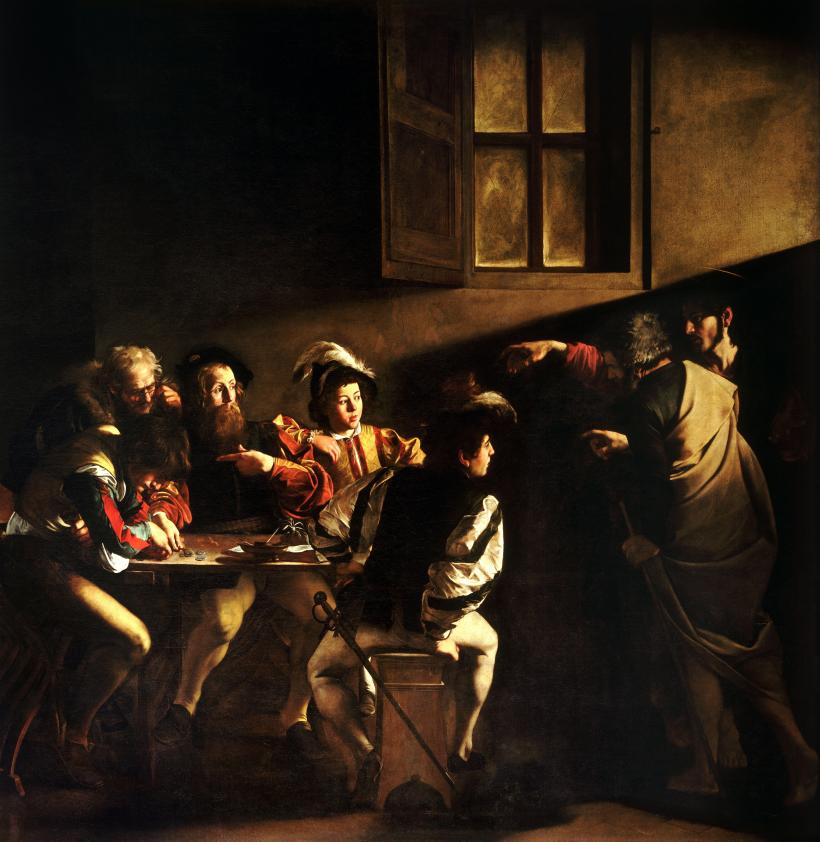
“That finger of Jesus, pointing at Matthew. That’s me. I feel like him. Like Matthew.” Pope Francis remarked in his 2013 interview with Fr. Antonio Spadaro, S.J.

“It is the gesture of Matthew that strikes me: he holds on to his money as if to say, ‘No, not me! No, this money is mine.’ Here, this is me, a sinner on whom the Lord has turned his gaze. And this is what I said when they asked me if I would accept my election as pontiff.”

In Caravaggio’s The Calling of St. Matthew, Pope Francis found the perfect image to express his own surprise at being uniquely called by Christ to serve the Church as supreme pontiff.

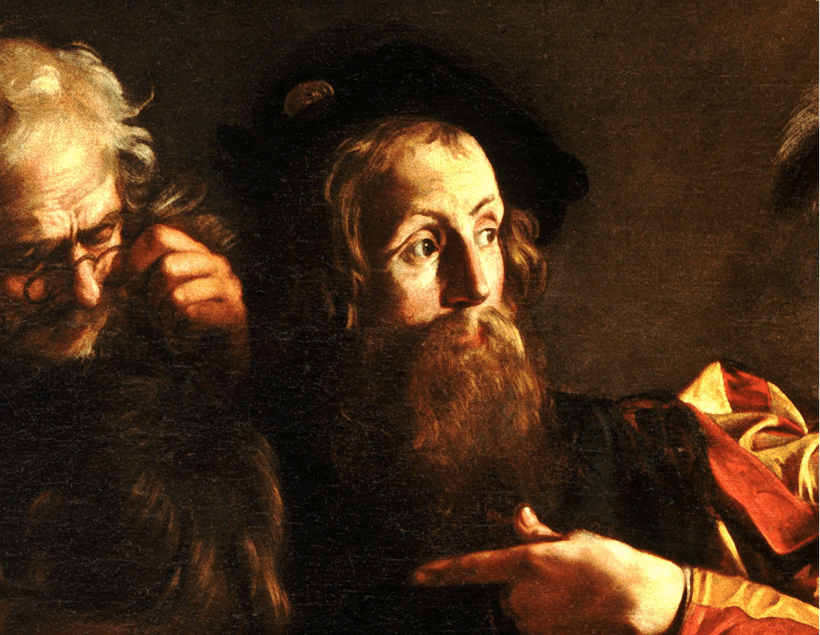
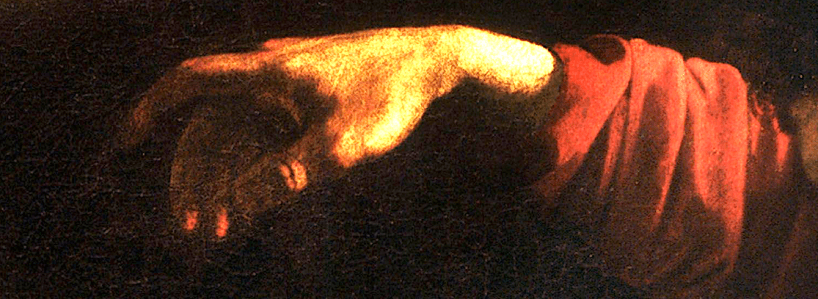
But, we have a problem. Which figure in the painting is St. Matthew?

(If you haven’t already done so, take a moment to give the painting a good look and try to figure it out for yourself.)

Besides the faintest loop over Christ’s head, there are no halos in this painting. Nor should there be – St. Matthew was only Matthew the tax-collector at this point. Here he is, in the midst of his sin and in corrupt company. Matthew has just as much chance of being called out of this situation as any of the five guys in the tax office.

But which one is he?


Option 1: The Bearded Man

At first glance, Matthew appears to be the man with long beard. His eyes show surprise, his face is illuminated, his finger seems to point toward his breast. And, maybe just to help us out, he has a distinguishing coin in his hat and a right hand fingering money on the table. If there is anyone in this painting who is reacting as the one who is called, it’s this guy.

bearded-guy

There are two other reasons why the bearded man is the best candidate for Matthew.

First, Caravaggio did not paint The Calling by itself. With this painting in the Contarelli Chapel in the San Luigi dei Francesi Church in Rome, Caravaggio painted two other scenes from the life of St. Matthew: The Inspiration of St. Matthew and The Martyrdom of St. MatthewIn both of these adjacent paintings, Matthew is depicted as a man with a sizable beard.

The second reason concerns some of the interesting history going on at that point. Before this was painted, there was a passing fear that France might go the way of the Church of England. This fear partially subsided when the Huguenot (Protestant) Henry IV converted back to Catholicism upon taking the French throne in 1593. Caravaggio was commissioned six years later to paint three works for the church of San Luigi dei Francesi (St. Louis of the French). To flatter the now-Catholic king of France (and appease his patron), Caravaggio painted St. Matthew to resemble Henry IV. (You can see the bearded resemblance here.)

But that might not be the whole story.


Option 2: The Hunched-Over Man

People make a big deal about Christ’s pointing gesture just below the window in the painting. His hand is unusually relaxed for a definitive signaling of direction. The reason for this is very likely that Caravaggio is alluding to a more famous painting: The Creation of Adam by Michelangelo.

finger-edited

fingers

Michelangelo’s Adam is depicted in the Sistine Chapel fresco in the moment just before his animation, with his finger less than an inch from that of God. Michelangelo, instead of showing an Adam already filled with life, depicts the precise moment prior to his ensoulment with all the drama of a limp wrist.

Like Michelangelo, Caravaggio may not be capturing the moment of the calling of Matthew; he might very well be capturing the precise moment before the calling of Matthew. The finger of Christ the New Adam has yet to be fully extended, the call is only just about to happen. The whole painting is in that dramatic tension of the moment before the call.

In that case, Matthew is not the bearded man whose face is fully illuminated; Matthew is the man whose face is about to be illuminated – the smooth-faced hunched-over man.

hunched-over-guy

And here, before the call reaches him – before the light reaches his face – Matthew is still a sinner, still a tax-collector, still fingering his coins and gripping his money bag. The bearded figure to his left anticipates the perceived direction of Christ’s soon-to-be-extended finger, pointing perhaps not to his own breast but to the hunched over man next to him. This man’s face, only half-illuminated by the light that comes from Christ’s entrance, still intently looks down to the table; he has but to lift his head an inch to make eye contact with Christ. Will his eyes meet the gaze that tests mortal men and will he remain the same? Will he respond to the call?


So, which one is Matthew?

It’s still not entirely clear. It can go either way.

But that’s probably how Caravaggio wants it to be. Caravaggio’s art was at the cutting edge of the subjective turn of modern thought. As a controversial artist of his time, he departed from the idea that art is exclusively at the service of the true, good, and beautiful, and turned instead toward an innovative realism. (See our earlier post on what makes art good.)

Part of Caravaggio’s goal is to pull the viewer into the painting. He wants this ambiguity; he wants you to be asking these questions. And he knows that things are not so cut and dry. Christ entered a world in chaos, a world engulfed in sin. He calls us out of that darkness and into His light.

Turning again to the painting, if we go to the source of Christ’s call and look above His not-yet-fully-outstretched right hand, we find ourselves at the base of a cross (the fourfold window pane forms a cross). Here we are meant to ponder Christ’s own cross. And at the cross, darkness appears to triumph over light, chaos over order, death over life. It is precisely at that moment when Christ conquers. It is from that cross that Christ calls His disciples, and it is to that cross that Christ calls His disciples. Like Matthew (whoever he is), we are drawn up while we are still sinners into the cross, into the central mystery of our faith.

Pope Francis (himself seeming to weigh in on Matthew as the bearded man) hits on what our response should be to Christ’s call: “I am a sinner, but I trust in the infinite mercy and patience of our Lord Jesus Christ, and I accept in a spirit of penance.”

Independent of who we decide Matthew to be in this painting, our response to Christ should be the same as that of Pope Francis. We are that sinner uniquely called by Christ.

How will we respond to His call?


Main image: “The Calling of St. Matthew,” Michelangelo Merisi da Caravaggio, 1599-1600