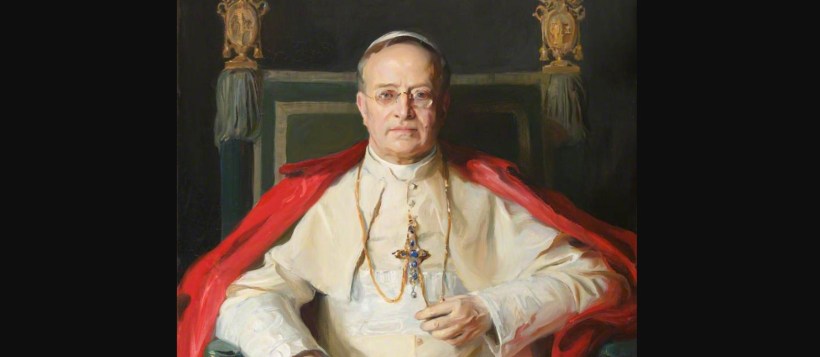
The Drive to Become an Altar

Below is a talk on penance I recently gave to my men’s group here in Rome (the Oratorio)… Enjoy.

Eamonn Clark, STL

One of the most significant figures of the 20th century neothomistic movement had only a four year long career in theology before being drafted into the Great War and getting shot in a trench in northeastern France. Fr. Pierre Rousselot is perhaps best known for a work titled “The Intellectualism of St. Thomas,” in which he does a kind of experiment attempting to reconcile Thomas with the aftermath of the Kantian revolution. One of the conclusions of that work was that our intellectual nature pushes us towards trying to develop the sort of knowledge that angels have, which is a knowledge of the essence of things. It can ultimately be summarized by saying simply that man contains a drive to become an angel; interestingly, the corollary for angelic creatures is that they, in fact, have an intellectual tendency toward Divine knowledge – the drive to become God.

Lent is fast approaching. Perhaps some of you even have “deification” on the brain after attending the conference at the university. While we certainly all are called to become like God according to our capacity, we have before us a different way than just knowledge, which is a special kind of love. Though knowledge indeed precedes love and directs it, just as the procession of the Son is logically prior to the procession of the Holy Spirit, as students we are concerned about knowing God and His revelation well enough. Lent is a challenge to make something out of that knowledge in unique acts of love called penances.

The title of this talk, derived from Rousselot, is the following: “The Drive to Become an Altar.”

First of all, penance is altogether useless for advancing in Christian perfection without sanctifying grace. One may still be bound to complete an act of penance, such as abstinence from meat, but this is a bit like being bound to the matter of a vow by canon law without having actually made the vow which contains that matter – think of an atheist communist infiltrating a religious order, for example. In truth, if he has been baptized, he is indeed bound to fulfill the matter of poverty, chastity, and obedience, but these things do not redound to any merit. On the other hand, someone who promises under a vow to attend daily mass increases the merit of that action – yet there is reason to be cautious about adding up vows, as Our Lord warns implicitly when condemning extraneous oath-taking – let your yes mean yes, and let your devotion be your devotion. You can overdo vow-making just like oath-taking. Something similar applies to penances.

There are four chief motives for fasting and other penances. The first reason is that they are obligatory, such as the penances prescribed by the Church, like abstinence from meat on Fridays or the fasts on Ash Wednesday and Good Friday. This is principally an act of obedience. The second motive is in reparation for sin – to take on a punishment with some relation to manifestations of our individual corruption. This is an act of religion. The third purpose is to help to elevate the mind from things of the flesh to things of the spirit. The final motive is to discipline the body for the sake of bringing it in line with the rule of charity. These last two seem not to be acts of obedience or even necessarily of justice but of infused temperance, which is a separate species from acquired temperance, as it exists for spiritual aims rather than merely moderating bodily health.

The altar of the Temple was where sacrifices were offered. Sacrifice is one of the external parts of the virtue of religion, and it is known by the natural law – in fact, it has been taught to all the nations throughout time. We know intuitively that we owe to God something. Those who are sensitive in spirit know with David that sacrifice must cost oneself something – another cannot pay for us, at least not generally speaking.

Christ is the New Temple. The Cross is where this becomes most evident, and this point is later confirmed by the “rebuilding” of the New Temple in the Resurrection. On the Cross, the Priest, the Sacrifice, the Temple, and God are in fact all the same. For the baptized who have died and risen with Christ, who live with Him in charity by the indwelling of the Holy Spirit in the soul, one participates in the religious synthesis of the Cross and receives the gift of infused temperance in virtue of sanctifying grace. By infused temperance, the abandonment of things of the flesh in favor of the things of the spiritual world is made more attractive. We begin to want to offer things to God more and more the stronger our friendship grows. Our heart becomes more and more an altar, where our will and the pleasures we could partake of, even licitly, are sacrificed to make room for the Lord Jesus.

St. John of the Cross would go so far in fact as to urge the use of physical pleasure only as an immediate springboard to the enjoyment of friendship with Christ. There is a profound sense to this – after all, a friend of the Almighty should not really be interested in enjoying something apart from his Divine Friend, or to be distracted by something lower than Him except out of necessity. However, despite Garrigou-Lagrange’s great attempt to harmonize John with Thomas, the Angelic Doctor seems less enthusiastic about such a prescription for the general public, despite his exhortation that more or less everyone ought to enter religious life, and this without even very much thought about it! But professing chastity, poverty, and obedience in common life is not the same as John’s “nada” doctrine. In fact, St. Thomas’s rather blunt critique of the Stoics – who professed a rejection of all pleasures – could partially be applied to the more rigorous interpretation of Carmelite ascetical doctrine… Thomas says to look at the life of men who say they reject all pleasures, as their lives will be different from their writings.

A great example comes to us in the treatment St. Thomas gives of the use of alcohol, and we should remember that he would have known the life of St. Dominic. The latter, we read, gave up the use of wine for some 10 years, only to take it up again at some point after founding the Order. It may sound like a joke, but not if Thomas is to be taken seriously: Dominic may have really just needed a drink. The teaching of St. Thomas is that, of course, the careless deprivation of reason through intoxication is always grave sin. Sometimes the use of alcohol can be scandalous, and for some certain persons who are especially bound to pursue perfection of their mind, such as bishops, it is probably better to abstain altogether. But, he says, for some people alcohol is extremely helpful. It seems it was for Dominic – or perhaps he wanted to soothe the scruples of his brothers by providing a good example. Another similar anecdote comes from near the end of the life of St. Anthony Claret, who had given up all alcohol many years before. When returning to visit the order which he had founded before becoming a bishop, the superior of the community ordered a glass of wine set before the prelate. He did not protest. St. Francis de Sales also speaks of the good example of St. Charles Borromeo, a great ascetic no doubt, but who would occasionally have a glass of champagne to celebrate some great accomplishment. To do otherwise would have brushed up against scrupulosity, suggests Francis.

Brother Lawrence of the Resurrection, a later Carmelite, warns of excessive penance and deprivation in his famous little book “The Practice of the Presence of God.” “One does not become a saint all at once,” he says. Of course, the Cross is only the means to the end. When the means becomes harmful for reaching the end, the means ought to be adjusted. If penance is driving one into despairing altogether of deprivations, or causing bitterness and harshness towards others, or neurotic worrying about pleasures being excessive, one ought to reduce the penance. If one becomes proud of what penances he is doing, it is maybe better to stop using penances altogether except under obedience.

So we must not be “overly virtuous” lest it be too much for us, as Qoheleth warns. St. Thomas says pleasures ought to function somewhat like a “spice of life.” However, Lent is a time for decidedly less spice.

Christ is now mostly hidden in the glory of Heaven, appearing only in the most extraordinary of visions. Penances ought to be mostly hidden as well, allowing us to appear normal, with the interior transformation conforming us to Christ. This is just like Christ in the Eucharist – an interior change of something ordinary which makes Him present.

The Crucified Christ is indeed a sacrifice which we can in fact offer, though it has cost us nothing; and yet, in the Mass we do indeed present materials which have been changed by human work, in bread and wine. By this symbol of human labor, we are taught to appreciate the fact of participation in the liturgy which is mystical. The Mass is an incarnational representation of the sacrifice of Christ on the Cross, and it is in fact so incarnational that it is a real sacrifice itself. This explains why one must be physically present at Mass in order to fulfill the obligation of attendance – one does not really offer oneself to the sacrifice which is occurring without some kind of moral presence before the altar where the sacrifice is occurring.

We also see in the Mass the four characteristic motives of penance: we are commanded to celebrate Mass by Christ Himself, we celebrate Mass for the reparation of our sins and the sins of others, and our minds are elevated to God. By the reception of Holy Communion we are conformed to the Glorified Christ, Whose Flesh and Blood which we receive as food is perfectly subject to His Soul and Divinity, which we likewise receive. And like penance, attending Mass profits one nothing without sanctifying grace. Therefore, go to Confession. Be contrite. Receive grace. Do penance. And be conformed more and more by the power of the Holy Spirit through the Gift of Wisdom which flow from charity, which call us away from worldly goods, and urge us toward the Crucified One: “Christ the Power of God, Christ the Wisdom of God.” (1 Corinthians 1:24) In this way, our hearts become true altars where the world is sacrificed, dies, and is transformed by rising to a Christified state, where He is all in all, and only charity moves us to have anything to do with its pleasures, and God is enjoyed above everything else for His own sake, not for His gifts which He will nevertheless lavish upon us. Just as His love comes down upon the altar at Mass, surely, it will come down likewise upon hearts which are altars where He lives as well.

The Forgotten Pope

Eamonn Clark, STL

Secret messages to a dictator living down the road. Escaping the Vatican. Immense building projects. The first papal speech by radio. An unpublished encyclical on racism hidden from the world by the machinations of a powerful Jesuit.

Just a taste of what is contained in the epic but almost entirely forgotten 17 year long papacy of Pius XI. This is to say nothing of his monumental career prior – only about 2 years of which was as a bishop.

I’ve just finished my 2nd biography of the late Pontiff. His writings and ministry are central to my doctoral thesis, which is a deep study of his encyclical Quadragesimo Anno, the first commemorative document of Leo XIII’s Rerum Novarum.

Only a few days ago on February 6, we unceremoniously passed the Pope’s 100th anniversary of election. He also died in February, on the 10th, in 1939.

I think it’s altogether unfitting that the man who created Vatican City and essentially braced Europe for World War II should be so utterly lost to the sands of history so quickly. Pius wrote 30 encyclicals, for goodness’ sake. And as I get to know him more, I am inclined to say that he is among the top 10 most significant popes after Trent.

In this series of posts – with an indefinite end – I will be breaking down some of the more interesting moments, great accomplishments, and yes, mistakes, of Achille Ratti. There is much to learn from Manzoni’s greatest fan… The expert alpinist from Milan who rose from librarian to diplomat to pope was a man whose life spans the gap between “old Europe” and modernity. This is all the more true with the archives now being wide open – archives I will soon be digging around in myself.

So strap yourself in for a ride into the world of the interwar papacy.

The Time the Pope Got Mad at Me

Eamonn Clark, STL

I don’t usually post here about my personal life. But today I am making an exception – and it will probably be enough for a long time.

I want to be able to share all the details of this story, but it will have to wait a while. Probably not for some years. It is enough that I am even writing about this publicly at all.

This past summer, I and a few others, in a specific house of formation which had only begun to be established somewhere in Europe, attracted the attention of the Holy Father. Negative attention. You might remember the headline – about “rigid seminarians,” and men who had been dismissed from formation. It was brought up in the context of the Pope’s speech to the annual meeting of the Italian bishops’ conference.

It was a speech about my house. Certainly not only about my house, but it was especially aimed at it. He had only been informed of our house a few days prior, and the two unique factors of the place were that all of the men leaned heavily towards more traditional modes of clerical life and certainly preferred the TLM, and all of us had been asked to leave another formation program before. Cardinal Stella, then-outgoing prefect of the Congregation for Clergy, had been personally reviewing candidates for this house.

It didn’t work out.

After the speech, there was a meeting, and a confrontation, between figures I won’t name. The gist was that to stay in the house, the men all needed to forget the “trad” stuff and be “normal” seminarians… “No,” was the answer from the house. The reply was the ecclesiastical version of, “Don’t let the door hit you on the way out.”

A benign take would be that this was a frantic reaction to the rumblings about “Traditionis Custodes” being released soon, and everyone was caught off guard and started to protect themselves at the cost of a few fledgling vocations. A more cynical take would be that all this had been orchestrated as some kind of stunt. Maybe it was somewhere in between.

I recently heard a quip that the post-Conciliar Church is the only place where men in their 70’s and 80’s are telling men in their 20’s and 30’s to “get with the times.” It’s all very strange, awkward, and unseemly. And it needlessly repels priestly vocations.

I returned to study and to work in Rome. Most of the other men are still in formation, and I may yet rejoin them. If you are interested in supporting them/us, please let me know through the “Contact” tab. I am happy to explain more of the details of our situation in private, and explain to you how you could help. In many situations, seminary education needs to be paid for by the seminarian himself… This is such a situation, and there is even more to it. Please consider reaching out.

Anyway, this was my second time exiting a formation program. There have been some news stories of late – some of which I have been rather close to – of men with very unhappy exits.

My second exit, this past summer, was more strange than difficult. Thankfully, I was able to move back into Rome without too much trouble. But my first exit, from a normal diocese in the USA, was very hard.

I think the most significant lessons I took from the earlier, more difficult experience were the following… and this is advice which I offer to men who might be quite salty after a bad exit…

First, in human conflict, the truth is normally in the middle. The chances are, if you are getting the boot, you probably messed up, and so did they. (Sometimes it’s one-sided, but usually not.) The reality is that, in this case, your mistakes matter more than theirs. Do not be scandalized by the partial Judas-nature of some chancery official or parish supervisor or seminary professor you think screwed you over, as he is not the Lord, and you are imperfect too. Saul was literally hunting David, and yet David was ashamed even to cut Saul’s cloak, as Saul held the office of king of Israel. So don’t needlessly badmouth your former superiors just because they “persecuted” you a bit. Embrace the cross and become a better Christian for it.

Second, the most important identity you have is as an individual disciple of Christ who has the chance to enjoy Beatitude if you bear your crosses well. Doing this or that in life is secondary, including priesthood or religious life. Really, the only great achievement that exists is to get to Heaven, which is something that we can only do with help from God.

Third, you don’t know everything. Even when you really do know better than those responsible for forming you, whether it’s liturgy, canon law, sacramental theology, or whatever, you can probably still learn something from them if you were to just shut up a bit. The child Jesus actually knew everything and He stayed pretty much silent for 30 years… The least a seminarian can do is stay quiet for 6. What’s more, over time, that “boomer” priest you secretly mock with your sem buddies might actually be willing to admit to you under his breath that his formation wasn’t the best and then even would maybe consider listening to you about following the rubrics or what the Church really teaches about x, y, or z, but only if you show him that you’re not a know-it-all jerkwad and that in fact you just really love Jesus and want to be the best help you can be to “Father Boomer” and the parish he serves.

So that was the rubbing alcohol. Here’s the balm.

Leaving, especially being shown the door, can hurt a lot. And there is really not much which the Church offers such men. This is why, over the past few years, I have been compiling some advice for men entering and leaving formation. I think I first had this idea after reading an article at HPR on the dearth of pastoral assistance for women leaving religious life. You will now find a tab on this website which is the fruit of the labor of many hands. It is still under development, but I think it is ready to share with the world. It will be updated from time to time. If you have something to add – only if you have personally experienced an entry or an exit, especially within the last 20 or so years – let me know.

In addition to this resource page, I would also like to announce that I am establishing an informal temp agency for men who leave seminary. I already have a few employers interested, but I need more, especially for next year. (We will run a small “beta-test” this spring.) If you are a Catholic employer in the USA, especially on the East coast, and you are interested in taking an interview with a man leaving seminary maybe this spring or definitely next spring, please tell me through the “Contact” tab, and we can talk about it. Likewise, if you are a seminarian who is leaving this spring, or have left within the past few years or so and are struggling, contact me. I will listen to your story, and I will try my best to put you in touch with someone who might be interested in employing you for more than junk wages and will care about your experience and your soul. (It’s not a promise of employment, it’s just a promise to try.) This program is for men who left on their own or were asked to leave (for non-crazy reasons, i.e. abuse, theft, fraud, violence, etc.), whether they want to go back into formation, don’t want to go back into formation, or aren’t sure yet and just need to survive in the meantime. These will NOT be parish or diocesan jobs, nor Catholic school jobs… This is “normal work.” There are other Catholic jobs websites which advertise such positions, but I can tell you that it is often unhealthy for a man to go into such an environment after leaving seminary. It is sometimes better to “go be normal” for a while.

More big news coming soon… but that’s enough for now. Please prayerfully consider supporting some vocations financially – just send me a note.

Intercession and Science

An oldie but a goodie. More fresh content coming soon.

Christian Renaissance Movement's avatarChristian Renaissance Movement

Once in a while some zealous atheist, agnostic, or deist will throw down a challenge: “If God answers prayers, we should be able to prove it with an experiment. But we see no statistically significant difference between groups of sick people who are prayed for and groups who are not. Therefore: A) there is no God, or B) we can’t be sure if there is a God, or  C) God does not involve Himself with us.”

It seems like a strong argument at first. If God really does respond to intercession, then we ought to be able to observe that response in contrast with a lack of response corresponding to a lack of intercession. Intercession is an action, healing or whatever response is or would be an equal and opposite reaction, while on the other hand whatever is in motion tends to stay in motion – those who are sick or…

View original post 1,000 more words

My New Year’s Predictions

It’s about that time.

How did I do last year?

1 – The Salesians, the second largest religious order in the world at about 14,800, will come within 1,000 members of the Jesuits (about 16,000) (NO)

2 – There will be a new most-viewed video on YouTube (YES – Baby Shark FTW!)

3 – Jordan Peterson will convert to Christianity (NO – not yet, but seeming very close…)

4 – I will complete the “Bring Sally Up” pull-up challenge (NO – haven’t bothered trying…)

5 – Ven. Fulton Sheen’s beatification will be (re-)announced (NO)

6 – It will not snow in Rome (YES)

7 – Bougainville will gain its national independence (NO)

8 – The Buccaneers will win the Superbowl (YES)

9 – No new voting-age American cardinals will be created (YES – in fact, no new cardinals were created at all)

10 – Another James Damore-type incident will happen in Big Tech (NO)

4/10… let’s see if we can do better this time.

1 – There will still be an indoor mask-mandate in most provinces of Italy after October 1.

2 – Pope Emeritus Benedict XVI will live through the year.

3 – Kyle Rittenhouse will announce lawsuits totaling over $1 billion in claims.

4 – China will not admit that it had a lab leak in Wuhan.

5 – There will not be a significant military event in Israel and Palestine (no lives lost).

6 – CNN will no longer be on the air.

7 – Google will buy Netflix.

8 – The Vatican finance trial will not be finished.

9 – UCLA will win March Madness.

10 – Elon Musk will officially announce a mission to Mars.

Principles for Chaste Relationships – Part II

Eamonn Clark, STL

After an inappropriately long break, we are continuing our moral analysis of romance. First post here, on the principle “distinguish between the passions of love, desire, and delight.” I am preparing some lectures on a related topic for some of my students – so I have these things on the brain a bit. I may publish some of those notes another time.

The second great principle: don’t start what you can’t finish.

We were talking about an analogy with food…

It’s not obligatory to finish the cheeseburger. We are much more masters over our own bodies in terms of regulating our self-preservation than we are masters over how to regulate the preservation of the human race. We can, for example, choose to eat more or less in one “instance” of eating. It is not exactly the same with the sexual faculty. It is true one can choose to engage in sexual activity or not, but it is not so true that one can licitly decide ahead of time to “half eat the cheeseburger,” or even “eat the cheeseburger and then spit it out.” Nor may one deliberately enjoy the feelings that come with “pretending to eat the cheeseburger,” as we have said in our discussion of morose delectation.

While the Council of Vienne declared that kissing is not intrinsically immoral (yes – this was an issue brought up at an ecumenical council, in the 14th century, due to the odd teachings of various beguinages), let’s read St. Thomas on this point (II-II:154:4), as he makes a helpful (but challenging) distinction, namely, that while not sins in themselves, kisses and touches can be mortal sins from their cause. Let’s carefully consider the following text (it is not a simple one, despite its appearance): “Now it has been stated above (I-II:74:8), that it is a mortal sin not only to consent to the act, but also to the delectation of a mortal sin. Wherefore since fornication is a mortal sin, and much more so the other kinds of lust, it follows that in such like sins not only consent to the act but also consent to the pleasure is a mortal sin. Consequently, when these kisses and caresses are done for this delectation, it follows that they are mortal sins, and only in this way are they said to be lustful. Therefore in so far as they are lustful, they are mortal sins.”

We have already unpacked a lot of this in the foregoing section. What this Article means is the following, at least on my reading of it (together with supporting texts, including the Article referenced – Article 8 of Question 74, which is rather complex)… After the first passion (love), the second passion (desire) begins soon enough. The third passion (delight) can then be taken in the second passion’s act itself. If this is willed deliberately, there is mortal sin, as the appetite has been conformed to a mortal sin, even though one is not actually committing the sin for whatever reason (others are watching, inconvenience, etc.). The more closely one is simulating actual sexual union, including by engaging in its accompanying acts, the more likely it is that one is taking delight in the desire for mortal sin, as evidenced by one’s clear intent to arouse the passion of desire for the sake of the pleasure it brings.

Thus we can start to get a grip on how to understand what is going on morally in various kinds of pre-sexual recreation (including, unfortunately, many things which go on at an average high school dance). Some amount of “kisses and touches” are indeed appropriate, especially given the societal context (our psychology being wired by our environment to expect courtship to contain certain signs of affection), but there are some more or less objective lines that we can draw. To reiterate, the more an action looks like it belongs to the marriage bed, the more dangerous it is, and one must also consider carefully the possibility of slipping into further acts – or occasioning this in the other person. Some of these lines are a little less clear.

What is certain, however, is that recreational simulation of sexual activity planned ahead of time with the intent to derive pleasure from the desire to “go further” is totally without excuse – they are acts that simply are lustful “from their cause,” as St. Thomas explains. One uses the other person for the sake of a sexual fantasy that he is conforming his appetite to by willfully enjoying the pleasure which that fantasy brings. These are also actions which have a definite trajectory – real sexual union, right now, and it is precisely this trajectory which makes them so enjoyable. They cry out to be finished, and we know from experience that playing with fire in this way eventually leads to being burned.

With married couples the case of “mere” kisses and touches is different, as there is at least an habitual desire and licit ability to finish the trajectory – however, looks, touches, kisses, etc. should be done in relation to this habitual intention towards actual sexual union, rather than done only for the sake of the pleasure of the moment. In other words, such things should be ordered towards building desire for an actually possible future sexual act, rather than simply as an isolated event for its own pleasures, lest it become autoerotic – for sure, to start the actual process of direct stimulation with the intention not to complete the trajectory would come under this unfortunate category. Thankfully, sincere and pious couples typically fall into this chaste mode of action rather naturally.

TL;DR: To try deliberately to have the feeling of anticipating sexual union (“desire”) is to want to have the appetite conformed to a mortal sin, which is mortal sin itself (morose delectation), and outward acts that cause this feeling (kisses, touches, etc.) must be treated very carefully, especially if they are very closely associated with actual sexual union (i.e. heavy petting). To “make out” or otherwise touch or even look at someone specifically to derive this pleasure of “wanting to go further”, with sufficient deliberation, is to use the other’s body to engage in the mortal sin of morose delectation of fornication (or whatever species of lust, i.e. adultery, an unnatural act, etc.).

This leads us to the third great principle – the emotions are not the body. We’ll explore that soon…

The Pandemic is Over

Eamonn Clark, STL

I have held off for a long, long time on writing about Covid. It has been a difficult exercise in restraint for me. Hopefully, readers will therefore appreciate that the points I am about to make are not “shooting from the hip” or any such thing.

Because I initially committed not to writing on this at all, as it is rather boring and unhelpful to spit in the ocean, this will likely be my only real post on SARS-CoV-2, unless we are still dealing with this issue as a world in another “15 days”…

All lives matter, therefore all deaths matter. I find it awful that anyone would contract a respiratory illness and succumb to it. But this does not negate the following important points.

  1. Covid has a rather low mortality rate, especially among the young and healthy. The average healthy child (under 18) is more likely to be struck by lightning than to die from Covid, and the average driver/rider of average cars is FAR more likely to die from a car crash than from Covid (about 1/1,100 people). The average age for death from Covid in many places is either approximately the same or even above the average age of death from any cause. Also, everyone is going to die – the point of life is not simply staying alive, it is virtue, flourishing, preparing for and striving for Heaven.
  2. Extraordinary means, including extraordinary expenses, are generally not obligatory to save any particular person’s life, even when those means are certain to be effective. We are not so certain that much of what has been done in a rash attempt to save individually unidentifiable people has been particularly effective, and it has certainly caused much collateral damage in terms of psychological, social, economic, and even medical harm. Rightly ordered love comes only after the acquisition of knowledge.
  3. Those who claim the mantle of “Science” are often engaged in pseudoscience in the strictest sense, and often this seems to be done in the service of personal and professional gain. “If they had only locked down more/worn more masks/took more vaccines, they would have done better.” The question is begged. That’s not science, it’s irrational dogma parading as science, as is the choking of discussion about treatment options and demonizing those who dare disagree with “The Science” who are plenty qualified to write prescriptions, run clinical trials, and evaluate such things.
  4. Masks don’t really work, and neither do lockdowns – unless you are doing something really extraordinary with either. Hand sanitizer is also practically useless for Covid, which if I recall, has been known by people as unqualified as myself since late spring of 2020. (The lines and arrows on the ground… well, I guess we are still waiting on those numbers.) The typical stuff which we are now used to is just not effective to any noticeable degree. (Here is a great game to play which helps to prove the point.) I don’t know how this can even continue to be a debate at this stage. In fact, the recommendations about masks in particular were made by certain three-letter organizations back when they embarrassingly insisted that they were right and others were wrong about how Covid spread – until they realized they were actually wrong and quietly changed their position on the issue, without changing their public policy recommendations so as not to draw too much attention to their ineptitude.
  5. Even if the more perverse policies were effective, this does not answer the question of whether they are worth it. Real empirical science gives us data but does not tell us how to value goods based on that data – only “The Science” does that.
  6. It has become unreasonable to say that vaccines prevent infection or transmission in the long-term. One must wonder if this was part of a “repeat business” strategy on the part of companies standing to make hundreds of billions of dollars, a constant stream of income from taxes and newly printed currency. Maybe, maybe not. Maybe “Trump’s Vaccine” which was evil and super-scary before has become so good because people stand to benefit financially from switching teams.
  7. Perverse financial incentives plague the Covid system from top to bottom, and at this point one must really be blind not to see this. It is not for health and safety that to travel one needs a test here, another test there, a self-funded quarantine, and then another test. As Qoheleth says, “Money answers all questions.” (Ecclesiastes 10:19) One must also wonder in certain countries about coordinated efforts by organized crime and by socialist parties to bring about the end of a large private sector which they do not have a death grip on through backrooms. Desperate small businesses either close during lockdowns, or they get loans from unsavory characters…
  8. It is reasonable to have reservations about adverse reactions from the vaccines, both in the short-term and in the very unknown long-term.
  9. The emaciation of intermediary associations like clubs, guilds, unions, etc. is one of the gravest social evils of our time. Social media is no replacement for directed, organized associations with particular aims that draw people together for the sake of lobbying for those aims. Major, non-violent, credible threats “from below” are almost impossible to make in the developed world right now.
  10. The vaccines are not intrinsically evil to take or to administer, despite their distant immoral origins in abortion. However, that does not mean they are moral to take in every case, such as one being convinced of a serious danger for their own health, or having a prudential concern about supporting the destruction of the principle of autonomy, both of which derive from Catholic moral theology quite directly and could thus be appealed to reasonably in addition to one’s disgust and concern about the use of illicitly obtained cell-lines which could also be grounds for objection in view of one’s own unnecessary act of supporting an illicit industry and practice, vis-à-vis one’s own actual individual estimation of the benefit of defense against Covid. Furthermore, a conscience objection could also have the motivation that one feels compelled to speak against a particular system or program and this is the best way to do it. These considerations were almost totally missed in all of the discussions about conscience objections in the Catholic world.
  11. In my professional estimation as a moralist, it is generally mortal sin for a pastor or bishop to meaningfully exceed the demands imposed by civil authority in limiting access to the sacraments and regular worship due to public health concerns like Covid.
  12. In St. Alphonsus Liguori’s much more professional estimation as patron saint of moralists, parish priests (pastors) are specially bound to administer the sacraments to the dying during time of plague when nobody else is available when the need for the sacraments is extreme or even only grave, even if such assistance is likely or even certain to be fatal for the priest. (See Theologia Moralis, Book IV, #358 – a topic which ought to be more explored these days.)
  13. This is probably only the beginning of a long battle over social credit. If you do not know what an algocracy is, educate yourself. We are poised to begin creating one… the “Green Pass” system can now be used to include, for example, one’s carbon footprint, one’s purchases, other medical information, and so on. If you have been a “good citizen,” doing “correct things,” you will be able to do more for less money. And simply trying to avoid conflict over this kind of thing will not only mean losing the conflict which one is trying to avoid, it means inviting more conflict later on with more serious consequences. It was just supposed to be 15 days, remember…
  14. A lot of “crazies” are actually really smart. Like the so-called “Brostradamus” (video from September of 2020). I am reminded of the parable told by Kierkegaard about a clown crying out in a village that the circus is on fire and that everyone needs to hurry to protect themselves. They laugh and cheer him on, he becomes more animated, they laugh and cheer more, and then the town burns to the ground. Those who are dismissed as “conspiracy theorists” are sometimes very well-read in history and medicine etc. but are just bad at self-branding and presentation.
  15. Most of the “narratives” are partly true. There is indeed a cabal of globalist billionaires who want to control the world, but this is not sufficient to explain everything; nor is a bunch of health experts with nothing but good will sufficient to explain what is going on. The real narrative is complex.
  16. Why people disagree so fiercely over Covid and how to respond to it is a function of several factors, including the intellectual laziness of preferring a simple narrative to a complex but more accurate one. Tribalism is unhealthy for the truth-seeker, and truth-seeking is necessary for good-seeking (knowledge, then love). Of course, many serious goods are on the line and are set up as being opposed to each other as alternatives – protecting biological life and health vs. principles of liberty which are ordered toward living a good common life… so it is understandable and actually good that people are angry about the issue, as injustices against life or liberty are very bad injustices indeed. This is compounded by various exposures to differently organized data sets, and different values which interpret data sets in light of a predisposition to or away from collectivism, and all this is augmented by people’s varying temperaments.
  17. The prevalence of the daughters of lust have dumbed down public discourse in general and led many people into despair of the goods of the next world such that they are apt to fixate on biological health to the neglect of social and spiritual health.
  18. Many comparisons have been made to Nazi Germany. Most of them have been overblown. However, the 1930’s came from the 1920’s. Most interestingly, the Jews were the object of fear in Italy, but the object of disgust in Germany. Disgust is often a more powerful incentive to repulsion/suppression/aversion. Now, we have the confluence of these two forces in the “unclean” people who have not done what the regime has indicated will make them “clean.” Simply not having reached a certain point in public policy does not mean it will not or cannot come… as history shows, the future comes after the past. It is important to make sure our future is not the way the 1930’s were to the 1920’s.
  19. It is obvious that there is a pseudo-religion present in the Covid “structure.” There is a sacramental system, special clothing, prophetic and priestly castes, a protology, an eschatology, a moral system, and special language. Heretics are not tolerated publicly. This is Covidism. In this case, I encourage people to be “spiritual” but not “religious.”
  20. Ideology develops its own interior life and logic. Havel describes this in great detail in his must-read book “The Power of the Powerless.” Many who do not believe in Covidism are too afraid to “live within the truth” to ignore the social pressure to conform to a system of rules and regulations which one does not believe in. To take Havel’s example, the greengrocer who takes down the Communist sign in his shop window becomes a massive threat to the post-totalitarian regime by making others aware that they can do this too – and that is very scary indeed. Even those who seem like they have real control are often only servants of the ideology and will be dispensed with if and when they deviate, including being dispensed with by other people who do not agree with the ideology but are afraid of being dispensed with themselves…

Well, there you have it. My 2 cents. I could say more, especially about the knowledge-love paradigm (and how central planning is such a bad idea because of this dynamic being ruined), but this is probably enough for now… see you in another “15 days,” perhaps… In the meantime, the pandemic is over – it is now a worldwide endemic. Covid is here to stay forever in constantly changing forms, and there is really nothing we can do about it. So relax, go for a walk, and live your life – in the truth.

The Oratorio – Opening Speech, 2021

Below is this year’s opening speech for my men’s group which I run here in Rome, the Oratorio, which I delivered some weeks ago. Enjoy!

The Catacomb Option

Cancel culture. Safe spaces. Hate speech. Green passes. It’s enough to make one’s head spin, and that’s just a little bit of what has come in the past few years.

Just as God sows seeds, and the Evil One rips them up, as the Parable of the Sower tells us, so too it seems that the inverse holds true: the Evil One sows seeds, and God rips them up. If we are to take at face value the alleged prophecy given to Leo XIII about the 20th century being the Devil’s “free reign” or playground to do as much damage as he liked – a kind of “new Job” – then we should consider that evil not only wounds those who are its object in the moment, but it leaves poisonous traces and echoes; it plants seeds which eventually become trees that bear rotten fruit if not torn up. So, on this All Hallows’ Eve, let’s look at some demonic seeds that have been sown, and then look at how they might be ripped up – or how the trees might be cut down.

From 1900 to 2000 we find a small number of evil orchards being planted. While the obvious candidates are the world wars, I suggest that these, while terrible indeed, are a smoke screen for the “long game.” We are not to fear those who can kill the body and do no more, and wars in and of themselves take lives, not souls. Just as with possession and other extraordinary diabolical phenomena, the real point of the Enemy is to turn souls to sin. It is easy to say the Devil was in the wars, just as it is easy to say he is in a body that speaks strange languages or floats around or any number of phenomena which mimic the extraordinary actions of the Holy Spirit. It is much more difficult, for the uninitiated, to identify the Devil’s presence in sin, and even more difficult to see him in occasions to sin.

But the Devil always shows his feet, as the saying goes. Just as the proud Odysseus couldn’t help but taunt the blinded Cyclops by shouting his real name, bringing down the wrath of Poseidon upon him and his ship, so too is the Devil proud. He can never have a truly silent victory – he wants the credit, after all.

I propose that many of our troubles can be traced one year in particular: 1968. It was this year that perhaps best symbolizes the beginning in earnest of the “sexual revolution” and the onset of cultural Marxism and the habitual extension of adolescence – also known as “hippiedom.”

These are three particularly bad seeds, the final fruits of which we are now seeing before us in today’s Western world. We take them in order.

I doubt I need to convince anyone here of the grotesqueness of the sexual revolution, but perhaps it is helpful to drive the point home by sharply distinguishing natural sexual vice and unnatural sexual vice. The former consists fundamentally in extra-marital relations of various kinds, modified by the object or mode of action. It’s true that some species take in other sins which are not sexual, such as violence or sacrilege which greatly aggravate the offensiveness of the sin, but insofar as such acts are sexual, they remain of a lesser kind of disorder than those which are part of unnatural vice. Whereas the category of natural vice is immoral principally because it hurts kids, namely, those which could be conceived out of the safety of wedlock and thus be exposed to many kinds of dangers in their upbringing, unnatural vice is immoral because it hijacks the sexual faculty away from the design of God for the propagation of the human race, for which the sexual faculty chiefly exists for in the first place, and reorders it towards something at odds with that plan; in short, unnatural vice is wrong because it hurts the human race. Just as a single act of fornication might not actually result in the harm of a child, especially if no child is conceived, a single act of self-abuse or sodomy might not result in the harm of the future of humanity, especially if it is not encouraged, imitated, celebrated. And yet many children are conceived out of wedlock, and unnatural acts are now not only tolerated but glorified in the western world. It is much less evil to allow some individual children to grow up without fathers than it is to have the entire principle of human sexuality undermined by a positive campaign of encouragement, imitation, and celebration. The former leads to the search for replacements for fathers, usually meaning the creation of gangs in the case of boys and brothels in the case of girls and a self-serving welfare state with economically atrophied populations dependent upon hand-outs which over time they feel increasingly entitled to. The latter leads almost directly to spiritual sins. The former leads to its own problems with the Second Tablet – lies, promiscuity, violence, and disobedience towards and dishonoring of civil society. The latter leads to problems with the First Tablet – a complete collapse of the virtue of religion. The former is obviously and viscerally evil to the careless onlooker, just like a war would seem. But the Devil is more present in the latter.

Unnatural vice, including the use of contraceptives, which became so popular in 1968 that the Pope intervened with the encyclical Humanae Vitae, is a greater sexual disorder than natural vice. The daughters of lust, or the effects of lust on the individual sinner, are therefore more quickly and more strongly rooted in those taken in by self-abuse, contraception, and homosexual acts than in those who simply sleep around. The daughters are eight, four affecting the intellect, four affecting the will. They are: blindness of mind, thoughtlessness, inconstancy, rashness, self-love, hatred of God, love of this world, and despair of the next world. It would be difficult to summarize better the current state of western civilization in as few words as these. Even for those who are not themselves mired in sexual vice, the overall long-term effect of the proliferation of sexual sins since 1968 has contributed to a general dumbing down of discourse, especially spiritual discourse, and an overall de-spiritualization to our understanding and practice of the virtue of religion, especially in the liturgy, and to our understanding of how to relate with other human beings in the communal search for goodness and truth. Unnatural vice in particular creates a kind of lack of fortitude, such that Thomas calls self-abuse “effeminacy.” If we gather all these data – the daughters of lust in general having become the social milieu in the west, together with the propagation of vices which especially lead to or characterize “softness,” or a lack of fortitude, we can understand a good deal about the state of things in our world right now, including, I suggest, how and why a mild respiratory illness coupled with a bit of media hype can cause mass psychosis.

With all of this intellectual darkness and weakness of will, the western youth need protection – not just from mild respiratory illnesses – and certainly not from China or from unchecked immigrants from Latin America or the Middle East – but from ideas which cause them discomfort by suggesting they are individually responsible for their own actions, that they are not owed anything just for existing but must actually earn a living by real work, that they cannot be whatever they want to be, and that “their truth” does not exist. Because of the emaciation of the intellect and will and their right interaction, or, as C. S. Lewis would put it, “men without chests,” unwelcome speech has become physical violence – because I am unable to think and process an unwelcome thought which causes me physical discomfort, “hate speech” is actually physically violent, thus it can justify physical violence in return. So goes the logic. Of course, the weak are still empowered by sufficient grace to do God’s will, so they are not therefore excused from sin on account of weakness.

Just as the welfare state serves itself by creating more patrons who are increasingly dependent, so too does “cancel culture” serve itself by taking hostage the intellect and will which are mired in the daughters of lust. The more “intersectional” one is, the more one ought to be protected and favored – race, sexuality and gender, nationality, creed, even health and bodyweight, could all remove individual responsibility. This is what “social justice” has become, a once solid neothomistic idea serving as a foil to subsidiarity which is now the method of cultural Marxism. The minorities are always oppressed, simply in virtue of being the minority, so they ought to be allowed to dominate over the majority and thus be liberated. We owe this unhappy thought to Herbert Marcuse, who was the intellectual father-figure of the radicalized youth of 1968.

The student revolt in Paris in May of that year – which became so bad that not only were sections of the University of Paris shut down, but President Charles de Gaulle actually fled France for a short time – was a reaction against what was perceived as an unjust bureaucracy plagued by “consumerism,” a system that needed reform, revolution, reconstruction by the newly allied Socialists and Communists of France, in view of a creative utopia There is perhaps some truth to there having been a depressing, machine-like malaise of 1960’s bureaucracy – let alone French bureaucracy – but an overbearing system which generally works for the right values still ought to be respected, just like an overbearing parent with right intentions. We expect little kids and teenagers to act like spoiled brats and throw a fit when they don’t get their way. We now expect college students to do the same, instead of having their minds opened to classic literature, honing professional skills, and so on. And then they complain that their loans should be paid off with tax dollars. “Jouissez sans entraves,” went one slogan of the Parisian students – enjoy without hindrance. Indeed.

And so the cycle of dependence and sin and the daughters of lust continues, on and on. Perhaps – or even probably – the deeper roots of all of this are found in nominalism and voluntarism, but we will leave aside such an analysis today.

What is the solution? Is there one, other than grace, or the end of the world? What can we sane people do to protect themselves from the cultural onslaught, and perhaps soon, espionage and even physical threats?

Ten years after 1968, a lengthy essay was written by one Václav Havel, later to become the last President of Czechoslovakia and the first President of the Czech Republic. Havel had been a major figure on the right side of Czechoslovakia’s own troubles in ’68, with the Prague Spring which was shut down by the Warsaw Pact troops from Germany and the USSR. Reflecting on all of this, in “The Power of the Powerless,” Havel describes the dynamic of ideology and dissent from ideology. A bad idea with just a little truth to it can overtake a population and a bureaucracy to such a degree that even those who seem to have power do not – they are beholden to the ideology, which has its own inner life. All are afraid of being held accountable to the ideology, including by others who do not believe in it. The greengrocer who puts up a pro-Communist sign in his window is not really a Communist, he is just “not-not Communist,” and he wants everyone to know that he is doing what he has been told so he can avoid conflict. This should sound especially familiar these days, as we endure the ideology of “Covidism,” but it holds true as well for discussing frankly in open fora the moral and religious values which we hold as Catholics, some of which we have just been exploring and would most certainly be cancelled for.

Havel’s thesis is something in between a program and a prediction. Human beings want to live in the truth, according to pre-political commitments and values. We want to be authentic, true to ourselves. We want the freedom to speak, to write, to disagree, to create art, even if it is bad art. Interestingly, Havel notes that one of the main tipping points in Czechoslovakia in the post-totalitarian regime which he is describing was not some famous dissident like himself publishing an essay like the one he was currently writing, but it was the public trial of a mediocre punk-rock group for not staying in line with the status quo. The trial woke people up to the reality of their situation, and Charter 77, one of the most significant moments in Czechoslovakian political history, came as a result, eventually leading to the Velvet Revolution, Havel’s own presidency, and finally the dissolution of the country. Havel notes how odd it is that this would come from the persecution of an underground rock band. It helps to demonstrate his thesis that the natural quest to live within the truth is the most threatening thing to the power of ideology – it declares that the emperor has no clothes, and it thus frees others to do the same.

While I doubt most of us are interested in playing punk-rock, we are interested in other activities and ideas which are increasingly viewed with suspicion and even outright hostility by those who tend the Devil’s rotten orchard. Rod Dreher’s book “The Benedict Option” presents a vision which ought to provoke deep personal and communal reflection. Is western civilization not worth trying to save anymore through traditional means? Probably not. But heading for the hills is not exactly possible, nor is imitating the life of Benedict advisable for most people. While this is not precisely the suggestion of Dreher or others who follow him, there is a group which we are well-familiar with which provides us with a model for Catholic life today. It is the same group whose old neighborhood we are now presently in, the Suburra, the original “sub-urb”; it is the early Christians of Rome.

May I present to you the Catacomb Option. The first thing to know is that Christians never lived in catacombs – anyone who has visited should be able to tell you that the air is toxic and thus is not a place to stay for too long. Instead, the catacombs, which were originally mines that were turned into burial grounds, were essentially the “side-streets of the side-streets.” Just as police in major cities know that criminals are on such streets plying their trades, as long as they are not on the main roads they are often more or less left alone. It is just too much effort to go chasing down every single lowlife down every single alley. It was likewise with our brothers and sisters in the first centuries here in the City up until Constantine. Everyone knew what was going on in the catacombs, but it was not the Forum and not even the Suburra. It was out in the graveyards by the farms. “Who cares? Just leave them alone, we will keep an eye on them.” So went the thought of most emperors. Well, as we can see, the quiet and patient pursuit of holiness in a “parallel society,” literally underground, without much energy spent trying to convert the City eventually bore fruit over and against the wild paganism of ancient Rome. They prayed, they celebrated the sacraments, they improved themselves, they kept quiet and out of sight, and God came down to help. Perhaps there is a lesson here.

Most of us cannot head out into the mountains to form monasteries like Benedict, or even form real intentional and cohesive communities of families, given the way life is today, though both of these endeavors are good. The path, then, is something a bit different. We need to be creating spaces for free exchanges of ideas, and groups which can function as intermediary associations when appropriate to keep the “system” at bay. The system needs to be bypassed, because we can’t simply face it on our own. We are worse off than Havel’s greengrocer. We need groups and clubs and networks with negotiating power, we need ways to communicate, we need space to be ourselves and to live within the truth as we wait for God’s extraordinary help in reconverting the West, if He wants to do so. We can’t rip up the Devil’s seeds, but God can and eventually will, even if this is simply by leading structures of sin to self-destruction, not so unlike the Midianite camp in the face of sudden threat from Gideon’s small but terrifying army. (Judges 7:17-22)

That is one of the goals of this group. The Oratorio is here for such things – less for intermediation, more for communication and authentic self-expression, in prayer, recreation, and fraternity. This is a “safe space” for Catholic lay men, to share ideas, to engage in masculine vulnerability, to aspire to the Greatest Good. There’s nothing toxic about such masculinity! Welcome, brothers, and I look forward to praying and playing with you.

Friday Fathers #8: Ignatius of Antioch’s Epistle to the Romans

Today we read the powerful letter of St. Ignatius of Antioch to the Romans, one of several such epistles he wrote while on his way to Rome to be killed. I recently read St. Alphonsus Liguori’s brief biography of St. Ignatius – it is well worth a read too.

St. Ignatius helps to remind us of the potential heights – and costs – of discipleship. He was eventually martyred, as he describes his intense longing for in this letter. Where is his pain now? Gone. Instead, he is in glory.

St. Ignatius was a friend of St. Polycarp, who was a disciple of St. John the Evangelist and the mentor of St. Irenaeus of Lyon, whom we read from recently.

St. Ignatius of Antioch, pray for us!

Ignatius, who is also called Theophorus, to the Church which has obtained mercy, through the majesty of the Most High Father, and Jesus Christ, His only-begotten Son; the Church which is beloved and enlightened by the will of Him that wills all things which are according to the love of Jesus Christ our God, which also presides in the place of the region of the Romans, worthy of God, worthy of honour, worthy of the highest happiness, worthy of praise, worthy of obtaining her every desire, worthy of being deemed holy, and which presides over love, is named from Christ, and from the Father, which I also salute in the name of Jesus Christ, the Son of the Father: to those who are united, both according to the flesh and spirit, to every one of His commandments; who are filled inseparably with the grace of God, and are purified from every strange taint, [I wish] abundance of happiness unblameably, in Jesus Christ our God.

Through prayer to God I have obtained the privilege of seeing your most worthy faces, and have even been granted more than I requested; for I hope as a prisoner in Christ Jesus to salute you, if indeed it be the will of God that I be thought worthy of attaining unto the end. For the beginning has been well ordered, if I may obtain grace to cling to my lot without hindrance unto the end. For I am afraid of your love, lest it should do me an injury. For it is easy for you to accomplish what you please; but it is difficult for me to attain to God, if you spare me.

For it is not my desire to act towards you as a man-pleaser, but as pleasing God, even as also you please Him. For neither shall I ever have such [another] opportunity of attaining to God; nor will you, if you shall now be silent, ever be entitled to the honour of a better work. For if you are silent concerning me, I shall become God’s; but if you show your love to my flesh, I shall again have to run my race. Pray, then, do not seek to confer any greater favour upon me than that I be sacrificed to God while the altar is still prepared; that, being gathered together in love, you may sing praise to the Father, through Christ Jesus, that God has deemed me, the bishop of Syria, worthy to be sent for from the east unto the west. It is good to set from the world unto God, that I may rise again to Him.

You have never envied any one; you have taught others. Now I desire that those things may be confirmed [by your conduct], which in your instructions you enjoin [on others]. Only request in my behalf both inward and outward strength, that I may not only speak, but [truly] will; and that I may not merely be called a Christian, but really be found to be one. For if I be truly found [a Christian], I may also be called one, and be then deemed faithful, when I shall no longer appear to the world. Nothing visible is eternal. For the things which are seen are temporal, but the things which are not seen are eternal. For our God, Jesus Christ, now that He is with the Father, is all the more revealed [in His glory]. Christianity is not a thing of silence only, but also of [manifest] greatness.

I write to the Churches, and impress on them all, that I shall willingly die for God, unless you hinder me. I beseech of you not to show an unseasonable good-will towards me. Allow me to become food for the wild beasts, through whose instrumentality it will be granted me to attain to God. I am the wheat of God, and let me be ground by the teeth of the wild beasts, that I may be found the pure bread of Christ. Rather entice the wild beasts, that they may become my tomb, and may leave nothing of my body; so that when I have fallen asleep [in death], I may be no trouble to any one. Then shall I truly be a disciple of Christ, when the world shall not see so much as my body. Entreat Christ for me, that by these instruments I may be found a sacrifice [to God]. I do not, as Peter and Paul, issue commandments unto you. They were apostles; I am but a condemned man: they were free, while I am, even until now, a servant. But when I suffer, I shall be the freed-man of Jesus, and shall rise again emancipated in Him. And now, being a prisoner, I learn not to desire anything worldly or vain.

From Syria even unto Rome I fight with beasts, both by land and sea, both by night and day, being bound to ten leopards, I mean a band of soldiers, who, even when they receive benefits, show themselves all the worse. But I am the more instructed by their injuries [to act as a disciple of Christ]; yet am I not thereby justified. (1 Corinthians 4:4) May I enjoy the wild beasts that are prepared for me; and I pray they may be found eager to rush upon me, which also I will entice to devour me speedily, and not deal with me as with some, whom, out of fear, they have not touched. But if they be unwilling to assail me, I will compel them to do so. Pardon me [in this]: I know what is for my benefit. Now I begin to be a disciple. And let no one, of things visible or invisible, envy me that I should attain to Jesus Christ. Let fire and the cross; let the crowds of wild beasts; let tearings, breakings, and dislocations of bones; let cutting off of members; let shatterings of the whole body; and let all the dreadful torments of the devil come upon me: only let me attain to Jesus Christ.

All the pleasures of the world, and all the kingdoms of this earth, shall profit me nothing. It is better for me to die on behalf of Jesus Christ, than to reign over all the ends of the earth. For what shall a man be profited, if he gain the whole world, but lose his own soul? Him I seek, who died for us: Him I desire, who rose again for our sake. This is the gain which is laid up for me. Pardon me, brethren: do not hinder me from living, do not wish to keep me in a state of death; and while I desire to belong to God, do not give me over to the world. Allow me to obtain pure light: when I have gone there, I shall indeed be a man of God. Permit me to be an imitator of the passion of my God. If any one has Him within himself, let him consider what I desire, and let him have sympathy with me, as knowing how I am straitened.

The prince of this world would fain carry me away, and corrupt my disposition towards God. Let none of you, therefore, who are [in Rome] help him; rather be on my side, that is, on the side of God. Do not speak of Jesus Christ, and yet set your desires on the world. Let not envy find a dwelling-place among you; nor even should I, when present with you, exhort you to it, be persuaded to listen to me, but rather give credit to those things which I now write to you. For though I am alive while I write to you, yet I am eager to die. My love has been crucified, and there is no fire in me desiring to be fed; but there is within me a water that lives and speaks, saying to me inwardly, Come to the Father. I have no delight in corruptible food, nor in the pleasures of this life. I desire the bread of God, the heavenly bread, the bread of life, which is the flesh of Jesus Christ, the Son of God, who became afterwards of the seed of David and Abraham; and I desire the drink of God, namely His blood, which is incorruptible love and eternal life.

I no longer wish to live after the manner of men, and my desire shall be fulfilled if you consent. Be willing, then, that you also may have your desires fulfilled. I entreat you in this brief letter; give credit to me. Jesus Christ will reveal these things to you, [so that you shall know] that I speak truly. He is the mouth altogether free from falsehood, by which the Father has truly spoken. Pray for me, that I may attain [the object of my desire]. I have not written to you according to the flesh, but according to the will of God. If I shall suffer, you have wished [well] to me; but if I am rejected, you have hated me.

Remember in your prayers the Church in Syria, which now has God for its shepherd, instead of me. Jesus Christ alone will oversee it, and your love [will also regard it]. But as for me, I am ashamed to be counted one of them; for indeed I am not worthy, as being the very last of them, and one born out of due time. (1 Corinthians 15:8-9) But I have obtained mercy to be somebody, if I shall attain to God. My spirit salutes you, and the love of the Churches that have received me in the name of Jesus Christ, and not as a mere passer-by. For even those Churches which were not near to me in the way, I mean according to the flesh, have gone before me, city by city, [to meet me.]

Now I write these things to you from Smyrna by the Ephesians, who are deservedly most happy. There is also with me, along with many others, Crocus, one dearly beloved by me. As to those who have gone before me from Syria to Rome for the glory of God, I believe that you are acquainted with them; to whom, [then,] make known that I am at hand. For they are all worthy, both of God and of you; and it is becoming that you should refresh them in all things. I have written these things unto you, on the day before the ninth of the Kalends of September (that is, on the twenty-third day of August). Fare well to the end, in the patience of Jesus Christ. Amen.

Friday Fathers #7: Ambrose on Christology

Today we read a small portion of St. Ambrose’s “On the Christian Faith.” He is defending and articulating the humanity of Christ and attacking the Arian doctrine in the following chapters (15 and 16), in Book I.

St. Ambrose, pray for us!

95. To no purpose, then, is the heretics’ customary citation of the Scripture, that God made Him both Lord and Christ. Let these ignorant persons read the whole passage, and understand it. For thus it is written. God made this Jesus, Whom you crucified, both Lord and Christ. It was not the Godhead, but the flesh, that was crucified. This, indeed, was possible, because the flesh allowed of being crucified. It follows not, then, that the Son of God is a created being.

96. Let us dispatch, then, that passage also, which they do use to misrepresent — let them learn what is the sense of the words, The Lord created Me. It is not the Father created, but the Lord created Me. The flesh acknowledges its Lord, praise declares the Father: our created nature confesses the first, loves, knows the latter. Who, then, cannot but perceive that these words announce the Incarnation? Thus the Son speaks of Himself as created in respect of that wherein he witnesses to Himself as being man, when He says, Why do you seek to kill Me, a man, Who have told you the truth? He speaks of His Manhood, wherein He was crucified, and died, and was buried.

97. Furthermore, there is no doubt but that the writer set down as past that which was to come; for this is the usage of prophecy, that things to come are spoken of as though they were already present or past. For example, in the twenty-first psalm you have read: Fat bulls (of Bashan) have beset me, and again: They parted My garments among them. This the Evangelist shows to have been spoken prophetically of the time of the Passion, for to God the things that are to come are present, and for Him Who foreknows all things, they are as though they were past and over; as it is written, Who has made the things that are to be.

98. It is no wonder that He should declare His place to have been set fast before all worlds, seeing that the Scripture tells us that He was foreordained before the times and ages. The following passage discovers how the words in question present themselves as a true prophecy of the Incarnation: Wisdom has built her a house, and set up seven pillars to support it, and she has slain her victims. She has mingled her wine in the bowl, and made ready her table, and sent her servants, calling men together with a mighty voice of proclamation, saying: ‘He who is simple, let him turn in to me.’ Do we not see, in the Gospel, that all these things were fulfilled after the Incarnation, in that Christ disclosed the mysteries of the Holy Supper, sent forth His apostles, and cried with a loud voice, saying, If any man thirst, let him come to Me and drink. John 7:37 That which follows, then, answers to that which went before, and we behold the whole story of the Incarnation set forth in brief by prophecy.

99. Many other passages might readily be seen to be prophecies of this sort concerning the Incarnation, but I will not delay over books, lest the treatise appear too wordy

100. Now will I enquire particularly of the Arians, whether they think that begotten and created are one and the same. If they call them the same, then is there no difference between generation and creation. It follows, then, that forasmuch as we also are created, there is between us and Christ and the elements no difference. Thus much, however, great as their madness is, they will not venture to say.

101. Furthermore — to concede that which is no truth, to their folly — I ask them, if there is, as they think, no difference in the words, why do they not call upon Him Whom they worship by the better title? Why do they not avail themselves of the Father’s word? Why do they reject the title of honour, and use a dishonouring name?

102. If, however, there is — as I think there is — a distinction between created and begotten, then, when we have read that He is begotten, we shall surely not understand the same by the terms begotten and created. Let them therefore confess Him to be begotten of the Father, born of the Virgin, or let them say how the Son of God can be both begotten and created. A single nature, above all, the Divine Being, rejects strife (within itself).

103. But in any case let our private judgment pass: let us enquire of Paul, who, filled with the Spirit of God, and so foreseeing these questionings, has given sentence against pagans in general and Arians in particular, saying that they were by God’s judgment condemned, who served the creature rather than the Creator. Thus, in fact, you may read: God gave them over to the lusts of their own heart, that they might one with another dishonour their bodies, they who changed God’s truth into a lie, and worshipped and served the thing created rather than the Creator, Who is God, blessed forever. Romans 1:24-25

104. Thus Paul forbids me to worship a creature, and admonishes me of my duty to serve Christ. It follows, then, that Christ is not a created being. The Apostle calls himself Paul, a servant of Jesus Christ, Romans 1:1 and this good servant, who acknowledges his Lord, will likewise have us not worship that which is created. How, then, could he have been himself a servant of Christ, if he thought that Christ was a created person? Let these heretics, then, cease either to worship Him Whom they call a created being, or to call Him a creature, Whom they feign to worship, lest under color of being worshippers they fall into worse impiety. For a domestic is worse than a foreign foe, and that these men should use the Name of Christ to Christ’s dishonour increases their guilt.

105. What better expounder of the Scriptures do we indeed look for than that teacher of the Gentiles, that chosen vessel — chosen from the number of the persecutors? He who had been the persecutor of Christ confesses Him. He had read Solomon more, in any case, than Arius has, and he was well learned in the Law, and so, because he had read, he said not that Christ was created, but that He was begotten. For he had read, He spoke, and they were made: He commanded, and they were created. Was Christ, I ask, made at a word? Was He created at a command?

106. Moreover, how can there be any created nature in God? In truth, God is of an uncompounded nature; nothing can be added to Him, and that alone which is Divine has He in His nature; filling all things, yet nowhere Himself confounded with anything; penetrating all things, yet Himself nowhere to be penetrated; present in all His fullness at one and the same moment, in heaven, in earth, in the deepest depth of the sea, to sight invisible, by speech not to be declared, by feeling not to be measured; to be followed by faith, to be adored with devotion; so that whatsoever title excels in depth of spiritual import, in setting forth glory and honour, in exalting power, this you may know to belong of right to God.

107. Since, then, the Father is well pleased in the Son; believe that the Son is worthy of the Father, that He came out from God, as He Himself bears witness, saying: I went out from God, and have come; John 8:42 and again: I went out from God. John 16:27 He Who proceeded and came forth from God can have no attributes but such as are proper to God.