Incest – The Surprising Thomistic Objections

Eamonn Clark

*WARNING: Put on your Charity Goggles*

A disappointing article appeared recently in the Chicago Sun-Times entitled, “Archbishop not backing gay marriage – yet.” (See Phil Lawler’s commentary here.)

While one might argue there are several problems in the article, I want to focus on His Eminence’s explanation of consanguinity in marriage. I think he is off-base and risks coming across as a consequentialist.

The Angelic Doctor lists four reasons why consanguine marriage is illicit – and guess what? The risk of birth defects is not one of them. To me, it seems unlikely that Thomas was altogether ignorant of the likelihood of sickly kids coming from kissing cousins, but suppose he was… He is still against it, and with today’s rapid advances in genetic manipulation, the “problem” of incestuous birth defects could eventually be overcome. We should see the causal link between incest and sickness as a sign that something is wrong with the act, not as a random feature of an otherwise virtuous behavior. Thomas gives us a more principled account of why consanguinity (and affinity) is such a big deal.

With that, the four reasons are:

  1. Shame (in its proper sense) before one’s parents – and those closely united with them by blood and law – is good on account of the special respect owed to them on account of one’s special relationship with them.
  2. Families often live together, and this would provide an untold number of occasions to lust if there were not a clear, strong, and constant prohibition against incest.
  3. Inter-family marriage increases the social good of individual human beings, and in so doing it also builds up the community.
  4. We already have a natural inclination to love family members, and if this had the possibility of intercourse added to it then there would be an occasion for too great a sexual desire for that person.

So, for St. Thomas, it is about filial piety, intemperance in itself, and the good of the commonwealth, not scoliosis or clubfoot.

Again, it is not that birth defects are irrelevant to the discussion, but it is a symptom of the problem rather than the problem itself – and it is a symptom which theoretically could be eliminated. If we are to win the battle of the minds against secular culture, then we need to do better. Going back to Thomas is almost always a good idea, and I suggest that this is one of those moments. Incest is one of the last sins against chastity that Western society actually considers immoral… Let’s be sure not to lose that ground.

St. John the Baptist – pray for us.

Reflections of a New Priest

Fr. Peter Gruber

Before I was ordained, I was asked what I looked forward to most about being a priest. My answer happened to be the same thing that filled me with the greatest uncertainty: hearing confessions.

Everything else about being a priest seemed somehow already familiar – daily Mass had made me accustomed to the priest’s role, diaconate ordination acclimated me to preaching, I had already adjusted to our primary ministry to the students at our universities.

However, hearing confessions was an entirely new experience. Sure, I had grown used to being on the penitent side of the screen, but the idea of encountering other people in what seems their most personal details had given me pause. Would I have anything to offer?

But upon being ordained, I quickly found hearing confessions the most impactful and formative aspect of being a priest of Jesus Christ.

I’m a priest of the Oratory of St. Philip Neri and hearing confessions is a particularly Oratorian thing to do – St. Philip Neri did the bulk of his pastoral care within the sacrament of Penance. Even the time spent waiting for the next penitent has become a new facet of my spiritual life. More than any other time do I get to practice what Blessed John Henry Newman would call (in his Advent sermon of the same name) “watching.” I pray that I may have the same zeal as St. Philip, who would go throughout the streets of Rome to attract people to the confessional early in his priesthood, and later would “attract souls as a magnet draws iron.” To support such zeal, I all the more have to be rooted in intimacy with Christ in prayer, as St. Philip was.

In one of our confessionals, we have a small statue of St. Padre Pio. A few years ago, while I was still in college, I found Padre Pio’s Prayer after Communion, and since then, St. Pio has accompanied me through this prayer with every communion. And now, he accompanies me as a priest. I’m reminded when I see him there how his advice in the confessional was short but filled with insight, and I pray that I may have something of his depth or brevity in my counsel.

As a mediator of Christ, it is His mercy that I dispense. Behind that screen, at the intersection of God’s love and human misery, I have to make real the words of John the Baptist, “He must increase, I must decrease” (John 3:30). It’s His cross, His sacrifice, that I witness to, and I pray that I do not get in the way of his outpouring mercy.

More than anything, I have found that sins do not make us who we are. The priest does not see our deepest selves when he hears our confession; he sees our deepest selves when he gives us absolution. “We are not the sum of our faults,” St. John Paul II says, “we are the sum of the Father’s love for us.”

Sola Scriptura: 7 Fatal Flaws of a Bleak Doctrine

Eamonn Clark

“Sola Scriptura” means “only Scripture,” as in “Scripture alone is the authority for Christian doctrine.” It is one of the foundations of Protestant theology… It rejects the teaching authority of the Church as such. Given that this day marks the dreadfully unhappy 500th Anniversary of the beginning of Protestantism, shall we examine this idea and expose it?

I submit that there are at least 7 massive problems with Sola Scriptura.

First: Sola Scriptura is anarchic. This is evident from the endless multiplication of divergent theologies and denominations within Protestantism. Without a unifying voice, namely, a bishop, pope, or something similar, one becomes his own definitive authority on the meaning of Scripture. Perhaps a pastor or teacher can help one form ideas, but it is I and I alone who am responsible for determining the true meaning of any given passage. Of course, I might say that the Holy Spirit is giving me the truth – which would mean that everyone must actually listen to me. In Protestantism, everyone is their own little pope. This same “bottom-up” approach to God existed once before, at the Tower of Babel. And there too did the languages multiply endlessly unto chaos, just as we see within Protestantism now, where there is splinter after splinter. Pentecost was the opposite – God came down to us (the Church as such, as represented by the Apostles and Mary in the Upper Room) and gave us a principle of unity from which to adapt to the many situations and needs of the day. Without a visible, living Pentecost among us, there can be no public unity around Christ. From the mere fact that there can be morally, liturgically, or doctrinally significant disagreement about the meaning of the same Biblical passage, it is evident that Scripture does not fit the bill of the “visible and living Pentecost”… Remember, the Devil knows Scripture too! (Mt. 4: 1-11) Unless one speaks about Scripture with the very authority of Christ, there is no end to disputation. As Peter says, interpreting Scripture can be very difficult and sometimes it ends badly, especially with Paul’s letters! (2 Pt. 3: 16) Would God really leave us orphans in this way? Did the Word really in practice just become more Words?

Second: Sola Scriptura is innovative. It did not exist until 500 years ago when Luther came up with it. Protestants often complain about “man-made traditions” infecting Christianity – well, Sola Scriptura is one of them. Would we not expect a Christian “God-made tradition” to have existed long before the 16th century? It sounds quite a bit like one of those “winds of doctrine” which Paul warned about (Eph. 4: 14). Of course, Scripture has been treated as authoritative throughout the ages, but it was not treated – or attempted to be treated – as the only authority until relatively recently. Did God let Sola Scriptura remain an obscure but correct practice and then even fall out of existence for centuries until Luther was inspired to revive it? This does not sound like the God of Christianity, does it… It sounds like a God Who did not remain among us but Who left us orphans instead – not only with no definitive interpreter of Scripture (see #1), but without the right doctrine about what Scripture is. And to think, He only left the children of Jacob in Egypt for 400 years…

Third: Sola Scriptura is historically impractical. This is not primarily due to illiteracy (though one might also wonder if that would be an impediment to being a good Protestant), it is due to the fact that for many years there simply was no such thing as Christian Scripture, let alone a collection of texts organized into “the Bible.” When Thomas the Apostle went to India, he did not bring with him the Gospel of Luke. When Peter went to Antioch, he did not bring Paul’s letters with him. When Matthew went to Alexandria, he did not bring the Johannine corpus with him. We can note that Paul in his missionary journeys, based on the whole Book of Acts and his own letters, is not using anything but Jewish Scripture in his disputations and preaching. How then could there be Christians in the wake of these evangelists? Doesn’t a Christian need a Bible? Obviously not. There were local churches set up in many places across the globe for a long time with little to no Christian Scriptures available, relying on the oral tradition and the authority of the Church as such, and it took even longer to form a real, authoritative canon (viz. “the Bible”) which allowed people to know what Scripture consisted of… Which brings us to the next problem.

Four: Sola Scriptura is conceptually impossible. We must know what actually is Scripture in order to use “Scripture alone,” yes? But how do we know what really counts and what doesn’t? The truth is that Scripture was defined by the Church, finally confirmed in a special way at the Council of Trent in response to the preaching and teaching of Luther, who wanted to throw out a few books which he didn’t think were really Scripture, but which most others did. Without descending into the minutiae of the history of the so-called “deuterocanon,” we can simply note that it was indeed widely regarded as Scripture from an early time, even though there was some controversy surrounding it. A Protestant response might be to fall back on the principle of St. Vincent of Lérins, that the faith is that “which has been believed everywhere, always, by all.” (Never mind that this was about faith in “the Catholic Church,” as Vincent says, nor that he only holds it out as a general rule for finding heresy rather than as a specific rule for formulating a biblical canon.) Universal acclamation of texts as Scriptural does not really work on its own… If there is a little disagreement, which there certainly was about non-deuterocanon, then one must begin to wonder, “How universal is universal enough?” There is no good answer. Instead, an authority must decide what is Scripture and what is not. Yes to 2 Peter, no to 1 Clement. Yes to Revelation, no to The Shepherd of Hermas. Etc. The New Testament itself does not and cannot provide a guide – nor does the New Testament provide a list of what belongs in the Old Testament. So the very existence of an authoritative canon which does not assemble itself or fall from the sky necessitates an authoritative compiler. That is the Church itself, which therefore must have its own special authority to speak for God. This guarantees the texts of Scripture are actually the ones which God inspired. (Let’s not even get into the bizarre and self-refuting theory that the Bible is a fallible collection of infallible texts…)

Five: Sola Scriptura is arbitrary. Of course, it makes sense that a revealed religion would involve a sacred text which has authority, but it is conceivable that it would not. And there is, therefore, no a priori need for “Scripture” as an authority at all, let alone as the sole authority. Let me be clear: I am not saying the Bible is not an authority, I am saying it is not clear that it automatically must be… And anyone who says that it is an authority has to appeal to something outside of Scripture. An appeal to Scripture to prove the authority of Scripture is perfectly circular. Why is Scripture an authority? Why not “Sola Papa” (the Pope Alone)? Why not “Sola Ego” (I Alone)? Why not “Sola Luther” (Luther Alone)? There must be an authority which supports Scripture as an authority, and that authority must derive from God. Seeing as Christ did not give us a biblical canon, He must have somehow given authority to mere human beings to decide what texts God actually inspired. In the end, men must cooperate in the governance of the Church, at least in this way. This brings us to problem #6…

Six: Sola Scriptura is self-contradictory. It is a teaching of Martin Luther, a mere man, and by those following him: also mere men. By obeying those who teach Sola Scriptura, the very doctrine is violated. To practice it on one’s own is also a violation, as one must listen to one’s own interpretation of passages (especially in cases of controversy), or one must say that the Holy Spirit is interpreting – Who is clearly not Scripture. And let us also note that Sola Scriptura is not taught by Scripture… So finally, we have the last and most problematic issue for the doctrine…

Seven: Sola Scriptura contradicts Scripture. The Bible does not teach Sola Scriptura, but it does teach the importance of the oral tradition which is not written down. Scripture also teaches the authority of the Church as such. Two verses will suffice. The first is 2 Thessalonians 2: 15 – “So then, brothers and sisters, stand firm and hold fast to the teachings we passed on to you, whether by word of mouth or by letter.” (Other translations render παραδόσεις “traditions” instead of “teachings.”) This is enough to show that at least Paul thought that more than Scripture might be necessary for safeguarding Christian doctrine. What might the mechanism be? He describes it in the second verse for our examination, 1 Timothy 3: 15 – “…if I am delayed, you will know how people ought to conduct themselves in God’s household, which is the church of the living God, the pillar and foundation of the truth.” How can “the church” be a “pillar” for the truth unless it functions as a means of connection to God, whereby false doctrines are corrected with good authority? The truth is tied at least to this pillar, “the church.” And how can it also be the “foundation” for truth unless it has a special means of holding up truth in a special way? What else could be the foundation of truth except that which is first in announcing it in the world? The guarantee of truth – infallibility – rests upon “the church.” God corrects error and announces truth through “the church.” This is how the Catholic Church understands its role in condemning heresies and defining doctrines (including what is Scripture and what is not).

There we have it… 7 fatal flaws with Sola Scriptura. Protestant readers (if there are any) might object with many verses of Scripture (especially 2 Timothy 3: 16, which simply insists that Scripture is indeed important – I do not deny this!)… However, in so doing they will no doubt demonstrate the points above.

You might consider sharing this post with any Protestant friends and see what they say. Tell them that no, God did not abandon us, leaving only a special book behind… That is a bleak doctrine indeed.

UPDATE (April 5, 2021): This post has become very popular, read many times every day – if you are reading, let me know how you found it! I always love to hear.

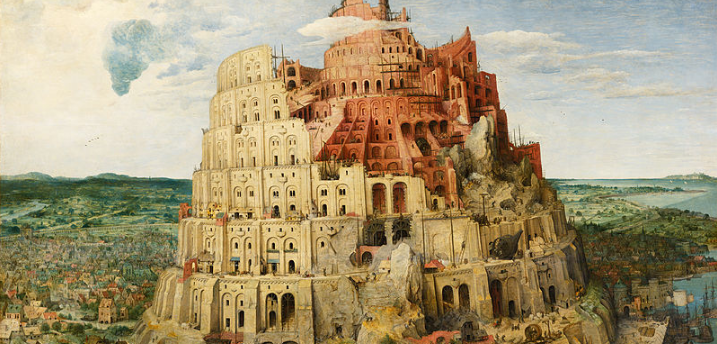
Main image: “The Tower of Babel,” Pieter Bruegel the Elder, 1563

Four Kinds of Problems with the Pan-Amazon Proposal on Married Priests

Eamonn Clark

The suggestion has been floated around in some quarters that at the newly announced Pan-Amazon Synod, to happen in 2019, bishops will discuss the possibility of ordaining married men in their region to the order of Priest. These “viri probati,” “proven men,” would make up for the absolute dearth of priests deep in the jungles of South America, where people are often deprived of the sacraments for long periods of time. There have been some missionary efforts there, but the terrain is vast and unfriendly, and the culture is extremely difficult to adapt to, so there has been limited success. It seems to some that simply ordaining certain men in isolated communities would help to make up for the absence of celibate priests in the area.

I note at least 4 categories of problems with the proposed solution. They are as follows:

  1. Canonical. The Code of Canon law, which binds the Latin Church (including, presumably, the men who might be ordained in the Amazon,) does allow for the possibility of married priests under certain circumstances (see c. 1047, §2, n. 3), but nowhere is the obligation to perfect and perpetual continence lifted for any cleric in the Code (though entering Orders – even the diaconate – without understanding or making the promise of continence means one cannot be obliged to its fulfillment). There has been much misunderstanding of the obligation to continence as distinct from the obligation of celibacy, and the widespread priestly ordination of married men in the Latin Church would make this worse. (On the other hand, it might finally get the mess canonically resolved.) For more on this confusing topic, see Dr. Ed Peter’s fine treatment here.
  2. Standard objections. There are many intrinsic problems with the idea of a married presbyterate. There are the economic problems, such as the time and energy a father and husband would have to spend between his family and the service of the community – or several communities, sometimes perhaps separated by miles of thick jungle, in this case. The resources needed to educate and train these priests adequately is an additional economic strain (and would likely never rise to the level of a normal priestly education), as is the payment of the priest who has to make enough income to provide for his family. There is the loss of the power of the witness of celibacy, which is a sign of contradiction to the spirit of the world, reminding people that there is a Heaven and a Hell, a death and a judgment, and that we had better start thinking about these things now if we are to be prepared for them later. There is also the impoverishment of the spirituality of the Latin priesthood as normally understood, which is spousal in nature and urges the priest toward greater charity for those in his care. In general, it seems that all the normal problems of a married priesthood obtain.
  3. Internal prudential. Not only will there likely be no comparison between the education and training of the Amazonian viri probati and a regular Latin priest, to the possibly very grave positive harm of the community (due to serious deficiencies in the confessional, in the pulpit, and so on), but the deeper problem causing the shortage is ignored. It is like a man who drinks to cure his depression – the feeling will go away for a while, but the underlying cause is never addressed. In the meantime, an addiction is developed which harms him positively and perpetuates the deeper problem, perhaps even worsening it. If there are no normal vocations to the priesthood, it is due to a lack of faith, a lack of zeal, a lack of something important in the local church. This ought to be the real object of discussion.
  4. External prudential. Once the Amazon has viri probati priests, who else will feel entitled? What other areas or countries will claim that they need this compromise? Meanwhile, as more concessions are made due to mounting pressure, the three foregoing sets of problems will perpetuate themselves.

The idea of a “simplex priest” may be what the bishops have in mind, a priest who does not do all of the public actions a priest with full faculties to preach and hear confessions would… But that comes with other problems, which will be addressed in a future post.

In summary, the bishops meeting at the Pan-Amazon Synod ought to think these things through quite carefully. I, for one, am unconvinced that it is a wise idea. But then again, I’ve only ever been to Amazon.com…

Sancti Obscuri – St. Crispin and St. Crispinian (October 25)

Jacob Gruber

In Shakespeare’s “Henry V”, King Henry overhears a soldier lamenting how few men have come from England to fight in a battle against the French at the Battle of Agincourt, leaving their odds of carrying home a win rather low. He responds with a bold appeal to all the courage left in the hearts of that “band of brothers” who did show up for battle and unites the hope of their victory with the celebration for all time of St. Crispin and Crispianus (Crispinian). It’s worth the watch:

Fictional though this speech may be, the king’s prediction seems to have unfortunately come true: “and Crispin Crispian shall ne’er go by from this day to the ending of the world but we in it shall be remembered!” In this article, it is my hope that on the feast of Crispin and Crispinian this year (October 25), Crispin and Crispinian themselves will be remembered for once!

These two saints lived the in middle of the third century in the Roman empire. Allegedly, they were brothers from a noble Roman family. The story from the Bollandists (from which the Catholic Encyclopedia draws their information in the case of these men) tells us that they went to Soissons in Gaul together to preach the faith. While there, they supported themselves financially primarily by making shoes. Their missionary work there was so effective, however, that it caught the attention of the high Roman authorities. A short historical detour is necessary at this point.

Crispin and Crispinian lived in the time of the Roman Emperor Diocletian. Any Christian familiar with some Roman history should be feeling the shiver run down their spine – this man was ruthless. He was Roman emperor from 284 to 305 AD, and in his rule he initiated one of the biggest, cruelest persecutions in early Church history (which is no small statement when the bloodbaths of Emperors Nero and Decius are taken into account). So bad was Diocletian’s persecution that, before Anno Domini (AD) came into fashion for marking years, the Christians (especially of the Alexandrian Church) used Anno Martyrum (AM), or the Era of the Martyrs, to mark their years. The Anno Martyrum system began year 1 in 284 AD – the beginning point of Diocletian’s reign and persecution.

With this in mind, consider that Crispin and Crispinian were preaching the Christian faith rather effectively at this time in Gaul, an important territory of the Roman empire. It did not take long at all for some action to happen. In the year 285 AD (or the year 2 in the Anno Martyrum), Maximianus Herculius, who had been made a sort of co-emperor with Diocletian, called the two men before him. After his efforts to persuade them to give up the faith, they responded,

“Thy threats do not terrify us, for Christ is our life, and death is our gain. Thy rank and possessions are nought to us, for we have long before this sacrificed the like for the sake of Christ and rejoice in what we have done. If thou shouldst acknowledge and love Christ thou wouldst give not only all the treasures of this life, but even the glory of thy crown itself in order through the exercise of compassion to win eternal life.”

Maximianus handed them over to Rictiovarus, the Gallic governor, who had them tortured terribly – stretched on a rack and flesh torn, among other horrible inflictions. After all of this, he had millstones fastened to their necks and had them thrown into the Aisne River. Miraculously, they managed to swim to safety. The Roman Martyrology succinctly finishes the story: “after [these] horrible torments, they were put to the sword, and thus obtained the crown of martyrdom.”

The Catholic Encyclopedia questions some of the credibility of this story, since its sources may be somewhat unreliable. However, we must examine a certain important principle in the matter of saintly stories, since credibility will always loom as an issue in the stories of the obscure saints. I simply quote a section from St. Francis de Sales’ Treatise on the Love of God in which he defends the practice of believing holy stories:

“Charity willingly believeth all things; that is, it is not so quick to believe that any one is lying, and if there are no apparent marks of falsehood in things which are told, it makes no difficulty about believing them; but above all when they are things which exalt and magnify the love of God towards men, or the love of men towards God … in matter of religion, good souls have more sweetness in believing things in which there is more difficulty and admiration.” (Chapter XII)

By means of this argumentation, St. Francis de Sales was insisting that a certain miraculous story told in a homily by St. Bernard could be believed, even though he simply had no evidence whatsoever to prove it. We are in a similar situation. We’ve been handed a story of the miracles and martyrdoms of Crispin and Crispinian with only the written testimony of writers centuries later to show for it. But the good souls have more sweetness to believe stories such as these. Our charity willingly believes all of these things.

Thus,  I would suppose that we can accept the story handed onto us from the works of the Bollandists – but I’ll leave that up to the reader.

So, what if Crispin and Crispinian hadn’t fallen into obscurity? They are already known as patron saints of shoemakers, saddlers, and tanners. But their legacy is more than cobbling. While the modern imagination tends towards Shakespeare’s reference in “Henry V,” it turns out that this reference is not so far from the original spirit of these men. The Battle of Agincourt was a battle in which England triumphed against great odds over France in 1415 AD. But Saints Crispin and Crispinian in their own way triumphed against great odds in France (Gaul at their time), albeit in a spiritual battle for souls.

So let us hail them today as victors all the same! May St. Crispin and St. Crispinian pray for us!

Heterodox Does Not Mean Heretical

Eamonn Clark

Update: See Dr. Ed Peters take on this issue (in a better way, taking up the issue of “refraining from proclaiming truth”) here.

In an earlier post I examined the beleaguered (and yes, still deserving of charity) Fr. James Martin, SJ’s denunciation of the rash use of the label “heretic,” together with some extremely suspicious Christology.

I actually agree with him regarding his claim that he is not a heretic (at least according to law, which involves outward signs revealing what is within the soul). This is with respect to his Christology and even with his homosexualist agenda. Nor does his shocking (but not quite totally direct) endorsement of apostasy rise to the level of “heresy,” I suggest. Of course, I also think these things are awful and deserve serious attention from the appropriate ecclesiastical authorities. Until such a time as those offices give that attention, and as long as “Martin Mania” continues, may I offer some selected thoughts on how to navigate this alarming controversy and propose the wide-spread resurgence of the use of a timeless treasure of the Church – hopefully in an “official” way?

Theological censures.

A theological censure is a kind of warning – or judgment – about a teaching or a written work. A local bishop, a special commission, a Roman congregation, or the pope himself might issue a censure. A censure says that a teaching or work is heterodox (at odds with the truth in any of a variety of ways) and/or dangerous to the moral life of those who might encounter it. Works that receive bad enough censures might be put on an index of forbidden literature, and teachings might be condemned in the form of a syllabus. Theological censures are still used today but not nearly as much as they used to be. While there is some danger with them (such as descending into incessant hair-splitting or losing a sense of theology’s purpose, such as was happening with the overuse of manuals), it seems an opportune moment to begin at least talking about popularizing this tool once more.

Suppose a Jesuit writes a book with imbalanced emphases, a bold assertion about rewording the Catechism, and generally scandalous phrases which tend to affirm sinners in their sin. What censures might be relevant?

There are three broad classes of censures which could possibly be placed on any work, or even propositions within a work. The first regards the importance of the teaching’s object itself, the second regards the mode of expression of that teaching, and the third regards the moral character of the teaching itself and its foreseen practical consequences for morals. (There is another means of categorizing censures, viz., according to the relevant “theological note”, but this is the simpler method and allows an easier way to admit the third category mentioned here.)

The first category is where we find the term “hæretica,” meaning “heretical.” It is the highest censure that can be placed on a teaching or work. A heretical teaching is one which directly and immediately contradicts a doctrine “de fide” (or dogma), a truth revealed by God which must be believed (“credenda”) with divine and Catholic faith. To say, “God is four Persons,” or “Christ had only a human nature,” or “the Eucharist is not substantially Christ,” or “the Commandments are impossible even for one in grace,” would be heretical. It is very, very difficult to earn this stamp of disapproval. The too frequent use of the word “heresy” is a bit like the casual use of bad language – it empties it of its power, and it should be discouraged. It is quite difficult to commit the sin of heresy, and it is even more difficult to commit the outward crime which can be judged by the Church publicly as such. The latter requires outward, explicit, and obstinate confession of a proposition directly contrary to a de fide truth/dogma.

Are there dogmas regarding morals? Yes. I contend it is dogmatically certain that murder is immoral, as it is expressly condemned in Scripture and denounced by the ordinary magisterium of the Church in an infallible way, that is, consistently and universally throughout the entire history of the Church. It would be heretical to support murder as such. On the other hand, it would be more difficult to say that the immorality of abortion is a dogma, as it is at least somewhat debatable that the ordinary magisterium has consistently and universally enough maintained that unborn life in all its stages is truly human and therefore inviolable. The naturally available truth of the humanity of the embryo, now completely evident, confirms that abortion does indeed constitute murder. But because we have to put these two truths together, one which is a dogma and one which is a natural truth related to it, to say abortion is immoral is not, in the strictest sense, heretical. One might put it in one of two categories: “erronea” (erroneous), supposing the humanity of the embryo is or was a sufficiently doubtfully applied natural truth, unlike an innocent adult (which, if taken away, would leave the 5th Commandment void of content altogether), or “hæresi proxima” (next to heresy or approaching heresy), if it is the case that one sees the humanity of the embryo as having been insufficiently doubtful to warrant the need for an additional truth on top of what is already implicitly contained in the Commandment. Either way, this is still a terrible label… To be in an error of faith, or to be next to heresy, should be frightening to the one putting forth the teaching, as it is still mortal sin. (Do take a look at the theological notes chart here, with more examples and explanations for all this.) Error regards things which still must be held (“tenenda”) by Catholics. The support of the legal recognition of same-sex unions as marriage would fall in one of these lower (but still binding) categories… It involves a dogma and a naturally available truth (called a “certa”), or it involves a truth immediately derived from the dogma which is “proxima fidei” (next to faith and commonly believed to be revealed, but without ever being the object of a formal enough definition). The dogma is that sacramental marriage is between a man and a woman, and the natural or derivative truth is that men are not women (and vice versa). Supporting homosexual marriage in law would be contradicting either a certa (mix of a truth from natural reason and a truth “de fide”) or to contradict the immediate derivative of the dogma itself. Heterodox? Yes. Heretical? No. (I tend to favor the label “erroneous,” but that’s too much to get into here.) And the vaguer the language becomes, the more difficult it is to levy a high censure rightly. To say something like, “There can be true love in a homosexual act,” is surely wrong in many ways, but it is vague enough to be far from deserving that worst of labels, “heresy.”

Returning to the example of abortion, the claim that so-called medical abortion or craniotomy (both of which destroy the child to save the mother) are licit procedures, given that such a condemnation is difficult to reconcile with the general affirmation of the morality of self-defense, could be called “errori proxima” (next to error): the contrary is able to be deduced from the right teaching on abortion. It would be “temeratia” (rash) to assert that the vast majority of abortions are only venial sins on the part of the mother due to the distress of the situation. In no way is this clear, as the natural truths involved are not at all available to the one who makes this claim (so one must wonder at the reasoning), and so this is also at odds with the common opinion of theologians.

Propositions which just seem like heresy or error but can’t quite be charged with the other offenses might be labeled “sapiens hæresi/errori” (smacking of heresy/error) or even “suspecta de hæresi/errori” (suspected of heresy/error).

There are other qualifying labels which might be added, according to what kind of truth is being contradicted (Scriptural, credal, moral, etc.), but this will do for our investigation of the first category.

The second regards the way a teaching is put forth. Even true teachings could be censured in this way. A proposition may be “ambigua” (ambiguous), for example, leaving itself wide open to bad interpretation. “Protestants should be welcomed into the Catholic Church,” might be an example… Surely, entrance into full communion should be done in a welcoming way, but we should not simply begin treating Protestants as part of the Catholic Church.

Statements might also be “captiosa” (captious), “male sonans” (evil-sounding), or, my favorite in this category, “piarum aurium offensiva” (offensive to pious ears). The first uses unobjectionable language to forward an objectionable agenda (“Priests might be allowed to marry one day.”) The second is when inappropriate words are used to express truths (use your imagination). The third simply shocks the sensibilities of Catholics, though it may well be true. (See my post on Jesus and the Aliens, which arguably comes under this category. I claim there that our sacramental economy could not incorporate extraterrestrial life because aliens are not descended from Adam. The short and “offensive” version is, “Jesus can’t save aliens.”)

The third category describes what a teaching does that is morally wrong or encourages that is morally wrong. They are rather self-explanatory. The category includes but is not limited to “subsannativa religionis” (derisive of religion), “decolorativa canodris ecclesiæ” (defacing the beauty of the Church), “subversia hierarchiæ” (subversive of the hierarchy), “arrogans” (arrogant), “scandelosa,” “perniciosa,” “periculosa in moribus” (scandalous, pernicious, dangerous to morals), which might include “blasphema” (leading to blasphemy), “magica” (leading to sorcery), “idolatra” (leading to idolatry), etc., etc.

Hopefully this will serve as a decent primer on this important and seemingly neglected area of Church governance and teaching.

What censures might some of Fr. James Martin, SJ’s countless articles, tweets, books, and speeches rightly be labeled with? Many, for sure, but that would be for the lawful authorities of the Church to determine and pronounce. Though I do not think that anything I have seen warrants that highest and worst label hæretica.

But that is surely nothing to brag about.

Comments are closed. See follow up here.


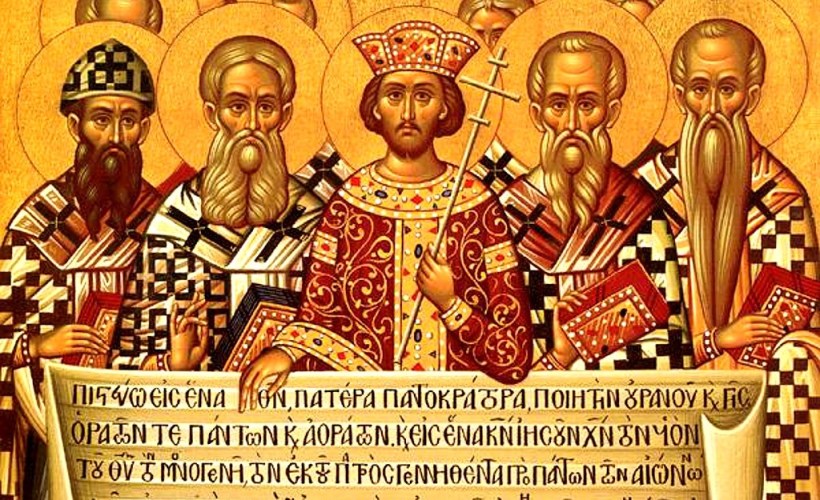
Main image: Detail of an icon of Nicaea I

In Defense of Bad Priests

Eamonn Clark

I recently prepared third graders for their First Holy Communion. Going through the story of the Last Supper several times, I noticed that they had a fascination with a certain Apostle… You guessed it – Judas. A fascination with such a character is understandable, as it seems rather out of place in a story which one would think is supposed to be exclusively upholding models of virtue. This is not unlike the very grown-up temptation to expect moral perfection from Catholic clergy. After all, they are supposed to be models of virtue, right?

Yes, they certainly are, and extra scrutiny is rightly deserved because we do indeed have the fullness of truth and grace available to us. But here are the facts. Our Lord chose losers, dummies, and wicked sinners as the foundation of His Church. Of the original Twelve, ten were ambitious cowards. One of those ten was also arrogant (Peter). The eleventh was just ambitious (John). And the twelfth one was a greedy traitor. (Later on He would also call a terrorist to this elite group.)

The place to start looking at the failure of any priesthood is a comparison with the first four failed priesthoods, and the first successful one: Adam, Aaron, Nadab, Abihu, and Melchizedek, respectively. (Others such as Abel and Noah and Abraham offered sacrifices, like priests, but they were not called by the name “priest.” More could be said about their sacrifices as well.)

Adam was the high priest of nature, called to guard and serve the Garden of Eden and his wife Eve at his own expense. He ought to have put himself in front of her and the serpent, but he shrinks away from his duty. He stands next to her (as Eve “turned to her husband” to give him the fruit) and watches this calamity take place. The serpent goes after Eve first, because he knows that she is easier to trick and that she might be able to trick her husband. When confronted by God, Eve blames the serpent, and Adam blames Eve: there is no responsibility taken.

The Devil often seeks to harm God’s priests through the very people they are called to protect. In this case, Adam’s own fear and self-interest allow his beloved to fall, and then she takes him with her – for what husband would want to have a wife estranged from him, as Eve surely would have been without Adam following her into sin? And yet they become estranged from each other anyway, needing to hide themselves with the flesh of animals… The first time blood is shed in Scripture, it is to cover up the sins of our first parents. A sign of things to come, for sure.

The next failed priesthood is Aaron’s. While Moses is busy with spiritual matters on Mount Sinai, the people grumble against him. The patience required to receive the Covenant is too spiritual for them, and so they threaten to leave the mountain in protest. Aaron is concerned about such a loss of numbers – he is afraid of what Moses will think. He has the people give him their gold, and he makes for them an idol which provides them with the experience of God they wanted: an unchallenging, unspiritual, ungodly experience. But the people are happy, and they stay put for a while, high on their own erroneous ideas about the worship of God. Aaron saved the day. When Moses returns with righteous fury, Aaron explains, like Adam did before God, that it was not his fault – it was the people’s and the furnace’s. More shirking of responsibility. (Moses gives them the proper experience of the god Aaron made for them when he ground it down, threw it in the water, and made the people drink. Like a good priest, he teaches them that a dead god gives even less life than water: it cannot save.)

Unlike Adam, Aaron’s ambitions were totally worldly. Instead of trying to become like God as a direct opponent, he simply wants to be the hero of God’s chosen people. Aaron wants just a little bit too much of their attention… He is not really after the gold, but what lies behind the gold – the esteem of men. That is what gives gold its value, after all.

Nadab and Abihu were Aaron’s sons. They violated the code of the Lord’s sanctuary by bringing unholy fire into the Tent of Meeting. This strange fire was deeply repugnant to the Lord, and so He slew them where they stood. Our Lord will only have sacred heat and light dwell within His holy place. Though profane fire may sustain bodily life, only sacred fire can sustain the life of grace.

The first successful priesthood is that of Melchizedek, whom Abraham meets after his battles. His is a totally spiritual and eternal priesthood, offering bread and wine and accepting the tithes owed to him for his work. He does not ask for money, he simply receives it. He is a priest not because of his family stock, like the Levites, but because of his charity. He gives to God first, then he receives what is rightfully his from men. He does not go looking for greatness: he simply is great.

Judas wraps up all of the failures of earlier priests in himself and makes them even worse. He is unwilling to do the work of a priest, putting himself in the place of Christ over and over again for the salvation of souls, standing in the way of the Devil’s reach of the weak, even though he would not have been alone in this task, unlike Adam. He trades the incarnate Lord not for the esteem of men, but for money itself. The purifying fires of the grace welling up in the Eucharistic Lord are traded for the fires of the foundry which purified the silver he would take as payment for his betrayal and would later throw into the Temple to try to buy back that grace. He takes into his body the blessed fruits of that very first celebration of Holy Mass which he was simultaneously endowed with the awesome power himself to perpetuate, as a recapitulation and elevation of Melchizedek’s priesthood, and then invites in the Devil to contradict it all. Though the accidents of bread and wine sustained Judas’ bodily life, the spirit within him died because of the rejection of the grace within the Lord’s Body and Blood – true food and true drink which preserve from everlasting death.

What greater human evil is there than the evil found in Judas on Holy Thursday? And yet that very night, Our Lord bowed before him to wash his feet, and He even personally called him “friend.” It is not unfair to say that, in a way, God loved Judas more than anyone else in human history, for there has never been a fouler human being to love. In the midst of this supreme wretchedness, Christ left us a memorial of His own greatness.

We know how the human story turns out. Judas despairs of the very mercy he was shortly supposed to be empowered to bring to others in the sacrament of confession. He attempts to slay himself (though perhaps did not succeed, and received even more time to repent), as if the death of the Lord had not been enough payment for his sin… No, Judas saw himself as so great that he believed his sin was unforgivable. “What a fool I have been,” he uttered. Yet this foolish failure brought about the culmination of our very redemption. Without Judas, there is no Passion, Death, or Resurrection. There is also not the greatest condescension of love ever shown by God. Deicide is not therefore justified, but God’s choice to allow a bad priest to exist in the Church is.

Meanwhile, Peter weeps in contrition and makes amends with “the man” he denied knowing, within earshot and within hours of having heard this prophesied. He left that “strange fire” in the courtyard, from where he watched the Lord shiver in the cold and dark of the prison cell, and he leaves the slave girl before whom he cowered in fear. Behold, the Prince of Apostles, who would eventually learn that taking up the sword is better left to those who persecute Christ than those who defend Him, and who would finally end his life as a willing victim upon a cross. The priesthood of Peter was in as sorry a state as the priesthood of Judas; the difference was repentance. Yet again, Our Lord shows his greatness through the failures of one of His hand-picked dispensers of grace.

The Church on Earth is institutional and hierarchical by nature, because human beings require such an order so as to avoid repeating the tragic error of the men of Babel who tried by their own powers to cooperate to reach up to Heaven. The Church on Earth is also sinful by nature, because it is populated by human beings – even in its hierarchy. It has been so from the moment of its inception, and this is by design. No, God does not want bad clergy in the same way He wants good clergy, but He does want to permit them to exist for now. He knew Judas would betray Him, and He knew all the clerical pedophiles, heretics, and antinomians of our own day would do the same. While they betray the Lord by selling Him for popularity or money, as they shrink from their duty to stand in front of Satan and then blame the weak or the natural insufficiency of their means, as they profane the Eucharist through indifference toward it, they repeatedly show the power of Christ in His Church: even through all this, there is victory waiting.

There has always been a crack in the foundation, there has always been chaff in the wheat, and yet there has always been grace available through these men nonetheless, as it is God’s own power which is the source of their priesthood and thus the source of their power to give grace – “ex opere operato.” God shows His majesty in the midst of this weakness and wretchedness. And sometimes He even brings these men out of their shameful disgrace and elevates them to the profoundest heights of sanctity, a feat which must be marveled at. There is true hope of Heaven for every bad priest in this world. Christ calls each of them “friend.”

Perspective is important. “There is nothing new under the sun,” as Qoheleth reminds us. We would do well to recall more frequently the beginnings of the Church to understand Her challenges today. (A reading of the disturbing history of ancient Israel would help too.) Whatever cleric is the object of concern – parish priest, celebrity priest, local bishop, curial official, pope… If there really is sin there, realize that it is just business as usual. The Barque of Peter has always leaked in the storm while the inept crew runs about helplessly, and yet it continues to float safely toward the harbor. Our Lord can guide it even in His sleep.

Let’s pray and fast for all priests, especially those who need it most.

Our Lady, Queen of the Clergy, pray for us!


Main image: Pope John XII, who was killed in the act of adultery by a vengeful husband

Priests and the Free Exchange of Ideas: A Closer Look at the Garvey Statement

Eamonn Clark

President Garvey of the Catholic University of America has made some excellent administrative decisions during his tenure, most famously regarding the implementation of single-sex dorms. The university itself is a wonderful place doing wonderful things, and I have had the privilege of visiting many times for various reasons.

It was with some surprise and disappointment then, that I read the most recent press release from CUA.

From the outset, and with the due charity everyone owes toward beleaguered Jesuit Fr. James Martin (which I hope readers will also sincerely extend to this deeply troubled man), I wish to say that I agree wholeheartedly with the decision of CUA’s diocesan seminary, Theological College, and its rector to cancel the invitation to this priest who has undoubtedly become the most famous American cleric without a miter. The “rap-sheet” of Fr. Martin is, at this point, enormous to the point of tragic hilarity. From the unrelenting LGBT advocacy, to his quasi-heretical Christology, to suggesting that apostasy could be demanded by Christ, there is perhaps no active cleric in the United States more inappropriate to host at a seminary speaking engagement.

Notice that last bit: a seminary speaking engagement.

President Garvey released a statement yesterday distancing both himself and CUA from TC’s decision to withdraw the invitation. In part, it reads:

The campaigns by various groups to paint Fr. Martin’s talk as controversial reflect the same pressure being applied by the left for universities to withdraw speaker invitations. Universities and their related entities should be places for the free, civil exchange of ideas. Our culture is increasingly hostile to this idea. It is problematic that individuals and groups within our Church demonstrate this same inability to make distinctions and to exercise charity.

Before analyzing, let’s also recall an interview with Crux where President Garvey explained this attitude toward selecting university speakers:

That’s a long wind-up, to the following answer: When we invite someone to be a commencement speaker, the university is saying something. That’s why the American Catholic bishops say that Catholic universities shouldn’t give honors, platforms, and awards to people whose view is at odds with the views of the Catholic Church.

What they are saying literally is that universities like us shouldn’t endorse people like that. We should not say “Yay, Barack Obama, you support enshrining the ‘right’ to kill the unborn.” We shouldn’t give him honorary degrees or hold him up to our students as our example.

On the other hand, I would be perfectly happy to invite President Obama to Catholic University, even to talk about abortion if he wanted to. What better place than to have a conversation with the President about an issue that is important to Catholics and others? We’re just not going to give him a prize for taking a position that we condemn.

While there might be many things to say about President Garvey’s press release and this interview excerpt (as well as the rest of it), I will limit myself to two observations:

1. Invitations to speak at major university functions are honors or awards – the sort a person might put on his or her resumé – and people are right to zero in on major moral failures of people being thus honored or awarded, especially at Catholic universities which are held to a higher standard.

2. A seminary is not a university.

The first point is hopefully not too contentious. We can certainly draw a distinction between a commencement address and a presentation or panel that exists for the sake of education within the context of a university setting. To cite Ex Corde Ecclesiae against holding a forum that hosts someone antagonistic to the Faith would be questionable, provided there were certain checks and balances in place to ensure an appropriate context for discussion and exploration of ideas which are at odds with the Church’s teaching.

The second point is, unfortunately, a distinction which President Garvey did not seem to care to explore, despite himself lamenting a dearth of distinction-making. While TC does operate under CUA and therefore is technically part of the university (as a “related entity”), the seminary itself exists for a much narrower purpose than the university at large, and thus it is governed by certain people and certain principles which ensure the successful fulfillment of that unique purpose: the formation of Catholic priests.

It beggars belief that Fr. Martin would be in a position to help forward any Catholic seminary’s distinct mission. In fact, had the invitation not been rescinded, it would have spoken volumes on how TC sees its purpose: remember, a major speaking engagement is a kind of award, and people are right to question awarding people with major public flaws. What would it say about the seminary’s curriculum? Its formators? Its sending bishops? Etc.

Mr. Garvey’s criticism would have been more on-point had Fr. Martin’s invitation to speak had come from the university’s sociology department, for example, if they were hosting a panel on gender studies. However, given that clerics represent the Church in a unique way, this too, I suggest, would have been inappropriate. Even if a priest with an opposing view (which accurately represents the Church’s teaching) were invited, such a panel would give vulnerable young minds the impression that the Church does not know what to say about these topics and that one priest’s opinion is just as good as any other’s. On the other hand, to take Mr. Garvey’s example, everyone knows that Obama is pro-choice. A pro-choice speech from him, in the right arena at a Catholic university, would not be particularly harmful in itself. But if Fr. So-and-So, “priest in good standing and whose ambiguous writings on abortion are approved by his superiors,” is invited to present a mildly pro-choice position, then we have a major problem.

Just as a seminary is not a university, a priest is not a layman. He is called to a higher standard, as Canons 273, 276 §1, and 277 §2 point out. (Perhaps some of these laws might make for a fitting addition to any Catholic university’s speaker invitation policy.) A priest who misrepresents the Church’s teaching – or even inordinately under-represents it – would be much more damaging to students than an openly anti-Catholic government official.

Seminarians and priests returning as alumni do not need the same kind of “free, civil exchange of ideas” which a Catholic university in general might benefit from. What such men need is the true doctrine of the Church presented clearly. They need insights into good, solid pastoral praxis. They need accessible summaries of critical issues in those sciences connected with pastoral work. They need emphatic encouragement to keep going in the face of cultural and personal opposition, and even worse, indifference. Anything else is almost guaranteed to be a waste of their time. It is quite doubtful that Fr. Martin was prepared to offer any of these things to the good men returning to celebrate 100 years of Theological College’s existence, and thus Fr. McBrearity’s decision as rector to disinvite him was certainly correct, with or without public outcry. There was nothing to gain by going through with the invitation, and there was so much to lose. While President Garvey thinks that an important principle has been undermined on his campus, this is simply not the case. On the contrary, several have been upheld.

Comments are closed.

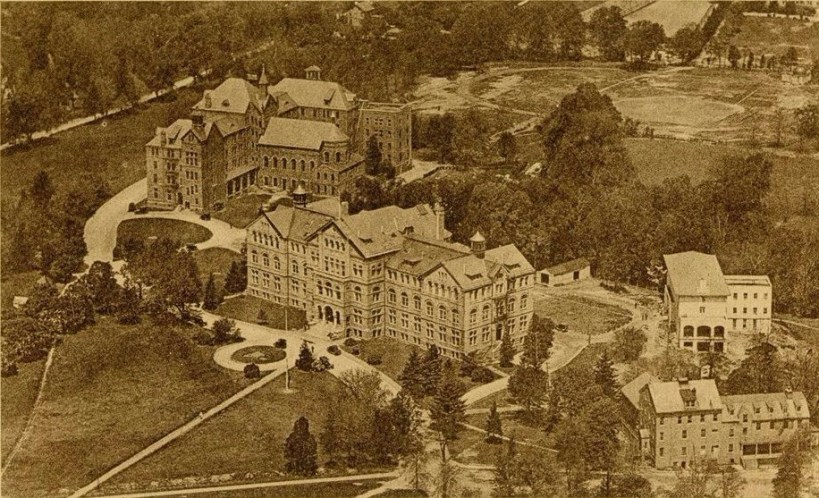
Main image: CUA in 1920

Sancti Obscuri – St. Porphyrius (September 15)

Jacob Gruber

​If you were asked off the top of your head to name five saints of the Catholic Church, who would come to mind? St. Therese of Lisieux, St. Padre Pio, or St. Francis of Assisi? Perhaps St. John Paul II or Mother Teresa? But what about St. Euphemia or St Paphnutius? Surely St. Iphigenia made it somewhere on the list?

​If these latter names don’t ring any Church bells for you, this new column may be right for you. It’s no secret that we have “saint celebrities.” If you’ve lost an item, you think to pray to St. Anthony, not St. Abundantius. If you want help in discernment, you probably prefer St. Therese’s roses to St. Rosalia’s. But what about these other saints? Don’t they have something to teach us, to inspire us with, to remind us?

​This new column, “Sancti Obscuri,” will look at different saints who, for one reason or another, have become obscure to the modern Catholic imagination. The posts won’t be exhaustive, considering how historical obscurity tends to coincide with a paucity of source material. But if these forgotten men and women have received the crown of sainthood, then they have a story worth hearing. (They know something of Thomas Jefferson’s exasperation in this old “Simpsons” episode, “Mr. Lisa Goes to Washington.”)

Our first “sanctus obscurus,” St. Porphyrius, shares a feast day with Our Lady of Sorrows on September 15. In his life, however, he would not have known what to do with a celebration of a “Lady of Sorrows.” By profession, he was a comedian, a mimic, a famous jester. He was a prevailing voice of the remnant of paganism in the post-Constantine Roman Empire, offering to those who hadn’t accepted Christianity a sufficient mockery of its tenets. People expected comedy and corruption from him, certainly not conversion. Yet, as we will see, he was a man who, within a day, went from mimicry to martyrdom, profanation to profession. Before we tell his story, some background is in line.

His story begins best with the story of Julian the Apostate, who, given the spoiler alert in his name, didn’t care for Christianity very much. In the years following the death of Constantine the Great in 337AD, a barrage of complicated politics had plagued the leadership of the vast Roman Empire. Fast forward a couple of decades, and in 361AD one “Flavius Claudius Julianus,” a nephew of Constantine, arose as sole emperor. His reign was to be short (only 20 months), but not without activity.

Although Christianity for almost 50 years had enjoyed political freedom and support from the emperor, the rule of Julian loomed as a serious threat. Though he was a Christian for the first 20 years of his life, he came to reject the Lord and choose instead the “way of Helios” (see his Letter 47). Julian the Apostate envisioned a return to the Roman paganism of old, a religious atmosphere marked by highly syncretistic polytheism, unified, as it were, under the banner of being ‘not Christian.’

When Julian heard of the fame of Porphyrius the Mimic whose specialty was mocking Christians, he had him brought in to entertain the royal court. Everything was set up for a successful show. The audience was eager to be entertained at Christianity’s expense, and Porphyrius had put together a special play; he was going to mock the Mystery of Baptism.

The show was a riot, eliciting raucous laughter to be sure. Things seemed to be lining up perfectly. The climax of the action involved a mock-baptism scene with fake clergy dressed in liturgical garb immersing the “catechumen,” Porphyrius, into some water.

He ceremoniously pronounced that he would now be a follower of Jesus Christ, “in the Name of the Father and the Son and the Holy Spirit” before being immersed. But something happened when Porphyrius entered the water. Submerged in that moment, Porphyrius felt the summons of actual grace, a call to serious conversion. Coming out of the water, he announced his decision to all present that he wished to be a Christian and would no longer mock the Living God. But, while he had his metanoia, the emperor was simply annoyed. The Roman Martyrology sums up best what happened next:

“Forthwith, by order of the emperor, he was struck with an axe, and thus crowned with martyrdom.”

​Struck with the extraordinary work of divine grace, he managed to get struck also by the work of human anger. Having given over his heart to Jesus, he gave his head to the emperor. Thus is the story of the great Martyr Porphyrius. Once a jester before secular courts, he was to become a martyr in the heavenly courts.

​As for Julian the Apostate, his hopes for a revival of Roman paganism would not find widespread success. In 363AD, following Julian’s military death, Emperor Jovian took the emperor’s throne and restored the faith of the Roman Empire to Christianity.

​Suppose St. Porphyrius hadn’t slipped into obscurity in modern spirituality. Comedians and performers would have a ready patron, and the whole Church would have a better sense of God’s poetic justice. As it is, let us at least take the lesson to have sincere reverence for the truth and all holy things even when it puts us in rather difficult situations. Don’t forget to invoke his intercession every September 15!

May St. Porphyrius pray for us, and teach us true reverence for the Lord!

The Very Bad Christology of Fr. James Martin, S.J.

Eamonn Clark

UPDATE (4/12/18): There could be some subtlety added to this discussion, such as whether God could intentionally withhold some knowledge from the human nature of Christ for plausible deniability or a capability of identifying with humanity more. See here for a filmed, in-depth, and orthodox exploration of this topic. Most of the post still stands.

*Charity Goggles required*

No doubt most readers will be aware of the furor surrounding Jesuit Fr. James Martin’s latest book, Building a Bridge: How the Catholic Church and the LGBT Community Can Enter into a Relationship of Respect, Compassion, and Sensitivity. Since the issues with the book have been beaten to death – though not to a definitive conclusion – they will not be treated here. An item which has gone nearly undetected by comparison, though perhaps deserving much more treatment than his very bad book, is the very bad Christology which Fr. Martin has been publicly espousing recently.

This past Holy Week, Fr. Martin preached on the 7 Last Words of Christ prior to the Good Friday liturgy at the Cathedral of St. Matthew in Washington D.C. The Archdiocese reported as follows:

The sixth phrase, “It has ended; it is finished,” is usually interpreted by scholars to be the fulfillment of God’s will, said Father Martin, but he suggested that it can also be interpreted as a resignation, with Jesus saying, “I have done all I can do.” He may have wondered whether the apostles would carry on His work after He died, and be unsure if the great project of His ministry was coming to an end, Father Martin explained. But even if Jesus didn’t yet know how His project would continue, “The Father had other plans,” Father Martin said.

Further on:

Lastly, Jesus said, “Father, into your hands I commend my spirit.” Father Martin said his favorite theological question to think about is whether Jesus knew what was going to happen on Easter Sunday before He died. While the answer to the question is a mystery, “the one thing we do know,” said Father Martin, is “He desires only to do the Father’s will,” and in the Garden of Gethsemane, He reached the “ultimate decision point.”

Anyone who has read the Gospels will at this point be reaching for an explanation. Doesn’t Christ speak many, many times about His Resurrection and what will happen after He leaves the Apostles? Doesn’t He show He has foreknowledge in other instances as well? Yes, but it is not for no reason that Fr. Martin has taken his position. He has seen a true difficulty and is attempting to resolve it.

LifeSiteNews ran an article which originally commented on the content of the Good Friday talk (although it has since been edited). Fr. Martin decided to attempt to defend himself in the combox.

He is fully human. With a fully human consciousness. (Which means he would have had knowledge only of what a human person could know.) And fully divine. With a fully divine consciousness. (Which means he would have had the knowledge of the Father.) It’s a great mystery of how those two natures participated together. But to imply that I was denying his divinity is absurd. Feel free to read “Jesus” and “Seven Last Words.”

I don’t want to be too hard on Fr. Martin’s comment, as it was only in a combox, but there is a lot to investigate here. Why does he say “consciousness” and not “nature,” or “intellect,” or “hypostasis”? “Consciousness” is very vague and could lend itself to various interpretations. Also, why does Fr. Martin use the phrase “human person” and then make a contradistinction with “the Father”? Surely, he would admit that Christ is not a human person, but a Divine Person (the Son, not the Father) with a human nature, yes?

Now let’s add one more piece to this puzzle.

Fr. Martin recently took to Twitter (on August 20th, 2017) to explain the interaction between Christ and the Canaanite woman (Mt. 15: 21-28, Mk. 7: 24-29), which was the Gospel reading of the day:

Gospel: Today we see Jesus’ human and divine natures: he learns from the woman that his ministry extends to all, and he heals her daughter.

And then later that day, after receiving numerous rebukes from people who did not agree that Jesus learned about the scope of His salvific mission – the very purpose of His existence – from a mere creature, Fr. Martin responded with:

The most popular heresy in the Catholic Twitterverse is Docetism. It betrays a fundamental fear of any indication that Jesus was fully human

Seeing as Fr. Martin here uses the “h-word” as a defense against people who disagreed with his exegesis, do we not have the right to examine what he is saying in as serious a way as he treats the matter of an accusation of heresy?

But it was an exchange with Massimo Faggioli, a well-respected church historian, during which Mr. Douthat randomly tweeted “Own your heresy,” which sent things over the edge…

Calling [a theologian] a “heretic” is like calling a journalist a plagiarist.  These aren’t funny punchlines to be taken lightly.  They are attacks on one’s faith, and for theologians possible career-enders…

I’m disgusted with the facile use of words like “heresy” and “schism” and “apostate,” passing itself off as defenses of the faith.

All this from the same piece – and these are just some highlights.

Seeing as Fr. Martin is not tolerant of the lax use of these words, even in Twitter fights, shall we investigate what is at stake in his recent comments?

The Council of Ephesus proclaimed Mary as “theotokos,” or “God-bearer” – the Mother of God. This was defined against the doctrine associated with Nestorius (whose relationship with the doctrine is actually quite complicated), which was that Christ was both a human person and a Divine Person loosely united together. This meant that there are really two separate beings or “whos” in Christ: Jesus the human person, and the Person of the Son. Nestorianism was condemned again 20 years later at the Council of Chalcedon. In short, Nestorianism is definitely a heresy, and no Catholic can argue otherwise.

A view which splits Christ into two persons – not merely two natures – could account for several puzzling items. (After all, heresy usually makes matters simpler than they really are.) How is it, for instance, that a woman could really be “the mother of God” if Christ is fully human and is being born according to His humanity by which He is her son? Are His divinity and humanity the same? Of course not (although Eutyches, condemned at Chalcedon, tried something like that solution to this problem). Nestorius could easily explain this – Jesus the human person was born, God the Son was not, even though He was united with Jesus. A similar solution might be given to the problem of the death of Christ. How can God the Son die? The Nestorian answer is that, in every sense, He did not. There is no need for the complex subtleties of the communicatio idiomatum on this account.

Some kind of Nestorian Christology could also explain a strange verse in Scripture which is, frankly, very confusing and frequently misunderstood. It is Mark 13: 32, where Christ speaks of His return: “But of that day and hour no one knows, neither the angels of Heaven, nor the Son, but the Father alone.” (Matthew 24: 36 is identical, although many ancient Matthean manuscripts lack “nor the Son,” for what it’s worth.)

How to explain this? Certainly, we would not say that the Person of the Son does not know “the day nor the hour,” as He is God in the same sense the Father is God. Could the Gospel writers be suggesting that there are future contingent things that Jesus “the Son (of Man?)” just does not know as a human being and needs to learn, even if God the Son knows them as God? What else would account for this strange utterance of the Lord? Perhaps Fr. Martin’s comments are not so off-base…

Fortunately, this exact issue was settled a long, long time ago, in the year 600 A.D. to be precise. There had been folks – the “Agnoetae” – who picked up on exactly this verse and ran with it. They suggested that Jesus, in His humanity, did not possess the fullness of knowledge He possibly could, as if God the Son had held back some secrets. Pope St. Gregory the Great thought this to be problematic and weighed in on the matter (Denzinger 248). Shall we go through the text?

(But) concerning that which has been written: That neither the Son, nor the angels know the day and the hour [cf. Mark 13:32], indeed, your holiness has perceived rightly, that since it most certainly should be referred not to the same son according to that which is the head, but according to his body which we are . . . . He [Augustine] also says . . . that this can be understood of the same son, because omnipotent God sometimes speaks in a human way, as he said to Abraham: Now I know that thou fearest God [Gen. 22:12], not because God then knew that He was feared, but because at that time He caused Abraham to know that he feared God. For, just as we say a day is happy not because the day itself is happy, but because it makes us happy, so the omnipotent Son says He does not know the day which He causes not to be known, not because He himself is ignorant of it, but because He does not permit it to be known at all. Thus also the Father alone is said to know, because the Son (being) consubstantial with Him, on account of His nature, by which He is above the angels, has knowledge of that, of which the angels are unaware.

Gregory suggests that perhaps Christ is speaking figuratively, just as we figuratively attribute some characteristic to a thing on account of that thing causing that characteristic in us. His non-Scriptural example is a “happy day,” which is happy because it makes us happy. On this account, Christ “does not know” because he does not make us know. Christ attributes the knowledge to the Father, since God the Father does have the knowledge, but since God the Son is consubstantial with the Father, this would also mean God the Son has the knowledge. Basically, Christ is condescending to the disciples’ poor understanding of His nature – they don’t know him as God the Son, consubstantial with the Father. (cf. Mark 10: 18, Luke 18: 19 – “Why do you call me good? None is good but God alone.”)

 Thus, also, this can be the more precisely understood because the Only-begotten having been incarnate, and made perfect man for us, in His human nature indeed did know the day and the hour of judgment, but nevertheless He did not know this from His human nature. Therefore, that which in (nature) itself He knew, He did not know from that very (nature), because God-made-man knew the day and hour of the judgment through the power of His Godhead. . . . Thus, the knowledge which He did not have on account of the nature of His humanity – by reason of which, like the angels, He was a creature – this He denied that He, like the angels, who are creatures, had. Therefore (as) God and man He knows the day and the hour of judgment; but on this account, because God is man.

Here, Gregory gives a better explanation. He says that Christ knew “the day and the hour” in both His human and Divine natures, but He did not know from His human nature. This account would lead a reader (or listener) to understand that “the day and the hour” are not able to be known by natural inference. In other words, “flesh and blood will not reveal this to you” (cf. Mt. 16: 17). Also, as with the first explanation, Christ is speaking to the disciples according to their present understanding of His nature (and in this case His knowledge specifically) – they think He has a human knowledge derived from human learning, sometimes supplemented by Divine inspiration such as the prophets had. They do not yet have a full Christology – that must wait until Pentecost. Of course, we must be careful to avoid an implication of dishonesty in Christ’s words. Rather, He uses a rhetorical device which simply allows the truth to remain obscure.

Finally, we have a startlingly aggressive condemnation of Agnoetism from Gregory:

But the fact is certainly manifest that whoever is not a Nestorian, can in no wise be an Agnoeta. For with what purpose can he, who confesses that the Wisdom itself of God is incarnate say that there is anything which the Wisdom of God does not know? It is written: In the beginning was the Word, and the Word was with God, and the Word was God. . . . All things were made by him [John 1:13]. If all, without doubt also the day of judgment and the hour. Who, therefore, is so foolish as to presume to assert that the Word of the Father made that which He does not know? It is written also: Jesus knowing that the Father gave him all things into his hands [John 13:3]. If all things, surely both the day of judgment and the hour. Who, therefore, is so stupid as to say that the Son has received in His hands that of which He is unaware?

Gregory draws out an implicit Nestorianism in the Agnoetist doctrine. If there is really one being and Person, Jesus Christ, the incarnate Person of the Son, with two distinct natures united in that one subsistent being, then the knowledge of the Son must overflow into the knowledge of the human intellect due to the unity of subsistence which obtains. That knowledge would of course be gradually bestowed according to the natural capacity of the human faculties of Christ, which is why Luke can say, “And Jesus grew in wisdom and stature, and in favor with God and man.” (Luke 2: 52) As an infant, the human Jesus really did not know “the day and the hour,” but once His natural capacity to receive this knowledge grew, it immediately accessed that knowledge (cf. CCC #472).

The Catechism also has something to say about Agnoetism, though it does not condemn it by name (#473-474)… The letter from Pope St. Gregory the Great is also cited in the footnotes:

But at the same time, this truly human knowledge of God’s Son expressed the divine life of his person. “The human nature of God’s Son, not by itself but by its union with the Word, knew and showed forth in itself everything that pertains to God.” Such is first of all the case with the intimate and immediate knowledge that the Son of God made man has of his Father. The Son in his human knowledge also showed the divine penetration he had into the secret thoughts of human hearts. By its union to the divine wisdom in the person of the Word incarnate, Christ enjoyed in his human knowledge the fullness of understanding of the eternal plans he had come to reveal. What he admitted to not knowing in this area, he elsewhere declared himself not sent to reveal.

Here we have a fine summary of everything wrong with Fr. Martin’s Christology. There is clarity of language, first of all, and there is also an affirmation of the fullness of Christ’s human knowledge due to His human nature’s union to the Person of the Son. This human knowledge consists, then, not only in what a human being could know from experience and study. It also contains, as far as is possible for Christ’s human nature, all that God the Son knows, including the secrets of human hearts, the meaning and extent of His own visible mission (contra Fr. Martin’s exegesis of the interaction with the Canaanite woman), all that pertains to the truth of God and His laws and His Scriptures, the “day and the hour” (contra the original application of Agnoetism), that He would rise from the dead and successfully send out the Apostles (contra Fr. Martin’s Good Friday sermon), and all other future contingent events. While a Jesus who walks by faith and not by sight is more relatable, that is not the Christ of reality.

What can we say of our Jesuit? I too, like Fr. Martin, am concerned with the rash use of words like “heresy.” (I suggest that a general resurgence in the use of the classical terminology of theological censures is appropriate, and I will apply some of that language here.) In the strictest sense, Agnoetism seems not to be heretical (hæretica), as it does not immediately contradict a divinely revealed and defined dogma (like Nestorianism itself does), but it is erroneous (erronea) or next to error (errori proxima), as the truth it contradicts is immediately or at least eventually deduced from a defined dogma (contra Nestorius) and a certainly known natural truth (that Christ’s unglorified human nature was capable of knowing “the day and the hour,” and such like particular things). An Agnoetist must either deny what is clear from the dogma defined against Nestorius, or he must deny the natural truth about the possibility of Christ’s human knowledge. For this reason, it is not strictly appropriate to call an Agnoetist a heretic, even though it is difficult to conceive that what is being denied is the naturally certain truth. (Gregory of course thought Nestorianism was much more likely to be the root.)

I do think, however, that Fr. Martin has made it clear that he is indeed an Agnoetist.

I would certainly welcome a response from him denying this accusation and explaining his position with more clarity than he has done in the texts I have quoted.

We need to pray for our high-profile priests. Clerics who gain fame live a constant high-wire act even more than the average parish priest. If the downfall of Fr. Corapi has any lesson for celebrity priests, of whom Fr. Martin is the contemporary paradigmatic example, it is this: a priestly ministry which is more about conferences, books, and special events than it is about the sacraments and other characteristically priestly acts is in big trouble. Recall then-Father Corapi’s very sad words when he announced he would be leaving priestly ministry…

I didn’t do very much of that [sacramental work] quite honestly in the twenty years that I did minister . . . 90 percent of what I did in the past did not require ordination. Speaking through social communication—radio, TV, so forth—that’s not ministry, strictly speaking. My particular mission was speaking, writing, and teaching—not so much in the sacraments, but outside of them, in conjunction with them. So what I’m going to be doing in the future is pretty much the same thing.

I do not know if these words ring true with Fr. Martin, but I do sincerely hope he goes “back to basics” to avoid a similarly disastrous end. That might mean sacrificing some of the limelight – or all of it.

Comments are closed.


Main image: a fresco in Santa Maria Maggiore (Rome), a papal basilica built in honor of the Council of Ephesus (source: https://www.touritalynow.com/italy-travel-guide/rome/basilica-di-santa-maria-maggiore)