Is the Church Really in a Crisis?

Eamonn Clark

It has been said that the Church is in a crisis… Some have even said we are now in the “Fourth Great Crisis.” After all, it seems that about every 500 years the Church needs to face some massive doctrinal upheaval. First was Arius, next was the Great Schism of 1054 between East and West, then exactly 500 years ago was the Reformation. Aren’t we due? Isn’t the confusion over Amoris Laetitia the manifestation of a widespread sickness that has been plaguing the Church for some 50 years or more? We are facing serious novelties and ambiguities regarding the doctrine of grace, at least three sacraments, fundamental morals, the nature of the office of the papacy, and canon law. Indeed, there is a massive problem… But the Church is not in a crisis.

The Church is a crisis.

We, the Church on Earth, are no longer in Eden. This is the Bad News™ which makes sense of the Good News. We are caught in between the life of our corrupted nature and the life of Heaven, with the possibility but without the guarantee of making it to glory. The Church Militant is “militant” because of the continual working out of our salvation in fear and trembling… We must constantly fight against our weakened wills and darkened intellects. Either the battle is fought – with the help of God – or the battle is lost. If you are not fighting, you are dying… The one who stops fighting allows the Evil One to gain ground.

A city which is in a perpetual state of warfare would certainly be in nonstop crisis, but the Church Militant simply is the war itself on the part of the baptized. To be baptized is to have the power to fight for what the sacrament makes possible to obtain, namely, Heaven, and it makes one a special target of the Devil and the possible subject of a tragic fall into damnation. Therefore, the Church Militant is itself a war – or a crisis.

Yes, it is more than that. The Church is a communion of persons united with God through grace, it is the access to a supernatural storehouse of merit, it is the temporal participation in the Mystical Body of the Lord, and so on. But it is also essentially a dramatic fight for Heaven, where the Lord does battle with us and within us. Thus did Joshua enter Canaan, and so must we enter the true Holy Land. Our nature being what it is, however, there will be resistance to grace, and this will make a mess of what could have otherwise been an immediate victory – Joshua failed to purify the land of all its idols, which occasioned much trouble – and we have failed in much the same way. So long as there is sin within the Church, we have not yet succeeded, and this means that the war must continue.

There has always been widespread sin in the Church in every day and age. (Do you really think the pre-conciliar Church was that nice? Where, then, did the post-conciliar Church come from, I wonder?) However, there are moments where sin becomes more pronounced or more accepted as good among members of the baptized or even among the clergy. When this happens, it is something of a return to form… If you want to know how bad things can really get, reread the story of Our Lord’s Passion and Death, keeping in mind that the apostles are clergy – and one is the pope. (An attentive reading of 2 Kings 21 might also help – surely, you will have a legitimate complaint when your local bishop institutes the policies of Manasseh, King of Judah, and stays in power for 55 years.) Nonetheless, God made good on His promises then, and He will do so again. His own holiness and fidelity have the last word. He fights with us, and this is why the crisis – which is the Church in time – will not last forever. Until that day, let’s cultivate an eternal perspective on the failures of mere men who have a special office in Our Lord’s mystical body.

Let’s pray, too.

Sancti Obscuri – St. Crispin and St. Crispinian (October 25)

Jacob Gruber

In Shakespeare’s “Henry V”, King Henry overhears a soldier lamenting how few men have come from England to fight in a battle against the French at the Battle of Agincourt, leaving their odds of carrying home a win rather low. He responds with a bold appeal to all the courage left in the hearts of that “band of brothers” who did show up for battle and unites the hope of their victory with the celebration for all time of St. Crispin and Crispianus (Crispinian). It’s worth the watch:

Fictional though this speech may be, the king’s prediction seems to have unfortunately come true: “and Crispin Crispian shall ne’er go by from this day to the ending of the world but we in it shall be remembered!” In this article, it is my hope that on the feast of Crispin and Crispinian this year (October 25), Crispin and Crispinian themselves will be remembered for once!

These two saints lived the in middle of the third century in the Roman empire. Allegedly, they were brothers from a noble Roman family. The story from the Bollandists (from which the Catholic Encyclopedia draws their information in the case of these men) tells us that they went to Soissons in Gaul together to preach the faith. While there, they supported themselves financially primarily by making shoes. Their missionary work there was so effective, however, that it caught the attention of the high Roman authorities. A short historical detour is necessary at this point.

Crispin and Crispinian lived in the time of the Roman Emperor Diocletian. Any Christian familiar with some Roman history should be feeling the shiver run down their spine – this man was ruthless. He was Roman emperor from 284 to 305 AD, and in his rule he initiated one of the biggest, cruelest persecutions in early Church history (which is no small statement when the bloodbaths of Emperors Nero and Decius are taken into account). So bad was Diocletian’s persecution that, before Anno Domini (AD) came into fashion for marking years, the Christians (especially of the Alexandrian Church) used Anno Martyrum (AM), or the Era of the Martyrs, to mark their years. The Anno Martyrum system began year 1 in 284 AD – the beginning point of Diocletian’s reign and persecution.

With this in mind, consider that Crispin and Crispinian were preaching the Christian faith rather effectively at this time in Gaul, an important territory of the Roman empire. It did not take long at all for some action to happen. In the year 285 AD (or the year 2 in the Anno Martyrum), Maximianus Herculius, who had been made a sort of co-emperor with Diocletian, called the two men before him. After his efforts to persuade them to give up the faith, they responded,

“Thy threats do not terrify us, for Christ is our life, and death is our gain. Thy rank and possessions are nought to us, for we have long before this sacrificed the like for the sake of Christ and rejoice in what we have done. If thou shouldst acknowledge and love Christ thou wouldst give not only all the treasures of this life, but even the glory of thy crown itself in order through the exercise of compassion to win eternal life.”

Maximianus handed them over to Rictiovarus, the Gallic governor, who had them tortured terribly – stretched on a rack and flesh torn, among other horrible inflictions. After all of this, he had millstones fastened to their necks and had them thrown into the Aisne River. Miraculously, they managed to swim to safety. The Roman Martyrology succinctly finishes the story: “after [these] horrible torments, they were put to the sword, and thus obtained the crown of martyrdom.”

The Catholic Encyclopedia questions some of the credibility of this story, since its sources may be somewhat unreliable. However, we must examine a certain important principle in the matter of saintly stories, since credibility will always loom as an issue in the stories of the obscure saints. I simply quote a section from St. Francis de Sales’ Treatise on the Love of God in which he defends the practice of believing holy stories:

“Charity willingly believeth all things; that is, it is not so quick to believe that any one is lying, and if there are no apparent marks of falsehood in things which are told, it makes no difficulty about believing them; but above all when they are things which exalt and magnify the love of God towards men, or the love of men towards God … in matter of religion, good souls have more sweetness in believing things in which there is more difficulty and admiration.” (Chapter XII)

By means of this argumentation, St. Francis de Sales was insisting that a certain miraculous story told in a homily by St. Bernard could be believed, even though he simply had no evidence whatsoever to prove it. We are in a similar situation. We’ve been handed a story of the miracles and martyrdoms of Crispin and Crispinian with only the written testimony of writers centuries later to show for it. But the good souls have more sweetness to believe stories such as these. Our charity willingly believes all of these things.

Thus,  I would suppose that we can accept the story handed onto us from the works of the Bollandists – but I’ll leave that up to the reader.

So, what if Crispin and Crispinian hadn’t fallen into obscurity? They are already known as patron saints of shoemakers, saddlers, and tanners. But their legacy is more than cobbling. While the modern imagination tends towards Shakespeare’s reference in “Henry V,” it turns out that this reference is not so far from the original spirit of these men. The Battle of Agincourt was a battle in which England triumphed against great odds over France in 1415 AD. But Saints Crispin and Crispinian in their own way triumphed against great odds in France (Gaul at their time), albeit in a spiritual battle for souls.

So let us hail them today as victors all the same! May St. Crispin and St. Crispinian pray for us!

Even More on Theological Censures

Eamonn Clark

Today’s post on censures, I am discovering in my private research, was a little bit lacking in precision and scope.

It could be labeled with several censures of its own, perhaps!

With that, I will provide a few additional distinctions and corrections (some of which have been added to the original post – email subscribers, I’m looking at you!), and some links for your perusal. My posts are certainly not exhaustive of this rather complicated subject. I encourage you to do your own research on this stuff and to get back to me and tell me my two posts are [insert Latin word here] and why.

Theological notes: a system of categorizing theological propositions according to their level of authority. Take a look at this useful chart, which also describes censures which might be fairly attached (and the sin which goes along with it, supposing sufficient knowledge and freedom in what one is doing). There ten notes, ranging from dogma to probable opinion.

Opinio tolerata: a tolerated opinion which is not probable (having significant evidence in favor of its truth). It could be called an eleventh theological note. Pious legends would come under this category, along with something like, “This was the veil of the Virgin Mary.”

De fide: There are three classes of de fide propositions. The first is de fide divina et ecclesiastica/Catholica (divine and ecclesiastical/Catholic faith), which is also simply and properly called “dogma.” Second is de fide ecclesiastica definita (definite ecclesiastical faith). The third is de fide divina (divine faith). The first kind of de fide proposition is that which is both revealed directly by God and has been solemnly declared as such by the Church. An example is, “Priests can confect the Eucharist.” The second category of de fide proposition, definite ecclesiastical faith, is a solemn declaration of the Church which, while infallible, is not dogmatic. In this case, God reveals through the Magisterium in a binding way without constituting a distinct item within the deposit of faith. One example is the sacramental efficacy of receiving Holy Communion under one species. Another, I suggest, would be the canonization of saints – a post is forthcoming on this interesting question. (For more on ecclesiastical faith, which is somewhat of a controverted topic, click here.) The third is what is revealed by God but not solemnly defined by the Church, often because there has been no significant controversy and therefore no need for such a definition. An example might be, “The Holy Spirit was present in a special way in the Upper Room at Pentecost.” The first two kinds of de fide propositions are matter for heresy. Contradicting immediately and directly (viz., without a mixture of any natural or derivative propositions) the first kind is heresy simply speaking, and with the second kind it is heresy against ecclesiastical faith. The third kind is matter for error in faith, as opposed to error in theology (which is simply a misapplication of certain principles – like the validity of the vernacular Novus Ordo).

De fide doctrines on morals: It seems difficult to speak about morals in a de fide way outside of the plain sense of the Ten Commandments due to their complexity and relation with natural truths. I would love to find some sources that explore this topic more in-depth.

Different lists of censures: There seems to be some differences between the old Catholic Encyclopedia’s enumeration and description of censures and Fr. Cartechini’s (the table of theological notes), even just regarding the teachings themselves (first category). Perhaps there is more than one way to skin a cat – or label a bad theological idea – which might depend on the purpose and resources of the body issuing the censures.

Maybe it is time to bring back these old distinctions and the discussions surrounding their particulars. Maybe it is time for the United States especially to have an operational Inquisition – that is, a canonical court specifically designed to investigate credible charges of heresy and error. The USCCB sort of has this in its Doctrine Committee, but maybe they could “turn up the volume.” The system we have now seems to provide too little too late.

Just some thoughts.


Heterodox Does Not Mean Heretical

Eamonn Clark

Update: See Dr. Ed Peters take on this issue (in a better way, taking up the issue of “refraining from proclaiming truth”) here.

In an earlier post I examined the beleaguered (and yes, still deserving of charity) Fr. James Martin, SJ’s denunciation of the rash use of the label “heretic,” together with some extremely suspicious Christology.

I actually agree with him regarding his claim that he is not a heretic (at least according to law, which involves outward signs revealing what is within the soul). This is with respect to his Christology and even with his homosexualist agenda. Nor does his shocking (but not quite totally direct) endorsement of apostasy rise to the level of “heresy,” I suggest. Of course, I also think these things are awful and deserve serious attention from the appropriate ecclesiastical authorities. Until such a time as those offices give that attention, and as long as “Martin Mania” continues, may I offer some selected thoughts on how to navigate this alarming controversy and propose the wide-spread resurgence of the use of a timeless treasure of the Church – hopefully in an “official” way?

Theological censures.

A theological censure is a kind of warning – or judgment – about a teaching or a written work. A local bishop, a special commission, a Roman congregation, or the pope himself might issue a censure. A censure says that a teaching or work is heterodox (at odds with the truth in any of a variety of ways) and/or dangerous to the moral life of those who might encounter it. Works that receive bad enough censures might be put on an index of forbidden literature, and teachings might be condemned in the form of a syllabus. Theological censures are still used today but not nearly as much as they used to be. While there is some danger with them (such as descending into incessant hair-splitting or losing a sense of theology’s purpose, such as was happening with the overuse of manuals), it seems an opportune moment to begin at least talking about popularizing this tool once more.

Suppose a Jesuit writes a book with imbalanced emphases, a bold assertion about rewording the Catechism, and generally scandalous phrases which tend to affirm sinners in their sin. What censures might be relevant?

There are three broad classes of censures which could possibly be placed on any work, or even propositions within a work. The first regards the importance of the teaching’s object itself, the second regards the mode of expression of that teaching, and the third regards the moral character of the teaching itself and its foreseen practical consequences for morals. (There is another means of categorizing censures, viz., according to the relevant “theological note”, but this is the simpler method and allows an easier way to admit the third category mentioned here.)

The first category is where we find the term “hæretica,” meaning “heretical.” It is the highest censure that can be placed on a teaching or work. A heretical teaching is one which directly and immediately contradicts a doctrine “de fide” (or dogma), a truth revealed by God which must be believed (“credenda”) with divine and Catholic faith. To say, “God is four Persons,” or “Christ had only a human nature,” or “the Eucharist is not substantially Christ,” or “the Commandments are impossible even for one in grace,” would be heretical. It is very, very difficult to earn this stamp of disapproval. The too frequent use of the word “heresy” is a bit like the casual use of bad language – it empties it of its power, and it should be discouraged. It is quite difficult to commit the sin of heresy, and it is even more difficult to commit the outward crime which can be judged by the Church publicly as such. The latter requires outward, explicit, and obstinate confession of a proposition directly contrary to a de fide truth/dogma.

Are there dogmas regarding morals? Yes. I contend it is dogmatically certain that murder is immoral, as it is expressly condemned in Scripture and denounced by the ordinary magisterium of the Church in an infallible way, that is, consistently and universally throughout the entire history of the Church. It would be heretical to support murder as such. On the other hand, it would be more difficult to say that the immorality of abortion is a dogma, as it is at least somewhat debatable that the ordinary magisterium has consistently and universally enough maintained that unborn life in all its stages is truly human and therefore inviolable. The naturally available truth of the humanity of the embryo, now completely evident, confirms that abortion does indeed constitute murder. But because we have to put these two truths together, one which is a dogma and one which is a natural truth related to it, to say abortion is immoral is not, in the strictest sense, heretical. One might put it in one of two categories: “erronea” (erroneous), supposing the humanity of the embryo is or was a sufficiently doubtfully applied natural truth, unlike an innocent adult (which, if taken away, would leave the 5th Commandment void of content altogether), or “hæresi proxima” (next to heresy or approaching heresy), if it is the case that one sees the humanity of the embryo as having been insufficiently doubtful to warrant the need for an additional truth on top of what is already implicitly contained in the Commandment. Either way, this is still a terrible label… To be in an error of faith, or to be next to heresy, should be frightening to the one putting forth the teaching, as it is still mortal sin. (Do take a look at the theological notes chart here, with more examples and explanations for all this.) Error regards things which still must be held (“tenenda”) by Catholics. The support of the legal recognition of same-sex unions as marriage would fall in one of these lower (but still binding) categories… It involves a dogma and a naturally available truth (called a “certa”), or it involves a truth immediately derived from the dogma which is “proxima fidei” (next to faith and commonly believed to be revealed, but without ever being the object of a formal enough definition). The dogma is that sacramental marriage is between a man and a woman, and the natural or derivative truth is that men are not women (and vice versa). Supporting homosexual marriage in law would be contradicting either a certa (mix of a truth from natural reason and a truth “de fide”) or to contradict the immediate derivative of the dogma itself. Heterodox? Yes. Heretical? No. (I tend to favor the label “erroneous,” but that’s too much to get into here.) And the vaguer the language becomes, the more difficult it is to levy a high censure rightly. To say something like, “There can be true love in a homosexual act,” is surely wrong in many ways, but it is vague enough to be far from deserving that worst of labels, “heresy.”

Returning to the example of abortion, the claim that so-called medical abortion or craniotomy (both of which destroy the child to save the mother) are licit procedures, given that such a condemnation is difficult to reconcile with the general affirmation of the morality of self-defense, could be called “errori proxima” (next to error): the contrary is able to be deduced from the right teaching on abortion. It would be “temeratia” (rash) to assert that the vast majority of abortions are only venial sins on the part of the mother due to the distress of the situation. In no way is this clear, as the natural truths involved are not at all available to the one who makes this claim (so one must wonder at the reasoning), and so this is also at odds with the common opinion of theologians.

Propositions which just seem like heresy or error but can’t quite be charged with the other offenses might be labeled “sapiens hæresi/errori” (smacking of heresy/error) or even “suspecta de hæresi/errori” (suspected of heresy/error).

There are other qualifying labels which might be added, according to what kind of truth is being contradicted (Scriptural, credal, moral, etc.), but this will do for our investigation of the first category.

The second regards the way a teaching is put forth. Even true teachings could be censured in this way. A proposition may be “ambigua” (ambiguous), for example, leaving itself wide open to bad interpretation. “Protestants should be welcomed into the Catholic Church,” might be an example… Surely, entrance into full communion should be done in a welcoming way, but we should not simply begin treating Protestants as part of the Catholic Church.

Statements might also be “captiosa” (captious), “male sonans” (evil-sounding), or, my favorite in this category, “piarum aurium offensiva” (offensive to pious ears). The first uses unobjectionable language to forward an objectionable agenda (“Priests might be allowed to marry one day.”) The second is when inappropriate words are used to express truths (use your imagination). The third simply shocks the sensibilities of Catholics, though it may well be true. (See my post on Jesus and the Aliens, which arguably comes under this category. I claim there that our sacramental economy could not incorporate extraterrestrial life because aliens are not descended from Adam. The short and “offensive” version is, “Jesus can’t save aliens.”)

The third category describes what a teaching does that is morally wrong or encourages that is morally wrong. They are rather self-explanatory. The category includes but is not limited to “subsannativa religionis” (derisive of religion), “decolorativa canodris ecclesiæ” (defacing the beauty of the Church), “subversia hierarchiæ” (subversive of the hierarchy), “arrogans” (arrogant), “scandelosa,” “perniciosa,” “periculosa in moribus” (scandalous, pernicious, dangerous to morals), which might include “blasphema” (leading to blasphemy), “magica” (leading to sorcery), “idolatra” (leading to idolatry), etc., etc.

Hopefully this will serve as a decent primer on this important and seemingly neglected area of Church governance and teaching.

What censures might some of Fr. James Martin, SJ’s countless articles, tweets, books, and speeches rightly be labeled with? Many, for sure, but that would be for the lawful authorities of the Church to determine and pronounce. Though I do not think that anything I have seen warrants that highest and worst label hæretica.

But that is surely nothing to brag about.

Comments are closed. See follow up here.


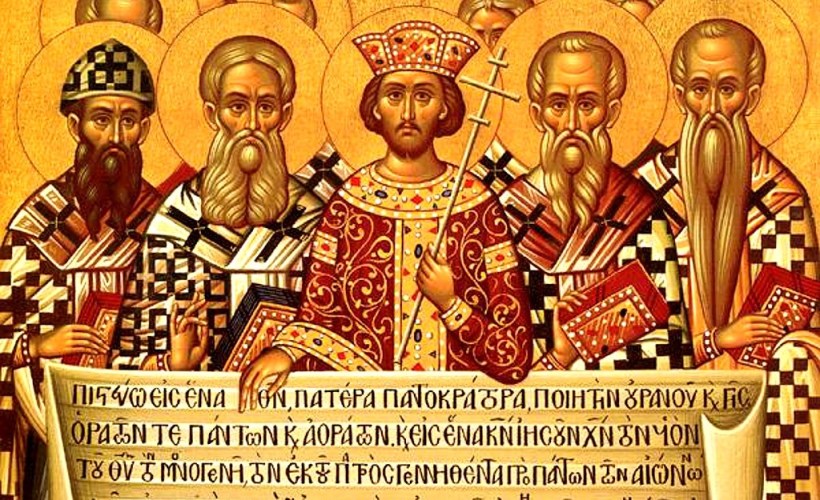
Main image: Detail of an icon of Nicaea I

Sancti Obscuri – St. Porphyrius (September 15)

Jacob Gruber

​If you were asked off the top of your head to name five saints of the Catholic Church, who would come to mind? St. Therese of Lisieux, St. Padre Pio, or St. Francis of Assisi? Perhaps St. John Paul II or Mother Teresa? But what about St. Euphemia or St Paphnutius? Surely St. Iphigenia made it somewhere on the list?

​If these latter names don’t ring any Church bells for you, this new column may be right for you. It’s no secret that we have “saint celebrities.” If you’ve lost an item, you think to pray to St. Anthony, not St. Abundantius. If you want help in discernment, you probably prefer St. Therese’s roses to St. Rosalia’s. But what about these other saints? Don’t they have something to teach us, to inspire us with, to remind us?

​This new column, “Sancti Obscuri,” will look at different saints who, for one reason or another, have become obscure to the modern Catholic imagination. The posts won’t be exhaustive, considering how historical obscurity tends to coincide with a paucity of source material. But if these forgotten men and women have received the crown of sainthood, then they have a story worth hearing. (They know something of Thomas Jefferson’s exasperation in this old “Simpsons” episode, “Mr. Lisa Goes to Washington.”)

Our first “sanctus obscurus,” St. Porphyrius, shares a feast day with Our Lady of Sorrows on September 15. In his life, however, he would not have known what to do with a celebration of a “Lady of Sorrows.” By profession, he was a comedian, a mimic, a famous jester. He was a prevailing voice of the remnant of paganism in the post-Constantine Roman Empire, offering to those who hadn’t accepted Christianity a sufficient mockery of its tenets. People expected comedy and corruption from him, certainly not conversion. Yet, as we will see, he was a man who, within a day, went from mimicry to martyrdom, profanation to profession. Before we tell his story, some background is in line.

His story begins best with the story of Julian the Apostate, who, given the spoiler alert in his name, didn’t care for Christianity very much. In the years following the death of Constantine the Great in 337AD, a barrage of complicated politics had plagued the leadership of the vast Roman Empire. Fast forward a couple of decades, and in 361AD one “Flavius Claudius Julianus,” a nephew of Constantine, arose as sole emperor. His reign was to be short (only 20 months), but not without activity.

Although Christianity for almost 50 years had enjoyed political freedom and support from the emperor, the rule of Julian loomed as a serious threat. Though he was a Christian for the first 20 years of his life, he came to reject the Lord and choose instead the “way of Helios” (see his Letter 47). Julian the Apostate envisioned a return to the Roman paganism of old, a religious atmosphere marked by highly syncretistic polytheism, unified, as it were, under the banner of being ‘not Christian.’

When Julian heard of the fame of Porphyrius the Mimic whose specialty was mocking Christians, he had him brought in to entertain the royal court. Everything was set up for a successful show. The audience was eager to be entertained at Christianity’s expense, and Porphyrius had put together a special play; he was going to mock the Mystery of Baptism.

The show was a riot, eliciting raucous laughter to be sure. Things seemed to be lining up perfectly. The climax of the action involved a mock-baptism scene with fake clergy dressed in liturgical garb immersing the “catechumen,” Porphyrius, into some water.

He ceremoniously pronounced that he would now be a follower of Jesus Christ, “in the Name of the Father and the Son and the Holy Spirit” before being immersed. But something happened when Porphyrius entered the water. Submerged in that moment, Porphyrius felt the summons of actual grace, a call to serious conversion. Coming out of the water, he announced his decision to all present that he wished to be a Christian and would no longer mock the Living God. But, while he had his metanoia, the emperor was simply annoyed. The Roman Martyrology sums up best what happened next:

“Forthwith, by order of the emperor, he was struck with an axe, and thus crowned with martyrdom.”

​Struck with the extraordinary work of divine grace, he managed to get struck also by the work of human anger. Having given over his heart to Jesus, he gave his head to the emperor. Thus is the story of the great Martyr Porphyrius. Once a jester before secular courts, he was to become a martyr in the heavenly courts.

​As for Julian the Apostate, his hopes for a revival of Roman paganism would not find widespread success. In 363AD, following Julian’s military death, Emperor Jovian took the emperor’s throne and restored the faith of the Roman Empire to Christianity.

​Suppose St. Porphyrius hadn’t slipped into obscurity in modern spirituality. Comedians and performers would have a ready patron, and the whole Church would have a better sense of God’s poetic justice. As it is, let us at least take the lesson to have sincere reverence for the truth and all holy things even when it puts us in rather difficult situations. Don’t forget to invoke his intercession every September 15!

May St. Porphyrius pray for us, and teach us true reverence for the Lord!

“Shallow Entry Point” – The Youth Dilemma

I recall quite clearly an encounter I had shortly after having been accepted as a diocesan seminarian at the tender age of 18. One of the older brethren was describing to me our upcoming annual retreat and convocation. He noted it would be pretty laid back, not too intense, and that there would be “more serious retreats” in seminary. “Okay,” I thought, “that should be no problem. I’ve been on plenty of retreats before.”

What I experienced was something quite at odds with what I was expecting… Sure, there was plenty of recreation, but every day also had Morning Prayer, Mass, Day Prayer, Holy Hour, Evening Prayer, Night Prayer, conferences, private meditation, and sometimes a rosary or extra Holy Hour… All that was a bit overwhelming at the time, as the retreats I’d been on in high school contained very little prayer by comparison, and yet this was “not too intense,” etc. “What then,” I wondered, “will the serious retreats be like? And do priests really have to pray this whole breviary thing every day? Oh my goodness!”

Well, I survived, and looking back I can definitely agree with the older seminarian’s description. For the average man in formation or clerical ministry, basically all those disciplines should constitute a normal day. Mass, rosary, the breviary, maybe some study, Holy Hour… In fact, it is not realistic to expect oneself to persist in celibacy or to be effective as a physician of souls without such a regimen. A “serious retreat” then, should consist of mostly silence, prayer, and possibly some extra mortification. It should be a time to focus exclusively on fellowship with God and the improvement of one’s spiritual life, not strengthening your volleyball serve, learning to play the guitar, or finally making a move on your crush, as good as these goals might be.

This brings me to the issue at hand: the amount of prayer and silence at many, or even most, youth retreats and conferences, or even regular events at the parish. Some are so incredibly noisy and chaotic one must wonder if the point is to traumatize kids into practicing the Faith, as if the louder the keynote speaker says something, the more the Holy Spirit is there. This is not really what is going on, of course; the point is to make the Gospel and prayer accessible by providing a “shallow entry point” to largely unchurched kids coming from a noisy and hostile culture, and “breaking in” can be done effectively with such means.

Okay. There is merit to this. But how shallow is too shallow? And how do you gently push the “big kids” into the deep end?

I suppose I am, to some extent, a product of “shallow entry-point” praxis, and I have known it to reap lasting fruit in others as well. On the other hand, I have also seen the growth spring up and wither away with the sun. (Matthew 13:6, 20-21)

It might be helpful to take a look at St. John of the Cross for a moment.  A few tidbits from the beginning pages of Dark Night will be enough to get a clear sense of the problems which inevitably come with a one-size-fits-all shallow entry-point praxis.

“Sometimes they are anxious that others shall realize how spiritual and devout they are, to which end they occasionally give outward evidence thereof in movements, sighs and other ceremonies; and at times they are apt to fall into certain ecstasies, in public rather than in secret, wherein the devil aids them, and they are pleased that this should be noticed, and are often eager that it should be noticed more.”

“Furthermore, they burden themselves with images and rosaries which are very curious; now they put down one, now take up another; now they change about, now change back again; now they want this kind of thing, now that, preferring one kind of cross to another, because it is more curious.”

“These persons, in [receiving Holy Communion], strive with every nerve to obtain some kind of sensible sweetness and pleasure, instead of humbly doing reverence and giving praise within themselves to God. And in such wise do they devote themselves to this that, when they have received no pleasure or sweetness in the senses, they think that they have accomplished nothing at all. This is to judge God very unworthily; they have not realized that the least of the benefits which come from this Most Holy Sacrament is that which concerns the senses; and that the invisible part of the grace that it bestows is much greater; for, in order that they may look at it with the eyes of faith, God oftentimes withholds from them these other consolations and sweetnesses of sense. And thus they desire to feel and taste God as though He were comprehensible by them and accessible to them, not only in this, but likewise in other spiritual practices.”

One can only imagine what this great Doctor of the Church would say about the average American youth conference – surely, his tongue would be as a whip. In fact, John would argue that the violent noise and flashy lights are exactly the opposite of the way out of the beginning stages of spirituality for someone already accustomed to such things. What the beginner needs is a calm introduction and encouragement into small mortifications and deprivations of the senses which their charity is already prompting them to make. Staying up all night in Adoration is certainly a good thing – on a retreat. But such an experience might prove rather fruitless without some firm resolution to grow in a reasonable way in the practice of daily prayer, mortification, detachment from some creature or even from some sin. So-called “retreat highs” constitute a serious obstacle to such discipline, as they soothe one’s senses and trick the soul into thinking itself to have grown on account of feeling consoled, while there has often been no earnest commitment made to rise higher in the spiritual life. In fact, a person who allows himself to be satisfied with feeling holy and therefore does not seek to purge himself of sin and vice is actually likely to be regressing. In other words:

Sincere and interested kids might be allowing themselves to be fooled by their own emotions. (Would it really be a surprise that this happens in the spiritual life as well as in natural affairs?) Teens (and adults, by the way,) who are already intrigued and present a modicum of commitment ought to be led away from self-serving spirituality into a more disciplined and moderate spirituality ordered toward a careful generosity. (I say the generosity should be “careful” because all too often a person moving out of the early stages of the spiritual life will want to make big commitments which are often the product of an earnest explicit desire to be generous with the Lord but which rest upon a secret pride or simple ignorance of what the sacrifice they are making actually entails. This sets the person up for bitterness, despair, or, worst of all, hubristic pride in their spiritual disciplines. Unlike a normal, merely human relationship, we must never give the Lord more than what He wants.)

On the other hand, many kids showing up for retreats or youth group are not being prompted by charity to move forward because, tragically, they do not have charity: they are in mortal sin and are often attached to it. They are there because their parents made them go, and they want to leave as soon as possible. They have not even really begun the spiritual life in earnest. Trying to lead them into silence, solitude, and mortification would likely be a total overload and utterly repel them. Even kids who have made a break with grave sin are often still so overwhelmed by the frantic quest of the senses for satiation that the thought of a whole day without human communication or any entertainment would be enough to crush their spirit to the point of making the whole exercise a waste or even a damaging experience. This reality shows the sense of Paul’s approach with the Corinthians: “I gave you milk to drink, not solid food, for you were not ready for it…” (1 Cor. 3:2) It seems that the quickest way to “hook” such kids might be to use the pleasant things they are already familiar with – loud noise, novelty, emotion, etc. There are, however, plenty of kids who will be even more repelled by such an attempt, especially if some imitation of the world is a bad imitation. They sense the lack of authenticity and figure that there couldn’t be something so great behind the mask, otherwise whatever it really is wouldn’t be pretending to be something it’s not. And these kids are on to something, aren’t they…

What to do? Here are some options which present themselves, arranged (in my opinion) from the most challenging to the least, though they are not mutually exclusive.

  1. Separate the kids who are more advanced, and give them more “solid food.” But how to go about this… What criteria would be used? Where are the human and economic resources for this? What social tension could be caused? What temptation would there be to “get into the holy group?” Etc. Perhaps something like this could be done informally and/or discreetly.
  2. Provide more variety at retreats and conferences. This is often difficult because of resources… Time, money, space, chaperones (!), etc. However, it might sometimes also be a function of a lack of expressed interest. Might there be some designated “quiet areas” at some larger youth conferences? Options for talks on more “difficult” subjects, like mortification? Perhaps…
  3. Provide different voluntary opportunities for more serious spiritual experiences throughout the year. Some high school kids really could benefit, for example, from an 8 day silent retreat, doing the Ignatian Exercises. Perhaps this number is small, and these things can be expensive, but the option ought to be there periodically. A lot of kids don’t even know that such opportunities exist – why are they not being informed? Even something communal could be done in a more seriously contemplative mode.
  4. Teach more about the spiritual life throughout the course of the year. This is practical, but those responsible for youth would have to put in the effort to learn and teach the basics of ascetical theology (in addition to other relevant things, like Scripture, fundamental morals, Sacraments, and so on). For the fringe kids who are only showing up to check the box to make Confirmation, this education would need to be extremely tactful but also assertive and frequent. Having a teen a grade higher give a talk before everyone goes on a Confirmation retreat is good; a series of letters to parents and those preparing for Confirmation which then are followed up with a one-on-one meeting with the pastor about their understanding of those letters and the spiritual life both in general and as it relates to their preparation for Confirmation might be better.
  5. Actively and tirelessly encourage kids to go to confession on a regular basis. Get Father to come by youth group once a month just for this reason. Seeing as not every kid could have a real spiritual director, as there are not enough clergy for the task (at least in America), this is the next best thing. Oh and they will have their sins forgiven too, making sure they are in grace and ready to make the most of whatever else is going on in youth group that day.
  6. Increase the use of neutral methods of attracting kids which lend themselves more easily to showing and providing the depth of the spiritual treasures of the Church, and decrease the use of other methods. For example, take the youth group hiking… This is basically what Our Lord did for three years with the Twelve. Get the kids involved with service to their own community (maybe not some far off land where their perceived use will far exceed their actual use)… Feed the homeless, visit the sick, etc. Have them step up to help with the parish’s broader life, especially liturgy. And so on. These are all activities that would satisfy a Borromeo or a Vianney but would also not be too much for the average 9th grader. In the meantime, try to strip away some of the kitsch and imitation of secular life that tend to deter (in the short term and in the long term) more than they attract.

Shepherding teenagers from various backgrounds and with differing levels of interest, maturity, and sensibility is undoubtedly a massive challenge which only grows with the numbers, and youth ministers are often under appreciated for all the work they do. But we ought to be able to admit that a monolithic (and therefore less work-intensive) “no child left behind” policy, where the lowest common spiritual denominators are always catered to, tends to stunt the growth of kids who are looking to go further but find no exterior means to do so; and this can sometimes result in their own eventual drifting away, as they see nothing beyond what they have already experienced and realize one day that what they have experienced is not as great as they once thought. Who wants to stay in the shallows forever? People will eventually look for a deep end to swim in, whether those waters are safe or not. There need not be a “youth dilemma” – we are a both/and kind of Church, after all. The pool should have a shallow end, but it can and should have a deep end too.

These are my thoughts and suggestions from my limited perspective. Please add your own in the comments!


Post by: Eamonn Clark

Main image source: http://www.sparhawk.info

Adventures in Liturgy: Funeral, or Celebration of Life?

Recently, I was distributing Holy Communion during a Mass of Christian Burial. The coffin was to my immediate right, and the family of the deceased to my immediate left. The Communion Procession was moving in an orderly fashion, when suddenly there was a bottleneck. When I looked up to see what was happening, I couldn’t believe my eyes: having just received Our Lord in the Blessed Sacrament, people were greeting members of the immediate family who were sitting in the front row. I was stunned! I whispered quietly, “Please keep moving, you are blocking the other communicants.”

How did we get here? Answering this question is simultaneously simple, and equally complex. While one may say people no longer know how to act properly in public, I propose that there are other realities at work as well.

The General Introduction to the Order of Christian Funerals states, Christians celebrate the funeral rites to offer worship, praise, and thanksgiving to God for the gift of a life which has now returned to God, the author of life and the hope of the just.[1] Our worship, whether at a funeral or many regular parish Masses, has become so anthropocentric, that we have lost a grip on the reality that we gather to worship, praise, and thank God; instead we often make ourselves the source, center, and end of our liturgical celebration. At a funeral, we gather not for a celebration of life, but to encounter the mercy of God and the promise of eternal life found only in Christ.

Secondly, we live in a world without sin. To admit that there is sin in the world and that we are sinners does not mean that we are bad people. To admit that we are sinners and that there are acts that are objectively right or wrong, proclaims that we are human beings who need to be redeemed through the Paschal Mystery of Christ. Death is a consequence of sin. The Church through its funeral rites commends the dead to God’s merciful love and pleads for the forgiveness of their sin.[2] To admit that we are sinners is to acknowledge that the deceased, and all those present, is truly human, and that God alone is the healer of our pain, and the source of forgiveness.

Death is very hard, and the reality of separation from those we love most dearly is heart wrenching. At the rite of final commendation and farewell, the community acknowledges the reality of separation and commends the deceased to God. In this way it recognizes the spiritual bond that still exists between the living and the dead and proclaims its belief that all the faithful will be raised up and reunited in the new heavens and a new earth, where death will be no more. [3]We have come from God and we are returning to God: our origin is a reality, and to return to God our goal. Is this basic reality present to the minds and hearts of believers today? While life is to be lived and lived to the fullest of the potential God has given us, do we keep before us that our time on earth is not what gives us meaning, but rather that we are destined for God? The preaching, life, liturgy, and catechesis of the Church needs to proclaim loudly that our citizenship is in heaven, and from it we await a savior, the Lord Jesus Christ.[4] A celebration of life fails to lead us to embrace our true citizenship.

If the Liturgy truly forms our faith and shapes our living, our approach to death and the Rites of Christian burial may reflect more accurately that we believe that all the ties of friendship and affection which knit us one throughout our lives do not unravel in death.[5]

Post by: Fr. Jordan Kelly, O.P.

Main image: A Funeral at Ornans, Gustave Courbet, 1850

[1] Order of Christian Funerals, hereafter OCF, #5.

[2] OCF, #6.

[3] Ibid.

[4] Philippians, 3:20.

[5] OCF, # 71.

A Forgotten Sin

There is a strange and subtle fault that plagues human hearts. It is strange because it is committed only with other sins, and it is subtle because one already has forgiveness on his mind when he commits it and so is likely not to think it needs repenting from. What is this sin?

Presumption.

Presumption is opposed to the virtue of hope, whereby we desire and expect God’s forgiveness and help in obtaining Heaven. It is the contrary of despair… The presumptuous person throws aside the moral law on account of the excessive character of his hope. He expects too much from God: he expects a thing not promised. Salvation has not been promised to those who merely fulfill a formula (viz., announcing one’s sins in sacramental confession, for example) but rather to those who exhibit perfect contrition, which is the rejection of all to do with sin – its evil effects, its evil content, and its evil motivation – out of love for God (with the assumption of making confession soon, if not presently making one), and to those who at least have true “attrition” (fear of punishment) within the sacrament of confession itself. Presumption is a special kind of motivation… a “meta-sin” if you will. One is in danger of not having adequate repentance for the sacrament of confession to receive absolution if he fails to mention presumption, as he brings his lack of the fear of God into the confessional with him. For a valid confession, one must at least have true attrition – fear of punishment. The presumptuous person does not have this fear with regard to himself. (If you have just become aware of this sin in your life, you should assume that your prior confessions were valid unless you have a clear certainty that you were not really trying that hard to examine your conscience. Simply mention presumption in your next confession.)

To help understand this sin, here’s a natural, human form of presumption. Imagine a child who stays out well past his curfew. When he comes home, his parents are upset, but he apologizes for his lateness and they forgive him. Then, on their way to bed, they hear their son talking on the phone to a friend – “Yeah they were mad but they forgave me. I knew they would, that’s why I did it.”

Ouch. What parent wouldn’t then proceed with an even more severe punishment than what mere lateness merited?

Unlike an unsuspecting parent, God is wise to this game. A person has “too much hope” if he thinks that “God will forgive me” is an excuse for doing whatever he wants and then only confessing the faults he commits because of his expectation of forgiveness. He must also confess his motivation – presuming upon God’s mercy. In this sense, presumption is “an inordinate conversion to God,” as St. Thomas puts it. This is strange to our ears, but it is indeed what this sin is; a person hopes so much for forgiveness that his servile fear is entirely demolished and replaced not by filial fear but by disobedience.

Presumption is a daughter of pride. One who thinks he is so great as to deserve Heaven is likely to fall into halfhearted repentance, or even into no repentance at all. What a calamity! Pride can also lead to another kind of presumption, namely, the rash assumption that God has blessed one’s endeavors in such a way that failure will be impossible or at least improbable in the project one has undertaken. For example, a man decides to become a missionary in China. He prayed, but he did not seek the approval of any ecclesial authority nor take counsel with a prudent spiritual director. How does he know that this is really God’s will? He does not. He would be guilty of this secondary kind of presumption. So too would a person who thinks himself to have “the gift of healing” and so goes about laying hands on people without authentic discretion. This is presumptuous of God’s grace and also exposes the Gospel to ridicule.

Knowing you have committed this sin is not always so easy. There is a difference between the hope of forgiveness motivating a sin and the hope of forgiveness occasioning a sin… I have given an example of the former in the context of human relationships. An example of the latter would be something more like a child who has become used to his parents forgiving him and so loses some respect and fear of punishment. He does not consciously choose to violate their legitimate demands on him because he knows they will forgive him, but a kind of vicious habit has been ingrained nonetheless. Where is the line between these two cases? It might not always be so clear. What we can say is that a person who consciously makes forgiveness a condition of his sinful action has certainly committed this sin, and a person who has lost respect and fear of punishment is in serious danger of committing this sin.

To reiterate, presumption requires its own mention in confession, as it is its own distinct sin. Often a person will know he has done something seriously wrong by using “God will forgive me” as a motivation for sin but will not have the vocabulary to explain himself in confession. The word is “presumption.”


Post by: Eamonn Clark

Main image: Pope Francis goes to confession – via Catholic News Agency

Lord, It Is Good That We Are Here

“Lord, it is good that we are here. If you wish, I will make three tents here, one for you, one for Moses, and one for Elijah.” (Matthew 17:4)

I’ve seen people give Peter a hard time for not “getting” what was happening in front of him at the Transfiguration. Mark’s Gospel says parenthetically “he hardly knew what to say – they were so frightened.” But I think we need to give our first pope some credit where credit is due.

Peter was thinking quickly on his feet. So he intrudes into the conversation and asks whether he should build three tents. For us, this sounds odd, but for Peter, he must have thought he had solved the problem: this had to be the beginning of the end times. He might have picked up on how Jesus is fulfilling the Old Testament festivals. He knew of the Jewish tradition that Moses and Elijah would come again before the end of the world. Now, since they’ve come, he was hoping Christ was finally going to restore the kingdom of Israel and reap the much-anticipated harvest of souls. It was the Christological fulfillment of the Jewish Festival of Booths.

They needed tents.

The Festival of Booths (Feast of Tabernacles / Sukkoth) is one of the three major feasts in the Jewish calendar (Leviticus 23:39). For a week, they would dwell outside in tents (“booths”) for seven days, reminiscent of their time dwelling in tents during their exodus sojourn. The timing of the Festival of Booths corresponded with a yearly grain harvest, wherein whole communities would work day and night (with the aid of a full moon) to gather in the harvest and do the work of threshing the grain. Removed from its initial agricultural context, the Festival Booths still looked forward to the harvest that was to come at the end of time. Although Peter’s exclamation of “Lord, it is good that we are here” is a fitting expression of eschatological rest, the tent-building suggestion might have been a little too much.

Peter figured out pretty well what was going on. However, Peter still did not know what he was saying. Where Peter erred was not his analysis – the event of the Transfiguration is the fulfillment of the Jewish Festival of Booths – but his approach.

Peter approached the Transfiguration as a problem to be solved, not as a mystery to be entered into.

The Meaning of Mystery

So when Christians use the word “mystery,” we do not mean a problem without an answer. No, for Christians, a mystery is something that is so intensely knowable that it exceeds the powers of human comprehension. A mystery is so great that it encompasses the subject.

With a little help from the French personalist philosopher Gabriel Marcel, we should distinguish between “mystery” and its misused synonym “problem.” For Marcel, something is a mystery when the self is implicated in it. A mystery cannot be studied from a distance, but is experienced by entering further into it. Openness to mystery is openness to the whole of a reality.

Screen Shot 2017-08-05 at 2.46.57 PM
Gabriel Marcel, French Catholic Philosopher, 1889-1973

A “problem,” on the other hand, is something that “is placed in front of me, blocking my way.” To treat something as a problem is to purposely exclude yourself from it. It is a purely notional engaging of a situation, wherein one can find objective and finite answers with universal implications.

Problems are the stuff of scientists. Mysteries are the stuff of mystics.

Let me give you an example.

Once, my five-year old niece told me, “Did you know that, when I’m in the car, the moon follows me? It really does!”

Infected as I was by the spirit of abstraction, I told her, “It only looks like it is following you because it’s so far away.” I thought I could maybe explain to her how perspective works at such distances. To prove this, I thought I could set up an experiment, putting her in one car and her sister in another car. They would go separate directions and observe how the moon follows both of them. Then I could prove to my niece that, since the moon cannot possibly be following both of them, there must be another explanation. That explanation would be in the reality of the great distance between the earth and the moon, a distance that can be observed and measured. Science would win out over childish naïveté.

But before I could get anywhere to disprove her childish notion, she interrupted, “NO. The moon really follows me.”

In the face of such opposition, I thus abandoned my attempt to scientifically disprove her childish perception.

For my five-year old niece, the moon was a mystery; it really did follow her. The moon was so beyond her that, rather than disconnecting her, it implicated her in its path. However mistaken her understanding of perspective, she approached it with wonder. And she rightly would not let that wonder be extinguished.

To me, the moon was a problem that needed to be solved; it could be measured and placed conceptually at a distance. I knew that its movements and phases are configured to a different pattern than my sporadic movements. Instead of encountering the moon with her, I abstracted. Although technically correct (the moon does not follow you), my approach prevented me from being gripped by the mystery of the moon and sharing in my niece’s wonder.

Like my niece with the moon, a mystery is so beyond us, that we cannot help but be pulled into it. A mystery is so large that it necessarily involves the viewer.

In this way, God Himself is a mystery, being so far beyond us that, at the same time, He embraces us and loves us in our very being.

The Mystery of the Transfiguration

It is in this way that the event of the Transfiguration is a mystery.

Since mysteries overwhelm us, they implicate us – they require our response. Our response, then, to the mystery of the Transfiguration is not to solve the puzzle of Moses and Elijah’s appearance, but to enter deeply into the reality of what is before us.

Although technically correct, Peter’s approach prevented him from being gripped by the mystery. So while Peter was still speaking, a higher voice interrupts him: “This is my beloved son with whom I am well pleased. Listen to him.”

Through the mystery of the Transfiguration, we are meant to share in Jesus’ own prayer with the Father. By beholding the glory of Christ transfigured and listening to him, we become sons and daughters in the Son. By entering in to the mystery of the Transfiguration – by listening to God’s beloved Son – we become what we contemplate.

How do we enter in to the mystery of the Transfiguration? For us Christians, we go to the source and the summit of the Christian life – the Holy Sacrifice of the Mass. Like Peter at the Transfiguration, we can look at the Mass just as a problem to be solved, a ritual to be analyzed, a puzzle to be deciphered. Or we can enter into the mystery of the Mass.

In every celebration of the Mass, we ascend the mountain with Christ, and we encounter something that overwhelms our understanding: God incarnate – the second Person of the Holy Trinity – comes to us as bread and wine. So great is the glory of Christ in the Eucharist, so utterly beyond us, that we are pulled into the mystery. The altar is our Mount Tabor, where we see His glory, not with the eyes of flesh, but with the eyes of faith. Over the altar the Father’s voice mystically resounds, “This is my beloved Son; listen to him.” We who enter into this mystery by receiving the Body of Christ in Holy Communion are enveloped by the cloud of the Holy Spirit. At Mass, we enter in to the mystery of God’s glory. He gazes on us, and we gaze on Him, and we become what we contemplate.

It is good that we are here.


Post by: Fr. Peter Gruber

Main Image: The Church of the Transfiguration, Mount Tabor

First Fridays: Leviticus 23

“The LORD said to Moses, ‘These are the festivals of the LORD which you shall celebrate at their proper time with a sacred assembly.’”

So begins the Old Testament reading for today. Following this introduction, the reading continues with God pronouncing the major feasts that would make up the Jewish calendar: The Sabbath, the Passover and the Festival of Unleavened Bread, the Offering of First Fruits, Festival of Weeks, the Festival of Trumpets, the Day of Atonement, and the Festival of Tabernacles. It may seem that this list of Jewish festivals may not appear to be particularly relevant to the modern Christian. After all, we don’t celebrate these feasts; so why did this passage and others like it make its way into our lectionary? What can we take away from them?

One reason why these readings are important to us is the historical background which they provide us about our ancestors in faith and the religious culture into which our Lord was born. The present is shaped by the past, so learning about the lived experience of those who preceded us and how they kept their traditions alive gives us a blueprint for doing the same today. For example, that the Festival of Weeks is a celebration commemorating the wheat harvest in Israel does not seem to be of utmost importance to the modern Christian. However, knowing that the Festival of Weeks was also known as Pentecost because it fell 50 days after Passover, in the same way as the Christian Pentecost follows 50 days after Easter, and that apart from being a harvest celebration, it commemorates the giving of the law at Mt. Sinai, allows us to enter into the liturgical importance of this festival. Understanding the relationship between the giving of the law at Sinai, and the giving of the Holy Spirit at Pentecost allows us to see the gradual fulfillment of salvation history and the slow unveiling of God’s love throughout time.

But for this post, I don’t want to talk about the rich theological insights a close study of each of these festivals would give us. There are others who have done a much better job than I could. Interested readers could do no better than to check out the Berit Olam commentaries published by The Liturgical Press. Rather, I want to focus on the general theme present throughout the entire narrative, (which in the reading is presented in a redacted form.) That is, the elements of time and space, and how they are ordered to the worship of God. If you look at Leviticus 23:1-44, there are several phrases that you would find repeated multiple times. “The Lord said to Moses, speak to the Israelites,” “The appointed festivals” or “sacred assemblies,” “Do no regular work,” and “lasting ordinance for generations to come” and “Wherever you live.” I want to concentrate on these repeated phrases as revelatory of the kind of relationship God wants the children of Israel to have with Him and with each other. Finally, after looking at these, I want to address the seemingly out of place verse of Leviticus 23:22 which I think is central to the passage.

To begin, it should be noted that Leviticus 23 begins a new “section” in the book of Leviticus. The previous “section” dealt with the conduct of the priests, and now we have seemed to move on from that to norms of general conduct for all the Israelites. How fascinating that the first directive God gives to His people is a calendar! Even before the seemingly paramount sections on rewards for obedience and punishments for disobedience (Leviticus 26), God gives very specific instructions for when to celebrate liturgical feasts. Furthermore, the passage makes it clear that this is a divine command. “The Lord said to Moses, speak to the Israelites,” is repeated several times, reiterating how the giving of the calendar of feasts comes from God Himself. In fact, the chapter ends with God saying, “I am the Lord your God,” using the divine “I am” with which he first identified Himself to Moses to underline the sacred nature of the festivals just commanded. Furthermore, the repetition of “lasting ordinance for generations to come” and “wherever you live” reflect the universality of these commands. These commands hold true, not just for the small group being spoken to, but for all of God’s people, wherever and whenever they are.

It is because of this that we hear repeated the command to do “no regular work” (in other translations, servile or laborious work). Is this command given because God disapproved of the work they Israelites did? Of course not. God commands that sacred days be days of rest as a reminder that these are not normal “work days.” They are days that we rededicate ourselves to the work of the Lord, that is, prayer. Just as God “rested” on the seventh day after the work of creation, we rest after our participation in that unfolding work of creation to remind ourselves of what that work is ordered to – God.

And that is what I think this passage reveals the most about God and about ourselves. Our work is ordered to our rest, which is itself ordered towards our relationship with God. As human beings, we are transcendent creatures. We have limited needs like any other animal; we eat until we aren’t hungry anymore, we sleep until we aren’t tired anymore, we seek shelter from the elements, and all the other basic necessities. But we also have unlimited transcendent desires. We have a desire for beauty, for companionship, for wholeness, for infinite joy. That is, we have a desire for God. God led the Israelites out of Egypt and he gave them the calendar of feasts not to satisfy their basic animal needs, but their transcendent human needs. God gave the Israelites a calendar of feasts and directions of how to celebrate them even before He finished leading Israel into the Holy Land because it was given to them for the purpose of worship, and so their time in the land and their use of it must be ordered to that purpose.

Do we find this to be the reality in our lives today? Do we order our time and our space to that reality? How often do we find our work encroaching into our time with God? How often are we tempted to skip prayer or even just healthy social activities in order to get work done because we think that is what is expected of us? Could you imagine what kind of a society we would be if our calendars were arranged around preserving the sacredness of the day of rest? Imagine if employers arranged work schedules in a way that not only provided employees with sufficient “days of rest” but also such that they could participate with dignity in community activities (both religious and other healthy communal gatherings.)

It is to that point which I think the, seemingly out of place, verse of Leviticus 22:23 is ordered. “‘When you reap the harvest of your land, do not reap to the very edges of your field or gather the gleanings of your harvest. Leave them for the poor and for the foreigner residing among you. I am the Lord your God.’” This is the “gleaning law” of ancient Israel, which essentially stated that those who owned and worked farmland ought not be so exacting in their harvest that those without land wouldn’t be able to find food should they glean from the field. In a passage about liturgical feasts, why would this command be placed in the exact middle? It’s true, the Festival of Weeks is a harvest festival and so making a point about harvesting is not completely out of place here, but it still seems a little strange.

However, reflecting on the idea that our time and resources are ultimately ordered to the service of God, we might find religious significance in the gleaning law. In some sense, the gleaning law made it possible for the poor to participate in the festival. It ensured that there would be food available after the harvest for those who begged in order to fulfill their basic needs. The poor would not have to worry if taking time off from their job for the festival would impact their ability to fill their needs. Just as a farmer has a right to collect the fruit of his labor from his field but not be so exacting that there is none left for others, an employer has a right to his employees time (for a fair wage of course,) but not to be so exacting in his demands that an employee does not have time or energy left for religious and community oriented activities in a respite from “regular work.”

As a reflection, we might ask ourselves, do we keep the “gleaning law” in our own lives? Do we ensure that every day we have several periods of time protected from the encroachment of our daily demands, our regular and laborious work? Do we use that time to concentrate not on our basic animal needs, but our transcendent human needs? What “mini-festivals” do we have planned in our day in which our focus is on prayer to God and charity towards our neighbor? Is our time away from the office ordered towards these higher things, or is it only a brief respite to prepare for the next day on the job? Essentially, do we work to live, or are we living to work? With these thoughts in mind, thanks be to our God, who takes care of our needs so that we can use this time on Earth to grow closer to Him!


Post by: Niko Wentworth

Main image: The Gleaners, Jean-François Millet, 1857, oil on canvas