Of Mollusks and Marble

I don’t normally do personal posts, let alone lifestyle posts, but… the past two days have been particularly Roman.

Today is the Feast of the Nativity of St. John the Baptist. Normally, it would be tomorrow, but it has been moved because tomorrow is Sacred Heart. So yesterday was the vigil, which means…

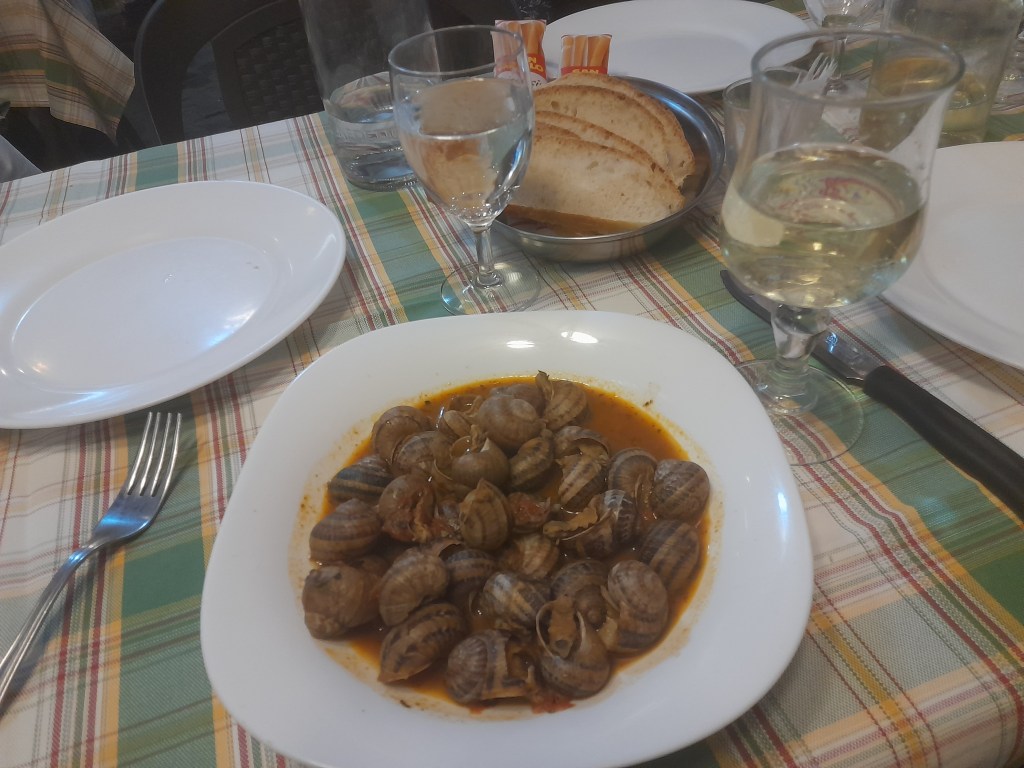
Snails.

It is an ancient Roman tradition – originally connected with the solstice and warding off ghosts, and now connected with the Vigil of the Nativity of St. John the Baptist – to eat snails. So eat them I did, with several friends and several bottles of white wine, in the Monti neighborhood. Lumache alla Romana, at Osteria della Suburra. Great stuff!

Today I meandered down, for the first time in almost a calendar year, to St. John Lateran. The full name of the basilica, which is the cathedral of Rome, thus the “mother church” of all Christendom, is the Archbasilica Cathedral of the Most Holy Savior and of Saints John the Baptist and John the Evangelist in the Lateran. Despite the name there is no relic of either saint as far as I know – but John the Baptist’s head (at least the “Roman” contender) is at San Silvestro in Capito, where I did not make it today unfortunately.

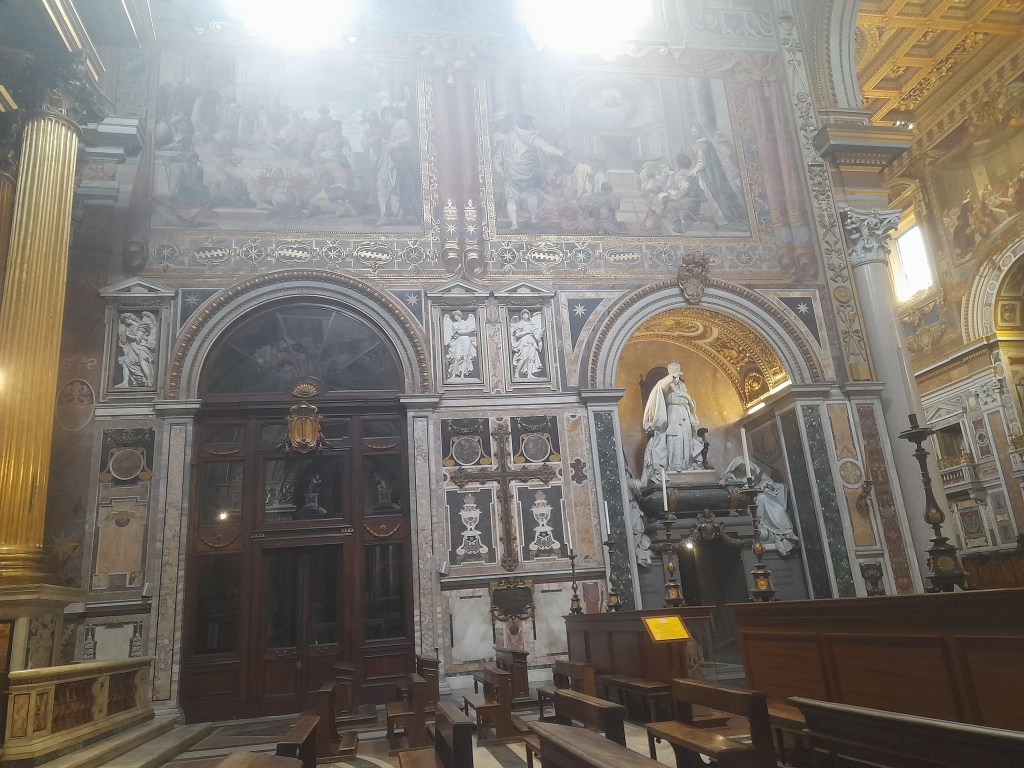
Some details of the left transept:

That is Leo XIII’s tomb on the right. He looks a little camera shy – or just got out of the movie theater and can’t take the sunlight?

One of the most striking things about the basilica is the statues of the apostles. They are very large, lining the right and left sides of the nave. Many of them are depicted with the instruments of their martyrdom.

St. Bartholomew, skinned alive.
St. Simon (not Peter), with a saw.

You can see one of the dedication crosses on the right, which were smeared with oil at (I suppose) the re-dedication of the basilica after its last major renovation (under Innocent X, his name is everywhere). I really dislike the fake candles, as I explained in a post a long time ago. It is especially bad when it is a papal basilica… the things we offer to God matter, especially in formal worship and sacred spaces.

Ugh. Convenient, yes, but… that sort of defeats the purpose.

There was another curious statue, in a side chapel on the right. It’s a saint who looks like she is playing table tennis, and she is holding a snake as well. I guess it is supposed to be a mirror, but… I like to think saints liked ping pong. But I have no clue who this is. Anyone got any idea?

The gate to the chapel is its own great piece of art. I think the guys who made it would have eschewed fake candles, for what it’s worth…

Look at the detail, and the creativity… I would wager the thinking with these creatures is similar to the gargoyles of French fame… scaring away evil angels. (Wait – they aren’t snails, are they!?)

Grrrrr…

There was a little exhibit going on about St. Therese of Lisieux. I was especially interested in the fact that they had a whole section on Pius XI’s devotion and teaching on her, as he is the object of my doctoral studies. The posters are a bit out of date… I wonder if you can see why.

Pius XI: [she is] “the star of my pontificate”

Speaking of Pius XI, here is a plaque about him in the basilica:

My Latin is not good, but luckily I ran into a friend (whose monastery I will be staying at in Poland next week – yes, pictures will be forthcoming), and his Latin is excellent. Had I bothered to work out the date, I would have figured out what this was, but… I took a shortcut.

It is commemorating this chapel, which is where the young Achille Ratti was ordained a priest. I knew he was ordained in the Lateran, but I always thought it was at the main altar. It was not… it was here, in this small side chapel.

He was ordained December 20, 1879 by Cardinal La Valletta – who also happened to ordain Benedict XV a priest.

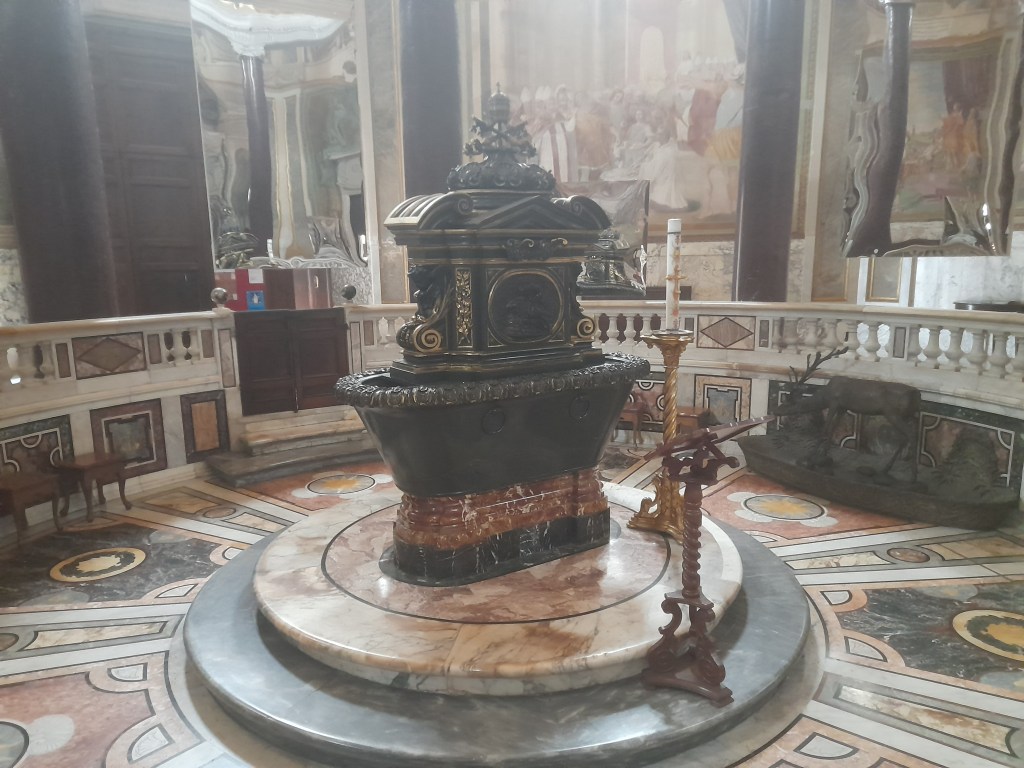
On my way out, I stopped by the baptistry. Constantine was baptized here – before the structure existed, which essentially serves to commemorate that blessed event.

Here is one of the famous obelisks of Rome. This one is Egyptian – one of 8. (Several others are Roman.)

It is the tallest in Rome, if one doesn’t include the base in the calculations. (With the base included the tallest is the obelisk at St. Peter’s.) This one weighs 330 tons, after reconstruction trimmed it down a bit, from 455 tons (quite a diet). It was in the temple of Amun in Karnak, near Luxor. It came over to Rome in 357 to be a decoration in the Circus Maximus.

The base.

And finally, a quick look in toward where the educational facilities are… including the main Roman diocesan seminary (I think Rome has about 30-40 seminarians of its own – incredible…), and the now-destroyed JPII Institute for Studies on Marriage and the Family. So sad. I think they have very few students. People vote with their feet – and their wallets. That includes candidates for the priesthood!

Well, that is it. Despite my rare “lifestyle” posts, another one coming up soon, from the Archabbey of Jędrzejów. But, with 5 likes on this post, I will do these more often!

Be sure to subscribe as well…

St. John the Baptist, pray for us!

-Eamonn

The Ottaviani Intervention – TLM vs. NO

Today I present the translated text of Cardinal Ottaviani’s famous intervention regarding the introduction of the Novus Ordo Missae, the missal reformed under Paul VI. As we approach the 1-year anniversary of Traditiones Custodes, it is important that we are increasingly aware of the deeper theological significance of the differences between the TLM and the NO. These are not merely superficial differences, as it might seem to someone sitting in the pews who has not bothered to study these things seriously; it is, however, evident to those priests who celebrate with both missals that the dissimilarities are profound. This study, presented to Paul VI by Cardinals Ottaviani and Bacci, is extremely helpful for those looking for a solid introduction to the gulf between 1962 and 1969. It is not taking any cheap shots, as it is easy to do with the new missal by pointing to the worst kinds of abuses… This is a serious theological critique.

For the footnotes and some more information, see the SSPX’s original page on this text here.

Letter from Cardinal Ottaviani to His Holiness Pope Paul VI

Rome
September 25, 1969

Most Holy Father,

Having carefully examined, and presented for the scrutiny of others, the Novus Ordo Missae prepared by the experts of the Consilium ad exequdam Constitutionem de Sacra Liturgia, and after lengthy prayer and reflection, we feel it to be our bounden duty in the sight of God and towards Your Holiness, to put before you the following considerations:

1. The accompanying critical study of the Novus Ordo Missae, the work of a group of theologians, liturgists and pastors of souls, shows quite clearly in spite of its brevity that if we consider the innovations implied or taken for granted, which may of course be evaluated in different ways, the Novus Ordo represents, both as a whole and in its details, a striking departure from the Catholic theology of the Mass as it was formulated in Session XXII of the Council of Trent. The “canons” of the rite definitively fixed at that time provided an insurmountable barrier to any heresy directed against the integrity of the Mystery.

2. The pastoral reasons adduced to support such a grave break with tradition, even if such reasons could be regarded as holding good in the face of doctrinal considerations, do not seem to us sufficient. The innovations in the Novus Ordo and the fact that all that is of perennial value finds only a minor place, if it subsists at all, could well turn into a certainty the suspicion, already prevalent, alas, in many circles, that truths which have always been believed by the Christian people, can be changed or ignored without infidelity to that sacred deposit of doctrine to which the Catholic faith is bound for ever. Recent reforms have amply demonstrated that fresh changes in the liturgy could lead to nothing but complete bewilderment on the part of the faithful who are already showing signs of restiveness and of an indubitable lessening of faith. Amongst the best of the clergy the practical result is an agonizing crisis of conscience of which innumerable instances come to our notice daily.

3. We are certain that these considerations. which can only reach Your Holiness by the living voice of both shepherds and flock, cannot but find an echo in Your paternal heart, always so profoundly solicitous for the spiritual needs of the children of the Church. It has always been the case that when a law meant for the good of subjects proves to be on the contrary harmful, those subjects have the right, nay the duty of asking with filial trust for the abrogation of that law. Therefore we most earnestly beseech Your Holiness, at a time of such painful divisions and ever-increasing perils for the purity of the Faith and the unity of the Church, lamented by You our common Father. not to deprive us of the possibility of continuing to have recourse to the fruitful integrity of that Missale Romanum of St. Pius V, so highly praised by Your Holiness and so deeply loved and venerated by the whole Catholic World.

A. Card. Ottaviani
A. Card. Bacci
Feast of St. Pius X

A Brief Critical Study of the Novus Ordo Missae
by a group of Roman Theologians

I

In October 1967, the Episcopal Synod called in Rome was requested to pass a judgment on the experimental celebration of a so-called “normative Mass,” devised by the Consilium for implementing the Constitution on the Sacred Liturgy. This Mass aroused the most serious misgivings. The voting showed considerable opposition (43 non placet), very many substantial reservations (62 juxta modum), and 4 abstentions out of 187 voters. The international press spoke of a “refusal” on the proposed “normative Mass” on the part of the Synod. Progressively-inclined papers made no mention of this.

In the Novus Ordo Missae lately promulgated by the Apostolic Constitution Missale Romanum, we once again find this “normative Mass,” identical in substance, nor does it appear that in the intervening period, the Episcopal Conferences, at least as such, were ever asked to give their views about it.

In the Apostolic Constitution, it is stated that the ancient Missal promulgated by St. Pius V, July 13, 1570, but going back in great part to St. Gregory the Great and to still remoter antiquity,[3] was for four centuries the norm for the celebration of the Holy Sacrifice for priests of the Latin rite, and that, taken to every part of the world, “it has moreover been an abundant source of spiritual nourishment to many holy people in their devotion to God.”

Yet, the present reform, putting it definitely out of use, was claimed to be necessary since “from that time the study of the Sacred Liturgy has become more widespread and intensive amongst Christians.”

This assertion seems to us to embody a serious equivocation. For the desire of the people was expressed, if at all, when—thanks to St. Pius X—they began to discover the true and everlasting treasures of the liturgy. The people never on any account asked for the liturgy to be changed or mutilated so as to understand it better. They asked for a better understanding of a changeless liturgy, and one which they would never have wanted changed.

The Roman Missal of St. Pius V was religiously venerated and most dear to Catholics, both priests and laity. One fails to see how its use, together with suitable catechesis, should have hindered a fuller participation in, and greater knowledge of, the Sacred Liturgy, nor why, when its many outstanding virtues are recognized, this should not have been considered worthy to continue to foster the liturgical piety of Christians.

Since the “normative Mass,” now reintroduced and imposed as the Novus Ordo Missae, was in substance rejected by the Synod of Bishops, was never submitted to the collegial judgment of the Episcopal Conference, nor have the people—least of all in mission lands—ever asked for any reform of Holy Mass whatsoever, one fails to comprehend the motives behind the new legislation which overthrows a tradition unchanged in the Church since the fourth and fifth centuries, as the Apostolic Constitution itself acknowledges. As no poplar demand exists to support this reform, it appears devoid of any logical grounds to justify it and make it acceptable to the Catholic people.

The Vatican Council did indeed express a desire (para. 50, Constitution Sacrosanctum Concilium) for the various parts of the Mass to be reordered “so that the distinctive character of each single part and its relationship to the other part may appear more clearly.” We shall now see how the Ordo recently promulgated corresponds with this original intention.

An attentive examination of the Novus Ordo reveals changes of such magnitude as to justify in themselves the judgment already made with regard to the “normative Mass.” Both have in many points every possibility of satisfying the most modernistic of Protestants.

II

Let us begin with the definition of the Mass given in n. 7 of the Institutio Generalis at the beginning of the second chapter of the Novus Ordo: De structura Missae:

The Lord’s Supper or Mass is a sacred meeting or assembly of the People of God, met together under the presidency of the priest, to celebrate the memorial of the Lord.[4] Thus the promise of Christ, “where two or three are gathered together in my name, there am I in the midst of them,” is eminently true of the local community in the Church” (Mt. 18, 20).

The definition of the Mass is thus limited to that of a “supper,” and this term is found constantly repeated (nos. 8, 48, 55d, 56). This “supper” is further characterized as an assembly presided over by the priest and held as a memorial of the Lord, recalling what He did on the first Maundy Thursday. None of this in the very least implies either the Real Presence, or the reality of the sacrifice, or the Sacramental function of the consecrating priest, or the intrinsic value of the Eucharistic Sacrifice independently of the people’s presence.[5] It does not, in a word, imply any of the essential dogmatic values of the Mass which together provide its true definition. Here the deliberate omission of these dogmatic values amounts to their having been superseded and therefore, at least in practice, to their denial.[6]

In the second part of this paragraph 7 it is asserted, aggravating the already serious equivocation, that there holds good, “eminenter,” for this assembly Christ’s promise that “Ubi sunt duo vel tres congregati in nomine meo; ibi sum in medio eorum” (Mt. 18, 20). This promise, which refers only to the spiritual presence of Christ with His grace, is thus put on the same qualitative plane, save for the greater intensity, as the substantial and physical reality of the Sacramental Eucharistic Presence.

In no. 8 a subdivision of the Mass into “liturgy of the word” and Eucharistic liturgy immediately follows, with the affirmation that in the Mass is made ready “the table of God’s word” as of “the Body of Christ,” so that the faithful “may be built up and refreshed”—an altogether improper assimilation of the two parts of the liturgy, as though between two points of equal symbolic value. More will be said about this point later.

The Mass is designated by a great many different expressions, all acceptable relatively, all unacceptable if employed, as they are, separately and in an absolute sense. We cite a few:

  • the Action of Christ and of the People of God;
  • the Lord’s Supper or Mass;
  • the Paschal Banquet;
  • the Common participation in the Lord’s Table;
  • the memorial of the Lord;
  • the Eucharistic Prayer;
  • the Liturgy of the Word and the Eucharistic Liturgy;
  • etc.

As is only too evident, the emphasis is obsessively placed upon the supper and the memorial instead of upon the unbloody renewal of the Sacrifice of Calvary. The formula “the Memorial of the Passion and Resurrection of the Lord” is, besides, inexact, the Mass being the memorial or the Sacrifice alone, in itself redemptive whilst the Resurrection is the consequent fruit of it.[7]

We shall later see how, in the same consecratory formula, and throughout the Novus Ordo such equivocations are renewed and reiterated.

III

We come now to the ends of the Mass.

I. Ultimate end. This is that of the Sacrifice of praise to the Most Holy Trinity according to the explicit declaration of Christ in the primary purpose of His very Incarnation: “Coming into the world he saith: sacrifice and oblation thou wouldst not but a body thou has fitted me” (Ps. 34, 7-9 in Heb. 10, 5).

This end has disappeared from the Offertory, with the disappearance of the prayer Suscipe, Sancta Trinitas; from the end of the Mass with the omission of the Placet tibi Sancta Trinitas; and from the Preface, which on Sunday will no longer be that of the Most Holy Trinity, as this Preface will be reserved only to the Feast of the Trinity, and so in future will be heard but once a year.

2. Ordinary end. This is the propitiatory Sacrifice. It too has been deviated from; for instead of putting the stress on the remission of sins of the living and the dead it lays emphasis on the nourishment and sanctification of the present (no. 54). Christ certainly instituted the Sacrament of the Last Supper putting Himself in the state of Victim in order that we might be united to Him in this state but this self-immolation precedes the eating of the Victim, and has an antecedent and full redemptive value (the application of the bloody immolation). This is borne out by the fact that the faithful present are not bound to communicate, sacramentally.[8]

3. Immanent end. Whatever the nature of the Sacrifice, it is absolutely necessary that it be pleasing and acceptable to God. After the Fall no sacrifice can claim to be acceptable in its own right other than the Sacrifice of Christ. The Novus Ordo changes the nature of the offering, turning it into a sort or exchange of gifts between man and God: man brings the bread, and God turns it into the “bread of life”; man brings the wine, and God turns it into a “spiritual drink.”

Thou art blessed Lord, God of the Universe, because from Thy generosity we have received the bread [or “wine”] which we offer Thee the fruit of the earth [or “vine”] and of man’s labor. May it become for us the bread of life [or “spiritual drink.”].”[9]

There is no need to comment on the utter indeterminateness of the formulae “panis vitae” and “potus spiritualis,” which might mean anything. The same capital equivocation is repeated here, as in the definition of the Mass: there, Christ is present only spiritually among His own: here, bread and wine are only “spiritually” (not substantially) changed.[10]

In the preparation of the offering, a similar equivocation results from the suppression of two great prayers. The “Deus qui humanae substantiae dignitatem mirabiliter condidisti et mirabilius reformasti” was a reference to man’s former condition of innocence and to his present one of being ransomed by the Blood of Christ: a recapitulation of the whole economy of the Sacrifice, from Adam to the present moment. The final propitiatory offering of the chalice, that it might ascend “cum odore suavitatis,” into the presence of the divine majesty, Whose clemency was implored, admirably reaffirmed this plan. By suppressing the continual reference to God in the Eucharistic prayers, there is no longer any clear distinction between divine and human sacrifice.

Having removed the keystone, the reformers have had to put up scaffolding; suppressing real ends, they have had to substitute fictitious ends of their own: leading to gestures intended to stress the union of priest and faithful, and of the faithful among themselves; offerings for the poor and for the Church superimposed upon the offerings of the Host to be immolated. There is a danger that the uniqueness of this offering will become blurred, so that participation in the immolation of the Victim comes to resemble a philanthropical meeting, or a charity banquet.

IV

We now pass on to the essence of the Sacrifice.

The mystery of the Cross is no longer explicitly expressed. It is only there obscurely, veiled, imperceptible for the people.[11] And for these reasons:

1. The sense given in the Novus Ordo to the so-called prex eucharistica[12] is: “that the whole congregation of the faithful may be united to Christ in proclaiming the great wonders of God and in offering sacrifice” (no. 54, the end).

Which sacrifice is referred to? Who is the offerer? No answer is given to either of these questions. The initial definition of the prex eucharistica is as follows: “The center and culminating point of the whole celebration now has a beginning, namely the Eucharistic Prayer, a prayer of thanksgiving and of sanctification” (no. 54, pr.). The effects thus replace the causes, of which not one single word is said. The explicit mention of the object of the offering, which was found in the Suscipe, has not been replaced by anything. The change in formulation reveals the change in doctrine.

2. The reason for this non-explicitness concerning the Sacrifice is quite simply that the Real Presence has been removed from the central position which it occupied so resplendently in the former Eucharistic liturgy. There is but a single reference to the Real Presence (a quotation—in a footnote—from the Council of Trent), and again the context is that of “nourishment” (no. 241, note 63).

The Real and permanent Presence of Christ, Body, Blood, Soul and Divinity, in the transubstantiated Species is never alluded to. The very word transubstantiation is totally ignored.

The suppression of the invocation to the Third Person of the Most Holy Trinity (Veni Sanctificator) that He may descend upon the oblations, as once before into the womb of the Most Blessed Virgin to accomplish the miracle of the divine Presence, is yet one more instance of the systematic and tacit negation of the Real Presence.

Note, too, the eliminations:

  • of the genuflections (no more than three remain to the priest, and one, with certain exceptions, to the people, at the Consecration);
  • of the purification of the priest’s fingers in the chalice; of the preservation from all profane contact of the priest’s fingers after the Consecration;
  • of the purification of the vessels, which need not be immediate, nor made on the corporal;
  • of the pall protecting the chalice;
  • of the internal gilding of sacred vessels;
  • of the consecration of movable altars;
  • of the sacred stone and relics in the movable altar or upon the mensa—when celebration does not occur in sacred precincts (this distinction leads straight to “eucharistic suppers” in private houses);
  • of the three altar cloths, reduced to one only;
  • of thanksgiving kneeling (replaced by a thanksgiving, seated, on the part of priest and people, a logical enough complement to Communion standing);
  • of all the ancient prescriptions in the case of the consecrated Host falling, which are now reduced to a single, casual direction: “reverenter accipiatur” (no. 239);
  • all these things only serve to emphasize how outrageously faith in the dogma of the Real Presence is implicitly repudiated.

3. The function assigned to the altar (no. 262). The altar is almost always called mensa.[13] “The altar or table of the Lord, which is the center of the whole Eucharistic liturgy” (no. 49, cf. 262). It is laid down that the altar must be detached from the walls so that it is possible to walk round it and celebration may be facing the people (no. 262); also that the altar must be the center of the assembly of the faithful so that their attention is drawn spontaneously toward it (ibid). But a comparison of nos. 262 and 276 would seem to suggest that the reservation of the Blessed Sacrament on this altar is excluded. This will mark an irreparable dichotomy between the presence, in the celebrant, of the eternal High Priest and that same Presence brought about sacramentally. Before, they were one and the same presence.[14]

Now it is recommended that the Blessed Sacrament be kept in a place apart for the private devotion of the people (almost as though it were a question of devotion to a relic of some kind) so that, on going into a church, attention will no longer be focused upon the tabernacle but upon a stripped bare table. Once again the contrast is made between private piety and liturgical piety: altar is set up against altar.

In the insistent recommendation to distribute in Communion the Species consecrated during the same Mass, indeed to consecrate a loaf[15] for the priest to distribute to at least some of the faithful, we find reasserted a disparaging attitude toward the tabernacle, as toward every form of Eucharistic piety outside of the Mass. This constitutes yet another violent blow to faith in the Real Presence as long as the consecrated Species remain.[16]

4. The formulae of consecration. The ancient formula of consecration was properly a sacramental, not a narrative one. This was shown above all by three things:

a. The Scriptural text not taken up word for word: the Pauline insertion “mysterium fidei” was an immediate confession of the priest’s faith in the mystery realized by the Church through the hierarchical priesthood.

b. The punctuation and typographical lettering: the full stop and new paragraph marking the passage from the narrative mode to the sacramental and affirmative one, the sacramental words in larger characters at the center of the page and often in a different color, clearly detached from the historical context. All combined to give the formula a proper and autonomous value.

c. The anamnesis (“Haec quotiescumque feceritis in mei memoriam facietis”), which in Greek is “eis tén emèu anàmnesin” (directed to my memory). This referred to Christ operating and not to the mere memory of Him, or of the event: an invitation to recall what He did (“haec… in mei memoriam facietis”) in the way He did it, not only His Person, or the Supper. The Pauline formula (“Hoc facite in meam commemorationem”) which will now take the place of the old—proclaimed as it will be daily in vernacular languages—will irremediably cause the hearers to concentrate on the memory of Christ as the end of the Eucharistic action, whilst it is really the beginning. The concluding idea of commemoration will certainly once again take the place of the idea of sacramental action.”[17]

The narrative mode is now emphasized by the formula “narratio institutionis” (no. 55d) and repeated by the definition of the anamnesis, in which it is said that “The Church recalls the memory of Christ Himself” (no. 556).

In short: the theory put forward by the epiclesis, the modification of the words of Consecration and of the anamnesis, have the effect of modifying the modus significandi of the words of Consecration. The consecratory formulae are here pronounced by the priest as the constituents of a historical narrative and no longer enunciated as expressing the categorical and affirmative judgment uttered by Him in whose Person the priest acts: “Hoc est Corpus Meum” (not, “Hoc est Corpus Christi”).[18]

Furthermore the acclamation assigned to the people immediately after the Consecration: (“we announce Thy death, O Lord, until Thou comest”) introduces yet again, under cover of eschatology, the same ambiguity concerning the Real Presence. Without interval or distinction, the expectation of Christ’s Second Coming at the end of time is proclaimed just as the moment when He is substantially present on the altar, almost as though the former, and not the latter, were the true Coming.

This is brought out even more strongly in the formula of optional acclamation no. 2 (Appendix): “As often as we eat of this bread and drink of this chalice we announce Thy death, O Lord, until Thou comest,” where the juxtaposition of the different realities of immolation and eating, of the Real Presence and of Christ’s Second Coming, reaches the height of ambiguity.[19]

V

We now come to the realization of the Sacrifice, the four elements of which were:

  1. Christ,
  2. the priest,
  3. the Church,
  4. the faithful present.

In the Novus Ordo, the position attributed to the faithful is autonomous (absoluta), hence totally false from the opening definition—“Missa est sacra synaxis seu congregatio populi”—to the priest’s salutation to the people which is meant to convey to the assembled community the “presence” of the Lord (no. 28). “Qua salutatione et populi responsione manifestatur ecclesiae congregatae mysterium.”

A true presence, certainly, of Christ but only spiritual, and a mystery of the Church, but solely as assembly manifesting and soliciting such a presence.

This interpretation is constantly underlined: by the obsessive references to the communal character of the Mass (nos. 74-152); by the unheard of distinction between “missa cum populo” and “missa sine populo” (nos. 203-231); by the definition of the “oratio universalis seu fidelium” (DO. 45), where once more we find stressed the “sacerdotal office” of the people (“populus sui sacerdotii munus excercens”) presented in an equivocal way because its subordination to that of the priest is not mentioned, and all the more since the priest, as consecrated mediator, makes himself the interpreter of all the intentions of the people in the Te igitur and the two Memento.

In Prex Eucharistica III (Vere sanctus, p. 123) the following words are addressed to the Lord: “from age to age you gather a people to Thyself, in order that from east to west a perfect offering may be made to the glory of Thy name,” the in order that making it appear that the people, rather than the priest[20] are the indispensable element in the celebration; and since not even here is it made clear who the offerer is, the people themselves appear to be invested with autonomous priestly powers. From this step it would not be surprising if, before long, the people were authorized to join the priest in pronouncing the consecrating formulae (which actually seems here and there to have already occurred).

The priest’s position is minimized, changed and falsified. Firstly in relation to the people for whom he is, for the most part, a mere president, or brother, instead of the consecrated minister celebrating in persona Christi. Secondly in relation to the Church, as a “quidam de populo.” In the definition of the epiclesis (no. 55), the invocations are attributed anonymously to the Church: the part of the priest has vanished.

In the Confiteor which has now become collective, he is no longer judge, witness and intercessor with God; so it is logical that he is no longer empowered to give the absolution, which has been suppressed. He is integrated with the fratres. Even the server addresses him as much in the Confiteor of the “Missa sine populo.”

Already, prior to this latest reform, the significant distinction between the Communion of the priest—the moment in which the Eternal High Priest and the one acting in His Person were brought together in closest union—and the Communion of the faithful had been suppressed.

Not a word do we now find as to the priest’s power to sacrifice, or about his act of consecration, the bringing about through him of the Eucharistic Presence. He now appears as nothing more than a Protestant minister.

The disappearance, or optional use, of many sacred vestments (in certain cases the alb and stole are sufficient—n. 298) obliterates even more the original conformity with Christ: the priest is no more clothed with all His virtues, becoming merely a “graduate” whom one or two signs may distinguish from the mass of people:[21] “a little more a man than the rest” to quote the involuntarily humorous definition by a Dominican preacher.[22] Again, as with the “table” and the altar, there is separated what God has united: the sole Priesthood of the Word of God.

Finally, there is the Church’s position in relation to Christ. In one case, namely the “missa sine populo” is the Mass acknowledged to be “Actio Christi et Ecclesiae” (no. 4, cf. Presb. Ord. no. 13), whereas in the case of the “missa cum populo” this is not referred to except for the purpose of “remembering Christ” and sanctifying those present. The words used are: “In offering the sacrifice through Christ in the Holy Ghost to God the Father, the priest associates the people with himself.” (no. 60), instead of words which would associate the people with Christ Who offers Himself  “per Spiritum Sanctum Deo Patri…”

In this context the following are to be noted:

  1. the very serious omission of the phrase “Per Christum Dominum Nostrum,” the guarantee of being heard given to the Church in every age (John 14, 13-14; 15; 16; 23; 24;);
  2. the all-pervading “paschalism,” almost as though there were no other, quite different and equally important aspects of the communication of grace;
  3. the very strange and dubious eschatologism whereby the communication of supernatural grace, a reality which is permanent and eternal, is brought down to the dimensions of time: we hear of a people on the march, a pilgrim Church—no longer militant against the Potestas tenebrarum — looking toward a future which having lost its link with eternity is conceived in purely temporal terms.

The Church—One, Holy, Catholic, Apostolic—is diminished as such in the formula that, in the Prex Eucharistica IV, has taken the place of the prayer of the Roman Canon “on behalf of all orthodox believers of the Catholic and apostolic faith.” Now they are no more nor less than: “all who seek you with a sincere heart.

Again, in the Memento of the dead, these have no longer passed on “with the sign of faith and sleep the sleep of peace,” but only “who have died in the peace of Thy Christ,” and to them are added, with further obvious detriment to the concept of visible unity, the host of all the dead “whose faith is known to Thee alone.”

Furthermore, in none of the three new Eucharistic Prayers is there any reference, as has already been said, to the state of suffering of those who have died, in none the possibility of a particular Memento: all of this, again, must undermine faith in the propitiatory and redemptive nature of the Sacrifice.[23]

Desacralizing omissions everywhere debase the mystery of the Church. She is not presented above all as a sacred hierarchy: angels and saints are reduced to anonymity in the second part of the collective Confiteor: they have disappeared, as witnesses and judges, in the person of St. Michael, from the first.[24] The various hierarchies of angels have also disappeared (and this is without precedent) from the new Preface of Prex II. In the Communicantes the reminder of the pontiffs and holy martyrs on whom the Church of Rome is founded and who were, without doubt, the transmitters of the apostolic traditions, destined to be completed in what became, with St. Gregory, the Roman Mass, has been suppressed. In the Libera nos the Blessed Virgin, the Apostles and all the Saints are no longer mentioned: her and their intercession is thus no longer asked, even in time of peril.

The unity of the Church is gravely compromised by the wholly intolerable omission from the entire Ordo, including the three new Eucharistic Prayers, of the names of the Apostles Peter and Paul, Founders of the Church of Rome, and the names of the other Apostles, foundation and mark of the one and universal Church, the only remaining mention being in the Communicantes of the Roman Canon.

A clear attack upon the dogma of the Communion of Saints is the omission, when the priest is celebrating without a server, of all the salutations, and the final blessing, not to speak of the Ite missa est[25] now not even said in Masses celebrated with a server.

The double Confiteor showed how the priest—in his capacity of Christ’s Minister, bowing downplay and acknowledging himself unworthy of his sublime mission, of the “tremendum mysterium” about to be accomplished by him and of even (in the Aufer a nobis) entering into the Holy of Holies—invoked the intercession (in the Oramus te, Domine) of the merits of the martyrs whose relics were sealed in the altar. Both these prayers have been suppressed; what has been said previously in respect of the double Confiteor and the double Communion is equally relevant here.

The outward setting of the Sacrifice, evidence of its sacred character, has been profaned. See, for example, what is laid down for celebration outside sacred precincts, in which the altar may be replaced by a simple mensa without consecrated stone or relic, and with a single cloth (nos. 260, 265). Here too all that has been previously said with regard to the Real Presence applies, the disassociation of the convivium and of the sacrifice of the supper from the Real Presence Itself.

The process of desacralization is completed thanks to the new procedures for the offering: the reference to ordinary not unleavened bread; altar servers (and lay people at Communion sub utraque specie) being allowed to handle sacred vessels (no. 244d); the distracting atmosphere created by the ceaseless coming and going of priest, deacon, subdeacon, psalmist, commentator (the priest becomes a commentator himself from his constantly being required to “explain” what he is about to accomplish)—of readers (men and women), of servers or laymen welcoming people at the door and escorting them to their places whilst other carry and sort offerings. And in the midst of all this prescribed activity, the “mulier idonea”[26] (anti-scriptural and anti-Pauline) who for the first time in the tradition of the Church will be authorized to read the lesson and also perform other “ministeria quae extra presbyterium peraguntur” (no. 70). Finally, there is the concelebration mania, which will end by destroying Eucharistic piety in the priest, by overshadowing the central figure of Christ, sole Priest and Victim, in a collective presence of concelebrants.[27]

VI

We have limited ourselves to a summary evaluation of the new Ordo where it deviates most seriously from the theology of the Catholic Mass and our observations touch only those deviations that are typical. A complete evaluation of all the pitfalls, the dangers, the spiritually and psychologically destructive elements contained in the document—whether in text, rubrics or instructions—would be a vast undertaking.

No more than a passing glance has been taken at the three new Canons, since these have already come in for repeated and authoritative criticism, both as to form and substance. The second of them[28] gave immediate scandal to the faithful on account of its brevity. Of Canon II it has been well said, amongst other things, that it could be recited with perfect tranquility of conscience by a priest who no longer believes either in transubstantiation or in the sacrificial character of the Mass—hence even by a Protestant minister.

The new missal was introduced in Rome as “a text of ample pastoral matter” and “more pastoral than juridical” which the Episcopal Conferences would be able to utilize according to the varying circumstances and genius of different peoples. In this same Apostolic Constitution we read: “we have introduced into the new missal legitimate variations and adaptations.” Besides, Section I of the new Congregation for Divine Worship will be responsible “for the publication and constant revision of the liturgical books.” The last official bulletin of the Liturgical Institutes of Germany, Switzerland and Austria[29] says:

The Latin texts will now have to be translated into the languages of the various peoples: the “Roman” style will have to be adopted to the individuality of the local Churches: that which was conceived beyond time must he transposed into the changing context of concrete situations in the constant flux of the Universal Church and of its myriad congregations.

The Apostolic Constitution itself gives the coup de grace to the Church’s universal language (contrary to the express will of Vatican Council II) with the bland affirmation that “in such a variety of tongues one [?] and the same prayer of all… may ascend more fragrant than any incense.”

The demise of Latin may therefore be taken for granted; that of Gregorian chant—which even the Council recognized as “liturgiae romanae proprium” (Sacros. Conc., no. 116), ordering that “principem locum obtineat” (ibid.)—will logically follow, with the freedom of choice, amongst other things, of the texts of Introit and Gradual.

From the outset therefore the new rite is launched as pluralistic and experimental, bound to time and place. Unity of worship, thus swept away for good and all, what will now become of the unity of faith that went with it, and which, we were always told, was to be defended without compromise?

It is evident that the Novus Ordo has no intention of presenting the Faith as taught by the Council of Trent, to which, nonetheless, the Catholic conscience is bound forever. With the promulgation of the Novus Ordo, the loyal Catholic is thus faced with a most tragic alternative.

VII

The Apostolic Constitution makes explicit reference to a wealth of piety and teaching in the Novus Ordo borrowed from the Eastern Churches. The result—utterly remote from and even opposed to the inspiration of the oriental Liturgies—can only repel the faithful of the Eastern Rites. What, in truth, do these ecumenical options amount to? Basically to the multiplicity of anaphora (but nothing approaching their beauty and complexity), to the presence of the deacons, to Communion sub utraque specie. Against this the Ordo would appear to have been deliberately shorn of everything which in the Liturgy of Rome came close to those of the East.[30] Moreover, in abandoning its unmistakable and immemorial Roman character, the Ordo lost what was spiritually precious of its own. Its place has been taken by elements which bring it closer only to certain other reformed liturgies (not even to those closest to Catholicism) and which debase it at the same time. The East will be ever more alienated, as it already has been by the preceding liturgical reforms.

By way of compensation the new Liturgy will be the delight of the various groups who, hovering on the verge of apostasy, are wreaking havoc in the Church of God, poisoning her organism and undermining her unity of doctrine, worship, morals and discipline in a spiritual crisis without precedent.

VIII

St. Pius V had the Roman Missal drawn up (as the present Apostolic Constitution itself recalls) so that it might he an instrument of unity among Catholics. In conformity with the injunctions of the Council of Trent it was to exclude all danger, in liturgical worship of errors against the Faith, then threatened by the Protestant Reformation. The gravity of the situation fully justified, and even rendered prophetic, the saintly pontiff’s solemn warning given at the end of the bull promulgating his missal: “Should anyone presume to tamper with this, let him know that he shall incur the wrath of God Almighty and of his Blessed Apostles, Peter and Paul” (Quo Primum, July 13, 1570).[31]

When the Novus Ordo was presented at the Vatican Press Office, it was asserted with great audacity that the reasons which prompted the Tridentine decrees are no longer valid. Not only do they still apply, but there also exist, as we do not hesitate to affirm, very much more serious ones today. It was precisely in order to ward off the dangers which in every century threaten the purity of the deposit of faith (“depositum custodi, devitans profanas vocum novitates.”—I Tim. 6:20) that the Church has had to erect under the inspiration of the Holy Ghost the defenses of her dogmatic definitions and doctrinal pronouncements. These were immediately reflected in her worship, which became the most complete monument of her faith. To try and bring the Church’s worship back at all cost to the ancient practice by refashioning, artificially and with that “unhealthy archeologism” so roundly condemned by Pius XII,[32] what in earlier times had the grace of original spontaneity means—as we see today only too clearly—to dismantle all the theological ramparts erected for the protection of the Rite and to take away all the beauty by which it was enriched over the centuries.

And all this at one of the most critical moments—if not the most critical moment—of the Church’s history! Today, division and schism are officially acknowledged to exist not only outside of but within the Church.[33] Her unity is not only threatened but already tragically compromised.[34] Errors against the Faith are not merely insinuated but positively imposed by means of liturgical abuses and aberrations which have been equally acknowledged.[35] To abandon a liturgical tradition which for four centuries was both the sign and the pledge of unity of worship[36] (and to replace it with another which cannot but be a sign of division by virtue of the countless liberties implicitly authorized, and which teems with insinuations or manifest errors against the integrity of the Catholic religion) is, we feel in conscience bound to proclaim, an incalculable error.

Some Thoughts on Papal Resignations – and “BiP”

Eamonn Clark, STL

Speculation abounds as to the possibility of a Francis resignation very soon, what with all the things going on – an extraordinary consistory, seemingly frantic reforms, a potentially symbolic trip to L’Aquila, and his unfortunately and obviously declining health – but on the other hand, he is still making plans for various travels in the future, after August. Bizarre.

Given the occasion, I have some thoughts on the idea of papal resignations in general which I thought I’d share.

To begin with, I think it is extremely clear that Benedict XVI validly resigned the papacy, and I believe just as well that Francis was validly elected. I have talked about this on these pages twice, here and here. I also point the reader to Steven O’Reilly’s work on the topic, of Benedict’s resignation in particular, which is extensive. See also Prof. Feser’s work on this.

When one looks at the text of the Declaratio, especially together with the text of Normas Nonnullas, published shortly afterward, it seems to be quite clear that, despite whatever theories Cardinal Ratzinger privately entertained about a “bifurcation” of the papacy before his election (which he apparently did), this is simply not what he intended, given his public words.

I would add too a canonical observation: it seems that categories like “substantial error” and “grave fear/coercion” with respect to papal resignations have a higher bar to clear than with respect the resignation of other offices. The famous “Beal Commentary” on the 1983 CIC talks about substantial error in resignations as being either from cause/motive, or from the essential character of resignation/its effects. So, cause or effect. The example given is a diocesan finance officer who mistakenly thinks he must resign upon the appointment of a new bishop, when he actually does not need to do so. Such a resignation is invalid from its cause. The case with the Benedict XVI bifurcation theory would be an error of effect, supposing, as I do, that the papacy, being the exterior and visible sign of ecclesiastical unity, cannot be split into two offices, one contemplative, one active, or one as “Bishop of Rome” and one as “Vicar of Christ,” despite the fact that St. Peter was simultaneously pope and not the Bishop of Rome… Ever since, they have been linked, a custom which seems to be sanctioned by Divine law, given the obvious facts that 1, St. Peter became Bishop of Rome while he, an apostle, was still alive, thus allowing for revelation to occur publicly, which at least opens the possibility of the existence of a revealed (but not explicitly defined) datum that the ecclesiastical control of Rome is intrinsically linked to the papacy, and 2, the Church has been organized this way in every single case since St. Peter, even when popes have lived outside of Rome (i.e. Viterbo, Gaeta, Avignon), thus suggesting the existence of a Divine law of such an intrinsic link in reality.

So, if Benedict XVI really had this bifurcation thought in mind, despite publicly giving every indication to the contrary, he would indeed seem to have had what would normally be a substantial error that would suffice for the invalidity of resignation. An analogy would be a diocesan bishop saying, “I will resign the ministry of my episcopate over this diocese, but I will still retain the right to ordain licitly, by my own authority, the diocesan clergy of this diocese.” The two go hand in hand, and they cannot be separated. But when one deals with something as important as the papacy, merely ecclesiastical law – viz., the laws regulating the validity of resignations or the loss of office more generally – must be seen in relation to the Divine laws which govern what the papacy is, and they must be seen in the light of the immense importance of the papacy for the health of the universal Church. The “hermeneutic of common sense” is very important… If one pope stops pope-ing, and another guy starts pope-ing, then the strong presumption has to be that the second guy is pope. In the history of the Church, there have been clear cases of false papal claimants, and there have been cases which were less clear, such as in the Western schism… But then there have been cases which, to us with our fancy CIC, would seem clearly to be cases of anti-popes usurping power, such as due to exile or simony (both of which happened with Benedict IX – who then left office for a third time by abdication, dying repentant in a monastery)… Well, here is some common sense: if another guy started pope-ing, and the Church went along with it, then the second guy was pope. It seems God sanctions the common sense hermeneutic when it becomes too difficult to know otherwise who is in fact the Successor of St. Peter. So, even accepting the hypothesis that Benedict XVI was pressured in this way or that, and had a rather significantly erroneous understanding of the papacy which informed his intentions in abdicating, his resignation would not therefore have been necessarily invalid. Anyway, that is my take.

All this stuff brings me to the next point. Popes should not resign. It’s a bad idea. It causes so much confusion, even schism. Benedict said his strength was failing him to such a degree he felt he couldn’t do the job well enough anymore – he had seen what was done by opportunists while John Paul II was dying, and he didn’t want it to happen under him… But somehow, the Church has gotten along just fine for millennia with popes who died in office, likely some who were for a long while in hospice, perhaps popes so decrepit they couldn’t even speak, and probably a handful of popes who even slipped into dementia or suffered from Alzheimer’s. The difference is, in fact, the precedent set by John Paul II especially, and to some extent his immediate predecessors (especially Paul VI). The papacy has not normally been what these men lived it as – traveling here and there, speaking publicly all the time, and being deeply involved in the affairs of the worldwide Church (such as personally appointing every bishop). It does have its advantages, but it also brings large risks with it… If popes were to recede more into the background, with a real and healthy kind of decentralization of power, gathering truly exemplary men to assist them in the curia, then there would be fewer problems with popes staying in office with declining health, whether it’s physical health, mental health, or both.

Anyway, we pray for Pope Emeritus Benedict XVI, and for Pope Francis, and his successors.

Who led the reform – Bugnini, or the Holy Spirit?

Eamonn Clark, STL

Cardinal-Elect Arthur Roche, Prefect of the Dicastery for Divine Worship and the Discipline of the Sacraments, has given an interview. It is worth reading, primarily for the following paragraph.

So, all that is taking place is the regulation of the former liturgy of the 1962 Missal by stopping the promotion of that, because it was clear that the Council, the Bishops of the Council, under the inspiration of the Holy Spirit, were putting forward a new liturgy for the vital life of the Church, for its vitality. And that’s really very important. And to resist that is, is something that is really quite serious, too.

Never mind that the Council didn’t itself reform the liturgy, nor that it was never suggested to create a “new liturgy” but simply have a restoration of sorts. The overall attitude/vision of Roche put forward here is congruent with the speech given by Pope Francis in 2017 to Italian liturgists. Anyone who is interested in what is happening right now in the world of Catholic liturgy absolutely MUST (re)read this speech. It is like an intellectual tell-all. This is the speech where he made one of the oddest statements perhaps ever uttered in public by a Roman pontiff: “After this magisterium, after this long journey, We can affirm with certainty and with magisterial authority that the liturgical reform is irreversible.”

The men leading this charge think that the work of the Consilium ad exsequendam Constitutionem de Sacra Liturgia (or just “the Consilium”), the liturgical committee which was commissioned by the Second Vatican Council to implement the document Sacrosanctum Concilium, was inspired by the Holy Spirit.

The claim of inspiration is not about the document, Sacrosancutm Concilium, which is a huge claim on its own, especially given the “pastoral” as opposed to “doctrinal” character of the Council, as Ratzinger/Benedict XVI pointed out;1 it seems very much to be the work of the Consilium which is being claimed to have inspiration. This sort of claim is without any precedent in the entire liturgical history of the Church, as far as I can tell – do correct me if I am wrong. Nobody claims that their liturgical reforms are “inspired” by the Holy Spirit, and traditionally liturgical developments are seen as being “protected” (a weaker influence of the Holy Spirit) only in special cases, like the commemoration of saints or generally the teaching content of prayers when adopted for a long time in a great number of places. What happens in liturgical reforms throughout the ages is that the general custom of the Church, in Her liturgy, is guided somewhat by the Holy Spirit, overall away from the introduction of error and toward the edification of souls, in the long-term – or something very close to this. Because the liturgy is the public worship of God by the Church, it stands to reason that God would be invested in its development and growth towards a form which more and more adequately reveals and instructs about the mysteries which it contains, including through legitimately diverse forms (i.e., the Eastern liturgies). This process, after the Last Supper, has gradually come to occur typically through minor reforms of bits and pieces of the liturgy, done in tandem with the growth of local liturgical customs. As the centuries have gone on, these changes have become smaller and less frequent.

Suffice it to say, what occurred in the late 1960’s at the Consilium was a bit different. The dishonesty of Archbishop Annibale Bugnini, who spearheaded the work of the Consilium, was sufficient to get him banished to Iran by the same pope who commissioned him in the first place, St. Paul VI.

Knowing the history of these things is no longer optional for anyone who is involved in theology, or in public ecclesiastical life.

There is a nice 3-part series being put out right now which I would encourage readers to watch. The first two episodes are out – PART 1, and PART 2. It is not a perfect production – on several levels – but as an introduction to the the old liturgy, the history of the reform, and what exactly is going on right now, it is helpful. One of the gems comes from the second episode, where the textual changes to the liturgy are shown graphically:

The thought that the Holy Spirit has any direct involvement with major liturgical reforms done by committees, let alone inspires such reforms, which is a category that only properly applies to the original writing of Sacred Scripture, is entirely novel. May I suggest that the ideas of some men about how to change the text and rubrics of one slice of the Church’s liturgy (the Latin/Western slice) are not equivalent with the words of Isaiah, or Genesis, or Matthew. The language we use to talk about these things matters. If Scripture is inspired, and the work of the Consilium is inspired, then how do they differ in authority?

Go read Francis’ speech. Pay attention.

For those readers of mine in higher theological studies – especially if you are looking for a good topic for a dogma STL thesis – start considering what the role of the Holy Spirit is in liturgical reforms. One can make various distinctions, such as inspiration vs. protection vs. providence, etc., which would be relevant. It is the most timely sort of topic, and it is sorely needed. This tension is not going to be swept away by the next pope, one way or the other. It will be here for a while. We may as well settle in, and we would be fools not to arm ourselves with knowledge.

We must also pray and fast for our bishops, including our Holy Father, Pope Francis.

1 – “The Second Vatican Council has not been treated as a part of the entire living Tradition of the Church, but as an end of Tradition, a new start from zero. The truth is that this particular council defined no dogma at all, and deliberately chose to remain on a modest level, as a merely pastoral council; and yet many treat it as though it had made itself into a sort of superdogma which takes away the importance of all the rest.” – Joseph Cardinal Ratzinger (Benedict XVI), July 13, 1988 (Santiago, Chile)

A good chastity video to watch

So I watch a lot on this channel – he has a series (he argues it is the longest running show on YouTube, which is probably actually correct) that is mostly him giving relationship advice to high school and college kids, and it is absolutely hilarious – but this one was a bit more serious. And as a major cultural-pastoral concern of today in the West, I thought I’d share. (The original video he’s reacting to is here.)

See my other posts on chastity here:

Practical chastity, principles for chaste relationships 1, part 2, and part 3 (parts 4 and 5 coming soon)

Matt Fradd (who wrote a book on the topic) also has a nice interview which I was watching the other day… also worth watching (he has several other similar interviews, as you might imagine):

Slope Slipped: the Normalization of Polyamory

Eamonn Clark, STL

People sometimes make the defensive claim that “what happens in my bedroom is none of your business.” In one sense that’s correct. However, it turns out that how the next generation comes into existence is of massive public interest, because that generation constitutes the make-up of the future society. Bracketing the question-begging argument that they will likely be taught bad marriage/sexual behavior, one wonders what the psychological effects are of certain innovations are. For example, IVF and surrogacy constitute a sort of commodification of children – as if a child is a product, something to buy. While this is not how most would explain their behavior or their lived experience of being such a child, it stands to reason that the desperation which drives one to such a procedure is not the well ordered procreative generosity and trust in God’s providence proper to marriage but rather a kind of spirit of self-determination which is bold enough to presume to rip human life out of God’s hands. How does such an attitude spill over into other facets of life, and of child-rearing? I leave that question aside today. My main focus is something which still, thankfully, is a taboo in Western society – polyamory.

The first time most people heard the word “throuple” was on HGTV a few years ago.

There you go. HGTV is not exactly deep in the world of on-demand cable. It is pretty mainstream. (Watch the video on YouTube, and scroll through the comments. It is enlightening.)

Some readers (as one commenter pointed out) might be asking themselves about certain polyamorous Biblical marriage arrangements, among the patriarchs and some of the kings. There are a few points to make about this.

1 – The arrangements frequently lead to trouble of some sort. Pick up your Bible!

2 – The point of the concession/dispensation, or rather restraint from the development to a more refined application of the natural law (on its social level), was to allow for the propagation of the human race and especially God’s own people, the Jews. There is no longer such a need, so the concession ends and the developed state of society requires the full development or application of natural law. (More can be said on how this works – but it suffices to leave it at this for now. You can read St. Thomas on the question here… but I have summarized it for you.)

3 – The arrangements are always one male with many women – NEVER anything else. This follows from point 2… women are less fertile than men. Just as well, the payment of the marriage debt could be significantly impeded by pregnancy, whereas a man can be ready at almost any time. Furthermore, we always know who the mother is in any arrangement (leaving aside IVF etc.), but it does not follow that we (easily) know who the father is. That creates problems for the inclination towards caring for one’s children, one of the fundamental precepts of the natural law.

Now, just today I have seen this short reaction clip, which inspired the present post:

The way the pair explains themselves so calmly and confidently, as if it were the most normal thing in the world, is, to me, bone-chilling. They happened to have social misfortune of being picked up by a major political and cultural commentator, but otherwise they would have almost certainly been faced with nothing but well-wishes and heart emojis.

There’s a whole lot of this stuff online, some videos getting hundreds of thousands of hits. In one playlist on a channel (“Truly”) with almost 10 million subscribers, there are over 100 videos wherein one can peruse the various forms of polyamory and other odd arrangements – including a poor woman who says she is in love with a chandelier. (I didn’t link to it, as the lead video features a woman who seems to fear wearing clothing that properly covers her.)

These ideas are now being offered to your children as they browse the internet. Do you know what your kids are up to online?

I wrote a post a while ago critiquing a certain cardinal on his poor argumentation against one of the other last remaining sexual taboos, incest. (I can think of only 6 real, visceral sexual taboos that remain in the Western world at large – in no particular order, they are: incest, polyamory, zoophilia, necrophilia, pedophilia, and rape.) If we don’t really know how to talk about marriage to our kids, our students, our friends, our congregations, then HGTV will inform them that they have nothing to fear from throwing one more person into the relationship. After all, more love is better than less love, right? Who could deny that!?

These days, since aristocracy and monarchies are not so common, incest seems to be a problem primarily for the lower class. Polyamory, however, seems to be primarily for rich people. It is real decadence – a kind of “sex club” that one might get to join if they are just right.

As we careen toward the end of the line of sexual perversion, (and thankfully we are likely getting close to reaching it,) we can notice the effect it is having on children. Such behavior as polyamory is deeply narcissistic – that narcissistic tendency fits together with other behaviors and trends which destroy the authentic meaning of human sexuality, which is life-giving and self-demanding. The more one turns in on oneself sexually, the more will one be blinded and weakened in other parts of the moral and spiritual life, especially in prudence and in spiritual perceptiveness. The daughters of lust are split evenly between afflicting the intellect and afflicting the will. They are: blindness of mind, thoughtlessness, inconstancy, rashness, self-love, hatred of God, love of this world, and abhorrence or despair of a future world. These anti-values exhibited by parents will deform their children (if they have any), either through the kids imitating their parents or by the kids simply being left to themselves to figure things out. And so sin multiplies upon the earth. Thankfully, many such people don’t have children to corrupt, and if they do, their children might become so corrupted that the chain of sin ends with their own sterility, whether by self-mutilation, homosexuality, or a general inability to find someone willing to have children with them. In itself, it is tragic, but insofar as it is a case of evil slowly destroying itself, it is something to rejoice about.

In his second best known work, the Summa Contra Gentiles, St. Thomas lays out the full argument for monogamy in marriage. In surrounding chapters, he goes into other dimensions of why marriage is what it is as well. Study up, my friends. The Devil knows the arguments – we need to as well.

St. Mary of Egypt, pray for us.

St. Paul and Building Bridges

Eamonn Clark, STL

Yesterday I happened to read two chapters of Scripture, each with its own value for reading the signs of the times.

The first was 2 Maccabees 4, where Jason usurps the office of High Priest through a bribe. He begins Hellenizing the Jews – destroying their customs which belong to the Law. Plots and murders follow, with another simonaical acquisition of the High Priesthood taking place with Menelaus. And this comes immediately after the wonderful protection God gave to his people in the episode of the miraculous defense of the Temple and subsequent conversion of its would-be violator, Heliodorus. (2 Maccabees 3)

Maybe there are lessons there for what is occurring today in the Church, but one of them is certainly that things have been worse and more dramatic than they are now, and yet God is still present and caring.

The second, which I want to focus on more, is 1 Corinthians 5. Now, it is true, I read the text in English, but something tells me that St. Paul would not be too enthused about some interpretations of this passage today.

In the RSV 2nd Catholic Edition, the first subtitle of this chapter is, “Sexual Immorality Defiles the Church.” The second, “Immorality and Judgment.” Chapters 6 and 7 continue these themes (lawsuits among believers, glorifying God in the body, questions on marriage, etc.).

St. Paul was not interested in dialogue, bridge-building, or tolerance. He was interested in maintaining discipline and real unity in the Church, clarity of doctrine in morals, and authentic love for the sinner. Here is the text of 1 Corinthians 5:

1 It is actually reported that there is immorality among you, and of a kind that is not found even among pagans; for a man is living with his father’s wife. And you are arrogant! Ought you not rather to mourn? Let him who has done this be removed from among you. For though absent in body I am present in spirit, and as if present, I have already pronounced judgment in the name of the Lord Jesus on the man who has done such a thing. When you are assembled, and my spirit is present, with the power of our Lord Jesus, you are to deliver this man to Satan for the destruction of the flesh, that his spirit may be saved in the day of the Lord Jesus. Your boasting is not good. Do you not know that a little leaven leavens the whole lump? Cleanse out the old leaven that you may be a new lump, as you really are unleavened. For Christ, our paschal lamb, has been sacrificed. Let us, therefore, celebrate the festival, not with the old leaven, the leaven of malice and evil, but with the unleavened bread of sincerity and truth. I wrote to you in my letter not to associate with immoral men; 10 not at all meaning the immoral of this world, or the greedy and robbers, or idolaters, since then you would need to go out of the world. 11 But rather I wrote to you not to associate with any one who bears the name of brother if he is guilty of immorality or greed, or is an idolater, reviler, drunkard, or robber—not even to eat with such a one. 12 For what have I to do with judging outsiders? Is it not those inside the church whom you are to judge? 13 God judges those outside. “Drive out the wicked person from among you.”

Let’s emphasize a few points.

First, the precise instance of immorality which occasions this passage is of a man sleeping with a woman, his “father’s wife,” probably his step-mother (or else St. Paul would have probably written “mother” instead of “father’s wife”). This is bad, very bad indeed, but when set in comparison to Paul’s invective against unnatural sexual immorality in Romans 1, we get the sense that it is not as bad as that… At least it is natural vice.

Second, the Corinthians are arrogant, as manifested by their boasting. They think they are just great, the perfect Christian community despite this manifest evil taking place among them without much concern on their part for addressing it. Later in the same letter, Paul will chastise the Corinthians for partaking of the Eucharist without adequate self-examination, and also for misusing (or perhaps even faking) the gift of tongues, urging them to strive for the higher gifts, especially prophecy, which teaches and edifies on its own without an interpreter.

Third, Paul enjoins the Corinthians to judge the wicked among them and separate them from the community to such an extent that they ought not even be associated with in one’s private life. While perhaps there is some legitimate prudential leniency to this principle today, especially given the size and complexity of the Church (as opposed to the few hundred Corinthian believers), one cannot avoid the fact that Paul in fact thought that this was at this time and place a good idea. He did not want a dialogue, a listening session, or a synod. He wanted them delivered over to the power of the Devil, thrown out of the public association of the faithful and deprived of social relations with Christians, in order that they might repent and come back to full communion. As an individual, he must be made to suffer so that he realizes his error. As leaven – as part of the public community of the Church – he must be removed, lest he corrupt everyone else. For Paul, certain people do not admit of a “chaff among wheat” sort of treatment… There are cases which are sufficiently clear and sufficiently dangerous that ecclesiastical authority has a duty to act for everyone’s sake. The way to “build a bridge” in these cases is to make it clear that the sinner is indeed “over there” and needs to do something to get “over here,” like a public act of reparation, along with a good confession.

Dear readers, pick up your Bibles more. There is much consolation, instruction, and challenge to be found. Memorize some passages, know where to find specific points. It can make a huge difference, in your own life and in the lives of those you might influence. The more you study theology, the more you pray, the longer you are “involved,” and the more you read Scripture, the more will leap out at you. Develop eyes to see and ears to hear, and you may be able to help others do so as well.

Adventures in Casuistry: Episode 1 – Sanchez on the Marital Debt, Part 1

Eamonn Clark, STL

May I draw your attention to my newly expanded “research” tab, above on the top right. (Email readers, you have to go to the website itself to see). I have added many links to old manuals of moral theology. The authors are listed in no particular order, and they are mostly files accessible through Google Books. The first volume of what I think is the most relevant moral theology text is what I link to, but other volumes and works are searchable below in the “related” section. It is incredible what is available to all, for free.

Almost all of them are in Latin. And they are generally enormous books, meticulously organized, quite searchable, and, for someone whose mind is “wound tight,” they are extremely satisfying to read.

I have known of the manuals for a while, but only in the past few weeks have I really become seriously interested in working through them – in part because I discovered many of them are available for free online, but also because I have been working on some questions related to sexual ethics… I am astonished to find the wisdom on this topic in the older authors being so rich, so vast, and so entirely forgotten. It is a tragedy. (The blame mostly falls on the myriad of things going on in the 19th century, including, we must admit, the rise of neoscholasticism. The manuals in general started to fall out of favor around this time.)

Therefore, in order to make a small contribution to the recovery of the manualist tradition, which ought to be revived to some extent, and to help expose new students like myself to these treasure troves of theological acumen, I will be posting some texts from them once in a while, with a translation, maybe even a few comments.

Today, flowing from my studies on marriage and sexuality, we dive into Thomas Sanchez, SJ’s immense work on marriage, De Matrimonio, which is one of the most important texts on the topic in the history of theology. It is a HUGE work, divided into 10 books over 3 volumes, with hundreds of questions addressed. Today, we are looking at the introduction to Disputation VIII, in Book 9 (On the Marital Debt), which we find on page 193 of Volume 3.

I am working on my Latin… I start, I admit, with Google Translate, and I go from there. I cannot vouch for the accuracy of all my translations, so be aware of that. If you are a Latinist and want to help, please reach out! (NB: I also might skip over some of the citations which authors make, for simplicity’s sake. You can always just look at the text yourself if you want to know references.)

Sanchez, De Matrimonio, Liber IX, Disputatio VIII (Tomus III, 193) [“Introduction”]

Disputatio VIII: An actus conjugalis vitietur ratione finis ad quem referetur? Et specialiter si solum exerceatur propter bonum sacramenti: nempe, ad significandam conjunctionem Verbi cum carne aut Ecclesia?

Disputation VIII: Is the conjugal act corrupted by reason of the end to which it is referred? And especially if it is exercised only for the good of the sacrament, namely, to signify the conjunction of the Word with the flesh or the church?

Hactenus in genere disputavimus, qualiter sit licitus, et obliget conjugalis actus. Jam de circumstantiis, quibus vitiari solet, agendum est. Et primo de finis circumstantia, quae in actibus humanis primum locum obtinet. Et potest esse multiplex finis illius actus, nempe, prolis, reddere debitum, significatio unius Christi cum Ecclesia, aut cum carne, sanitas corporis, vitatio fornicationis, voluptas, aut alius finis extraneos. In praesentiarum disserimus conjugalis licitus est, relatus in bonum prolis, aut in fidei bonum: nempe, dum exercetur gratia prolis habendae, aut servandae fidei alteri conjugi reddendi ei debitum. Conclusio tanquam certissima statuitur a Magistro 4. d. 11 et D. Th. ili q. 2 . a. 2 et universis Theologis: et ab omnibus utriusque juris professoribus cum Gloss. e. Quidquid 31 q. 2. verb. Ab adulterio. Et constat de bono prolis. Quia cum Deus ad multiplicationem generis humani matrimonium instituerit, illo utens ad hunc finem peccare nequit: alias Deus aliquid illicitum instituisset. De bono etiam fidei constat. Quia tenentur conjuges ex justitia ad debitum sibi mutuo reddendum. Quia ergo, ut huic satisfaciat obligationi, ad conjugem accedit, tantum abest, ut peccet, ut potius opus virtutis et obligatorium faciat.

So far we have discussed in general how the conjugal act is lawful and how it binds. We shall now treat of the circumstances under which it is wont to be vitiated. First, the circumstance of the end, which takes place first in human acts. And there may be a manifold end of that act, namely, children, paying the debt, signifying Christ’s oneness with the Church, or with the flesh, the health of the body, the avoidance of fornication, the pleasure, or other external ends. In the present discussion, a married person is allowed to join in the good of the child, or in the good of faith, namely, when he exercises the influence of having a child, or of keeping the faith in return to the other spouse due to him. The conclusion is established as the most reliable by the Master 4. d. 11 and St. Thomas in q. 2 a. 2 and by all theologians. And it is clear about the good of the child. Because when God instituted marriage for the multiplication of the human race, one cannot sin by using it for this purpose: otherwise God would have instituted something unlawful. It is also evident of the good of faith. Because married couples are bound by justice to pay the debt to one another. And because, in order to satisfy this obligation, the man goes to his wife, so far from being a sinner, he rather does an obligatory work of virtue.

Observare tamen oportet minime sufficere, quod actus conjugalis culpae venialis immunis sit ex finis circumstantia, ipsum referre ad bonum prolis. Nam si in prole sistatur, desiderioque habendi successorem ea intendatur, culpa venialis erit: sed proles intendi debet ad cultum Dei amplificandum. Ratio est, quia alias staretur in creatura, nec bonum esset faeramenti. Natura enim bonum prolis intendit, ut in ipsa species conservetur: bonum autem sacramenti exposcit, ut referatur in Deum. Nec inde inferre licet motum naturae malum esse, sed esse imperfectum; nisi ad aliquod sacramenti bonum referatur. Sic D.Th. 4. d. 31 qu. 2 a. 2 ad. 1 Gerson. p.1 in compenio Theologiae tract. de sacramento conjugii, alphabeto 27 litera O. Tabiena Matrimonium 3 q. 2 s. 3

However, it is far from sufficient to observe that the act of a conjugal act is immune from venial guilt, from the circumstance of the end, that it relates to having a child. For if it is ordered towards having offspring, and it is motivated by an intense desire simply to have a successor, it will be a venial sin; but having offspring should be directed to enlarging the number of those worship of God. The reason is, that otherwise it would be only about creatures, and thus would not be well done. For while it is true that nature intends the good of the offspring to be preserved in the species itself, the good of the sacrament demands that it be referred to God. Nor is it lawful to infer from this that the motion of nature is evil, but only that it is imperfect unless it is referred to some sacramental good. Thus St. Thomas 4. d. 31 qu. 2 a. 2 ad. 1.

Nec tamen reminisci opus est in actu ipso conjugali alicujus ex finisbus licitis, sed satis est, si habitu referatur ad illos. Sicut juxta communem. Theologorum senten. id satis est ad meritum. Atque ita D.Th. et Tabien. num. praeced. allegati dicunt erigi, ut proles actu vel habitu referatur in Deum. Ita docent Veracruz 3 p. Speculi, art. 16. concl. 5. Matienz. lib. 5 recop.t.I.rubr.glos.I. n. 105. Led. 2 p.4.q.5 1. ad fi. Quare satis est, si a principio conjuges matrimonium inierint propter hos fines, nec intentionem ipso actu contrariam habeant, ut actus conjugalis in ipsos relatus censeatur. Ut bene docent Led. et Veracr. ibidem, qua de causa dicit Led. excusari conjuges a multis venialibus. Quod optime etiam explicuit Sylvest. verb. Debitum, quaest. 12. vers. 2 ubi dicens ut actus conjugalis meritorius si, referendam esse prolem ad Dei obsequium: subdit id esse verum, licet de obsequio divino nil cogitetur, sed solum de successore. Quia ex quo conjux est in gratia, nec malum finem intendit, virtute refert in Deum.

However, there is no need to remember anything from the lawful ends of the conjugal act itself, but it is enough if it refers to them in habit. It is approximately the general opinion of the theologians this is enough for merit. And St. Thomas and Tabien. say the same. Surely the preceding say that the procuring of offspring may be referred to God in act or habit. Therefore, it is sufficient that if couples from the beginning had entered into marriage on account of these ends, and they did not have an intention contrary to the act itself, then it would be considered related to their conjugal acts. See Veracruz, (ibid.). And it is for this reason which reason Led. says couples are excused from many venial sins. Sylvest. also explains this very well, where he says, that if the conjugal act were meritorious, that the offspring should be referred to the service of God, he adds, that it is true, even if nothing is thought of divine obedience, but only of a successor. Because since he is a partner in grace and does not intend an evil end, he refers the act virtually to God.

Next time, we will continue on with Sanchez and see what conclusions he draws from the foregoing.

Happy Easter, dear readers!

What is TikTok? A Primer for Clergy

Eamonn Clark, STL

Dear Fathers – if you are unaware of the pervasiveness and influence of TikTok, you are way out of the loop. If you have never heard of it, then I welcome you back to Earth from your mission to the International Space Station… A lot has changed in the years you have been gone.

This app presents an absolutely immense pastoral challenge which anyone engaged in parochial ministry – or any ministry involving youth or parents – ought to be aware of.

Below, I offer a series of videos which will get you up to speed on what this thing is, how it works, and some reasons why it is so dangerous.

TikTok was the most visited website in the world last year – more than Google. You really do need to know what it is.

What worse kind of poison to a good education in faith and morals could there be than a thing such as this? How will souls attached to this thing ever be led into the beginnings of contemplative life?

The video above is a basic introduction to what TikTok is.
Incentivizing bad behavior – a subtle political maneuver?
I’m giving three videos from this YouTuber. He runs a gaming channel, so some clips are from games… if it looks like a video game, that’s not TikTok.
Top 50 most liked TikToks (as of a few months ago)
#trans videos racked up a whopping 27 billion hits last year. Take a look at what the kiddos are watching and being formed by.
Some #christian TikToks
A self-described reel of “progressive Catholic” TikToks… Not necessarily a lot of hits/views relatively speaking, but the fact that there is such a thing as a “LeftCath” community/group pushing weird stuff which will reaffirm emotionally vulnerable and poorly catechized kids is its own cause for concern (see the video’s description).
Another take on the dangers of TikTok, especially for girls.

My recommendation for any pastor in the developed world would be to work with your youth minister on a way of combating this problem. Really, I would recommend that basically every pastor have a small group of trusted young people keep him informed once a month of the most significant goings-on in the world of youth media… TikToks, memes, top-40 music, blogs, etc., so that Father is aware of what on earth the kids are up to. But maybe a good pastoral moment could be had by hosting an open forum for parents to address concerns that they have, for Father to talk about concerns that he has, and for the youth minister to talk about concerns he or she has. You could even team up with other parishes in the deanery. It’s an idea.

Fathers… Come up with a plan. The Devil has one… and it’s this.

What is a “just cause” for using natural family planning?

Eamonn Clark, STL

I am on a really deep dive right now into the source material and several questions surrounding the use of “natural family planning” (NFP). There is a LOT on my mind… many questions, many distinctions, and maybe a few answers. While I will wait to share my findings – primarily, whether and why this practice as broadly taught is in principle legitimate, illegitimate, or needs more qualification – here I want to explore what a “just cause” is for the use of periodic continence or NFP in the first place.

Before looking at the documents, to summarize briefly, NFP involves tracking the fertility of the woman in order to know when she can conceive. The idea is that abstaining from relations during those fertile times, or, conversely, trying especially hard to conceive during the fertile times, will be more conducive to the familial goals of the spouses. There are a number of ways to do this, but the specifics of the methods are beyond the scope of this post.

The texts which will be quoted are going to make the point, in various ways, that only serious reasons justify the recourse to the exclusive use of natural infertile periods. (To give you a sneak-peek of my other work on this question, part of my hypothesis is that NFP can be compared with speech in various ways – broad mental reservations can be justified by legitimate reasons, but one needs to have a good reason for speaking in the first place, or else it is idle speech. Thus, NFP needs not only a serious reason in principle but also in the individual case of its use, i.e., the legitimate need for the relaxation of concupiscence, not just “recreation.” But I am getting ahead of myself.) These come after several responses from the Sacred Penitentiary about the issue, twice in the 1800’s and once in 1932, slowly opening the door to the practice. But here we are only concerned with “just causes” for the use of NFP, not the liceity of the practice in itself. (It is true the 1932 decision refers to “just and grave causes,” but there is no elaboration.) Here they are, in order of appearance. Emphases added.

Pius XII, Address to Italian Midwives, October 29, 1951:

“However if the limitation of the act to the periods of natural sterility does not refer to the right itself but only to the use of the right, the validity of the marriage does not come up for discussion. Nonetheless, the moral lawfulness of such conduct of husband and wife should be affirmed or denied according as their intention to observe constantly those periods is or is not based on sufficiently morally sure motives. The mere fact that husband and wife do not offend the nature of the act and are even ready to accept and bring up the child, who, notwithstanding their precautions, might be born, would not be itself sufficient to guarantee the rectitude of their intention and the unobjectionable morality of their motives.

The reason is that marriage obliges the partners to a state of life, which even as it confers certain rights so it also imposes the accomplishment of a positive work concerning the state itself. In such a case, the general principle may be applied that a positive action may be omitted if grave motives, independent of the good will of those who are obliged to perform it, show that its performance is inopportune, or prove that it may not be claimed with equal right by the petitioner—in this case, mankind.

The matrimonial contract, which confers on the married couple the right to satisfy the inclination of nature, constitutes them in a state of life, namely, the matrimonial state. Now, on married couples, who make use of the specific act of their state, nature and the Creator impose the function of providing for the preservation of mankind. This is the characteristic service which gives rise to the peculiar value of their state, the ‘bonum prolis’. The individual and society, the people and the State, the Church itself, depend for their existence, in the order established by God, on fruitful marriages. Therefore, to embrace the matrimonial state, to use continually the faculty proper to such a state and lawful only therein, and, at the same time, to avoid its primary duty without a grave reason, would be a sin against the very nature of married life.

Serious motives, such as those which not rarely arise from medical, eugenic, economic and social so-called “indications,” may exempt husband and wife from the obligatory, positive debt for a long period or even for the entire period of matrimonial life. From this it follows that the observance of the natural sterile periods may be lawful, from the moral viewpoint: and it is lawful in the conditions mentioned. If, however, according to a reasonable and equitable judgment, there are no such grave reasons either personal or deriving from exterior circumstances, the will to avoid the fecundity of their union, while continuing to satisfy to the full their sensuality, can only be the result of a false appreciation of life and of motives foreign to sound ethical principles.”

Pius XII, Address to the National Congress of the Family Front and the Association of Large Families, National Catholic Welfare Conference, Washington, DC, November 27, 1951:

On the other hand, the Church knows how to consider with sympathy and understanding the real difficulties of married life in our day. For this reason, in Our last address on conjugal morality, We affirmed the legitimacy and at the same time the limits – admittedly far-reaching – of regulating offspring, which, contrary to so-called “birth control”, is compatible with God’s law. One can indeed hope (but in this matter the Church naturally leaves judgment to medical science) that medical science will succeed in giving this licit method a sufficiently secure basis, and the most recent information seems to confirm this hope.

St. Paul VI, Humanae Vitae, July 25, 1968

“If therefore there are well-grounded reasons for spacing births, arising from the physical or psychological condition of husband or wife, or from external circumstances, the Church teaches that married people may then take advantage of the natural cycles immanent in the reproductive system and engage in marital intercourse only during those times that are infertile, thus controlling birth in a way which does not in the least offend the moral principles which We have just explained. Neither the Church nor her doctrine is inconsistent when she considers it lawful for married people to take advantage of the infertile period but condemns as always unlawful the use of means which directly prevent conception, even when the reasons given for the latter practice may appear to be upright and serious. In reality, these two cases are completely different. In the former the married couple rightly use a faculty provided them by nature. In the latter they obstruct the natural development of the generative process. It cannot be denied that in each case the married couple, for acceptable reasons, are both perfectly clear in their intention to avoid children and wish to make sure that none will result. But it is equally true that it is exclusively in the former case that husband and wife are ready to abstain from intercourse during the fertile period as often as for reasonable motives the birth of another child is not desirable. And when the infertile period recurs, they use their married intimacy to express their mutual love and safeguard their fidelity toward one another. In doing this they certainly give proof of a true and authentic love.”

Catechism of the Catholic Church, #2368

“For just reasons (de iustis causis), spouses may wish to space the births of their children. It is their duty to make certain that their desire is not motivated by selfishness but is in conformity with the generosity appropriate to responsible parenthood. Moreover, they should conform their behavior to the objective criteria of morality.”

So those are the most relevant texts about motives for NFP. Here’s Christian Brugger’s take.

Here’s mine.

First, one ought to note the distinction between the use of periodic continence and abstinence. The documents do not drill into this difference, and it is a potentially significant difference. In the Speech to Italian Midwives, Pius XII seems to address both of these practices under the same aspect, but it is not clear that they are morally equivalent. For the sake of simplicity, we will only address the use of periodic continence, that is, the “normal way” of using NFP, which is not total abstinence, though it seems to me there is an extension of this argument, if only partial, into the use of total abstinence as well.

Second, the only malleable or truly subjective consideration seems to be the economic factor. There are broadly 4 kinds of things which can legitimately influence the decision to use periodic continence.

  1. Economic (we will come back to this)
  2. Social and psychological (considerations like: are you possibly facing a divorce? is there nobody helpful emotionally in your life? are there sources of psychological and emotional distress which you cannot escape from and which already impede your normal functioning?)
  3. Physical and medical (considerations like: is pregnancy dangerous for the woman? is it dangerous for the child, whether by miscarriage or by serious birth defect or congenital illness? are you too unhealthy to raise a child well?)
  4. External and eugenic (considerations like: is there a “one-child” policy that would force you to obtain an abortion? is there some other regime which would radically endanger your child, such as a warlord looking for child soldiers? are you in a war zone? does your spouse intend on doing some strange genetic modification treatment/experiment on the child if the child isn’t “right”?)

The economic factor is the most interesting and most subjective consideration. Clearly, all the factors listed require some amount of “phronesis,” or “practical wisdom,” meaning a kind of judgment based on experience and reasonable estimation of what the possibilities are in the future.

Most couples in the developed world, I would suggest, are infrequently facing issues 2 through 4, although they do exist – and when they obtain, it is relatively clear, though there could be some ambiguity.

The economic factor is what most couples probably think about. “Can we afford another child?” This is the question. By this, almost nobody in the developed world who lives above the poverty line means, “Can we actually feed, clothe, and house this child, and provide for his or her medical needs,” it is rather something more minor… “Can we still do all the things we enjoy, in the way we enjoy them, if we have another child?” This is prescinding from the first few years, which absolutely excludes any sort of frequent extended leisure for almost every couple except the “1%”.

Some would say, “You do not need another television/car/house/vacation,etc., be more generous,” and that is their whole solution. While plausible, I think that there is a better or at least more nuanced path forward. That path is an application of the doctrine of St. Thomas and the manualists following him on the distribution of one’s wealth, through almsgiving and justice.

Justice demands that we pay fair taxes on our wealth and financially help those closely connected to us when they are in extreme indigence. Charity demands that we give some small amount of our excess wealth to those whose need, while not extreme and urgent, is serious, whether directly or through some intermediary (like a philanthropic organization). However, this giving based on charity does not ever need to disadvantage one to the point where he or she would live in a way that is unbecoming to his or her social class. To live in a way that is unbefitting is actually sinful on St. Thomas’ account, and to give that which would risk putting one in such a situation can only be justified by extraordinary circumstances, such as the clear choice to change states of life (i.e., entering religious life, giving all of your property away), the extreme need of an individual or the common good, or the case where one could foresee the easy recovery of adequate wealth to live in the way one is generally accustomed to.

I would cautiously suggest the following thesis, which I may modify in the future… Justice demands that the married couple is open to life in virtue of being married, and, insofar as economics bears on the question, charity – even the virtue of religion – demands that they try to have children (or at least not try to avoid having children) when they would not be moved down a social class thereby. Charity and religion demand us to love our neighbor – and by extension, our potential neighbor – on account of God’s love for them. Religion demands fitting sacrifices for the glory and honor of God, which in this case means that couples always have at least a habitual intention to raise children to be pious worshipers of Christ. Justice means rendering the other what is due, which means both the mutual self-giving of the spouses’ bodies to each other, and also the “legal justice” (one of the three types of justice) of providing for the common good of the community by having and raising children.

Nobody ever regrets having a child. It only goes in the opposite direction, whether by not having one or by the even more tragic decision to kill them in the womb. But sometimes the peripheral effects of having a child are regrettable and even warrant the avoidance of what would occasion them, even though children are the primary point of marriage as an office of nature. This is an act of prudence and magnanimity… To be reckless here can be imprudent and presumptuous. Even though God will always provide the child what he or she needs for salvation, it is the role of the parents to participate appropriately in that task, which task can be greatly complicated in some cases. It does not become impossible to do the will of God in such circumstances, but one does in fact sin by putting themselves into a situation which is beyond their natural means and habitual graces, which are the primary tools of discernment here.

A corollary is: if you aren’t ready to have kids, don’t get married…

There is so, so, so much to talk about in this minefield of issues. I have plenty more to say. But I will just let this bomb drop for now. I am running an unofficial survey right now on people’s attitudes towards NFP in view of some other writing, including eventually here on these pages. Please leave a comment below telling us what your thoughts are. Do young married people of this generation “just not get it”? Are the documents missing something which could help illuminate the problem? How is NFP presented in your parish and diocese? Tell me everything, I am interested to hear. You can use the “Contact” tab too, if you want.

If you enjoyed this post, also subscribe!