It makes for a great time and great liturgical music, from what the trailer shows.
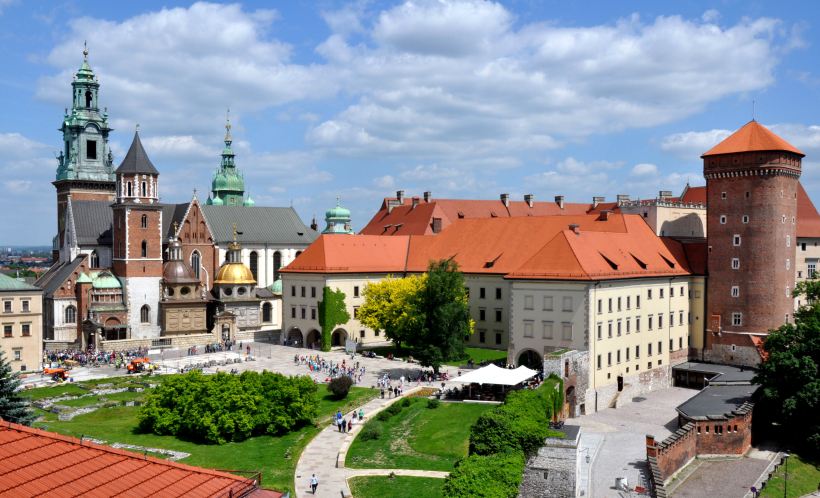
THIS IS EXACTLY THE KIND OF THING WE NEED MORE OF. Hopefully they will consider doing it every year, or even establishing a full conservatory. Maybe this year’s World Youth Day, which is being held in Krakow, will bring the grace to inspire such an endeavor.
So guess what? Turns out some researchers in the Netherlands think more countries should legalize pot.
Captain Obvious, of Hotels.com fame
For those who think flying to Amsterdam (or Colorado, etc.) to indulge in the herb is just fine and dandy, let’s do some thinkin’.
Principle 1: Creation is good.
Principle 2: Not all creatures are equally good.
Principle 3: We ought to avoid evil.
Principle 4: Rastafari is a false religion.
Humans are ontologically higher than rocks, plants, and animals. We can use them, even to their detriment, if they are beneficial enough to us. Jesus was not a vegetarian. And yes, Brother Carrot and Sister Lettuce are okay to kill, unless it is out of sheer disdain and spite for their existence as creatures of God.
But Uncle Bud is a little different, because when we harvest him, it’s usually for the sake of affecting our bodies in a way that suspends our intellect.
Eat-ay ad Thomam:
The sin of drunkenness, as stated in the foregoing Article, consists in the immoderate use and concupiscence of wine. Now this may happen to a man in three ways. First, so that he knows not the drink to be immoderate and intoxicating: and then drunkenness may be without sin, as stated above (Article 1). Secondly, so that he perceives the drink to be immoderate, but without knowing it to be intoxicating, and then drunkenness may involve a venial sin. Thirdly, it may happen that a man is well aware that the drink is immoderate and intoxicating, and yet he would rather be drunk than abstain from drink.
That’s from the Summa Theologica, II-II, Q. 150, art. 2. Wine stands here for any intoxicating substance… One might not know a substance to have intoxicating effects, and so there is no sin in such drunkenness (unless its use was immoderate for other reasons). But if one knows something to be potent, it is another story. But just how drunk is “drunk?”
[The third kind of man] is a drunkard properly speaking, because morals take their species not from things that occur accidentally and beside the intention, but from that which is directly intended. On this way drunkenness is a mortal sin, because then a man willingly and knowingly deprives himself of the use of reason, whereby he performs virtuous deeds and avoids sin, and thus he sins mortally by running the risk of falling into sin. For Ambrose says (De Patriarch. [De Abraham i.]): “We learn that we should shun drunkenness, which prevents us from avoiding grievous sins. For the things we avoid when sober, we unknowingly commit through drunkenness.” Therefore drunkenness, properly speaking, is a mortal sin.
So there is still a mystery… How intoxicated must one be before he “deprives himself of the use of reason?” Let’s remember a few things though before we shame the Angelic Doctor for being obscure. First, he expects a student to have read all the text which precedes this Article. That would give one a better idea of what he means. Second, the Summa really is just a beginner’s crash-course. It is not meant to be exhaustive. In some articles, this is more evident than in others. Third, it’s unlikely St. Thomas had much firsthand experience with drinking to provide us with more subtlety… When Albertus Magnus is your professor and Bonaventure lives on your hall, you’re inspired to “rise above the influence,” as it were.
“Bonaventure Shows Thomas Aquinas the Crucifix,” Francisco Zurbaran, 1629
However, we know that some of the more austere saints occasionally indulged, such as Charles Borromeo and John Vianney. And of course, the Lord did as well, as He so famously pointed out in Matthew 11:19. Since potent substances will technically have some effect no matter how little is taken of them, we can say from this alone that it is not evil in itself to use intoxicating substances.
Then there is the principle of totality to keep in mind. Later in the same Question, Thomas alludes to this by saying a physician might tell one to use drink to induce vomiting – but since lukewarm water works too, that should be used instead. However, if it didn’t (and we hadn’t discovered Ipecac) then it would be fine. This is because the greater health of the body is worth the temporary loss of reason… That’s also why it’s not a sin to plan on going to sleep each night! And while there is violence done to the body and soul when, for instance, a gangrenous limb is removed, it is for the sake of the entire person. But this too should be moderated by wisdom, since not every ailment is worth doing violence to yourself. If you get occasional leg pain, that doesn’t mean you should cut off your leg.
So anyway, how drunk is drunk? How high is high? It is so difficult to say because of the problem in trying to quantify a quality. “It’s when you feel like… you know, drunk.”
There he is again!
We won’t solve the issue of exactly where “the line” is today – maybe another post with some ¡HARDCORE SCIENCE! – but perhaps we can lay down some guideposts based on Thomas and basic research.
Certain drugs act far more quickly than others. THC (the active ingredient in marijuana) acts more quickly than alcohol, based on the popular conventions of consumption. That is a big deal.
Reason helps us to distinguish the true from the false. Once you have trouble doing that, it’s time to call it a day… If sober people around you start laughing at everything you say, it’s probably not because you’re witty and charming, it’s because you’re diminishing your material brain’s capability to interact with your immaterial intellect (AKA you’re becoming drunk). And so on.
If you’re starting to forget stuff that you shouldn’t forget, then that’s another sign your faculties are slipping. So put it down.
When you feel like doing something really dumb that you normally wouldn’t, STOP and don’t do that much again. Once you know that tequila makes your clothes fall off, then kiss it goodbye. It’s better to enter into life without a bottle of Patrón than into Gehenna with all you could ever drink. (And Tequila burns even without being on fire…)
If you can’t walk right and are slurring words, then your brain is shutting down. Same story.
So no hard answers here today, but basically the faster and stronger the drug, the less morally safe it is to use. AND, if one uses any substance for the pleasure of changing his mental state in a way that diminishes its capacity to execute its proper function, as distinct from some some other effect, this too is a red flag… We should not delight in an unnatural state!
All this would make the average consumption of pot pretty bad.
The 67P/Churyumov-Gerasimenko Comet (or “Rosetta’s Comet”) has been found to have organic elements on board. That’s quite a discovery, but how much bigger would it have been if the Mars Rover had found a little clump of algae?
There’s an entire industry around extraterrestrial life. One can just imagine with what care and reverential fear the world’s scientists would handle (or even discuss) some Petri dish of alien amoebas. How many billions of dollars would go to the protection, preservation, and cultivation of that life?
Meanwhile, it’s springtime, and you know what that means: hormones. And we all know hormones lead people to make dumb choices.
“Romeo and Juliet,” Ford Madox, oil on canvas, 1870
Nobody seems to care so much about destroying human life in the womb, even though it behooves us far more to protect our own kind than to grovel over some alien fungus. Space-grass won’t take care of you when you’re old. It will never look you in the eye and tell you it loves you. And no matter how hard you try, you will not be able to teach it how to ride a bike. The list goes on.
BUT, BUT… ALIENS!
Yes, aliens. But yes, humans, too. Shouldn’t we be our first priority? Shouldn’t we figure out how to flourish on our own before trying to flourish as an inter-galactic community?
The drive to search for space-buddies isn’t as strong as the drive for human intimacy. And no matter how many remakes there are of War of the Worlds, the prospect of having a child is more threatening. So we cheat the system.
Pfft. Puny humans.
Although this is less ridiculous than the fact that the destruction of the eggs of endangered turtles carries a higher penalty than the destruction of your own child. At least aliens are cool… No offense to the hawksbill turtle.
One last question… If there really is intelligent extraterrestrial life, and they know anything about our planet, why exactly would they want to have anything to do with us?
I read a piece recently about a kid who left a pair of glasses on the ground at a modern art museum. Hilarity ensued.
Following our earlier post on the essence of art, now we can ask the question: what makes art good?
We can limit ourselves here to the question of what we’ll call “didactic art,” that is to say we will consider a work inasmuch as it is to be enjoyed for its own sake rather than some practical function like digging a hole or magnifying light… Obviously, in those cases, the measure is how well the job is accomplished.
In didactic art, there is not as clear a solution. One might immediately say that it is “a thing well made which is beautiful.” Okay, but that not only raises the thorny question of what beauty is but also seems to exclude many things that we have an impulse to call good art but would probably not call beautiful.
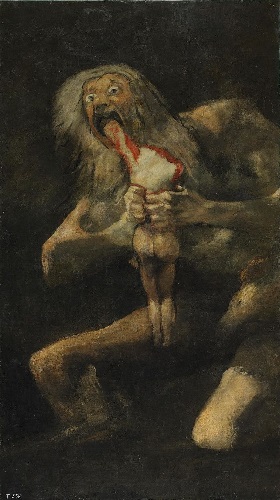
If Francisco de Goya had meant for “Saturn Devouring his Son” to be “beautiful,” we would say he failed. But who would deny that this is good art?
Clearly then, the intention of the artist is important. It is important not only in the sense of craftsmanship – how closely what is in the mind is actually achieved in reality by the work done – but also in the sense of purpose. What is the artist trying to effect in his audience, and how is he trying to accomplish it? What point is he trying to get across to people, how is he trying to make them feel, what is he trying to get them to think? These questions seem pertinent.
Here’s a radical thought… Not all points should be made, not all feelings effected, and so on. If the point is not something true, or if the idea is to make one hate something good – or even to feel a disordered passion, like lust – perhaps it can’t be good didactic art. Alternatively, if there is no message, or the message is so obscure as to be comical (as highlighted so well by the glasses prank), or the message is obscured by the work evoking some distracting feeling (like sensuality), perhaps it can’t be good didactic art. The intention must be a worthy one, and how well that worthy intention is communicated through craftsmanship would be the measure. Here is a familiar painting we might consider:
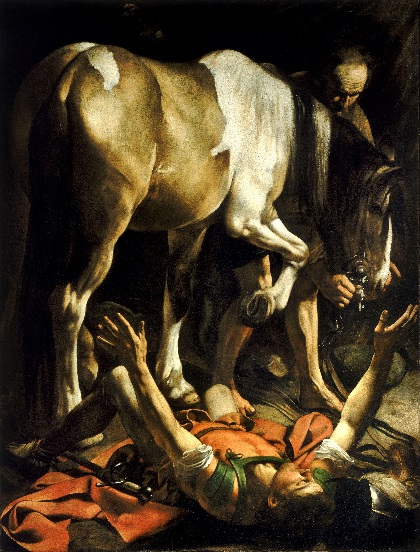
“Conversion on the Way to Damascus” by Caravaggio was a wildly controversial work upon its release. It was thought sacrilegious that the hind end of a horse would occupy the main focus of such a scene! One could see why that might have had an adverse effect on people, especially when it is coupled with Caravaggio’s scandalous life, a life that even included having the pope give him a death sentence (which he evaded by running off to Malta and then bribing a relative of the Holy Father with several paintings).
This work has become greatly admired though, to the point where most people think that the Scriptures actually say Paul fell of a horse on the way to Damascus! But is the shift in public opinion due to a better appreciation of a righteous intention or a deadening of spiritual sensitivities?
Of course there is no doubt that it is well crafted: the chiascurro, the perspective, the expressions – all wonderful. But was Caravaggio making fun of St. Paul? We can only wonder at his intention, but if it was evil and we get only good out of the work anyway, it is by accident rather than by art.
Just some food for thought.
So maybe didactic art, too, is about “how well the job gets done,” but the job is done in the audience themselves. And maybe good art is more about truth and goodness than beauty… But we’ll keep beauty in our tagline anyway.
Main image: By cea + from The Netherlands – Ecce Home, Before, After, and After the After, CC BY 2.0, https://commons.wikimedia.org/w/index.php?curid=48015408
Second image: “Saturn Devouring his Son,” Francisco de Goya, 1819-1823
Third image: “Conversion on the Way to Damascus,” Caravaggio, 1601
Today is the Feast of Corpus Christi. Deo Gratias!
The Eucharist baffles materialists… Such a radical paradigm can easily invade a mind to the point where it can’t even understand how someone could possibly begin to believe the doctrine of the Real Presence, and not only because two elements (Soul and Divinity) are immaterial to begin with. A materialistic vision of the universe, if applied honestly, will reduce all things to a soup of non-distinct matter. There are words or concepts that can be useful, but they don’t correspond to real “substances.” There is no “Socrates,” only “this bit of matter that we call Socrates.” There is no “essence,” in general or in particular.
So, if there is no such thing as substance, (and only “accidents,” such as position, quality, etc.) then it is easy to see why it would be hard to begin to grasp how the Real Presence could work, even hypothetically. “Bracketing” beliefs that much can be very hard sometimes.
Furthermore, the Real Presence, like so many doctrines of religion, is “pseudoscientific.” That means that it is impossible either to prove or to disprove through empirical science, even though it makes a claim about reality. The difference here is that we can touch its consequence – unlike with the division of grace, the Ascension, and so on. This is often frustrating and confusing to secularists. The whole sacramental world is, after all, a giant wrench in the modernist machine: God actually involves Himself in the world, and in certain ways He has subjected himself to men, like that day Joshua made the sun stand still.
The “science of the sacraments” depends upon the “science of the Page.” Theology is a science whose principles are authority and witness rather than direct observation. The primary witness is God Himself, the secondary witnesses are those with whom He has had interactions directly by certain kinds of revelation, and tertiary witnesses are those who have trusted the preceding witnesses… However, tertiary witnesses could also be those events which testify by their nature and circumstance to the authority of the secondary and primary witnesses.
We might rightly call each confection of the Eucharist “miraculous,” since indeed something supernatural is happening in the natural world, but it is ordinary, inasmuch as it can be expected.There are also extraordinary events surrounding the Eucharist, even in our present day: note that a Host was found bleeding in Poland in 2013, and it has just been confirmed after several years of study.
I remember the first time I was turned on to this phenomenon… It was a short video of a presentation by a cardiologist on a recent Eucharistic miracle which happened in Buenos Aires. (Interestingly, Pope Francis has not made much mention of it.) A host had been dropped, put into water, began bleeding and had turned into living heart tissue exhibiting great signs of distress.
How edifying that was to me! “What a slap in the face to those who don’t believe,” I thought. Except it is very, very hard to pull oneself out of the swamps of materialism, secularism, and hedonism, into which so many individuals in our society have fallen. Many of them might say that encountering just one miracle would change their whole lives – but we know how that panned out in the Book of Exodus. Perhaps they will change, but it is easy to slide back again. Humans are both rational and animal, after all.
Miracles can be aids to receiving faith, but faith is only given by God. When Peter confesses his faith in the divinity of Jesus, he gets the reply, “Flesh and blood has not revealed this to you, but my Father in Heaven.” What a paradox to reflect on during this feast of the Lord’s Body and Blood.
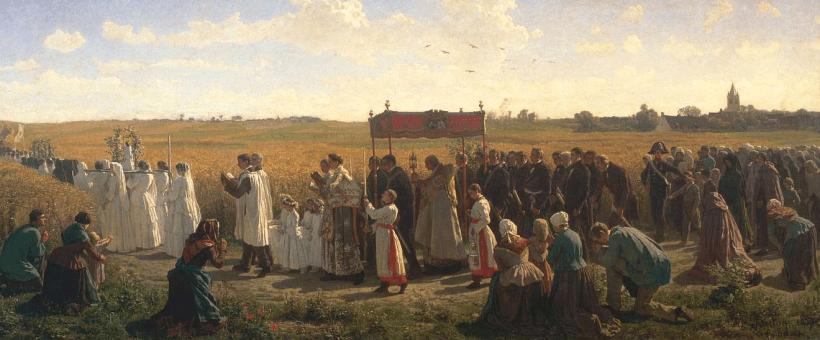
Main image: “Bénédiction des blés en Artois,” 1857, Jules Breton
Second image: “Joshua Commanding the Sun to Stand Upon Gideon,” 1816, John Martin
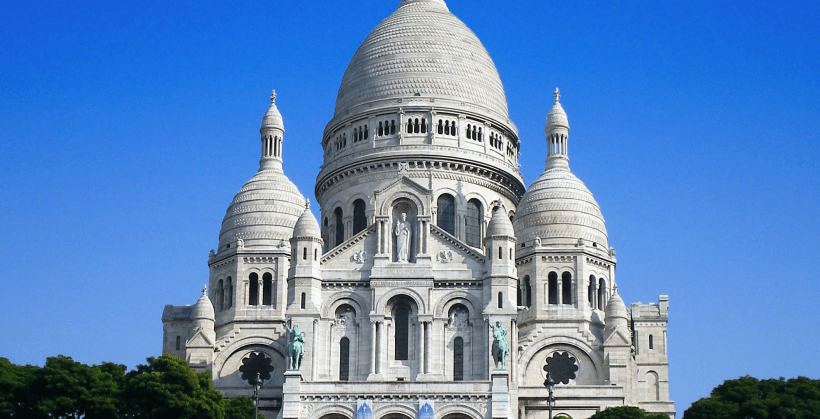
It may be surprising, but Sacré Cœur is a relatively new church.
Groundbreaking began in 1875 and finished in 1914. It was only consecrated in 1919 (delayed by the Great War)… that’s less than 100 years ago, for the mathematically challenged among us.
The story of the basilica’s indiscreet existence winds its way through politics and religion in 19th century France, but it really begins with the diffusion of the devotion to the Sacred Heart, first proposed by St. Marguerite-Marie Alacoque in the late 17th century. We find a letter from her to Louis XIV, dated 1689, which reads:
“The Eternal Father, wishing reparation for the bitterness and anguish that the adorable heart of His Divine Son had experienced amongst the humiliations and outrages of His Passion, desires an edifice where the image of this Divine Heart can receive veneration and homage.”
You can see this text in stone near a statue of the saint in the basilica.
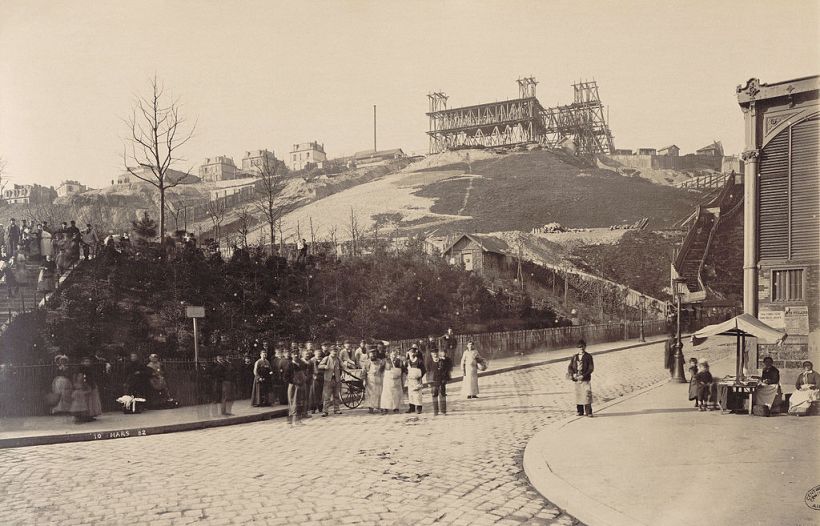
Without a full course in France’s modern political history, one can simply state that, throughout the several rises and falls of the monarchy in the revolutionary and post-revolutionary periods, a large number of the faithful were displeased with the transgressions of those who had gone before them, most recently under Napoleon III. This group included the mercurial royalty. With the cult of the Sacred Heart picking up steam, especially once Pius IX beatified Alacoque in 1864, the natural choice was to fulfill Louis XVI’s vow (made while he was imprisoned) to build a chapel to the Sacred Heart, and the top of the “Butte Montmartre” seemed the best place – and not just for its obvious dominance of the skyline… Many of the more important incidents of the very recent “Paris Commune” of 1871 had taken place there in that exact spot. This radical socialist government echoed the Revolution and executed the Archbishop of Paris at its opening. “Penance through architecture,” was the thought. The rationalist and anti-clerical sins of the Revolution, which had been the cause of so much bloodshed, would surely be expiated by a fitting monument to the Sacred Heart as Alacoque had proposed.
construction in 1882
And it is fitting indeed. Paul Abadie, who won the competition to be its architect, was clearly no artistic slouch. The domes, which might remind one of Byzantine churches, rise proudly in the northernmost part of the city. The tourist who casually meanders throughout Paris is almost just as likely to catch a glimpse of the gleaming white stone atop Montmartre as he is to spot the Eiffel Tower.
The somewhat Roman facade gives the building a strange elegance, but the overall impression of the building is that it is a kind of sepulcher: is it marking the death of the spirit of the Revolution? Is it honoring the innocent lives taken by it, even those in that very spot? Most definitely both.
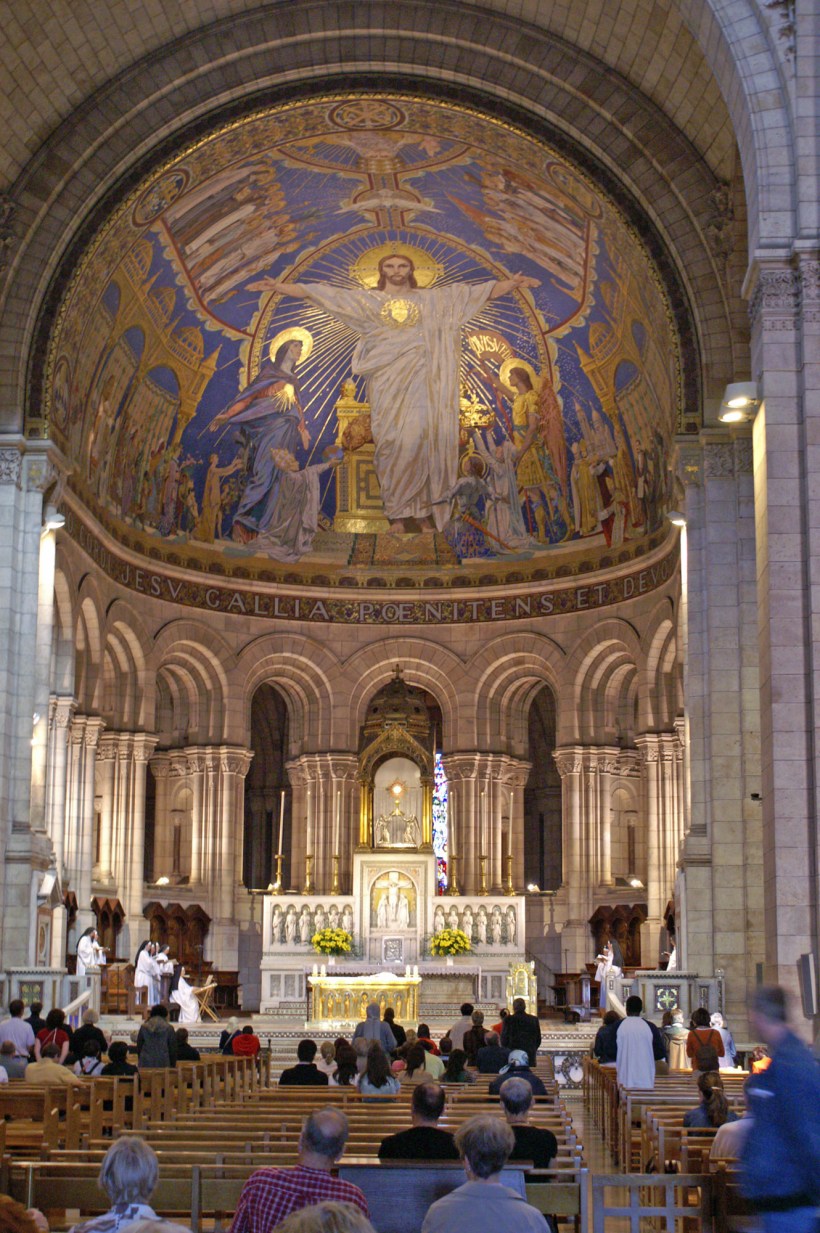
The interior of the basilica matches the Romano-Byzantine structure. The mosaic overlooking the apse is one of the largest of its kind. Notice the “GALLIA POENITENS” underneath the image… “Gaul penitent.”
A trip to the basilica will never disappoint, not just for the unique architecture, but also for the religious exercises. There has been perpetual adoration in the church since 1885, even before its construction was finished. The Benedictine sisters associated with the basilica chant compline there as well, which is phenomenal. One can also stay at the basilica for a very low price, though you must sign up for an adoration shift during the night and be in by 8 PM. The overall atmosphere is extraordinarily reverent for a major tourist attraction, in stark contrast to Notre Dame. And then there is the view…
If all this weren’t enough to convince a traveler to climb the hill through all kinds of rather aggressive vendors, or at least to take the “funicular,” the Jesuits were also founded on the top of Montmartre in the church right next door.
Sacré Cœur fittingly overlooks one of the most “exciting” neighborhoods in Paris, and even all of Europe, continually fulfilling its ever-needed function of penance for sins. At night, the gleaming structure almost seems to call out softly to the streets below, “Come, see this Heart of mine…” It stands as a perpetual and extremely visible monument to the Faith, built quite literally on the ruins of sin and death.
Thus spake St. Augustine in the Confessions about the first time he heard music in a church. He debated whether having music in worship was a good idea, period. Augustine could see that the emotions were a powerful force to drive the human spirit, but if they got too strong they could actually become a distraction from real spirituality, which is ultimately a silent and invisible relationship measured by conformity of the intellect and will to God… One might end up conforming himself to the music instead.
Obviously, we’ve settled that debate, and it is safe to assume that we came down on the right side. But now there is a new debate – and yes, it is new – over what kind of music is appropriate for aiding prayer.
I would like to offer an example of extremes.
Here is a song with 16 million hits on YouTube called “Touch the Sky.” It is by Hillsong United, one of the most popular Christian bands in living memory.
Here is a song with 3.6 million (and that many only because it is being conducted by Leonard Bernstein) called “Ave Verum Corpus.” It is by Mozart.
It doesn’t seem that any serious person could equate the two, and yet it is not an uncommon experience to hear both a “praise and worship” song and a “classical” song in the same mass. I think that was once turned into a play.
If all you’ve ever had is grape juice, how will you appreciate fine wine? It’s not a wonder that a culture increasingly obsessed with the ephemeral and emotional is drawn to a sentimental spirituality summed up by C-G-Am-F.
Yes, this music can be a channel of grace. Yes, it can pick people up when they’re down. But to insist on this to the exclusion of the real musical heritage of the Church is a little bit like picking through the dumpster in the back of a fancy restaurant because the leftovers have calories and nutrients. Go into the restaurant instead.
There is a great temptation in the modern mind to put things “in boxes.” We have our lives at work, at play, at home, within ourselves, and we tend to consider these separately, on their own terms… even though a realistic perception of one’s life would have one admit that all these dimensions are in fact interrelated. There is, however, a special temptation to box the natural and the supernatural, in a way that they can never, ever touch: most often this manifests in the tendency to think of God only when one is at church or “needs a miracle,” as if God weren’t important at other times, or as if He didn’t even exist. But when the hallway is dark and a strange sound is heard, all of a sudden, “It might be a ghost!”
The readership might be interested to know that the area in which our Lord was baptized (an action which symbolized His “descent” into the sins of Israel and of all mankind) occupies a privileged place on the globe in its own right, apart from such a momentous event… It is the lowest piece of land on the planet. Yes, God became man, and was plunged into the waters of the lowest place on Earth!
That is an obvious example of a crossover between the natural and the supernatural, where a natural reality is used as a symbol to emphasize a supernatural reality (almost like a sacrament). And of course, the Incarnation itself is the perfect antithesis of the separation of God and creation.
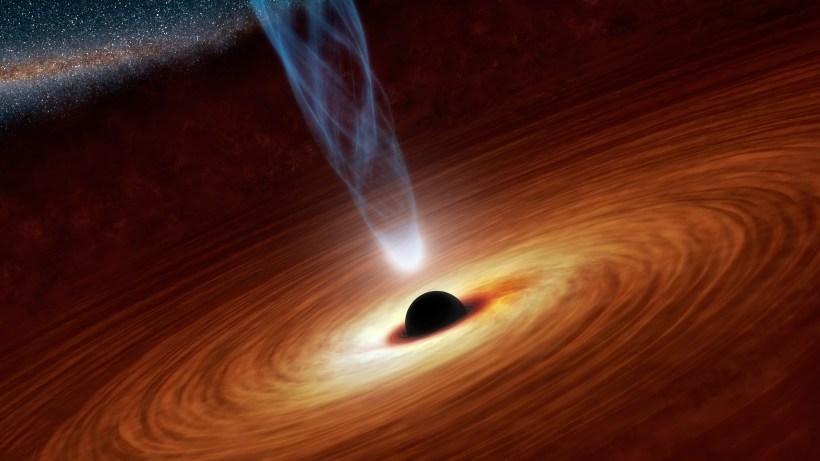
There is no reason this kind of crossover should be limited to the explicitly “theological.” Recently, black holes have been in the news. One story, while plenty interesting, is less relevant for our purposes here in this post than another story: what happens when two black holes collide? Apparently, you get a perfect Middle C.
That would be merely an odd kind of coincidence if it weren’t for St. Boethius, a 6th century Christian philosopher, claiming in his De Institutione Musica* that there is a sort of “musical schema” of the universe in which a creature with a nobler character – angels included – would tend to produce a higher sound. The note now called Middle C (261.6 hertz) has long been realized to be basically the center of the human vocal range, and Boethius figured that since humans are the existential center of creation, that would extend to the realm of music and sounds… Middle C is the Boethian center of audible reality.
What does this all mean? Are black hole collisions portals into the underlying order of creation? Who knows. Given the fact that in the world of pop-science, mystique swirls around these super-massive objects like clouds of gas do in reality, that theme could make for its own miniseries on the Discovery Channel. The point is that the idea that such “supernatural” concepts like Boethius put forward about music ought to be taken seriously in natural research, and an observation like this collision can call attention to that – the sound just as easily could have been over a hundred octaves lower! The supernatural and natural are intertwined, just like space and time. God, the Primal Logos, created the natural world with an order that goes back towards Himself and in which reason can perceive Him. Dismissing God as irrelevant to the quest for natural knowledge saws off the limb on which the scientist sits… “Where does it ultimately come from? Where is it ultimately going?” There can never be holistic science without answering these two questions, and the answer is always the Alpha and the Omega. There is not a science world and a religion world, there is just the one world.
*Unfortunately, this text of Boethius is not entirely available online, although you can see a sample of it here.
In grade school, and even in college course catalogs, one is bound to come across a class simply called “art.” Almost everyone in the civilized world has, in fact, taken an art class. Maybe you have a Christmas ornament that your child made in art class from many years ago. Maybe you know something about pointillism because of that one time you listened to your 8th grade art teacher. But maybe you’ve never stopped to consider what “art” actually is.
It is no wonder then that most people think of art in terms of its particulars: painting, drawing, sculpture, and the like. All of these are certainly forms of art, but what is “art” itself?
Of course, we know there are other forms of art beside what we learned in class in elementary school. Writing is an art, music is an art, architecture is an art, and even cooking is an art. What then, is the common denominator here? What is the same between singing an aria from Turandot and building a skyscraper?
Our friend St. Thomas Aquinas can help, and he has a surprising insight: art is not something outside of man, it is something in man himself.
From the Summa Theologica, I-II, Q. 56, a. 3: “Art is nothing else than the ‘the right reason about certain things to be made.'”
Everything that requires some thought to be put into its creation deserves to be called a form of art, or rather, a product of art. The art of shipbuilding produces good ships, the art of war produces good outcomes in battle, etc. And certainly, “right reason” would necessarily demand that what is produced by art is “good”:
“And yet the good of these things depends, not on man’s appetitive faculty being affected in this or that way, but on the goodness of the work done. For a craftsman, as such, is commendable, not for the will with which he does a work, but for the quality of the work.”
This is a dagger to the common wisdom that good art is whatever people like… Thomas is here insisting on something objective about the quality of the work itself as the primary measure of its artistic merit. I will argue here that this would naturally extend beyond the artist and into the realm of critical reception: just because others have an appetitive inclination toward a painting does not make it good artwork. Few today have a taste for Beethoven, but that does not make whatever’s on the Top 40 better art than his 5th symphony (but some is probably better than the disco version). The work must be considered “in itself,” apart from what people think or feel about it.
“And so art has the nature of a virtue in the same way as the speculative habits, in so far, to wit, as neither art nor speculative habit makes a good work as regards the use of the habit, which is the property of a virtue that perfects the appetite, but only as regards the aptness to work well.”
Art is a virtue! It is something in the soul that helps us to do good! How refreshing a concept is that? But it is up to the will, through other virtues (like justice and charity) to use art properly, hopefully satisfying higher appetites, such as for truth, beauty, and goodness, rather than for the fulfillment of baser urges, especially sensuality and vanity.






 Christian Renaissance Movement