How the Camera is Spoiling Religion

A while back a professor commented to my class about the cover of a recent edition of The Word Among Us. He noted that the title was “The Gospel of Encounter,” and yet it featured something rather opposed to such a notion… A woman who actually “turned away from the Vicar of Christ,” as he put it, to take a selfie. (It’s the June 2015 issue.)

You have no doubt experienced the frustration of such things before, if you’ve ever been to Notre Dame, the Holy Sepulchre, or any major church or shrine. A lot of people are there just to snag photos.

I was recently at the Holy Father’s Sunday Angelus address, which is held weekly in St. Peter’s Square. Yes, it makes sense that people would take a picture or two, yes, it makes sense to have two large television screens with live streaming due to how far away the Pope’s window is. But what I noticed was something very odd and disconcerting: many people were taking pictures of the screens.

They were taking pictures. Of pictures.

“Little Johnny, look at this photo here, it’s from 40 years ago.”
“Oh boy, what’s it of, grandpa?”
“It’s a picture of some footage of the pope.”
“Wow, golly gee, that must have been special. But can’t I just look up the real thing on YouTube?”
“That’s not the point – I saw this footage in person.”
“I can too, grandpa, here it is. If only you had seen the pope himself!”
“I did, but the screen was just as interesting.”

Why aren’t people satisfied with a postcard from a famous church? Certainly, it’s not the 50 cents it costs, because people are likewise not satisfied with the professional quality footage that is now taken at every papal event and then immediately uploaded for the whole world to see. Is it really necessary that it’s on YOUR phone? Why not just soak in the experience instead, so that it’s actually in YOUR brain?

“I just want to remember it,” people will say. Well, first of all, if you need to take a picture to remember something, it couldn’t have been that spectacular, so why do you want to remember it? And you can’t remember something you never really encountered in sincerity anyway. The “flesh and blood” of the experience must be primary, the digitized “word” of the experience must be secondary.

In focusing too much on getting a picture, one immortalizes a moment that he never had.

resphone

God can’t be experienced directly in this life, only in the next life in the fullness of the Beatific Vision, where we will behold the Divine Essence “face to face.” For now it is always, as St. Paul says, “dimly in a mirror.” (1 Cor 13:12) Why are we so intent on adding yet another piece of glass to hide Him from ourselves?

Many years ago I traveled to Quebec. I was in some reenactment Native American village (or is it Native Canadian?), where my group was told by the guide that absolutely no pictures were to be taken of the masks inside one particular hut – that if this law was broken, our cameras would be too. Why? Because there was a belief that developed that taking a picture somehow steals the soul away from the object… It desecrates it, profanes it, sucks its life out. While we know that masks don’t have souls, and that cameras don’t half-kill what they capture images of, perhaps this is not far off from the truth, but in the opposite direction: taking pictures of the sacred, if done irreverently, is bad for the photographer’s soul. It half-kills the experience he could have had. It has profaned and desecrated his relationship to it.

Now, there can be good photography of the sacred. There is plenty of it, actually. But good sacred photography is never done out of vanity, out of “touristic” motives, out of bandwagon-hype. Such would be, in some small way, a sacrilege. If a Catholic walks into one of the great churches of Christendom, forgets to genuflect, and starts grabbing pictures of the statues, hasn’t he sort of missed the point? And how much of an excuse does he really have?

Perhaps some person or place really speaks to you, and after having authentically encountered it you desire to catch a picture. That is quite a different phenomenon, as you have already genuinely engaged with what you now encounter through lenses, mirrors, and a screen. The Word became flesh, after all – He certainly did NOT become a digital picture.

In the meantime, let’s all sit back, relax, and actually experience the incarnational nature of our Faith, rather than neurotically re-immaterializing it.


Post by: Eamonn Clark

Main image: CTV’s coverage of the Papal audience of May 25, 2016

The Transfiguration and the Meaning of Christian Mystery

“Master, it is good that we are here; let us make three tents, one for you, one for Moses, and one for Elijah.” (Luke 9:33)

Peter had two options for approaching the event of the Transfiguration: he could see it as (a) a problem that needs to be solved, or (b) as a mystery.

When Jesus led Peter, James, and John up the high mountain, they woke up to a scene that seemed to defy all understanding. Jesus brings them up to the top of Mount Tabor and begins to glow unworldly bright. Then Moses and Elijah from the Old Testament show up and all three of them have a conversation.

Peter, thinking quickly on his feet, intrudes into their conversation and asks whether he should build three tents. For us, this sounds like odd, but for Peter, he must have thought he had solved the problem: this had to be the beginning of the end times. He might have picked up on how Jesus is fulfilling the Old Testament festivals. He knew of the Jewish tradition that Moses and Elijah would come again before the end of the world. Jesus, along with Moses and Elijah, was finally going to restore the kingdom of Israel and reap the much-anticipated harvest of souls. It was the Christological fulfillment of the Jewish Festival of Booths.

They needed tents.

However, Peter “did not know what he was saying.” He approached the Transfiguration as a problem to be solved, not as a mystery to be entered into. So while Peter was still speaking, a higher voice corrected him: “This is my beloved son with whom I am well pleased. Listen to him.”

The Limits of Science

When Christians use the word “mystery,” we do not mean a problem without an answer. No, for Christians, a mystery is something that is so intensely knowable that it exceeds the powers of human comprehension.

Let me give you an example.

Once, my five-year old niece told me, “Did you know that, when I’m in the car, the moon follows me? It really does!” My immediate response was to try to explain to her that since the moon is so far away, it only looks like it is following her. My impulse was to set up an experiment, putting her in one car and her sister in another car. They would go separate directions and observe how the moon follows both of them. Then I could prove to my niece that, since the moon cannot possibly be following both of them, there must be another explanation. That explanation would be in the reality of the great distance between the earth and the moon, a distance that can be observed and measured. Science would win out over childish naïveté.

But before I could thoroughly disprove her childish notion, she interrupted, “No. The moon really follows me.” With such opposition, I thus abandoned my attempt to scientifically disprove her childish perception.

For my five-year old niece, the moon was a mystery; it really did follow her. The moon was so beyond her that, rather than disconnecting her, it implicated her in its path. However mistaken her understanding of perspective, she approached it with wonder. And she rightly would not let that wonder be extinguished.

To me, the moon was a problem that needed to be solved; it could be measured and placed conceptually at a distance. I knew that its movements and phases are configured to a different pattern than my sporadic movements. Although technically more correct, the approach that reduced the moon to a problem prevented me from being gripped by the mystery of the moon and sharing in my niece’s wonder. To my niece, however, the moon was a mystery to be entered into.

Like my niece with the moon, a mystery is so beyond us, that we cannot help but be pulled into it. A mystery is so large that it necessarily involves the viewer. In this way, God Himself is a mystery, being so far beyond us that, at the same time, He embraces us and loves us in our very being.

Mysteries are not problems; they are not to be solved – they are to be entered into. A mystery is like a piece of art that pulls the viewer in; it is not a mere opportunity for scientific analysis.

The Mystery of the Transfiguration

It is in this way that the event of the Transfiguration is a mystery. Since mysteries overwhelm us, they implicate us – they require our response. Our response, then, to the mystery of the Transfiguration is not to solve the puzzle of Moses and Elijah’s appearance, but to enter deeply into the reality of what is before us. Through the mystery of the Transfiguration, we share in Jesus’ own prayer with the Father. By beholding the glory of Christ transfigured and listening to him, we become sons and daughters in the Son. By entering in to the mystery of the Transfiguration – by listening to God’s chosen Son – we become what we contemplate.

How do we enter in to the mystery of the Transfiguration? For us Christians, we go to the source and the summit of the Christian life – the Holy Sacrifice of the Mass. Like Peter at the Transfiguration, we can look at the Mass just as a problem to be solved, a ritual to be analyzed, a puzzle to be deciphered. Or we can enter into the mystery of the Mass.

In every celebration of the Mass, we ascend the mountain with Christ, and we encounter something that overwhelms our understanding: God incarnate – the second Person of the Holy Trinity – comes to us as bread and wine. So great is the glory of Christ in the Eucharist, so utterly beyond us, that we are pulled into the mystery. The altar is our Mount Tabor, where we see His glory, not with the eyes of flesh, but with the eyes of faith. Over the altar the Father’s voice mystically resounds, “This is my beloved Son; listen to him.” We who enter into this mystery by receiving the Body of Christ in Holy Communion are enveloped by the cloud of the Holy Spirit. At Mass, we enter in to the mystery of God’s glory. He gazes on us, and we gaze on Him, and we become what we contemplate.


Main Image: The Church of the Transfiguration

Sing to the Lord a New Song – in an Old Way?

“I heard there was a secret chord, that David played and it pleased the Lord.” But if you can’t figure out what that chord was, maybe just try singing. God made your voice, after all.

With roots going back to ancient Judaism, singing is an integral part of Christian worship. St. Paul tells us to “be filled with the Spirit, addressing one another in psalms and hymns and spiritual songs, singing and making melody to the Lord with all your heart” (Eph 5:17-19). One would guess that musical instruments would be helping to make this melody, adding another musical layer and aiding proper pitch, tempo, and rhythm.

Aulos_player_Louvre_G313
Aulos Player

However, the Fathers of the Early Church came down very hard against the use of any musical instruments in the liturgy. For example, St. John Chrysostom says rather forcefully that “where aulos-players are, there Christ is not.” By exploring their reasons, we’ll uncover some theological underpinnings to the Church’s use of chant in her liturgy.

Hebrew
Hebrew Psalter, 15th century AD

Jewish Roots

“Praise him with trumpet sound; praise him with lute and harp! Praise him with timbrel and dance; praise him with strings and pipe! Praise him with sounding cymbals; praise him with loud clashing cymbals! Let everything that breathes praise the Lord!” (Psalm 150:3-6)

Although the Temple at one point was known for its loud instruments, Judaism itself cast aside musical instruments in the wake of the destruction of the Temple in 70 A.D. When the Romans left Jerusalem devestated, the Jews dispersed throughout the Roman Empire abandoned their harps and lutes, as they had once done in the Babylonian Exile 600 years prior:

By the rivers of Babylon there we sat and wept, remembering Zion; on the poplars that grew there we hung up our harps. For it was there that they asked us, our captors for songs, our oppressors, for joy. “Sing to us,” they said, “one of Zion’s songs.” O how could we sing the song of the Lord on alien soil? (Psalm 137: 1-4)

Like the Babylonian Exile, the destruction of the Temple fundamentally changed Jewish worship, and the “lute and harp” lost out.

Another reason musical instruments lost out was that pagan cults were known for playing musical instruments. And since the early Jews had a real fear of obfuscating the sacred and the profane, the association of musical instruments with paganism was enough to render musical instruments unclean.

When the Early Church looked for guidance in how to conduct their worship, they seemed to follow suit. But the Church Fathers didn’t stop with just condemning the use of musical instruments in the liturgy of the Church; they went on to condemn them in other aspects of secular life. For example, St. John Chrysostom calls musical instruments “the devil’s great heap of garbage.” St. Augustine adds: “The pipe, tabret, and harp here associate so intimately with the sensual heathen cults, as well as with the wild revelries and shameless performances of the degenerate theater and circus, it is easy to understand the prejudices against their use in the worship.”

Because of this great aversion to musical instruments, early Christian liturgical music was exclusively vocal. The liturgy would be sung but only in a subdued fashion, using a form of singing called “cantillation” that resembled speech more than song.

Clement
St. Clement of Alexandria (d. 215 AD)

Patristic Interiorization

“He who sings, prays twice” – this aphorism often attributed to St. Augustine is actually a distillation of his commentary on Psalm 73:

For he that sings praise, not only praises, but only praises with gladness; he that sings praise, not only sings, but also loves him of whom he sings. In praise, there is the speaking forth of one confessing; in singing, the affection of one loving.

Perhaps better distilled as “Only the lover sings,” singing adds to our praise the element of love, the internal disposition of the heart. The act of singing, involving the mechanisms of the human voice, expresses that love of God or, even, is that love of God. Something much more profound is happening in the song of the lover than a mere doubling of prayer.

But what about musical instruments?

Although Jewish and Christian worship changed, the Old Testament did not. How did the Early Church contend with the many instances of musical instruments in the Old Testament?  The Church Fathers interiorized the external musical instruments featured in the psalter. Chief among the Church Fathers in that area, St. Clement of Alexandria writes on Psalm 150:

The Spirit, to purify the divine liturgy from any such unrestrained revelry, chants: ‘Praise Him with sound of trumpet,’ for, in fact, at the sound of the trumpet the dead will rise again; ‘praise Him with harp,’ for the tongue is a harp of the Lord; ‘and with the lute, praise Him,’ understand the mouth as a lute moved by the Spirit as the lute is by the plectrum; ‘praise Him with timbal and choir,’ that is, the Church awaiting the resurrection of the body in the flesh which is its echo; ‘praise Him with strings and organ,’ calling our bodies an organ and its sinews strings, for from them the body derives its coordinated movement, and when touched by the Spirit, gives forth human sounds; ‘praise Him on high-sounding cymbals,’ which mean the tongue of the mouth, which, with the movement of the lips, produces words.

Far removed from the “unrestrained revelry” of pagan culture, the human voice alone sufficed for authentic praise of God. All the references to musical instruments are made into allegories for the human body, each signifying different aspects of our physical anthropology.

But more than just our bodies, God made the whole human person – body and soul – in His image, capable of praising Him in melodious song. The early monk Cassiodorus writes that “the notes previously observed as issuing from musical instruments are now seen to emanate from the rational bodies of men.” Connecting this to the Incarnation, St. Clement of Alexandria writes:

The Word of God, scorning the lyre and cithara as lifeless instruments, and having rendered harmonious by the Holy Spirit both this cosmos and even man the microcosm, made up of body and soul – he sings to God on his many-voiced instrument and he sings to man, himself an instrument: “You are my cithara, my aulos and my temple,” a cithara because of harmony, and aulos because of spirit, and a temple because of the word, so that the first might strum, the second might breathe, and the third might encompass the Lord… The Lord made man a beautiful breathing instrument after his own image; certainly he is himself an all harmonious instrument of God, well-tuned and holy, the transcendental wisdom, the heavenly Word.

The Word of God became flesh – with human lungs, lips, tongue, and voice – and continued his eternal praise of the Father, now as one of those “beautiful breathing instruments.”

The definitive departure from “lifeless” Davidic musical instruments made room for such interpretations of the psalms. With this anthropologizing and allegorizing of the psalms with the elevated anthropology of the Incarnation, we have the beginnings of a theological foundation for liturgical chant.

Theology of the Unassisted Voice

When the Word became human flesh in the Incarnation, the study of human nature became a study of God – anthropology became a theology. Likewise, the study of the human voice reveals in some way the mystery of Christ. According to Dom Mark Kirby, the human voice in the Church’s liturgy prepares “in a kind of renewal of the mystery of the incarnation, an acoustical body for the Divine Word” (“The Psalmody of the Divine Office,” 17-18). In this way, liturgical chant is a participation in Christ’s mediation to the Father, as manifested in the Incarnation.

Here (with some help from Dom Kirby) are some theological musings on several aspects of the unassisted human voice.

Breathing: Within the Trinity, “the breath of God is indissociable from the word of God, and the word of God cannot be uttered save in a communication of the breath of God.” (“Toward a Definition of Liturgical Chant,” 15). Breathing thus images the action of the Holy Spirit in singing. In a cappella singing, pauses for breathing are left unfilled and exposed. Through the breathing necessary for supported singing, “the human person, fully alive, expresses likeness to God. Breath, life, and word constitute an inseparable triad in the divine economy of creation and redemption” (Ibid.). Together, the co-incidence of breath and word resonate in the human heart, the inner sanctuary of the temple of one’s body, where one prays to the Father in secret (Matt 6:6).

Memory: Unlike visual art which is stretched spatially, music is stretched temporally, requiring the human memory to link words across time into a coherent discourse. “Liturgical chant,” according to Dom Kirby, “being heightened discourse, engages the memory of both singer and hearer, becoming a disclosure, in time, of the timeless mystery, a contemplative unfolding of the Word” (“Toward a Definition of Liturgical Chant,” 14).

Communion: The prayer of the Christian is never solitary; every prayer is uttered in union with Christ and in communion with His Church. Chant captures this aspect of communion. The propers, antiphons, and psalmody chanted in the sacred assembly make present that communion of persons, all praying ecclesially with the voice of the Church. Chanting the prayer of the Church together leads to a uniformity without homogenization, a unity without loss of identity – each unique voice aids the others in a common song of praise. Even when chanted alone, the prayer of the liturgy is united with the prayers of all the faithful from the rising of the sun to its setting, stretching throughout space and time.

Disposui
16th Century Chant Manuscript – Psalm 89: “I have made a covenant with my elect: I have sworn to David my servant. Alleluia.”

Silence: Chant begins and ends with silence: “the context of liturgical chant is, before and after anything else, silence. It originates, with the word, in silence. Like the Word, it ‘springs from the silence’” (Ibid., 20). More than merely assisting prayer, chant is prayer. In fact, chant is a participation in the highest prayer of Christ’s mediation to the Father. As such, chant should not feel rushed or busy, but must rather be irrigated with silence. The pockets of silence are little Mount Horebs wherein we hear the “still small voice” of God (1 Kg 19:12). This prayer does not need musical instruments filling in the gaps of singing and supporting the sound of the human voice with additional melodic layers. Rather, in liturgical chant, the exposed and vulnerable human person encounters the Father most authentically in silence.

What Next?

In chant, the human voice alone carries the word and expresses the fullness of the human person – body and soul. Chanting the text without accompaniment, one’s voice, one’s prayer – one’s whole person – is exposed to God. Chant is thus a full, conscious, and active participation in the prayer of the Church in the liturgy.

As the Church spread throughout Europe and the influence of paganism began to wane, musical instruments lost their negative associations. No longer seen as “the devil’s heap of garbage,” the Church began to reintroduce instruments into worship. With a little help from Charlemagne, the pipe organ became a prominent feature of medieval churches. As a “breathing” machine operated by bellows, the pipe organ was seen as an appropriate mechanical approximation of the human voice.

Vouet,_Simon_-_Saint_Cecilia_-_c._1626
St. Cecilia (d. 230) anachronistically depicted playing the organ

But before the organ became a staple of church construction, the initial vacuum created by the Church Fathers’ opposition to musical instruments was filled by a theology of the unaccompanied human voice. Even though the Church no longer fears a connection to pagan worship, it was that initial aversion that occasioned the development of a robust theology of the unaccompanied voice – a theology whose praises are often unsung.

Such a theology became the basis for the great depositum orandi – deposit of prayer (to coin a phrase) – in Gregorian Chant. To this day, Gregorian chant is still “specially suited to the Roman liturgy” and “should be given pride of place in liturgical services” (Sacrosanctum Concilium 116).

Like the Early Church, the negative cultural associations of some contemporary genres of music ought to be taken into account in developing liturgical music fitted for the worship of the Father through, with, and in the incarnate Son. But more importantly, we ought not to turn our back on the larger theology of chant rooted in the Incarnation.


Post by: Deacon Peter Gruber, C.O.


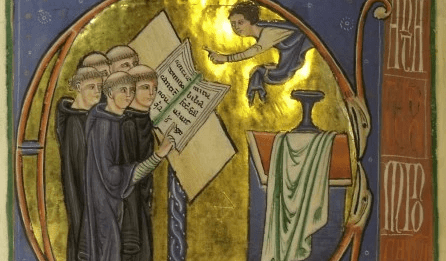
Main image: The Worcester Psalter
The Initial of Psalm 97

Animation & Iconography

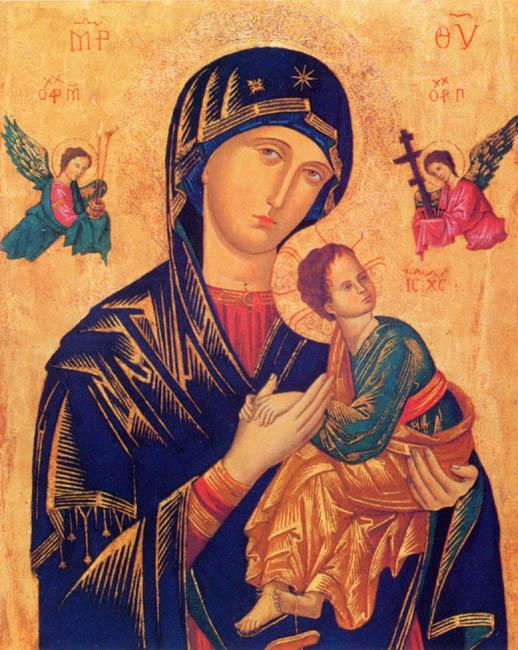
There is a charming story told about St. Bernadette, the Lourdes visionary. After the apparitions were well over, people wanted to know what Mary looked like, especially to construct a statue for the Grotto. She gave a sculptor as many details as she could remember, but the result dissatisfied her: “That is not Our Lady!” She was then brought all kinds of paintings – Our Lady of This and That, and whatnot. None of them matched her memory. Finally, she picked up a picture of Our Lady of Perpetual Help. “That is the Blessed Virgin!”

Desprestaur
Our Lady of Perpetual Help

The “non-realism” of icons, at its root, is a sign of respect for the mystery of the holiness of the subject being depicted. It leaves something to the imagination, as if to say “it is impossible to depict the reality, you must go find it for yourself.” It is revelation through negation, perhaps what we could call a “weak apophatic” mysticism. The medium also allows for one to emphasize certain features of a subject as a symbol.

Icons are never “drawn” or “painted,” they are always “written,” like a word. The goal is not to capture the reality so much as it is to start one down the right path to a real encounter with the subject, and ultimately with God. There is great value in this. We would find it odd to have a devotional picture of someone posing as the Blessed Mother… We do not find it odd to have an icon, which is “less realistic” but is still somehow much more accurate, as St. Bernadette would affirm.

One might call to mind many scriptural corollaries to this – the ubiquitous treatment of “seeing God” as difficult or impossible, the veil over Moses’ face, the gradual progression from Law to Spirit… And, if you pay close attention to the Gospels, almost no miracle of Christ takes place in direct visibility – it’s always in the midst of chaos, in a storm, in a cloud, inside a body, etc. This is why a scene like this – while well done in other ways – might feel a little “off”:

If this is what His miracles looked like, He may as well have flown around Jerusalem (Mt. 4: 5-7) and been done with it.

This whole issue of the delicacy of mystical imagery is particularly poignant in film, where actual people who we know are not “real” become stand-ins: they do the walking, talking – all of it. Sometimes this is helpful. But no matter how good an actor or director is, you know that “this is not how it actually looked, and that’s not actually Jesus/Mary/etc.” If you want an “authentic picture,” you have to do more work in a way because you need to deconstruct what is being shown and then stick to a mostly shapeless image in your mind.

For these reasons, I want to suggest that the art of animation gets a largely undeserved bad rap, or is at least not given enough serious attention.

This is an absolutely wonderful bit from The Prince of Egypt. The film has a pretty killer soundtrack, but the step back from the “big orchestra” pieces here is particularly effective. The lyrics are a play off of the song which is sung by Moses and the Israelites after the crossing of the Red Sea. Most important, however, is the symbolic imagery – notice especially the moment at 0:38, as a type of the Crucifixion. All of this achieved through “a kid’s medium”… Still very moving, no?

Compare and contrast with the same scene from a live-action film (go to about 1:14:00):

Here is another example of religious animation done extremely well, telling the story of Bl. Joan of Aza giving birth to her son, St. Dominic:

This short wouldn’t work nearly as well if it weren’t animated. Think about it. There’s an ethereal character to it that allows for the strange to be beautiful in a way that live-action characters would render impossible. (It would end up looking more like this, which wouldn’t seem right.)

These are just a few examples. But it is clear that the “unreal” can achieve certain goods that the “real” can’t, especially with spiritual realities which are distant (or “unreal”) to our intuitions.

In art class in elementary school, we often thought the goal of painting, drawing, etc. was to make the work look as similar to the subject as possible. Maybe this attitude never quite left some of us. And maybe it’s time it did, especially if we are using art to evangelize or catechize.


Post by: Eamonn Clark

Re-Turning Towards the Lord

Let’s be bold and ask the question: if the priest has his back to the people when he faces ad orientem, Who does he have his back to when he faces them?

Robert Cardinal Sarah, Prefect of the Congregation for Divine Worship, recently gave an address to the “Sacra Liturgia” Conference, entitled “Towards an Authentic Implementation of Sacrosanctum Concilium.” In this address, he said the following:

…[It] is very important that we return as soon as possible to a common orientation, of priests and the faithful turned together in the same direction—Eastwards or at least towards the apse—to the Lord who comes, in those parts of the liturgical rites when we are addressing God. This practice is permitted by current liturgical legislation. It is perfectly legitimate in the modern rite. Indeed, I think it is a very important step in ensuring that in our celebrations the Lord is truly at the centre.

Cardinal Sarah’s appeal to return to ad orientem worship is not made in a vacuum. There has been a growing interest in the traditional practice that has kept pace with a growing scholarship in this area.

The whole question of the orientation of the liturgy takes as a starting point the fact that the liturgy is the communication of something innately beautiful – that, in the highest sense of the word, liturgy is an art.

In his Post-Synodal Apostolic Exhortation, Sacramentum Caritatis, Pope Emeritus Benedict XVI argues that beauty is no mere decoration, but rather an “essential element of the liturgical action, since it is an attribute of God himself and his revelation.” The gestures and signs of the liturgy form a sort of divine choreography. This divine choreography – the “ars celebrandi” – arises not from arbitrary or superficial principles, but from the astounding depth of the Paschal Mystery and the truth of the Christian faith. For our purposes, it is important to see that the ars celebrandi cannot be underestimated for its ability to invite real immersion into the liturgy. Indeed, for Pope Emeritus Benedict XVI, it is “the primary way to foster the participation of the People of God in the sacred rite.” With stakes so high, it is necessary to embody within the celebration of the Mass the right imagery.

Behind the recent remarks of Cardinal Sarah, there is a world of theological debate about the choreography of the liturgy – particularly the orientation of the priest. To situate the debate, we will examine two major works on the topic: Turning Towards the Lord by U. M. Lang and The Spirit of the Liturgy by Joseph Cardinal Ratzinger (now Pope Emeritus Benedict XVI).

Within this context of liturgy as art (and without delving too much into the liturgical polemics in the wake of Cardinal Sarah’s address last week), we will investigate some of the reasoning that advocates for versus populum have used, the response by those who advocate ad orientem, and the prevailing recommendation to correct the issues.

Arguments In Favor of Versus Populum

First, it will be most helpful to have an idea for the argument for keeping the new practice of celebrating Mass versus populum.

1. Advocates of versus populum would point out that the Mass originates in the Last Supper on Holy Thursday. In that context, Christ was reclined around a table with his apostles. Thus, the Mass in the modern day ought to be reflective of a communal meal, with priest and the people facing each other in order to be true to the origins. Doing so would fulfil Sacrosanctum Concilium’s call for “active participation” in the liturgy by the faithful, by inviting them into the communal act in so direct a way. Since “active participation” is such a major concern in the last century’s liturgical reform, it has seemed most expedient to construct new altars that invited versus populum celebration.

2. By way of anticipating objections, advocates for versus populum are guarding against “archaism” in liturgy. Pope Pius XII, in his encyclical Mediator Dei, warns against any misguided archaism:

The liturgy of the early ages is most certainly worthy of all veneration. But ancient usage must not be esteemed more suitable and more proper, either in its own right or in its significance for later times and new situations, on the simple ground that it carries the savour and aroma of antiquity … [I]t is neither wise nor laudable to reduce everything to antiquity by every possible device.

Lest the Church fall into this archaism, supporters of versus populum argue that we must allow the liturgy to develop the way that it has. New forms and new practices are all the more fitting for new ages of the Church. Accordingly, they argue that there is no reason to reverse the trend of celebrating versus populum.

Responses to these Arguments

Is the appeal to bring back ad orientem celebration simply “archaism”? Are its proponents just advocating liturgical nostalgia?

Quite the contrary. The defense of ad orientem celebration is robust, thorough, clear, and convincing. Lang points out several flaws in the reasoning for versus populum. That the Last Supper was merely a meal, Lang takes issue. The Mass did begin as a meal, but its development did not end there. The Eucharistic sacrifice commemorates the Passion, Death, and Resurrection of Jesus – the Paschal Mystery. It is not merely a meal. Lang explains: “it was the new reality, not the meal as such, that Christ commanded us to repeat in memory of him” (93). To think that the development from the Jewish festal meal to the distinct act of liturgical worship in Christianity could or should be reversed, Lang concludes, would be “a most deceptive archaism” (93).

The second flaw with the appeal to the Last Supper is that it does not match up with the reality of the actual meal in the first place. According to Lang, “it was customary for the diners to recline on couches arranged in a semicircle, with small tables being used for holding food and dishes. In this arrangement, the place of honour was on the right of the semicircle” (93). In effect, it is not true that the Last Supper would have meant that the people would face each other, as has been perpetuated by the art of the 13th century onward. Although a contemporary reading of the Last Supper meal would impose such a reality, it is more likely that all the diners were facing the same direction at the time. Thus, the appeal to the Last Supper fails, not only because it is a mistaken view of the Mass as merely a meal, but also because it does not take into account the actual historical conditions of the Last Supper.

If the image of a meal does not fully capture the symbolic meaning of the Mass, are there other ways in which we may understand the Mass? Ratzinger puts forward another image: the Exodus. In the liturgical exodus, the priest is not just a “presider” – rather, like Moses he leads the people towards the Lord from slavery to the Promised Land. The priest facing the same direction as the people expresses the meaning of pilgrimage in our participation in the Exodus of the New Covenant – the Paschal Mystery of our Lord.

As a final response to the proponents of versus populum, Lang addresses the accusation of archaism:

This is not a form of archaism, if only because it was the virtually universal practice in the Latin Church until the most recent times and is part of the liturgical heritage in the Churches of the Byzantine, Syriac, Armenian, Coptic, and Ethiopian traditions. (98)

The practice of offering Mass ad orientem simply has too rich of a history and is too universal in its usage to be oversimplified to archaism.

The Defense for Ad Orientem

Having discussed the flaws in the versus populum argumentation, it is fitting to look at the whole argument for facing east in the offering of Mass. We will look at this argument based off the history of Church, the symbolism behind the orientation, and the necessity of maintaining proper symbols.

The history of the Church’s liturgical celebrations and the symbolism contained within these decisions are so interwoven that we will discuss them together. The Jewish custom for worship consisted in the synagogues facing the temple. All the ritual celebrations pointed back to Jerusalem as the focal point of Jewish worship. It was here that God centered his relationship with His chosen people.

As the Christians developed their own identity and broke from Jewish customs, it was no longer important to face the temple. Now, Christians faced towards the New Jerusalem. How could this be manifested in the direction of worship? Facing the east quickly became the Christian response, not only in liturgy but in prayer in general. Lang gives some biblical examples:

[F]or instance, the sun of righteousness (Mal 4:2), the feet of the Lord standing on the Mount of Olives, which lies before Jerusalem on the east (Zech 14:4), the day dawning from on high (Lk 1:78), the angel ascending from the rising of the sun with the seal of the living God (Rev 7:2), not to mention the Johannine light imagery. (41)

In addition to these examples, the Son of Man came with power and glory, appearing as lightning in the east, shining as far as the west (Mt 24:27,30). For the early Christians, the image of the rising sun was very significant. They would face that direction in order to face the Lord.

This eastward orientation held true nearly universally and affected all types of Christian prayer. Origen (around AD 231) explains the connection in his treatise On Prayer:

It should be immediately clear that that the direction of the rising sun obviously indicates that we ought to pray inclining in that direction, an act which symbolizes the soul looking where the true light rises.

In case Origen is not enough of an authority, St. Augustine is in agreement: “When we stand at prayer, we turn to the east.”

The architecture of ancient Churches points out that the liturgy was almost always celebrated ad orientem. In the cases where the doors were facing to the east, which was a minority, the celebrant and the people would all look to the doors together. When, as was the case most often, the apse faced east, the celebrant and the people all faced the apse. The common direction became important no matter what the architectural direction was. (Remember that pews are a recent invention, and most ancient churches did not have seating of any kind except for the elderly and infirm.)

Finally, the defense of ad orientem drives home the point most powerfully when it argues that the symbolic significance of the direction of prayer is of utmost importance. Lang states:

The sacrificial character of the Eucharist must find an adequate expression in the actual rite. Not even the best mystagogical catechesis can make up for the decline of understanding of the Mass among Catholics, if the liturgical celebration sends out signs to the contrary. (115)

So it is clear that there is significant symbolic importance to celebrating the Mass ad orientem. Does this hold true for versus populum as well? The Congregation for Divine Worship, explains albeit in a 1993 editorial, that the symbolism does not hold up for versus populum:

It is fitting to explain clearly that the expression ‘to celebrate facing the people’ has no theological sense but is only a topographical concept … Theologically, therefore, the Mass is always facing God and facing the people. In the form of celebration one must be careful to avoid confounding theology and topography, especially when the priest is at the altar. It is only in the dialogues from the altar that the priest speaks to the people. All the rest is prayer to the Father, through the mediation of Christ in the Holy Spirit. This theology must be visible. (Quoted in Lang, 126)

As a sacred art, liturgy grips the imagination with symbols that carry divine meaning. If you change the symbol, you lose that meaning. If you want to retain the symbolism – if you want to ensure that the meaning of “facing God” is maintained – then you ought to make sure that symbolism is expressed visibly.

Unfortunately, liturgical practice in the last few decades has forgotten the cosmological and theological significance of the celebration of the Mass ad orientem and has thus changed its practices unnecessarily. Lest in our celebration of the Mass we betray the imagery that most befits it, the Church indeed must reconsider how she intends to incarnate the Mass’s deep reality in its ars celebrandi.

Recommendations for the Future

Since it seems that the significance of the liturgy as a procession and as a sacrifice to God is best protected in the celebration of the Mass ad orientem, it is fitting to provide the scholarly recommendation for how to amend the liturgy in its current situation. Ratzinger says, “This mistake should be corrected as quickly as possible; and it can be done without further rebuilding” (84).

Cardinal Sarah gives the following exhortation:

I ask you to implement this practice wherever possible, with prudence and with the necessary catechesis, certainly, but also with a pastor’s confidence that this is something good for the Church, something good for our people. Your own pastoral judgement will determine how and when this is possible, but perhaps beginning this on the first Sunday of Advent this year, when we attend ‘the Lord who will come’ and ‘who will not delay’ (see: Introit, Mass of Wednesday of the first week of Advent) may be a very good time to do this. Dear Fathers, we should listen again to the lament of God proclaimed by the prophet Jeremiah: “they have turned their back to me” (2:27). Let us turn again towards the Lord!

How ought ad orientem worship be implemented? First, with prudence, catechesis, and confidence. But what will ad orientem look like in the particulars of the Mass? That may be outside the scope of this post to make concrete suggestions (others, like Fr. Ryan Erlenbush, have provided some much-appreciated guidance). The point here is that the Mass, as a divine choreography that communicates supreme beauty, ought to express visibly its intrinsic orientation – its ars celebrandi ought to be configured to Christ’s prayer to the Father.

Ad orientem worship is not only well-founded in theology and history, but is also spiritually advantageous to the faithful. Cardinal Sarah, recognizing the demands of pastoral charity and prudence, sees this upcoming Advent as a great opportunity to “turn again towards the Lord.”

-Post by Jacob Gruber


Main image: Pope St. Pius X celebrates a Pontifical Mass in St. Peter’s Basilica.

Why is only this called Praise and Worship?

Deep in the silence of the Roman catacombs, a dim light grows brighter from around the corner as several torchbearers approach. There is urgency in their demeanor, but there is also a peacefulness. As they turn into the long, narrow corridor, the figure of an emaciated but sturdy pontiff can be seen slowly making his way behind them in full vesture. He is preparing to celebrate Mass over the tomb of one of his favorite martyrs, but he is trying to escape the notice of the emperor’s soldiers above. He turns to one of his deacons: “We’ll keep the volume on the amps down this evening, but I think we can still use the drum set.” The little group starts their liturgy to a hushed rendition of “Gather Us In.”

Suddenly, several of the emperor’s guard are heard rushing down from above! But the worship leaders will not be deterred, singing all the louder, “Gather us in, the rich and the haughty, gather us in, the proud and the strong…” The men get closer and closer. “Not in the dark of buildings confining, not in some heaven light years away…”

You decide what happens next: Are the soldiers so touched by the devotion and beauty of what they encounter that they are miraculously converted, or is this pope martyred for having terrible taste in music?

This is a ridiculous example meant to illumine a serious problem… The crisis of liturgical music, and even more broadly, the crisis of Christian music today in general.

Before we get into it, can we atone for the sins of the video above with a sample of something that won’t offend our sensibilities and is possibly similar (albeit very distantly) to what might have actually been sung in such a setting?

Ahh. That’s better.

We can realize the disparity in the dignity of the two pieces. We laugh at the thought of acoustic guitar accompanying someone like Pope St. Sixtus II, whose mere memory emboldens faith and charity. But when we imagine him being surrounded with this wonderful a capella piece performed by Ensemble Organum, it moves the mind to another world – we sense that this chant has a gravity and that anything done while it is sung is at least similarly serious. (And yes, it is a capella… The deep tones are droning.)

You will no doubt agree that this music is ordered to the praise and worship of God. Why then, does “Praise and Worship” refer to a class of music with such vast differences, like “Gather Us In,” (which, to be honest, is really more like a hymn than real P&W) or the stuff you would hear on the local Christian music radio station?

It starts in the same time and place that many other important things began to be destroyed: the late 1960’s in California. Coming on the heels of the secular music revolution going on at that time, “Jesus music” made its debut. A small group of hippies figured out that “free love” wasn’t all it was cracked up to be and starting becoming “born-again” Christians. Then they simply incorporated biblical messages into the music they were already playing in the back of the van and on the street corner. The growing popularity of the music of the ecumenical Taizé community in France also had some influence over the new genre, which is not so bad in itself, but when combined with 70’s guitar gets a little strange.

Credit needs to be given for the desire to leave a terrible way of life and to embrace and share the Christian faith. But if you are listening from far away, you ought to be able to tell whether a song is more likely to be about the Incarnation or about dropping acid. It is fundamentally a problem of proportion between means and ends. (This will be explored in other posts.)

The novelty of such a strange mix took off, and it turned into a bona fide industry within a few years. Soon it became “contemporary Christian music,” even having its very own magazine.

This all of course also conveniently followed the Council, which had set the stage for a plethora of misguided innovations.

So whence did the name “praise and worship” come? Perhaps there was some event or concert that first popularized the phrase, or maybe some big producer started talking about the music in that way. But that it has become accepted terminology – over and against Mozart – is surely more than hearing other people use the term. There must have been some kind of large-scale interior breakdown of the sense of latria (adoration) in order to identify praising and worshiping with only a specific kind of Christian music, and music of dubious liturgical quality at that. It would seem that the Church of What’s Happening Now deemed its music to be superior to all that had gone before, and thus gave it the truly dignified title of “praise and worship” – as if it were the first time music had ever been used for such things… And this is to make no mention of the often self-centered lyrics that sort of miss the point of praise and worship to begin with. (This one might be the worst.) If the songs you sing at church use personal pronouns more than “You,” “God,” “Christ,” etc., then there might be a problem.

Maybe this theory is a little “out there.” But then again, the 70’s were “out there” too.

How is this for a thought: if it isn’t praising God, or aiding in the worship of Him, then it really isn’t Christian music at all. It might be about Christian themes, it might be done by people who are not afraid to say they are Christians, etc. But if we really want to bestow the name “Christian” onto something, it had better be ordered toward Christ. We should remind ourselves how seriously St. Ignatius of Antioch took that title.

There’s no easy solution to this. But let it be known that the official stance of CRM is that all Christian music is also Praise and Worship music. Maybe introducing this idea in our parishes and schools could help recall to mind the truth of the matter and tone down some of the craziness.


Main image credit: http://www.confrontmagazine.com/wp-content/uploads/2014/09/crowd2.jpg