I will not turn this blog into a place just to post my podcast episodes. I will post Episode 1 (coming in 2 weeks), and other episodes occasionally, but if you are interested in my podcast, it only takes 2 clicks to subscribe! You can subscribe on YouTube and/or Spotify (look in the podcasts section).
As I mentioned a few weeks ago, I am launching a podcast. It will be the flagship production of my little company’s fledgling “Media Group.” There will be other shows coming down the line… hopefully sooner rather than later.
After years of waffling and delay, I am happy to announce the show and its title: Roman Sunrise.
I don’t normally talk much about my personal life on these pages, for various reasons. The truth is, I’ve been in a bizarre hurricane of professional and existential twists and turns in the past year or so especially.
In 2016 I wanted to come to Rome for two years, just to finish the STB. Well, it’s been almost eight years at this point. I finished the STB. I finished the STL. I’m almost done now with the STD. And I am now presuming to be in Rome for the long-haul – until something obviously better induces me to leave. I have tried to leave Rome 5 times now – to return to the USA, to go elsewhere in Italy, to go teach in a seminary in Nigeria, to move to France, and to move to Ireland. It has not worked. I am resigned to staying here, in this strange city, with its barely functioning bureaucracy, its gaggles of tourists, its absurd lunch hours… I am HERE.
I don’t mean to complain. There are obviously many consolations too, both natural and supernatural, and there are far worse places to be than Rome! In the end, I actually do love it here. It’s where I’ve really grown up. It’s where most of my important friendships have been made. It’s where I’ve learned the most about God and my own journey towards Him. It is home. But it is not the paradise that people might think.
Nor is it the cartoon-villainy that others think. All the keyboard warriors sitting nice and cozy in the USA (or wherever) who think that everything bad that happens in Rome is the outcome of some concerted plot by scheming cardinals playing 5-dimensional chess have an outsized presence in social media and pseudo-journalism, and they often get huge followings because the narrative is so simple and satisfying: “FRANCIS IS TRYING TO DESTROY THE CHURCH! ACT NOW!” And then, in the next breath, they will mock “NPC’s” for saying “Orange Man Bad!” Hot tip – don’t do that.
It’s true… Roman shenanigans are sometimes very wicked, and they are sometimes very calculated. Other times – most times? – failures are due to systemic mediocrity or cultural dispositions which allow bad things to go unchecked or be magnified. “Monsignor doesn’t want to make his best friend of 40 years look bad. He’ll try to make this go away, or pass it off to someone else.” “His Eminence has a lunch reservation in 15 minutes. Then he will not be back in the office today, and he’ll just want to start the weekend early after a hard couple of days and a busy travel schedule next week. So we’re just not going to have time to deal with this right now.” “The Archbishop is not in Rome at the moment, because it’s August. It will have to wait until September, but there are other files he needs to deal with first, because there is a bit of a backlog. So maybe October or November…” “Father is afraid that the Pope won’t like that decision, so he’s just going to let this sit and hope it kind of goes away or that someone else can deal with it.”
Not exactly inspiring stuff. But not jaw-dropping scandal either. It’s the epiphenomenon that is really bad – the stuff that comes as a grand result of all the little problems. Sure, there ARE very bad actors here, other than the Devil… who is really the Enemy we need to worry about… But until you understand that most guys are really just trying to go along to get along, or were literally asked out of the blue by chance to serve as some undersecretary in a dicastery whose mission they have essentially no special competence in, or can’t get a meeting with the Cardinal Vicar because they annoyed the wrong person in the Lateran 5 years ago… you don’t really understand Rome.
I’ve had it in mind to do this podcast for years. I’m glad I waited. I’m in a position to do this show precisely because of all the years I’ve been here, living in different communities, trying different things, getting to know different “layers” of the city. Now I’m a bit seasoned. I actually know some stuff… I have a bit of a feel for what things are really like. What I want to do with the podcast is bring out some more of the complexity of stories in the headlines. There are enough doomers and gloomers out there, telling you that everything is awful, the sky is falling, etc. If that’s what you’re into, then Roman Sunrise is not for you. This podcast will do the hard thing of being fair, even to people I personally find to be very annoying, stupid, and toxic. I want to respect the truth – which sometimes means not drawing conclusions but just laying out the story, giving some context and theological insight, and letting you decide. You can be a journalist or an activist, but you can not be both at the same time in the same way.
Can you be a journalist and a theologian? I think so. But one has to be careful not to cross the wires of objective orthodoxy and individual intentions, which happens all the time. The theological aspect of the show is going to be accessible but also deep. I am repeatedly told I have the gift of breaking down complicated topics into digestible pieces. Well, I’ll do a lot of that then and go light on the nerding out. We will cover many, most, or almost all stories from a theological angle (and sometimes a canonical one, when necessary). To be very clear, I am a pretty hardline Thomist, and in other things mostly what would be called “conservative.” I am not, however, in the “everything is MODERNIST!” camp, nor am I all that impressed with the attempts at promoting or theologically demonstrating something like the implausibility of evolutionary theory. No thanks.
We will normally have a 30-45 minute show covering three or four major news stories or other things which I personally find interesting that are going on in the world of theology and pastoral practice, in the broadest sense. Occasionally, we will do a human interest piece, or some kind of historical or cultural exposition. I’ll stash away a few episodes recorded way in advance to pull out when I can’t get around to recording a fresh one for whatever reason.
Almost every week I will have a co-host – regulars whom you will get to know a bit. Guests will be on every month or so. Part of the advantage of the approach the show will take is that a lot of different characters will possibly be open to talking to us… Not just the same handful of people, every time, with the same predictable opinions on the controversy du jour. At least, this is my hope.
My dream for Roman Sunrise is that it becomes the talk show where people go for serious, nuanced discussions about Church news from a deeply theologically informed perspective.
Mid-March will be the right time for this to launch. Your Friday morning commute on Tax Day (March 15 – YIKES, IT IS COMING!) will hopefully be accompanied by the inaugural episode of Roman Sunrise…
Why that title? Well, it evokes “morning talk show” vibes, which is nice. It has a hopeful feel to it, which is great. And anyone who has actually seen a sunrise in Rome knows that it’s something you wouldn’t mind seeing again. So, there you have it. And come on, do we need a show with a Latin title telling you that THIS is the show that will “save the Church” or whatever? Again, if that kind of thing is what you’re into, take a hard pass. Or, give it a chance, and maybe see that the clickbait stuff is the journalistic equivalent of junk food. Maybe my content won’t always taste the best, but deep down you will know that it’s healthier for you…
We will be the only English-language podcast in Rome covering both news and theology in any depth. I’m glad you can be part of this! I will post about how to find and follow us on various platforms in the days before the launch. (I might put up an “Episode 0” just to establish our active existence.)
If you would like to help with financing this project, or other upcoming projects in Pro Fide Media Group (which will be creating an independent “ground-up” Catholic communications empire, beginning in Africa), please contact me.
My company is selling it. All the other posters you can find that are marketed as “Books of the Bible” are Protestant canons – so they are missing some books.
But is it worth it? I have missed only a few days since starting the blitz – including yesterday (whoops) – and while it does stretch me, it might be stretching me a bit too thin… What else makes me reconsider is that the content is a bit thinner too.
Constancy is a virtue. But so is prudence.
Unless this post gets 15 likes – the most I’ve ever had – by this time tomorrow, I am going to return to a milder pace… Once or maybe twice a week, rather than once a day. I’d prefer to put out really meaningful content than really frequent content. But you tell me.
Look, I have opinions on the SSPX. Who doesn’t. But… if you are not tuned in to their USA seminary’s YouTube channel for the occasional livestreamed devotion, what are you waiting for?
This is what liturgy is supposed to look and sound like… everywhere in the Latin Church.
Read the piece at OSV which I am responding to here. The author, whose writing has certainly been helpful over the years in various ways, seems to have some gripe with bishops, and especially cardinals, having suitable housing.
I realize I just begged the question.
Most people who criticize the “opulence” of cardinals’ apartments in Rome have never been inside one (I have – including one of the apartments mentioned), nor are they aware of the history which led to the current arrangements (I am, at least more than most). If you are not aware, there is a “cardinals’ neighborhood” just to the east of St. Peter’s Square. The entire area was built up by Pius XI about a hundred years ago, for offices and, yes, for apartments. If you are a cardinal residing in Rome, this is typically where you live, unless there is some special circumstance which would require you to live somewhere else, such as being archpriest of one of the papal basilicas.
The apartments are large enough for an office, a bedroom, a kitchen, a chapel, and a spacious sitting room, sometimes another few rooms, and they are often decorated in keeping with their function – to offer to other prelates, and to any number of distinguished persons, including diplomats or even heads of state, a fitting place of reception. Cardinals receive all kinds of gifts which might furnish their quarters and remind them of their gracious benefactors.
As for paying rent and receiving salaries/stipends (not brought up but is connected) – well, imagine you are a globally visible prelate who has had a career as a bishop in another country or some other place in Italy over the span of decades, and you are sought after as a speaker in far away places – you will be constantly on the move, paying for your travel costs. People ask you for funding for their pious pet projects, some of them very large projects – all the time. You are responsible for hosting this group, that dignitary, and some other prelate, all in the same week. You have your own personal expenses – food, medicine, clothing (very particular and expensive clothing), liturgical implements, various (sometimes rare) books, and other odds and ends. Maybe you are even paying some assistant out of your own pocket as well. (I believe the full-time secretaries are compensated in some other way – though I’m not sure about that.) Should we add rent to this too, now?
Soon enough, that 4,000 Euro/month stipend (or thereabouts) doesn’t exactly seem “luxurious.” In fact, it is kind of measly. No, it’s not life in the slums, but it is not Richie Rich either.
Cardinals and other prelates ought to have quarters which befit their office and which honor the guests which they host, as noted above. We shouldn’t begrudge them for that.
Also, security concerns, for both residents and guests. Hello.
As for Francis’s living quarters, his own word on that matter was that his preference for the Casa S. Martha was on account of proximity to larger numbers of people – not because it is “simpler” – he rejected that, and he noted that the papal apartment (in the palace) is actually not that lavish at all, just tastefully decorated. So… so much for that.
As for the poor around the colonnade – they are of various types, and anyone who spends real time around the piazza (or in Rome) knows that the lion’s share of the Roman homeless and beggars are either mentally ill, addicts of some sort, a combination of those two, or are “professional beggars” of some kind. There are some exceptions – I have personally known one such case, who actively sought work and finally found it – but it is just farcical to argue that since some poor guy with schizophrenia and a serious alcohol problem sleeps in the tunnel by the parking garage near St. Peter’s, Cardinal So-and-So should live in some random residential quarter of Rome in an unremarkable apartment surrounded by who knows what sort of people accountable to who knows what kind of landlord. (And there are some CRAZY ones here – just think what Signora X, the Cardinal’s new landlord and upstairs neighbor, a young divorcee and a lover of night-life, would put His Eminence through, and for what? So some bloggers feel better about things? Give me a break.)
I don’t know how much any given cardinal knows about various housing crises around the world. But that is a little irrelevant to the fact that being a cardinal in Rome usually means you need an apartment, preferably almost on top of the Vatican. Luckily – there is a whole neighborhood designated for that function, where only cardinals and their staff live. It’s almost like Pius XI thought this through.
As for normal bishops, if they like living in their own house, great. If they have a very dignified house, preferably near the cathedral, great. If they want to live in a normal rectory with other priests, great. But many of the arguments above apply similarly. Yes, there can be abuses – as has been seen in past years, here and there (i.e. the “Bishop of Bling” incident)… But that is not the norm. So let’s stop the finger-wagging, shall we? Especially when such apartments are, in fact, standard-issue, and such houses are often part of the history and legacy of the diocese.
I want my bishops to live well so they are not hindered by temporal needs. It should be the last thing they need to worry about. And supplying prelates with nice temporalities is a way to thank them for their work and to remind them of the dignity of their office – and it is a way to honor Him who entrusted them with that office in the first place.
There are a few questions I have – “doubts,” one might say…
What exactly was the need for addressing this issue in the first place, as opposed to any number of issues which seem much more pressing and much more serious to the vast majority of informed observers, especially given the very recent (and largely opposite) treatment by the DDF?
Is it Roman opinion that there were clergy “on the fence” about this practice who will now fundamentally change how they minister?
Did not occur to the DDF that, in fact, all kinds of “irregular couples” have been blessed for ages – even “liturgically” in the strictest sense – ever since such people have showed up at Mass and stayed to the end, when everyone present gets a blessing?
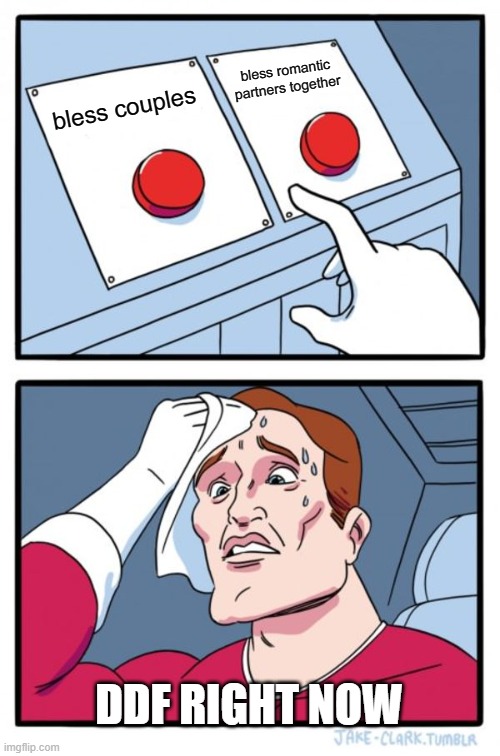
Why is it presumed to be appropriate or advantageous to give “one” blessing to two people whose “couplehood” in and of itself clearly presents seriously problematic moral data, rather than two individual blessings to the two individuals of the “couple” (or however many members of a polyamorous relationship)? (This is the most important question.) Is it because some priests have very tired arms and can only muster one motion of the hand? Or are drive-by blessings a thing in some places? Yes, no? What is it?
If the confusion and blowback were foreseen, what is the need for all the explanation, especially since the document said not to expect clarification? If the confusion and blowback were not foreseen, why? What is the plan to keep this from happening again? Is there one?
If “irregular couples” can be blessed “non-liturgically” or “pastorally,” does this extend to other groups or associations which of themselves or in their proper context are morally problematic, such as terrorist camps, conventions of abortionists, and other such entities, especially given that these seem to need grace even more than “irregular couples”? If not, why not? Is it merely a prudential consideration, or is it something intrinsic to the act itself?
Why was it not recommended instead merely to pray for “irregular couples,” rather than to “bless” them, especially given that much of the world is unable to distinguish “blessing a couple” from “blessing a union” or even from “witnessing a marriage”?
So, those are some questions. The argument that some have made about cohabiting heterosexual couples receiving blessings (i.e. in the context of a marriage preparation session) fails; the reason is that such a relationship does not present a problem in and of itself the way that adulterous, homosexual, or polygamous relationships do. There is a legitimate “telos” or “end” of the relationship as such with a single man and a single woman. Not so with the “irregular.”
I really do think that ignorance is a better explanation than malice. I also think that Fiducia Supplicans, for all its issues, has called attention to a serious problem which has until now not been so evident – we have a very weak understanding all around of what exactly “blessings” are and how they work. I hope to do a follow-up post in some weeks to go through some points which could be helpful (i.e. the distinction between invocative blessings and constitutive blessings).
We should make fun of what is ridiculous, with due respect for people and their office.
The DDF is an absolute clown car right now, putting out seriously harmful nonsense.
I remind you the WORST thing, which went relatively unnoticed, was the Prefect strongly implying a few weeks ago in that document on cremation that Catholics can believe in reincarnation…
I’ll release my own thoughts on “Fiducia Supplicans” in a few more days. It’s good to take time to think before reacting.


 Christian Renaissance Movement