Check out this very cool video…
Check out this very cool video…
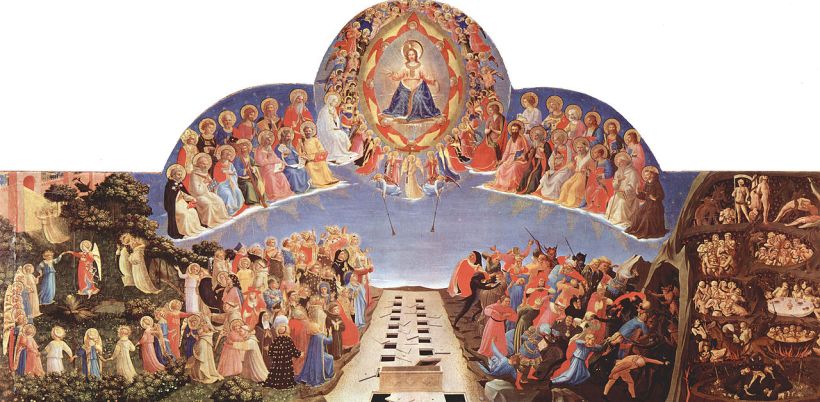
Not to be confused with Frangelico, the popular liqueur, Blessed Fra Giovanni da Fiesole, AKA Fra Angelico (the Angelic Friar), was one of the highlights of the early Italian renaissance.

Born at the end of the 14th Century, he entered the Dominicans around the age of 25, at which point he was already a practiced hand at the canvas. His work speaks solely to his devotion and piety.
Eventually taken under the wing of several popes and the famous Medici family, Fra Angelico produced numerous altar pieces, frescoes, and paintings for churches and convents around Italy. (Two sections of an altarpiece of his were recently rediscovered in the possession of a woman whose father had picked them up for £100 at a garage sale or some such nonsense.)
One of the most striking elements of the work of Fra Angelico is its incarnationality. By this I mean the weight that his figures usually have, instead of an ethereal airiness. This was in contrast to the predominant schools of religious art at the time, which were not as naturalistic. This naturalism became a characteristic element of Renaissance artwork.
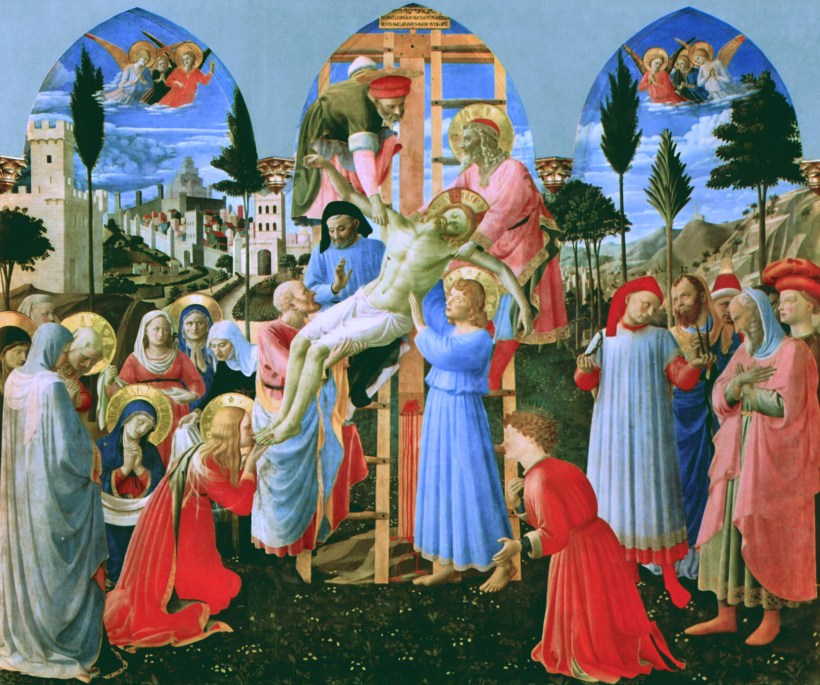
Another interesting feature is the color – usually light pastels, with very few royal blues and golds (which symbolized wealth and human esteem, including for the patron who could provide such materials). This is again reflective of the inner life of the simple, pious friar.

Pope St. John Paul II said of him at his beatification: “Angelico was reported to say “He who does Christ’s work must stay with Christ always”. This motto earned him the epithet “Blessed Angelico”, because of the perfect integrity of his life and the almost divine beauty of the images he painted, to a superlative extent those of the Blessed Virgin Mary.”
He died in 1455 at a convent in Rome, poor, chaste, and obedient, leaving a legacy that would help to ignite the artistic soul of the Italian Renaissance, like a glowing ember that refuses to cool.

Main image: The Day of Judgement
Final image: By carulmare – ANGELICO, Fra Annunciation, 1437-46, CC BY 2.0, https://commons.wikimedia.org/w/index.php?curid=5446878

“What was that?”
“We just hit a raccoon.”
“Jonathan, don’t you think we should stop?”
“Oh trust me babe, that raccoon would not have stopped for us.”
I’ve had this hilarious exchange from Hot Rod in my mind recently.
There is a reason we say someone is “acting like an animal” when he’s doing crazy or immoral stuff… Animals have no real moral sense, no conscience, no supernatural end to which they are called. We don’t really think of them as guilty or innocent, except inasmuch as those words mean the existence or non-existence of some act.
To begin with, even asking the question sets one off on the wrong path: “Is there a morality gene?” All the dispositions of our bodies can ever incline us to desire are temporal goods (like pleasure or security), even if they are delayed in their acquisition in some way or are diffused among a community to which one belongs, UNLESS they are ordered somehow to the preservation of the species in such a way that it is altogether compulsory. Genetics, therefore, could only ever tell us why a person feels like doing x which will ultimately redound to his own temporal benefit in some way. And in animals, genetics are altogether compulsory, so the disjunction above is irrelevant for them.
In humans, these impulses can be intellectualized into rational selfishness, and certain kinds of structures of cooperation can indeed bring about a society that on its surface is stable and healthy. Read an Ayn Rand novel and you’ll get the idea.
But that’s not what real morality is. Real morality searches for the good in itself, not just for I me myself, even through others, but for others in themselves. Real morality moderates self-interest, while genetics can only incline one to seek his own good.
What about all those birds who are so committed to caring for their chicks? What about those elephants that cry for their dead? What about, etc., etc.?
If an animal does something we might call moral or right that does in fact only lend itself to the preservation of the species (which we would be tempted to call altruism), it is because it had an instinct to. Isn’t that the same as a morality gene? No, it is a gene that compels them to act in such a way, and the satisfaction for them lies precisely in the completion of an urge rather than “doing what is ‘right'” or something similar. There is no order to which a bear clings outside of itself when it protects its cubs – it has no reason for protecting them that it is aware of other than “because that’s what bears do.” We would call this a virtue if it was rationally chosen among other options, but the bear doesn’t have real rational options: it just has genes which force it to act in such a way. In fact, the very same impulse to protect its children would compel it to kill an innocent man, which we would NOT call virtuous.
“So what? It’s still bad to kill animals.” Well, while you chomp down on your burger tonight, think about what Cecil the Lion would have done to you (or your village) if given the chance. Think about what Harambe might have been about to do to that child. And so on.
We are not in a real community with animals, because they can’t communicate with us rationally. They can’t do that because they can’t reason. We are simply better and higher in the order of creation, as Genesis teaches. We have immortal souls, they do not. We can relate with God intellectually, they can not. We are called moral or immoral, they are not. This means that justice, with regard to animals, is nothing more than their proper temporal use as part of the goods shared among ourselves and God, and we expect absolutely nothing from them in return. The conclusion is this: unless you are killing animals for the sheer pleasure of destroying them, or the animal you kill is somehow important for human flourishing (like a cow that makes a family’s milk), or in killing them you are desensitizing yourself to human pain and death, you’re not doing anything wrong.
So there can’t even be such a thing as justice for Harambe. He’s owed nothing – especially since he no longer exists. But that won’t stop our culture from hashtagging more about a gorilla than about the innocent victims of abortion, or the news from covering Harambe’s death six times more than Christians recently killed by ISIS. As G.K. Chesterton famously opined, where there is animal worship, there is human sacrifice.
And anyway… Harambe would not have wanted justice for you.
Main image: By TKnoxB from Chemainus, BC, Canada – Flickr, CC BY 2.0, https://commons.wikimedia.org/w/index.php?curid=1826972
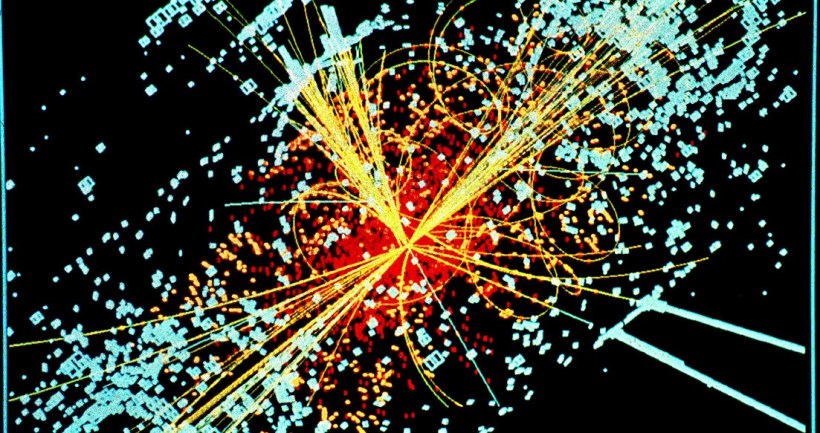
The Higgs-Boson has caused a lot of ruckus throughout the past decade. From being featured in multiple specials on cable TV, making headlines in several major newspapers, and even being involved in the plot of a Hollywood film, it is safe to say that the so-called “God particle” has entered deeply into the subconscious of semi-scientifically informed Americans.
But what is a Higgs-Boson?
Time for some ¡HARDCORE SCIENCE!
Here’s a quick rundown of the background. In the 1970’s, the project of creating a “Standard Model of Particle Physics” came to fruition. It was an attempt to account for how subatomic particles interact the way that they do (through radiation, electromagnetism, and binding) and to explain what each known particle actually is, as well as what other kinds of particles ought to exist based on what was already known. The particles we speaking of are things like electrons, gluons, leptons, quarks… You know, really, really small things.
The challenge is so large in part precisely because the stuff is so small. To confirm the whole Standard Model, you would have to find each particle, where it’s supposed to be, doing what it’s supposed to be doing, when it’s supposed to be doing it. This is expensive, time consuming, and sometimes very frustrating… But it’s wicked cool.
Additionally, the Standard Model still has some kinks to work out… The challenge on the theoretical level is to reconcile this internally consistent theory with what we know about gravity, cosmology, and a few other things.
One of the biggest observational challenges for the Standard Model, which is usually tested by experiments done with particle accelerators (like the Large Hadron Collider) , has been the Higgs-Boson. It should be there, if the model is correct, but it is elusive. Not only is it super small, it’s got a lifespan of about 1.56×10⁻²² seconds – that’s about one and a half sextillionth of a second – after which it decays into other particles. Maybe it would feel at home in Manhattan.
The Higgs-Boson would basically be the thing that allowed certain particles to have mass. (And I do not mean unlocking the sacristy door.) The Higgs-Boson IS NOT what makes ALL particles have mass. This is a common misconception.
Here’s an analogy to help get the idea. When light goes through a prism, there is refraction… Photons, which were in “symmetry,” or acting the same as each other, all of a sudden begin to behave differently, with higher and lower frequency waves splitting apart to make all those pretty colors we know and love. The symmetry is disrupted. Well, when boson particles encounter a Higgs field, (think “gravitational field,” “electromagnetic field,” etc.) something similar happens… the massless particles can lose their symmetry, and some gain mass.
So what is the whole “God particle” schtick about? Well, if you ask that sad camerlengo from Angels & Demons, who clearly did not pass a single philosophy class in seminary, the Higgs-Boson is a threat to God’s claim on the act of creation.

“If science is allowed to claim the moment of creation, what is left for God?”
The title “God particle” comes from a book written in 1993. It is just a way of pointing out how basic, important, and elusive the Higgs-Boson is. The “God particle” is clearly a mixture of act and potency (more potency than act you might say, seeing how quickly it pops in and out of existence) and, while we’re at it, it must in some way be composed of other stuff more basic than itself. It’s a composite, so it must be caused, since things can’t put their essential parts together (or else they would have already existed).
Unfortunately, many people think that the Higgs-Boson actually is some kind of threat to religion. Or something.
Once again, from the film, Angels & Demons:
Vittoria Vetra: It’s a way of studying the origins of the universe, to try to isolate what some people call the God particle. But there are implications for energy research.
Man: The God particle?
Vittoria Vetra: What we call it isn’t important. It’s what gives all matter mass, the thing without which we could not exist.
Robert Langdon: You’re talking about the moment of creation.
Vittoria Vetra: Yes. You know what? I am.
Lolz. They didn’t even get the SCIENCE right.

Crazy, but true: the male orb-weaving spider is very picky about what female to mate with, but 4/5 times he’s going to be eaten by her anyway.

The carnal pleasures, when detached from the higher ones, ultimately leave one sad and desperate for more lest he become even sadder. As St. John of the Cross teaches, there is a bitterness in not doing our own will, but there is a double-bitterness in doing it. You would think that people would learn from this mistake, but hey, that’s concupiscence for ya… We’ll just stay going down the same road frantically looking for that next big rush, that next high, that next whatever it is, even though it is likely to eat us. How aware is the male cyrtophora criticola that he’s about to have his abdomen punctured and his insides sucked out by his new-found lady-friend? Maybe a little bit, in some very dim way. He’s probably seen it happen to others like him. But he is driven by his urges alone, by his instinct alone, by his body alone. His desires distract him from the horrifying and sticky end he is likely to meet. The drug addict knows that what he’s doing is bad for him – sorta. But he needs it, so he allows himself to be swallowed up… and the zeitgeist is always hungry.
What is so peculiar about this spider is that he is incredibly discerning of which female to approach: should I buy the new Lexus, the new Lamborghini, or the new Ferrari? Eventually though, he’d probably take whatever he could get. He’s enticed by the mere shadow of real pleasure, which is the satisfaction of his primal urge, not unlike one finds in the pages of that dreadful novel by E. L. James… although, granted, this is a little bit crazier…
But at least the spiders are open to new life!
Main image: By Taken byfir0002 | flagstaffotos.com.auCanon 20D + Canon 17-40mm f/4 L – Own work, GFDL 1.2, https://commons.wikimedia.org/w/index.php?curid=599586
 Christian Renaissance Movement