Ireland – Weeks 5 and 6

Eamonn Clark, STL

What’s hot with the young kids right now is learning Irish.

Maybe it’s part of the search for some kind of identity “qua” Irish. Now that the English aren’t oppressors, and the Church isn’t “status quo” as a point of reference for Irish culture, it is a bit difficult to nail down precisely what it is to be Irish, other than simply being born here, of a certain stock, etc. The language is one of the only major things mooring the country to itself.

Most Irish don’t speak the language. Sometimes (and somewhat incorrectly) called “Gaelic,” Irish is a very hard thing to master, or even get a grip on.

It’s a challenge, and a unifying cultural symbol which connects people to the past, in view of the future.

I think this is also why young people in general are drawn to the older forms of the liturgy. It’s a challenge, and a root which ties one to something whence one comes. There is interest in this in Ireland, albeit in a different form from the major hot-spots of motion on the old mass, namely, the USA and France. I am still getting familiarized with that situation, so I will just point out that the note is there in the song, not quite as a refrain but more as something of a leitmotif. It’s in the background, but it’s noticeable, and it means something.

I’ve been getting around to different events and places these past two weeks. The time flies – like a carpet being pulled out from my feet. A wedding, a wake, a monastery… All things that Irish do typically rather well historically.

Irish also do hospitality very well. I’ve been made quite welcome during my stay. My picture’s even been featured in a national newspaper. A story for another day…

A story I must tell is of Declan’s Rock – or, more specifically, the time a bishop tried to destroy it back in the 1800’s. St. Declan, whose feast day was two days ago, was mentioned in an earlier post. There is a whole charming narrative about this particular rock floating ashore, a connection to a bell, and the prophetic claim that connected the rock to where Declan would rise to meet Christ on the last day. Well, the local bishop some centuries ago thought all this was a load of crap. “The people with their superstitions. They need to wake up. It’s clearly from an ancient glacier, the science is obvious.” This was the attitude.
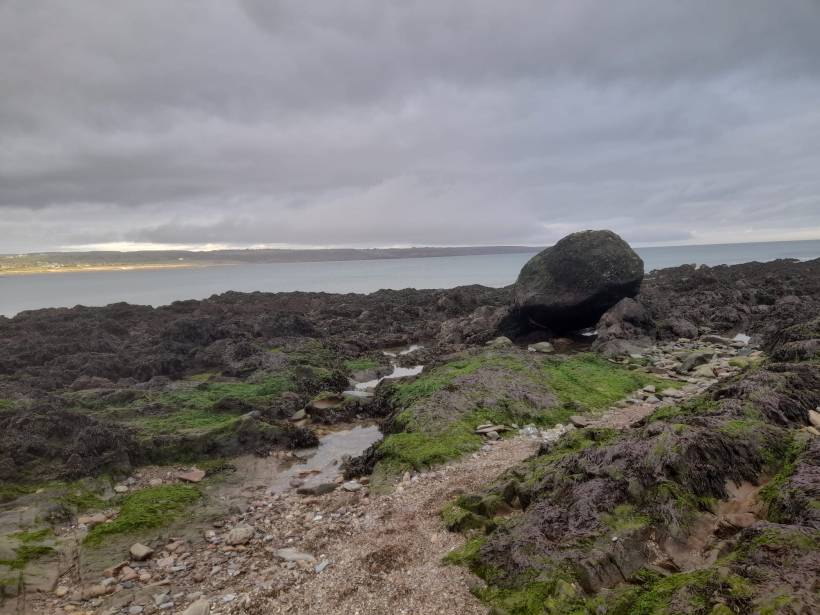
But in a country of fairy forts and Mass paths (a topic for another post), the bishop should have known better. Having found two adolescent boys to help him crush the rock down, the Bishop arrived in Ardmore to find the whole town standing up on the hill overlooking the beach where the rock sits. Staring the three of them down, silently. The kids turned to His Lordship the Bishop, and handed him the hammers, saying, “You first.” A strange reversal of the incident of the Woman Caught in Adultery! It was, in fact, the Bishop who needed to wake up. He walked away.

The people kept their rock. The initiation ritual into “Irish Catholicism” as such, which I will perhaps do myself one day, and which the Bishop was likely especially annoyed by, involves walking out to the rock, getting down on one’s stomach, and shimmying through the hole underneath to emerge from the other side. Just be sure the tide is right – or you’ll drown, as I’ve recently been informed.

Weddings, wakes, and the cloister. All kinds of death to self to be reborn in a greater way, and, thus, all kinds of initiation. All traditions which connect us to our past, despite the struggle, pain, and change involved. And all involve – hopefully – the right kind of hospitality.

Ireland does it particularly well.

Naomh Declan, guigh orainn!
(St. Declan, pray for us!)

Ireland – Week 4

Eamonn Clark, STL

Dublin is a city of contradictions.

It’s a place where there are churches and bars on every street. You can see a pious old woman on her way back from mass and a gaggle of girls with the most vulgar tastes in dress standing on the same corner waiting for a bus. You can find rabble-rousers and men of the most refined manners in the same shop. There goes a priest, there goes a trans-rights activist.

It’s a city at war with itself.

In truth, Ireland is a complex country. It’s not complex like America – America (and Americans) are complex because of parts… lots of “things to do.” Ireland (and Irish) are complex because of layers… lots of “things going on in there.” (Yes, yes, it’s an oversimplification. Got it.) The subtle and amiable wit of your average Irish gentleman is counterbalanced by a charming habit of self-deprecation or at least humility. (Irish tend not to brag.)

Even the Irish flag symbolizes a conflict, represented by the layers of the tricolor – the Orange and the Green… Protestants and Catholics. White in the middle as an aspiration of peace.

Ireland is just barely big enough to be really anonymous if you want to be and small enough to be a well-known figure without being some kind of phenom. Though it’s not quite like the Middle East or Iceland, where everyone knows exactly how they are related to everyone else, there’s nevertheless only ever a few degrees of separation between any two people. Major public figures – musicians, politicians, athletes, prelates – they are just kind of part of the family, and part of the story.

Everyone is sort of in it together, in a tangible way. That means all the tensions and wounds of poor old Ireland are shared collectively somehow, too. So is a lot of the unwillingness to talk about it all. This extends from the relatively recent violence (late 1960’s-1998) between North and South during the Troubles, to the ecclesiastical abuse crises (plural) that unfolded on everyone’s watch – and in which therefore basically the whole of Irish society was complicit, in one way or another, to some degree. It’s not polite table conversation. Or polite conversation anywhere else, even on a blog. But the prolonged failure to wrestle with these important collective memories only serves to bury them deeper. What does that do to a soul, of an individual and of a country? Perhaps forms some kind of neurosis?

This theme of repressed pain over the abuse crises in particular was explored and driven home very well by Derek Scally in his recent book “The Best Catholics in the World,” a must-read for anyone interested in the Irish situation. It’s not an entirely balanced take, but it’s an important one.

Dublin, the cultural and political capital of the Republic of Ireland, is something of a symbol of the Irish psyche. There’s some kind of neurosis that is manifesting itself there. No doubt, most Irish would resent that. And that’s kind of the point. In Dublin there are plenty of “normal people,” but there is also a very vocal minority of well-funded and coddled extreme leftists, a large number of ruffians and other kinds of low-culture individuals, and now a significant influx of immigrants (many of them seemingly economic opportunists rather than refugees). Then there is also the undercurrent of the echoes of the strong piety that once animated the city, just barely hanging on, with approximately 1% mass attendance any given Sunday. Now, all that does not represent Ireland. And yet it does, because that’s a major part of what Dublin is, and Dublin is, well, Dublin. So there’s tension between what is most culturally and internationally identifiable about Ireland, and the greater part of the country, or “real Ireland.” All this gives Dublin a uniquely charged energy which is rather hard to describe. And that energy sits on top of the rest of the country, at odds with it.

Layers and contradictions.

These thoughts came to me (in a less-developed form) at the Dublin Rally for Life the other day. It was a good crowd, maybe 8,000-10,000 or so, from all over the country. I already found myself running into people I’ve met during my stay, and that without trying to meet up. It’s not the same as D.C. – smaller, yes, and also lacking the “organizational splendor” that comes with the sort of funding and personnel involved in the March for Life. It’s a much quainter operation. But it has heart.

The constitutional referendum on abortion in Ireland passed by a very slim margin a few years ago (2018). Dubliners would have been the outsized supporters of this. So there were some unfriendly onlookers as we went down one of the main thoroughfares of the city, ending up next to the River Liffey. But there were also people walking by who were openly supportive. A mix. More layers and contradictions to explore.

Like the Troubles or the abuse crises, abortion by this point has touched just about everyone in Ireland somehow. Will the awful reality of 31,000 unborn being killed be yet another deep wound to leave alone for now and later psychologically bury? Or will this tragedy be too much to ignore and suppress, something that runs up too hard against the deeper cultural values which “real Ireland” still possesses deep down? Only time will tell. In the meantime, the Liffey keeps on flowing, and Dublin keeps on changing.

Ireland – Week 3

Eamonn Clark, STL

Nobody knows what the round towers were for.

Were they defense towers, or some kind of refuge for monks hiding from Viking raiders? Unlikely, but possible. Were they watchtowers? Belltowers? Astronomy towers? Communication towers? Maybe some of all of this? Who knows. These towers, so distinctive to Ireland, are a mystery.

On my last visit to this island, I had an extended visit to Ardmore, which boasts one of the most well-preserved round towers in the country.

Ardmore is where organized Christianity really began in Ireland. There had already been a small smattering of Christian presence on the island when St. Declan was born, as he was baptized by a priest. But there was no real structure yet, just individual Christians here and there. The bishop Palladius had been sent on a mission by the pope in 431, but no real apostolic efforts seem to have meaningfully penetrated what was then a thick forest covering essentially the entire land.

Declan was educated in Rome and ordained a bishop by the pope, and he returned to Ireland as perhaps its first proper missionary, after meeting with and agreeing to a strategy with none other than St. Patrick, who would follow behind him in some time. (There are four pre-Patrician saints of Munster, each a bishop.) The legend of the return of Declan is its own fascinating tale, nestled in the murky gap between fact and fiction. I’ll save the story for another time, as well as the anecdote about the local bishop in the 1800’s who had a different take on the popular piety associated with “Declan’s Rock” and his comical endeavor to destroy it.

St. Declan’s Rock

The site of Ardmore became homebase for Declan, where a monastery was built according to Patrick’s instructions. Eventually he retreated into the wilderness nearby, where he lived in a small house as a hermit. Ardmore overlooks the sea, where Declan made his famous landing.

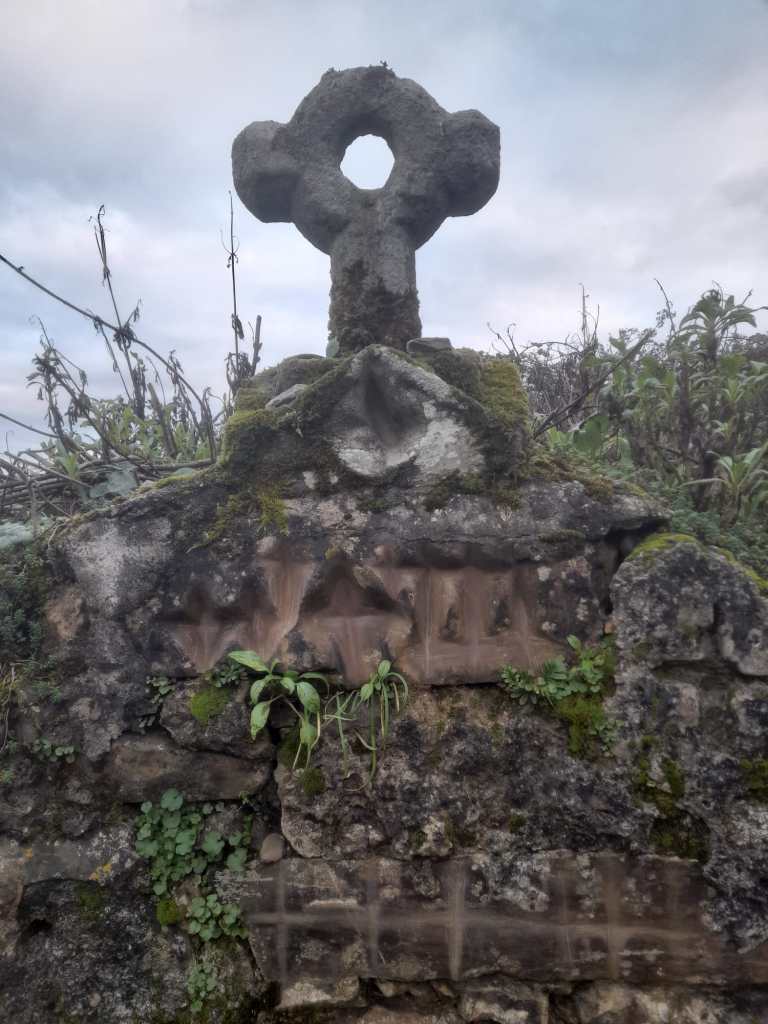
The “pattern” at Ardmore involves walking around some of these locations while reciting certain prayers, and, most distinctively, marking the wall near “Declan’s Well” (very likely the same spring he used, next to his house) with crosses by using a small stone. This has been going on for hundreds and hundreds of years.

You can see the engraved crosses in the stone above.

Soon after Declan came Patrick, whose missionary endeavors were more successful and thus more famous. You’ll notice, however, that Patrick concentrated his efforts in the northern part of the island – that’s because Declan had already been quite successful in the south.

St. Declan is now buried in a small tomb adjacent to the monastery which was for centuries the center of perhaps the most powerful ecclesiastical territory in Ireland. Now the monastery is in ruins, and the Diocese of Ardmore has long been swallowed, not even memorialized by a hyphenated name, as so many such dioceses are… it’s just gone.

The ground around it is host, most likely, to approximately 10,000 graves, almost all of them unmarked, and many of them likely quite ancient.

More graves, including St. Declan’s, inside the house-shaped mausoleum.

It’s a mesmerizing place. Haunting, almost.

I find myself increasingly fascinated both with graveyards and with archaeology. There is something so existentially alarming about old things and people, and the markers that indicate them. We stand on top of an entire world that has come and gone, and one day others will stand on top of ours. No doubt, there will be “digital archaeology” in a thousand years… But there will still be a need to dig stuff up and touch it. I’ve been privileged this past year to get my hands on some very interesting texts in various archives around Rome… the thrill of holding a manuscript or book that you know you are the first to handle in 50, 100, 200 or more years, is just really special. And I have a tactile mindset about even my own past – I want to be in this place and that, just to feel connected with my own life, to help make sense of it, and somehow thereby to see what it means. I’ve noticed that not everybody cares about that the way I do. I guess this same sort of impulse is at least part of what attracts me to the older liturgy… It connects me to those who’ve gone before, makes them alive again in some way, helps me to understand where I am from – and where I am to go.

I was at a gathering of priests a few days ago; the men were celebrating various major ordination anniversaries. I sat in on the mass. It was pointed out that there were a few hundred years of priesthood between them all. While contemporaneous, the cumulative experience of priests is nevertheless a bit like Ardmore. How many secrets held under the Seal… dead things, which are hidden underground now – finished, out of sight, out of mind. How many words or encounters which for them were not significant enough to remember, but were so powerful for others that they changed someone’s whole life and even saved their soul. How many repetitive but intentional rituals done, over and over, prayers and signs repeated on and on, to the edification of the faithful who devoutly attend to them. How many unique and always somewhat mysterious ministries – whatever they are, always reaching up towards God in service of His people… like a round tower.

And a saint lies buried within each one.

St. Declan of Ardmore, pray for us.