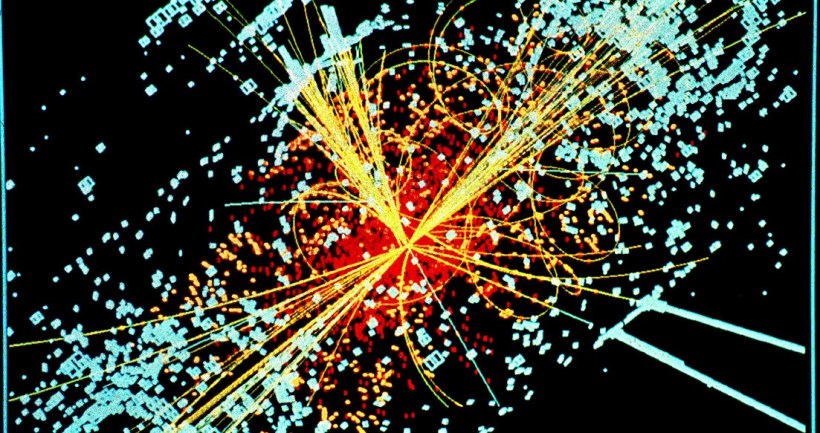
The Higgs-Boson has caused a lot of ruckus throughout the past decade. From being featured in multiple specials on cable TV, making headlines in several major newspapers, and even being involved in the plot of a Hollywood film, it is safe to say that the so-called “God particle” has entered deeply into the subconscious of semi-scientifically informed Americans.
But what is a Higgs-Boson?
Time for some ¡HARDCORE SCIENCE!
Here’s a quick rundown of the background. In the 1970’s, the project of creating a “Standard Model of Particle Physics” came to fruition. It was an attempt to account for how subatomic particles interact the way that they do (through radiation, electromagnetism, and binding) and to explain what each known particle actually is, as well as what other kinds of particles ought to exist based on what was already known. The particles we speaking of are things like electrons, gluons, leptons, quarks… You know, really, really small things.
The challenge is so large in part precisely because the stuff is so small. To confirm the whole Standard Model, you would have to find each particle, where it’s supposed to be, doing what it’s supposed to be doing, when it’s supposed to be doing it. This is expensive, time consuming, and sometimes very frustrating… But it’s wicked cool.
Additionally, the Standard Model still has some kinks to work out… The challenge on the theoretical level is to reconcile this internally consistent theory with what we know about gravity, cosmology, and a few other things.
One of the biggest observational challenges for the Standard Model, which is usually tested by experiments done with particle accelerators (like the Large Hadron Collider) , has been the Higgs-Boson. It should be there, if the model is correct, but it is elusive. Not only is it super small, it’s got a lifespan of about 1.56×10⁻²² seconds – that’s about one and a half sextillionth of a second – after which it decays into other particles. Maybe it would feel at home in Manhattan.
The Higgs-Boson would basically be the thing that allowed certain particles to have mass. (And I do not mean unlocking the sacristy door.) The Higgs-Boson IS NOT what makes ALL particles have mass. This is a common misconception.
Here’s an analogy to help get the idea. When light goes through a prism, there is refraction… Photons, which were in “symmetry,” or acting the same as each other, all of a sudden begin to behave differently, with higher and lower frequency waves splitting apart to make all those pretty colors we know and love. The symmetry is disrupted. Well, when boson particles encounter a Higgs field, (think “gravitational field,” “electromagnetic field,” etc.) something similar happens… the massless particles can lose their symmetry, and some gain mass.
So what is the whole “God particle” schtick about? Well, if you ask that sad camerlengo from Angels & Demons, who clearly did not pass a single philosophy class in seminary, the Higgs-Boson is a threat to God’s claim on the act of creation.

“If science is allowed to claim the moment of creation, what is left for God?”
The title “God particle” comes from a book written in 1993. It is just a way of pointing out how basic, important, and elusive the Higgs-Boson is. The “God particle” is clearly a mixture of act and potency (more potency than act you might say, seeing how quickly it pops in and out of existence) and, while we’re at it, it must in some way be composed of other stuff more basic than itself. It’s a composite, so it must be caused, since things can’t put their essential parts together (or else they would have already existed).
Unfortunately, many people think that the Higgs-Boson actually is some kind of threat to religion. Or something.
Once again, from the film, Angels & Demons:
Vittoria Vetra: It’s a way of studying the origins of the universe, to try to isolate what some people call the God particle. But there are implications for energy research.
Man: The God particle?
Vittoria Vetra: What we call it isn’t important. It’s what gives all matter mass, the thing without which we could not exist.
Robert Langdon: You’re talking about the moment of creation.
Vittoria Vetra: Yes. You know what? I am.
Lolz. They didn’t even get the SCIENCE right.