On the Fernández Document: PART II

Eamonn Clark

PART I

WHEN ONE CANNOT

Francis considers that even knowing the norm, a person “may be in a concrete situation which does not allow him or her to act differently and decide otherwise without further sin. As the Synod Fathers put it, ‘factors may exist which limit the ability to make a decision’” (AL 301). He speaks of subjects who “are not in a position to understand, value or fully practice the objective requirements of the law” (AL 295). In another paragraph he reaffirms: “Under certain circumstances people find it very difficult to act differently.” (AL 302).

Here, the Archbishop begins to violate his earlier commitment to looking beyond the possibility that one could be ignorant of the “norm” itself. This is its own mistake, as it tends toward emptying the meaning of Christian conscience. But what is more important, and indeed, in my opinion, the most important point to consider in the article, is the apparent suggestion of an impossibility of following the 6th Commandment. Trent condemned such opinions in the strongest terms: “If anyone says that the commandments of God are, even for one that is justified and constituted in grace, impossible to keep; let him be anathema.” (Canon XVIII, Session 6) Of course, a person who is not justified by grace (and therefore might not be able to follow the Commandments) is in mortal sin, and that sin is due to his or her own fault (along with the sins which result), as he or she resists God’s free gift of sanctifying grace. (The Buenos Aires guidelines also could be read as contradicting this anathema when they speak about continence not being “feasible.”) Nobody argues that such choices are easy to make and live out, but to say that they are impossible or that failing to make them is without guilt due to mere temptation is to contradict the clear teaching of the Church. Let us recall the sobering words of the Lord: “If anyone comes to me and does not hate father and mother, wife and children, brothers and sisters – yes, even their own life – such a person cannot be my disciple.” (Luke 14:26) If one must be ready to make these persons and one’s own life second to the Lord – goods which have frequently been used in the Amoris debate as foils for the choice to live “more uxorio” with a non-spouse – what of the sexual goods themselves which are being provided by an illegitimate lover? What of the distant possibility that that person might withdraw some financial and/or emotional support? Sometimes doing the right thing requires enormously difficult sacrifices, and it may also occasion sin in others – the witness of the martyrs demonstrates this.

He also recalls that John Paul II recognized that in certain cases “for serious reasons, such as for example the children’s upbringing, a man and a woman cannot satisfy the obligation to separate” (FC 84; AL 298). Let us note that St. John Paul II recognized that “they cannot“. Benedict XVI was even more forceful in saying that in some cases “objective circumstances are present which make the cohabitation irreversible, in fact.” (SC 29b).

A couple definitely may find themselves unable to separate physically or even according to civil law. Persisting in such a state does not of itself constitute sin. (While it is fitting for civil status to correspond to ecclesiastical and sacramental status, it is not absolutely necessary. In fact, one must change his or her civil status through divorce before changing his or her ecclesiastical status through annulment.) What should be evident, however, is that remaining together physically and civilly is distinct from living “more uxorio.”

This becomes particularly complex, for example, when the man is not a practicing Catholic. The woman is not in a position to oblige someone to live in perfect continence who does not share all her Catholic convictions. In that case, it is not easy for an honest and devout woman to make the decision to abandon the man she loves, who protected her from a violent husband and who freed her from falling into prostitution or suicide. The “serious reasons” mentioned by Pope John Paul II, or the “objective circumstances” indicated by Benedict XVI are amplified. But most important of all is the fact that, by abandoning this man, she would leave the small children of the new union without a father and without a family environment. There is no doubt that, in this case, the decision-making power with respect to sexual continence, at least for now, has serious forms of conditioning that diminish guilt and imputability. Therefore, they demand great care when making judgments only from a general norm. Francis thinks especially of “the situation of families in dire poverty, punished in so many ways, where the limits of life are lived in an excruciating way” (AL 49). In the face of these families, it is necessary to avoid “imposing straightaway a set of rules that only lead people to feel judged and abandoned” (ibid.).

The Archbishop’s points about the difficulty of such situations is granted. What requires much caution, however, is examining how mitigating factors work in the act of forming a habitual intention to continue “more uxorio.” If it is not a matter of a persistent acute fear or a mental illness, what must be shown is that some particular external temptation has become an internal force which has rendered the will unable to carry out its proper function – in other words, a true addiction. Sexual addiction is, I suggest, possible but extremely rare, given the fact that the vast majority of such couples may go a long time without intimacy for some other reason, such as a health condition or even simply the mundane distractions of daily life, quite unlike a real addiction. (We should also note that it is especially egregious for any person willfully to use as license to commit a sin those factors which would mitigate that sin’s culpability. This surely only adds guilt, even hardening a person’s heart in the vice.) 

BEYOND SITUATIONALISM

The Pope, faithful to the real and limited possibilities which the Synod opened – and even against the proposals of progressive moralists – has preferred to maintain the distinction between objective sin and subjective guilt. Therefore, although it can be held with all clarity and forcefulness that sexual relations for the divorced in a new union constitute an objective situation of habitual grave sin, this does not imply that there necessarily exists grave sin in a subjective sense, that is to say, grave guilt that takes away the life of the sanctifying grace:

There has long been a distinction between “formal sin” and “material sin,” which seems to be what the Pope means by “subjective guilt” and “objective sin.” If there are factors which sufficiently mitigate or remove the guilt for what would otherwise be mortal sin, there remains “grave matter” but there is not mortal sin. This is not what is at stake in c. 915, however, as that canon refers to sin in a distinctly legal sense, which is related to but different from the moral sense… For example, a gullible and innocent person who is otherwise free to receive Holy Communion in public might have to be denied if he or she were tricked into wearing a rainbow sash under the pretext of celebrating the Noahic covenant. Onlookers would take scandal at the knowledge of an objective situation (“rainbow sash-wearing”) which would be reasonably assumed to mean that this individual is a committed LGBT activist, which itself is reasonably assumed to mean obstinate and persistent grave sin. That the soul of this individual is in grace is not a consideration in this situation.

The Church possesses a solid body of reflection concerning mitigating factors and situations. Hence it is can no longer simply be said that all those in any “irregular” situation are living in a state of mortal sin and are deprived of sanctifying grace. (AL 301).

One is left wondering when and where this was ever said with any universality. There are no documents cited to support the thought that there has been a true development here. If the Archbishop’s text is taken in its plain meaning, the possibility of an irregular couple living in continence is included, rendering his claim without the kind of significance he seems to envision it having. The apparently implied meaning is that irregular couples living “more uxorio” may not be in mortal sin due to mitigating factors impinging on their culpability for such acts. This, I submit, is not a development at all, just a theoretical possibility which has always existed – and is unlikely to exist in reality with much frequency.

It is already widely accepted – even in the Catechism – that “imputability and responsibility for an action can be diminished or even nullified by ignorance, inadvertence, duress, fear, habit, inordinate attachments, and other psychological or social factors” (CCC 1735).

The paragraph cited is only directly and fully applied in the Catechism in its treatment of self-abuse (#2352), a sin which lends itself to conditioning and inadvertent commission in a way that relations with another human being do not.

For Francis, however, it is not the concrete circumstances that determine objective morality. That forms of conditioning can diminish culpability does not mean that what is objectively evil may become objectively good. Suffice it to read the following sentence: “Because of forms of conditioning and mitigating factors, it is possible that in an objective situation of sin – which may not be subjectively culpable, or fully such – a person can be living in God’s grace” (AL 305). That is to say, it remains an “objective situation of sin”, because there remains the Gospel’s clear proposal on marriage, and this concrete situation does not objectively reflect that. Francis, like the Synod, maintains the existence of objective truths and universal norms, and has never defended subjectivism or relativism. God’s plan is a marriage understood as an indissoluble union, and this point was not placed in doubt either in the Synod or in his pontificate.

There is some rhetoric in this paragraph, but we should notice that the Archbishop points out “that what is objectively evil [cannot] become objectively good.” Could this be a way to leave one with the impression that what is objectively evil could become “subjectively” good? Whatever the case, while there has perhaps not been subjectivism or relativism or “situationalism,” in some circles there has been some consequentialism insofar as the possible good outcome of some adulterous act (or some bad outcome of failing to commit some adulterous act) has been suggested as rendering that act less objectively grave in itself, but the Archbishop seems to have avoided this by implying that such a consequence rather inhibits freedom and therefore mitigates culpability. While the former is condemned, the latter is at least questionable. The mere existence of external or even internal temptation does not mitigate culpability, and it is a stretch to say that in these difficult cases a person faced with such consequences is necessarily overcome by them in a way that inhibits the natural operation of the intellect and will in a way that would eliminate grave guilt for an objectively grave sin.

THE POWER OF DISCERNMENT

On the other hand, Francis has never claimed that anyone can receive communion if he is not in the grace of God. But, as we have just seen, for someone to be deprived of sanctifying grace, it is not always enough that a serious objective fault exists. Therefore, there can be a path of discernment, open to the possibility of receiving the nourishment of the Eucharist.

So far, the Archbishop has neglected to cite the governing canons (c. 18, c. 213, c. 915, and c. 916). It is now a serious problem: c. 915 does not preclude from public access to Holy Communion those known with moral certainty by the minister to be in personal grave sin – c. 916 does precisely this, but it does so only in private administration. This distinction is absolutely essential to a coherent discussion of the entire issue.

This is only possible if a different way of thinking about the consequences of the norm is accepted. This does not admit exceptions with regard to the objective evaluation starting from an absolute moral precept, but he allows a discernment with regard to its disciplinary derivations. Although the norm is universal, however, “since the degree of responsibility is not equal in all cases, the consequences or effects of a norm need not always be the same” (AL 300). “This is also the case with regard to sacramental discipline, since discernment can recognize that in a particular situation no grave fault exists” (AL footnote 336).

This could be possible for private reception of Holy Communion, but it is not possible for public reception. But this would not constitute a new discipline at all, for it has always been the case that private reception is allowed given the minister has no reasonable certainty that the communicant is in mortal sin.

The question that arises is the following: Can this be discerned in pastoral dialogue? The Pope says yes, and that is what opens the way to a change in discipline. Francis’ great novelty is in allowing that a pastoral discernment in the realm of the “internal forum” can have practical consequences in the manner of applying the discipline. The general canonical norm is maintained (cf. AL 300), although it cannot be applied in some cases as a consequence of a path of discernment. In this discernment, the conscience of the concrete person plays a central role with regard to his real situation before God, his real possibilities, and his limits. That conscience, accompanied by a pastor and enlightened by the guidelines of the Church, is capable of an assessment that gives rise to a judgment, sufficient to discern regarding the possibility of access to communion.

Surely, determining personal culpability for past actions could be helped by a dialogue with a priest or other learned individual. Once again though, in such a setting, away from the distressing and mitigating factors which would encroach on a person’s freedom in an acute way sufficient for rendering that person less responsible than what mortal sin requires, it is not possible to choose to continue habitually in a “more uxorio” relationship with the non-spouse without mortal sin. Intending to continue choosing such acts, even if only because one foresees the impinging of one’s freedom, cannot be rendered less culpable merely on account of the difficulty of refraining from those acts or the goods which might be lost due to their omission – a person must really intend to try to avoid these acts. (Such a decision might be without grave guilt if the person has a mental illness, such as PTSD or split-personality disorder which would be carried into every situation, thus rendering the habitual presumption to continue “more uxorio” insufficiently free to constitute mortal sin.) What is even more inadmissible is the usurpation of a tribunal’s proper role or a contradiction of the judgment of a tribunal. This would undermine the judicial system of the Church, such that we would have a kind of canonical vigilantism.

Does this imply that a judgment can be given about one’s own state of grace? St. John Paul II stated that “the judgment of one’s state of grace obviously belongs only to the person involved, since it is a question of examining one’s conscience.” (“De gratiae statu, ut patet, iudicium solum ad singulos homines spectat, cum de conscientiae aestimatione agatur”: EdE 37b.) But it must be clarified that it is only a certain moral security, the only thing which someone can obtain before approaching to receive communion. It is never a certainty, however much one may be unaware of having violated a commandment. The Council of Trent defined that, looking at ourselves, we cannot be certain about our state of grace (cf. Session VI, chapter 9). We speak, then, of that minimal “moral security” that the person can obtain after a process of personal and pastoral discernment, which should not be based only on a single general norm.

To reiterate, this would only be relevant for private reception, not public reception.

Up to now, discernment about an attenuated culpability did not allow for removing consequences at the external or disciplinary level. The disciplinary consequences of the norm remained unaltered, because they were based only on an objective fault against an absolute norm. Francis proposes to go one step further. It is true that the general norm is not purely a discipline, but it is related to a theological truth, such as the union between Christ and the Church which is reflected in marriage. But sometimes “undue conclusions from particular theological considerations” (AL 2) are derived when they are translated into a rigid discipline that admits no discernment whatsoever. This is the point where Francis makes a change with respect to the previous praxis.

It must be asked: what specific change is being made? There is no change in law on this point, either in Amoris Laetitia, Mitis Iudex Dominus Iesus (where he actually did reform canon law on marriage), or any document of Pope Francis, nor is there a clear and authentic interpretation of canon law (such as would allow for a different application of c. 915, as St. John Paul II did with respect to allowing the divorced and civilly remarried publicly receiving Holy Communion if they were living in continence and were reasonably sure there could not be scandal taken), as has already been argued. I submit that until such is done, nothing can be presumed to have changed, either in legislation or its authentic interpretation.
PART III

On the Fernández Document: PART I

Eamonn Clark

The Rector of the Pontifical Catholic University of Argentina, Archbishop Victor Manuel Fernández, has published a summary defense of the apostolic exhortation Amoris Laetitia, which he helped draft. (English) The Archbishop is widely believed to be a close confidant of the Holy Father.

Though I had said in a former post that CRM would not be engaging further in debate on Amoris Laetitia, given that we have gone through some internal changes, and given the extremely significant defense which has been written by Abp. Fernández and the dearth of exhaustive and substantial counterarguments launched at this document specifically thus far, I publish here a commentary and exploration of this article in 3 parts, using the English translation linked to above (courtesy of Andrew Guernsey – used with permission).

–CHAPTER VIII OF AMORIS LAETITIA: WHAT IS LEFT AFTER THE STORM–

After several months of intense activity by sectors that oppose the novelties of the eighth chapter of Amoris Laetitia – minorities, but hyperactive ones – or of strong attempts to disguise them, the war seems to have reached a stalemate. It is now worth pausing to acknowledge that which is concretely what Francis leaves to us as an irreversible novelty.

The claim about who is really the majority is debatable, but it should be remembered that in any case truth is not at the service of democracy. On we go then, into the body of the article to examine the “irreversible novelty.”

“THERE ARE NO OTHER INTERPRETATIONS”

If one is interested to know how the Pope himself interprets what he wrote, the answer is very explicit in his commentary on the guidelines of the Bishops of the Buenos Aires Region. After discussing the possibility that the divorced in a new union live in continence, they say that “in other, more complex circumstances, and when it is not possible to obtain a declaration of nullity, the aforementioned option may not, in fact, be feasible.” They then add that

“nonetheless, it is equally possible to undertake a journey of discernment. If one arrives at the recognition that, in a particular case, there are limitations that diminish responsibility and culpability (cf. AL 301-302), particularly when a person judges that he would fall into a subsequent fault by damaging the children of the new union, Amoris Laetitia opens up the possibility of access to the sacraments of Reconciliation and the Eucharist (cf. footnotes 336 and 351) (Bishops of the Pastoral Region of Buenos Aires, “Criterios básicos para la aplicación del capítulo VIII de Amoris laetitia” [Basic criteria for the application of chapter VIII of Amoris Laetitia], Buenos Aires, September 5, 2016, 6)).”

It is not clear what the Buenos Aires guidelines intend from the text. What do they mean with regard to a declaration of nullity not being possible to obtain? If they are speaking about so-called “conflict marriages,” which a tribunal is not really built to investigate (albeit some progress is being made on the point), or where some situation makes approaching a tribunal literally impossible or extremely difficult due to external factors like distance or danger, that could be stated easily enough (and would surely make for an interesting conversation). If they are speaking about someone who petitioned a tribunal and received a denial of his or her request for a declaration of nullity, then the entire authority of the law and court is undermined and the rights of the other party in the prior union are trampled. How do mitigating factors for objectively wrong acts change the application of c. 915, which is not about subjective guilt? Do the bishops only have in mind private reception? How would the good intention of protecting children change the adulterous act itself, without falling into a consequentialist vision of normative ethics (condemned by the Church)? How would a person have firm purpose of amendment sufficient for absolution without at least formally intending to avoid adulterous acts, even though he or she sees the real possibility of failure, given the expectation of duress? What kind of complex circumstances do the bishops envision in their exceptions? Does “not feasible” mean “very difficult” or “impossible”? There are many questions and few answers in the Buenos Aires guidelines.

Francis immediately sent them a formal letter stating that “the document is very good and completely explains the meaning of chapter VIII of Amoris Laetitia.” But it is important to note that he adds: “There are no other interpretations” (Letter from the Holy Father to Mons. Sergio Alfredo Fenoy, Delegate of the Pastoral Region of Buenos Aires, September 5, 2016). Therefore, it is unnecessary to expect another response from the Pope.

Because the Buenos Aires guidelines are ambiguous (and they themselves are interpreting the also ambiguous Footnote 351), it does not seem possible to make a reasonable claim that there is nothing left to discuss or explain.

It could be called into question that the pope would clarify his interpretation in a letter to a group of bishops. But, in fact, this has happened other times. To give an example, let us recall an incident about the interpretation of Vatican Council I. The German bishops responded to Chancellor Bismark, who argued that a Roman centralism had been defined that weakened episcopal authority. With their response, they rejected that interpretation of the Council. Pius IX endorsed the interpretation of those Bishops with a letter (March 12, 1875) and with the consistory of March 15, 1875 (DH 3112-3117). In a footnote to Lumen Gentium 27 the letter of Pius IX to the German Bishops is quoted, whereby its hermeneutical authority is confirmed.

Surely, nobody is questioning the competency of the pope to comment authoritatively on his own document. What is in question is whether this private letter legislates new law, or a binding and authoritative interpretation of existing law. I suggest that this has certainly not occurred – the Pope’s letter to the Buenos Aires region bishops has not even entered into the Acta, the normal place to promulgate such authoritative interpretations and legislation. But again, even if it were, there is such a lack of clarity in the Buenos Aires guidelines that it is impossible to draw a definitive conclusion about what the text actually means even if it were promulgated authoritatively. The Holy Father could indeed write such legislation or give a new authoritative interpretation of existing law which contradicts past authoritative interpretation, or he could answer the pending dubia (laden as they are with citations which would adequately settle the matter), which, for whatever reason, he has chosen not to do.

Obviously, a letter from the Pope does not have the same weight as an Encyclical, but, as we see, it can have a great practical, decisive importance to explain the correct interpretation of a text of greater weight. If the Pope has received a unique charism in the Church in the service of the correct interpretation of the divine Word – the charism given to Peter to bind and to loose and to confirm his brethren in faith – this cannot exclude his ability to interpret the documents he himself wrote.

Here, the Archbishop draws a comparison between “the divine Word” and “the documents [the Pope] himself wrote.” There is some analogy, insofar as the pope can indeed write infallible documents. The proper object, however, of papal infallibility is nothing other than what has already been at least implicitly revealed by God through Scripture or Tradition and is in the deposit of Faith. The charism is usually used because there is some controversy that requires an infallible definition for the good of the faithful. (Normally, this is done through an ecumenical council.) The proper object of infallibility would certainly not extend to interpreting the pope’s own documents except inasmuch as they are themselves expositions of the deposit of Faith. This means that a pope could fallibly interpret his own intentions, let alone produce fallible utterances when enunciating anything other than the deposit of Faith in a universally binding way which does not contradict past teaching. In short: no, the pope is not infallible here. 

“PERFECT CONTINENCE”

St. John Paul II’s proposal to the divorced in a new union to live in perfect continence, as a requirement to make access to Eucharistic communion possible, was already an important novelty. Many resisted this step. Still some today do not accept this proposal because they believe it leads to relativism. On the other hand, we must note a later novelty in the language of Benedict XVI. While Pope John Paul II asked them to “assume the commitment to live in full continence” (FC 84), Benedict XVI proposed to them, more delicately, “to commit themselves” to live “as brother and sister” (SC 29b).

In the judgment of Pope John Paul II, this was permissible only if the possibility of scandal was morally certain to be excluded, in accord with the true spirit of c. 915 which aims at preventing the sin of scandal (and only indirectly at the sin of sacrilege). It certainly may be unwise for a couple to separate civilly, though one or both remain in another bond according to Divine and ecclesiastical law. John Paul II was also insistent, as was Benedict XVI, on continence. One is led to some head scratching by the Archbishop’s implied dichotomy between continence and living as brother and sister. Surely, brothers and sisters ought to be continent in their relationship, yes?

Francis recognizes the possibility of proposing perfect continence to the divorced in a new union, but admits that there may be difficulties in practicing it (cf. footnote 329). Footnote 364 gives a place to administering the sacrament of Reconciliation to them even when new falls are foreseeable. There, Francis calls into question priests who “demand of penitents a purpose of amendment so lacking in nuance that it causes mercy to be obscured by the pursuit of a supposedly pure justice” (AL 312). And there he takes up an important statement of St. John Paul II, who held that even the anticipation of a new fall “should not prejudice the authenticity of the resolution” (Letter to Cardinal W. Baum, 03/22/1996, quoted in the footnote.). Against this cautious precision of St. John Paul II, some seem to demand a kind of strict control of what others do in intimacy. We must heartily congratulate those who manage to live in perfect continence, enriching their daily cohabitation in various ways. But that does not imply ignoring that others have serious difficulties in achieving this.

There is nothing wrong with this except the implication that there is any opposition between the firm purpose of amendment necessary for absolution and “strict control of what others do in intimacy.” A confessor would indeed be bound to “control strictly” that a person not be “intimate” with someone other than his or her spouse according to Divine and ecclesiastical law. If there is not an intention to try to avoid this sin, there can be no absolution – the penitent does not have true purpose of amendment.

When the need to avoid scandal is spoken about, we must note that this only happens when people “flaunt” their situation as if it were correct (cf. AL 297). Otherwise, scandal would also be given when the first marriage has been declared null, since probably many who see them go to confession and communion do not know about the annulment. For that matter, neither could they know whether they live as brother and sister or not. The objective fault is not “manifest” insofar as it cannot be confirmed from the outside, and all deserve the benefit of the doubt. Let us leave this matter – in fact, unverifiable – to the intimacy of the discernment of the member of the faithful with his pastor.

The Archbishop’s argument is difficult to see through if one does not understand this key principle behind c. 915: the reasonable suspicion of obstinate perseverance in grave sin based on a reality which is generically publicly available knowledge. The primary concern of c. 915 is to prevent scandal, and its object, apart from those under some penalty, is those persons whose sufficiently manifest and exterior (or “objective”) conditions would be reasonably assumed to imply obstinate perseverance in grave sin if those conditions were actually known. To be sure, “good faith” ought to be applied in the distribution of the Sacraments. A priest ought not barrel into a litany of questions about the personal lives of every individual in his parish, confessional, or Communion line, but when an irregularity becomes known it must be addressed in a certain way which will indeed depend on the reality of what occurs in private – if they are continent, then they must be ministered to privately, or provision must be made to preclude scandal. If they are living “more uxorio,” then they must be helped to understand that they cannot present themselves for Holy Communion, for, if their irregular status were to become known (even if known only independently of their activity), which is certainly possible given human nature and the public character of civil marriage, then there would be grave scandal given and likely taken. If the couple has obtained an annulment, and they have a convalidation to regularize their union, then they have publicly removed the possibility for giving scandal in this way. That scandal may still be taken is possible, and adequate provision can and should be made, but there is no longer an irregular situation to discover or actually know: they are indeed not irregular, so no revelation or knowledge is possible to the contrary. The couple who practice continence in an irregular union have themselves the obligation at least to be sure that the possibility of scandal is excluded before their public reception, lest it become known that they are in an irregular union; people would have the reasonable assumption that they would indeed be living as married people, and scandal would be taken. It is the reasonable assumption of the grave sin that generally goes with such adultery, contingent upon the reasonable possibility of revelation of irregularity, which c. 915 aims at avoiding here – “flaunting” as the Archbishop envisions it need not occur for either to happen in most parish settings. (I have never been to Argentina, and so perhaps there is some unique situation there which allows for what the Archbishop says to make some practical sense.) Publicly civilly remarrying after a divorce without an annulment, and publicly receiving Holy Communion, certainly do seem to be “flaunting” in a way that is sufficient to cause plenty of gossip, loss of respect for the Sacraments and their ministers, and even imitation, should part or all of the truth come out.

The great resistance that this issue provokes in some groups indicates that this question, beyond its importance in itself, breaks a rigid mental structure, very concentrated in issues of sexuality, and it forces them to broaden their perspectives. This is why Francis asks pastors to help the faithful “to treat the weak with the logic of compassion, avoiding aggravation or unduly harsh or hasty judgements.” (AL 308).

The claim that the “conservative” approach has a concentration on sexuality is easily dismissed on account of the consistency of that approach with respect to other sorts of sins. On the contrary, the “liberal” approach seems fixated – it is only the sexual sins which warrant this special exemption from the timeless understanding of c. 915 and its predecessors. Why, for instance, does the somewhat secretive abortionist who has no other means of feeding his family not qualify for the same kind of exception as the divorced and remarried? He may indeed be faced with much pressure, have no easy options, and see a great good to be obtained by doing abortions, such as feeding his family. It would be immensely difficult for him to stop, and he could probably get away with nobody finding out that this is his business, if he doesn’t “flaunt” it, but instead goes to a parish far away from where he more openly practices his business… If he explains his situation to Father, could he too discern that he can go to Holy Communion, despite intending to continue performing abortions? Hopefully, it is clear that this would be totally inadmissible, not only because of the grave sin which is likely on his soul, but also because of the risk of someone discovering what has occurred – and that scandal being both taken and given due to the reality of such a decision by the parish priest who decided to give him a pass and implicitly confirmed him in his wicked practice. How much damage could be done! Further, we can ask if the abortionist could receive absolution without a firm purpose of amendment, viz., a real intention not to perform any more abortions? No. Presumably, the Archbishop would agree, but why then is there such a fixation on the 6th Commandment? In fact, the Archbishop will soon go on to argue that there are exceptions to the 5th Commandment (and the 7th), in addition to implying that there is one for the 6th. Why, then, can distressed abortionists not discern on the internal forum that they can present themselves publicly for Holy Communion? If we are going to be looser on c. 915, then we ought not be fixated on the sexual sins, right?

ABSOLUTE MORAL STANDARDS AND HUMAN LIMITS

Amoris Laetitia brings back a teaching of St. Thomas Aquinas on the application of the general principles: “The more we descend to matters of detail, the more frequently we encounter uncertainty” (AL 304). Francis does not affirm that general moral laws cannot provide for all situations, nor that they are incapable of impeding the decision of conscience. On the contrary, he says that “[they] set forth a good which can never be disregarded or neglected.” However, “in their formulation they cannot provide absolutely for all particular situations” (AL 304). It is the formulation of the norm that cannot provide for everything, not the norm itself. And this applies not only to positive laws, but even to our way of formulating the natural law in its various expressions. In this line, the International Theological Commission, within the Pontificate of Benedict XVI, stated: “Natural law could not be presented as an already established set of rules that impose themselves a priori on the moral subject; rather, it is a source of objective inspiration for the deeply personal process of making a decision” (International Theological Committee, “In Search of a Universal Ethic: A New Look at Natural Law,” Rome, 2009, 59.).

The teaching of St. Thomas being applied here is found in the Summa Theologica II-I, q. 94, a 4. In this Article Thomas is explaining, among other things, that the natural law is not always easily formulated in general principles which can account for every case. His example is the placing of goods in trust, which would normally require the holder to return those goods upon demand, though some wicked intention of the retriever might render the relinquishment of the goods unjust (cf. II-II q. 120 a. 1). The general formula “return entrusted property when asked to by the depositor,” does not account for the murderous intentions of one retrieving an entrusted sword. Needless to say, it would be quite easy to misapply this idea to suit one’s own purposes: one can simply claim, “The law doesn’t apply to this case.” The burden of proof, then, is upon the one who would claim that some widely accepted general formulation of natural law would not apply in a particular case. One situation which the general formulation against adultery would not seem to obtain would be the reasonably presumed but not entirely certain death of a spouse. Is it really a requirement of justice and chastity that one be absolutely sure that his or her spouse is dead? The Church does not seem to think so (see c. 1707), and attempting to remarry and living “more uxorio” while one’s spouse is hopelessly stranded on a desert island would not be the sin of adultery except in a material sense, with no guilt whatsoever. It remains to be shown, however, how the general principle fails in what seems to be its clearest application by Our Lord and by the Church throughout 2,000 years of legislation and moral theology, namely, to divorce and live “more uxorio” without proper certainty of nullity or dissolution (Pauline and Petrine privilege, etc.). One must also wonder if St. Thomas would agree with this application, given his brief and uncompromising treatment of adultery in the same text.

The absolute norm in itself does not admit exceptions, but that does not imply that its succinct formulation must be applied in every sense and without nuances in all situations. “Thou shalt not kill” does not admit exceptions. However, it raises this question: should taking life in self-defense be included within the term “killing” prohibited by the norm? Should taking food from others to feed a hungry child be included within the term “stealing” prohibited by the norm? No one would doubt that it is legitimate to ask whether these concrete cases are actually included within the narrow formulations of the negative precepts “Thou shalt not kill” or “Thou shalt not steal.”

While there are cases where killing becomes legitimate, the 5th Commandment, despite popular translations, is definitely not simply about “killing” (“matar”), but about a specific kind of killing. The Hebrew “ratsach” does not mean to execute lawfully, nor does it mean to kill in moderate self-defense. It means, roughly, “to slay,” which is done through malice or negligence. Even if not fully clear in the text of the Decalogue itself, it is clear in its interpretation within Scripture and the constant authoritative interpretive tradition surrounding it. As for the 7th Commandment, there is no possibility of theft when the principle of the universal destination of goods makes into momentarily common property some object which is another’s property according to human law. We understand that taking a ladder from a hardware store without paying is not stealing if it is urgently needed to save a child from a burning building – even if there is no possibility of returning the ladder or making reparation. So these analogies do not seem to work so well… As John Paul II taught in Veritatis Splendor, the negative precepts of Divine law, when properly understood, do not admit of exceptions (see par. 52 and 56).

For this reason, it is also licit to ask if the acts of a more uxorio cohabitation should always fall, in its integral meaning, within the negative precept of “fornication”. I say, “in its integral meaning,” because it is not possible to hold that those acts in each and every case are gravely immoral in a subjective sense. In the complexity of particular situations is where, according to St. Thomas, ‘uncertainty increases.’ Indeed, it is not easy to describe as an ‘adulteress’ a woman who has been beaten and treated with contempt by her Catholic husband, and who received shelter, economic and psychological help from another man who helped her raise the children of the previous union, and with whom she had new children and cohabitates for many years.

It is certainly odd that the Archbishop uses the word “fornication” (“fornicar”) rather than “adultery,” seeing as we are presumably not speaking of a couple with both partners being free of other presumed marital bonds (which, by the way, would not come under c. 915’s scope unless the fornicative cohabitation were sufficiently notorious or “manifest” and there was obstinate perseverance). The difficulty of the situation the Archbishop describes is granted – but one must wonder why such a woman did not approach a tribunal for a declaration of nullity so that she might marry the second man. In any case, the Archbishop is now walking back the proposition that there is an “exception” as for the 5th and 7th Commandments – now he is simply saying that there might not be sufficient culpability for grave guilt. So, which is it? Is there an exception to the rule, or is the rule simply not broken in a grave way?

The question is not whether that woman does not know that cohabitation with that man does not correspond with objective moral norms. It is more than that. Some claim to simplify the matter in this way, by saying that, according to Francis, “The subject may not be able to be in mortal sin because, for various reasons, he is not fully aware that his situation constitutes adultery.” (This is what Claudio Pierantoni stated in a recent conference, very critical of Amoris Laetitia in Rome on April 22, 2017.) And they question him that it makes no sense to speak about discernment if “the subject remains indefinitely unaware of his situation” (Ibid.). But Francis explicitly said that “more is involved here than mere ignorance of the rule” (AL 301). The issue is much more complex and includes at least two basic considerations. First, if a woman who knows the existence of the norm can really understand that not abandoning that man – of whom she cannot now demand a total and permanent continence – is truly a very grave fault against the will of God. Second, if she truly can, at this point, make the decision to abandon that man. This is where the limited formulation of the norm is incapable of stating everything.

Surely, it is difficult to imagine a baptized, sane adult not having internal access to the moral law against divorce and remarriage, as set down in all four Gospels, though perhaps a seriously deficient moral education could cause a Christian to be invincibly ignorant. A coherent explanation of such ignorance would have to be harmonious with the clear sense of, among other important texts, Romans 1(On the other hand, a person certainly could be invincibly ignorant of ecclesiastical law or matters of fact; for example, if an individual was unaware of his/her baptism and subsequently violated canonical form in attempting marriage, this would render the marriage invalid but not morally problematic in a subjective sense.) Instead of developing this point, he seeks to introduce a conflict of obligations – a situation which sometimes, it is true, can only be solved by recourse to one’s own practical wisdom. It remains to be shown, however, that there is not an objective hierarchy of obligations which can be appealed to; it seems that there is, as adultery comes under a negative Divine prescript, while care of children comes under a positive Divine prescript. This means that the former must never be done, while the latter should be done as far as possible without violating other more serious duties – like not committing adultery, which is itself contrary to the welfare of children in a variety of ways, lest we forget.

In any event, the specific and principal proposal of Francis, in line with the Synod, is not concerning the considerations on the formulation of the norm. Why then is this question part of his proposal? Because he calls for much attention to the language that is used to describe weak persons. For him, offensive expressions such as “adulterer” or “fornicator” should not necessarily be deduced from the general norms when referring to concrete persons.

The prudence of this is at least questionable in light of the uncompromising and “offensive” language of Our Lord. Nobody, of course, would suggest that “name calling” is an effective approach to saving souls, but delicate euphemisms are not always appropriate either.

But his emphasis is rather on the question of the possible diminution of responsibility and culpability. Forms of conditioning can attenuate or nullify responsibility and culpability against any norm, even against negative precepts and absolute moral norms. This makes it possible not always to lose the life of sanctifying grace in a “more uxorio”cohabitation.

That there is a possibility of mitigation of culpability for individual adulterous acts has not come under serious criticism as far as I know, although one should certainly be wary of overextending this possibility (which is surely not hard to do). What is different from individual instances of such behavior, however, is the intention to continue in it. When that intention occurs apart from some grave duress (or other mitigating factor), it seems that this would always constitute mortal sin (excepting those cases of invincible ignorance). It should also be noted that mere temptation does not constitute a mitigating factor, and the loss of some good (like financial support) is itself merely an external temptation until it actually damages the soul’s ability to function properly in decision-making. Further, we should recall that “subjective guilt” for such acts is not matter for c. 915, only for c. 916. Finally, we should at this point draw the distinction between a person choosing to do an act and tolerating an act being done on oneself. These distinctions must be made in order to have a coherent discussion of the issue at hand. The relevant magisterial treatment of the resistance needed to be offered to sexual assailants is also relevant.

PART II

The Grotesqueness of the Mass and the Problem of Evil

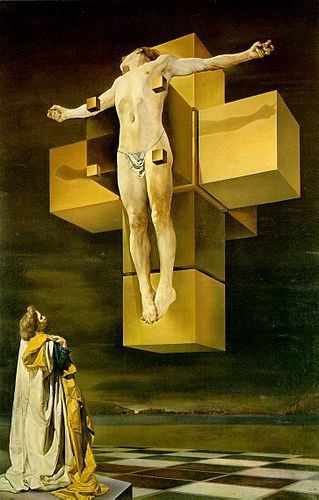
Dali_Crucifixion_hypercube.jpg

I would like you to imagine the classic love story. You know the one: The daring knight rescues the damsel in distress from the fiery dragon. The details really don’t matter. All the story needs, seemingly, is a knight, a dragon, and a princess. However, it seems that there is one other element needed in the story, and that is the element of danger. For the story to work, the knight must triumph in the end, but only after a battle in which he might have lost. And this seems to be true, not just from our perspective, but from the perspective of the princess as well.

I mean, if the story is to be believed, the princess loves her knight, and love seems to include a desire for the beloved to be safe from harm. Yet, imagine how the princess would feel if the daring knight, instead of facing the dragon in hand to hand combat, camped a mile away from the castle with a sniper rifle, killed the dragon from a safe distance, and then waltzed in to pick up the princess. A bit anticlimactic isn’t it? Don’t we all feel, as much as we might not like to admit it, that if we were the princess, we’d prefer our beloved risking it all to save us? Don’t we, in a secret place in our heart, want our knight to be scarred?

Now, I’m not going to try to understand the motivation for this desire. I don’t know where it comes from, I only know that it seems true that we have it. But, I do think it has to do with what comes after the knight’s daring rescue. While the knight and princess gallop away on a snow white stallion, isn’t there already a natural bond forged by their shared experience of the dragon? If the knight had faced no danger and suffered no injury in his battle with the dragon, wouldn’t the princess, as much as she loves her knight, feel estranged from him? Wouldn’t she ask herself, “Does he understand what the dragon did to me?”

I have often had that question about my relationship with God. Knowing how much my sin has hurt me and made me despicable to myself, and reflecting on the glory and perfection of God, I sometimes have asked myself, “Does He understand what sin did to me?” The answer God gave me at the cross, and continues to give me every day in the Mass is, “Yes, because sin has done it to me too.” There seems to be a deep psychological reason that the bread and wine are consecrated separately in the mass: We want a God who knows what it feels like to have his blood separated from his body, in the same way that we have spilled our blood living in a broken world. Of course, we want a God who is all-powerful, who triumphs over sin and death, no denying that, but we also want a God who bleeds in the process. We want our God to carry the same scars we do.

That is “the grotesqueness of the mass.” In the mass, as a continuation of the eternal sacrifice of Christ on the cross, God makes himself vulnerable to us, so that He can share in our weakness. Our suffering becomes the point of encounter with God. In the mass, God enters our brokenness, our loneliness, our anger, our numbness. That is the horrible beauty of the Mass and the cross: that the hour of good’s triumph over evil is when good is weakest. It is when God looks most like a man. God suffers with us, in order to make Himself capable of being understood by His creatures who have so long suffered under sin, that they are unable to comprehend a life of love without suffering.

the_body_of_the_dead_christ_in_the_tomb-copy-300x45.jpg

And yet, we know that this is not the end. God chose to suffer not just to meet us in our suffering, but to bring us out of it. We have hope that there is a love that transcends suffering, and though, in our broken human condition, we can’t experience it now, (or at least, our experience of it is limited,) our hope in God is that some day we will. That is why the problem of evil (Why does a good God allow suffering in the world) is not so much a problem as it is a recognition of our broken selves. As fallen men and women, our experience of our own brokenness makes us want others to have experienced our suffering. This is not because we are evil and sadistically want others to suffer, but because we want to know we are not alone. The cross not only gives us that reality, but also the hope for something more: something we cannot fully comprehend now, but something we know we’ve been missing. Evil exists because in our broken state, we need evil to help us recognize the good. In the evil of the cross, we see the ultimate good, and that ultimate good gives us hope for a good without evil, a love without pain, a final victory over sin.

jesus_returns-300x225.jpg

Post by: Niko Wentworth

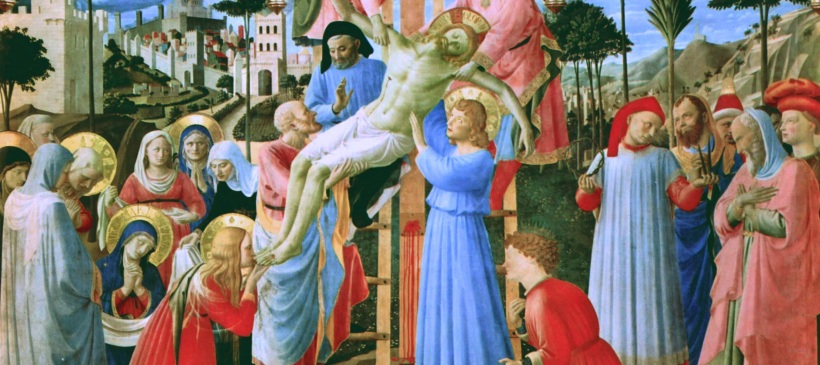
Main image: The Deposition from the Cross, Bl. Francis Angelico, 1434

A Forgotten Sin

There is a strange and subtle fault that plagues human hearts. It is strange because it is committed only with other sins, and it is subtle because one already has forgiveness on his mind when he commits it and so is likely not to think it needs repenting from. What is this sin?

Presumption.

Presumption is opposed to the virtue of hope, whereby we desire and expect God’s forgiveness and help in obtaining Heaven. It is the contrary of despair… The presumptuous person throws aside the moral law on account of the excessive character of his hope. He expects too much from God: he expects a thing not promised. Salvation has not been promised to those who merely fulfill a formula (viz., announcing one’s sins in sacramental confession, for example) but rather to those who exhibit perfect contrition, which is the rejection of all to do with sin – its evil effects, its evil content, and its evil motivation – out of love for God (with the assumption of making confession soon, if not presently making one), and to those who at least have true “attrition” (fear of punishment) within the sacrament of confession itself. Presumption is a special kind of motivation… a “meta-sin” if you will. One is in danger of not having adequate repentance for the sacrament of confession to receive absolution if he fails to mention presumption, as he brings his lack of the fear of God into the confessional with him. For a valid confession, one must at least have true attrition – fear of punishment. The presumptuous person does not have this fear with regard to himself. (If you have just become aware of this sin in your life, you should assume that your prior confessions were valid unless you have a clear certainty that you were not really trying that hard to examine your conscience. Simply mention presumption in your next confession.)

To help understand this sin, here’s a natural, human form of presumption. Imagine a child who stays out well past his curfew. When he comes home, his parents are upset, but he apologizes for his lateness and they forgive him. Then, on their way to bed, they hear their son talking on the phone to a friend – “Yeah they were mad but they forgave me. I knew they would, that’s why I did it.”

Ouch. What parent wouldn’t then proceed with an even more severe punishment than what mere lateness merited?

Unlike an unsuspecting parent, God is wise to this game. A person has “too much hope” if he thinks that “God will forgive me” is an excuse for doing whatever he wants and then only confessing the faults he commits because of his expectation of forgiveness. He must also confess his motivation – presuming upon God’s mercy. In this sense, presumption is “an inordinate conversion to God,” as St. Thomas puts it. This is strange to our ears, but it is indeed what this sin is; a person hopes so much for forgiveness that his servile fear is entirely demolished and replaced not by filial fear but by disobedience.

Presumption is a daughter of pride. One who thinks he is so great as to deserve Heaven is likely to fall into halfhearted repentance, or even into no repentance at all. What a calamity! Pride can also lead to another kind of presumption, namely, the rash assumption that God has blessed one’s endeavors in such a way that failure will be impossible or at least improbable in the project one has undertaken. For example, a man decides to become a missionary in China. He prayed, but he did not seek the approval of any ecclesial authority nor take counsel with a prudent spiritual director. How does he know that this is really God’s will? He does not. He would be guilty of this secondary kind of presumption. So too would a person who thinks himself to have “the gift of healing” and so goes about laying hands on people without authentic discretion. This is presumptuous of God’s grace and also exposes the Gospel to ridicule.

Knowing you have committed this sin is not always so easy. There is a difference between the hope of forgiveness motivating a sin and the hope of forgiveness occasioning a sin… I have given an example of the former in the context of human relationships. An example of the latter would be something more like a child who has become used to his parents forgiving him and so loses some respect and fear of punishment. He does not consciously choose to violate their legitimate demands on him because he knows they will forgive him, but a kind of vicious habit has been ingrained nonetheless. Where is the line between these two cases? It might not always be so clear. What we can say is that a person who consciously makes forgiveness a condition of his sinful action has certainly committed this sin, and a person who has lost respect and fear of punishment is in serious danger of committing this sin.

To reiterate, presumption requires its own mention in confession, as it is its own distinct sin. Often a person will know he has done something seriously wrong by using “God will forgive me” as a motivation for sin but will not have the vocabulary to explain himself in confession. The word is “presumption.”


Post by: Eamonn Clark

Main image: Pope Francis goes to confession – via Catholic News Agency

Lord, It Is Good That We Are Here

“Lord, it is good that we are here. If you wish, I will make three tents here, one for you, one for Moses, and one for Elijah.” (Matthew 17:4)

I’ve seen people give Peter a hard time for not “getting” what was happening in front of him at the Transfiguration. Mark’s Gospel says parenthetically “he hardly knew what to say – they were so frightened.” But I think we need to give our first pope some credit where credit is due.

Peter was thinking quickly on his feet. So he intrudes into the conversation and asks whether he should build three tents. For us, this sounds odd, but for Peter, he must have thought he had solved the problem: this had to be the beginning of the end times. He might have picked up on how Jesus is fulfilling the Old Testament festivals. He knew of the Jewish tradition that Moses and Elijah would come again before the end of the world. Now, since they’ve come, he was hoping Christ was finally going to restore the kingdom of Israel and reap the much-anticipated harvest of souls. It was the Christological fulfillment of the Jewish Festival of Booths.

They needed tents.

The Festival of Booths (Feast of Tabernacles / Sukkoth) is one of the three major feasts in the Jewish calendar (Leviticus 23:39). For a week, they would dwell outside in tents (“booths”) for seven days, reminiscent of their time dwelling in tents during their exodus sojourn. The timing of the Festival of Booths corresponded with a yearly grain harvest, wherein whole communities would work day and night (with the aid of a full moon) to gather in the harvest and do the work of threshing the grain. Removed from its initial agricultural context, the Festival Booths still looked forward to the harvest that was to come at the end of time. Although Peter’s exclamation of “Lord, it is good that we are here” is a fitting expression of eschatological rest, the tent-building suggestion might have been a little too much.

Peter figured out pretty well what was going on. However, Peter still did not know what he was saying. Where Peter erred was not his analysis – the event of the Transfiguration is the fulfillment of the Jewish Festival of Booths – but his approach.

Peter approached the Transfiguration as a problem to be solved, not as a mystery to be entered into.

The Meaning of Mystery

So when Christians use the word “mystery,” we do not mean a problem without an answer. No, for Christians, a mystery is something that is so intensely knowable that it exceeds the powers of human comprehension. A mystery is so great that it encompasses the subject.

With a little help from the French personalist philosopher Gabriel Marcel, we should distinguish between “mystery” and its misused synonym “problem.” For Marcel, something is a mystery when the self is implicated in it. A mystery cannot be studied from a distance, but is experienced by entering further into it. Openness to mystery is openness to the whole of a reality.

Screen Shot 2017-08-05 at 2.46.57 PM
Gabriel Marcel, French Catholic Philosopher, 1889-1973

A “problem,” on the other hand, is something that “is placed in front of me, blocking my way.” To treat something as a problem is to purposely exclude yourself from it. It is a purely notional engaging of a situation, wherein one can find objective and finite answers with universal implications.

Problems are the stuff of scientists. Mysteries are the stuff of mystics.

Let me give you an example.

Once, my five-year old niece told me, “Did you know that, when I’m in the car, the moon follows me? It really does!”

Infected as I was by the spirit of abstraction, I told her, “It only looks like it is following you because it’s so far away.” I thought I could maybe explain to her how perspective works at such distances. To prove this, I thought I could set up an experiment, putting her in one car and her sister in another car. They would go separate directions and observe how the moon follows both of them. Then I could prove to my niece that, since the moon cannot possibly be following both of them, there must be another explanation. That explanation would be in the reality of the great distance between the earth and the moon, a distance that can be observed and measured. Science would win out over childish naïveté.

But before I could get anywhere to disprove her childish notion, she interrupted, “NO. The moon really follows me.”

In the face of such opposition, I thus abandoned my attempt to scientifically disprove her childish perception.

For my five-year old niece, the moon was a mystery; it really did follow her. The moon was so beyond her that, rather than disconnecting her, it implicated her in its path. However mistaken her understanding of perspective, she approached it with wonder. And she rightly would not let that wonder be extinguished.

To me, the moon was a problem that needed to be solved; it could be measured and placed conceptually at a distance. I knew that its movements and phases are configured to a different pattern than my sporadic movements. Instead of encountering the moon with her, I abstracted. Although technically correct (the moon does not follow you), my approach prevented me from being gripped by the mystery of the moon and sharing in my niece’s wonder.

Like my niece with the moon, a mystery is so beyond us, that we cannot help but be pulled into it. A mystery is so large that it necessarily involves the viewer.

In this way, God Himself is a mystery, being so far beyond us that, at the same time, He embraces us and loves us in our very being.

The Mystery of the Transfiguration

It is in this way that the event of the Transfiguration is a mystery.

Since mysteries overwhelm us, they implicate us – they require our response. Our response, then, to the mystery of the Transfiguration is not to solve the puzzle of Moses and Elijah’s appearance, but to enter deeply into the reality of what is before us.

Although technically correct, Peter’s approach prevented him from being gripped by the mystery. So while Peter was still speaking, a higher voice interrupts him: “This is my beloved son with whom I am well pleased. Listen to him.”

Through the mystery of the Transfiguration, we are meant to share in Jesus’ own prayer with the Father. By beholding the glory of Christ transfigured and listening to him, we become sons and daughters in the Son. By entering in to the mystery of the Transfiguration – by listening to God’s beloved Son – we become what we contemplate.

How do we enter in to the mystery of the Transfiguration? For us Christians, we go to the source and the summit of the Christian life – the Holy Sacrifice of the Mass. Like Peter at the Transfiguration, we can look at the Mass just as a problem to be solved, a ritual to be analyzed, a puzzle to be deciphered. Or we can enter into the mystery of the Mass.

In every celebration of the Mass, we ascend the mountain with Christ, and we encounter something that overwhelms our understanding: God incarnate – the second Person of the Holy Trinity – comes to us as bread and wine. So great is the glory of Christ in the Eucharist, so utterly beyond us, that we are pulled into the mystery. The altar is our Mount Tabor, where we see His glory, not with the eyes of flesh, but with the eyes of faith. Over the altar the Father’s voice mystically resounds, “This is my beloved Son; listen to him.” We who enter into this mystery by receiving the Body of Christ in Holy Communion are enveloped by the cloud of the Holy Spirit. At Mass, we enter in to the mystery of God’s glory. He gazes on us, and we gaze on Him, and we become what we contemplate.

It is good that we are here.


Post by: Fr. Peter Gruber

Main Image: The Church of the Transfiguration, Mount Tabor

First Fridays: Leviticus 23

“The LORD said to Moses, ‘These are the festivals of the LORD which you shall celebrate at their proper time with a sacred assembly.’”

So begins the Old Testament reading for today. Following this introduction, the reading continues with God pronouncing the major feasts that would make up the Jewish calendar: The Sabbath, the Passover and the Festival of Unleavened Bread, the Offering of First Fruits, Festival of Weeks, the Festival of Trumpets, the Day of Atonement, and the Festival of Tabernacles. It may seem that this list of Jewish festivals may not appear to be particularly relevant to the modern Christian. After all, we don’t celebrate these feasts; so why did this passage and others like it make its way into our lectionary? What can we take away from them?

One reason why these readings are important to us is the historical background which they provide us about our ancestors in faith and the religious culture into which our Lord was born. The present is shaped by the past, so learning about the lived experience of those who preceded us and how they kept their traditions alive gives us a blueprint for doing the same today. For example, that the Festival of Weeks is a celebration commemorating the wheat harvest in Israel does not seem to be of utmost importance to the modern Christian. However, knowing that the Festival of Weeks was also known as Pentecost because it fell 50 days after Passover, in the same way as the Christian Pentecost follows 50 days after Easter, and that apart from being a harvest celebration, it commemorates the giving of the law at Mt. Sinai, allows us to enter into the liturgical importance of this festival. Understanding the relationship between the giving of the law at Sinai, and the giving of the Holy Spirit at Pentecost allows us to see the gradual fulfillment of salvation history and the slow unveiling of God’s love throughout time.

But for this post, I don’t want to talk about the rich theological insights a close study of each of these festivals would give us. There are others who have done a much better job than I could. Interested readers could do no better than to check out the Berit Olam commentaries published by The Liturgical Press. Rather, I want to focus on the general theme present throughout the entire narrative, (which in the reading is presented in a redacted form.) That is, the elements of time and space, and how they are ordered to the worship of God. If you look at Leviticus 23:1-44, there are several phrases that you would find repeated multiple times. “The Lord said to Moses, speak to the Israelites,” “The appointed festivals” or “sacred assemblies,” “Do no regular work,” and “lasting ordinance for generations to come” and “Wherever you live.” I want to concentrate on these repeated phrases as revelatory of the kind of relationship God wants the children of Israel to have with Him and with each other. Finally, after looking at these, I want to address the seemingly out of place verse of Leviticus 23:22 which I think is central to the passage.

To begin, it should be noted that Leviticus 23 begins a new “section” in the book of Leviticus. The previous “section” dealt with the conduct of the priests, and now we have seemed to move on from that to norms of general conduct for all the Israelites. How fascinating that the first directive God gives to His people is a calendar! Even before the seemingly paramount sections on rewards for obedience and punishments for disobedience (Leviticus 26), God gives very specific instructions for when to celebrate liturgical feasts. Furthermore, the passage makes it clear that this is a divine command. “The Lord said to Moses, speak to the Israelites,” is repeated several times, reiterating how the giving of the calendar of feasts comes from God Himself. In fact, the chapter ends with God saying, “I am the Lord your God,” using the divine “I am” with which he first identified Himself to Moses to underline the sacred nature of the festivals just commanded. Furthermore, the repetition of “lasting ordinance for generations to come” and “wherever you live” reflect the universality of these commands. These commands hold true, not just for the small group being spoken to, but for all of God’s people, wherever and whenever they are.

It is because of this that we hear repeated the command to do “no regular work” (in other translations, servile or laborious work). Is this command given because God disapproved of the work they Israelites did? Of course not. God commands that sacred days be days of rest as a reminder that these are not normal “work days.” They are days that we rededicate ourselves to the work of the Lord, that is, prayer. Just as God “rested” on the seventh day after the work of creation, we rest after our participation in that unfolding work of creation to remind ourselves of what that work is ordered to – God.

And that is what I think this passage reveals the most about God and about ourselves. Our work is ordered to our rest, which is itself ordered towards our relationship with God. As human beings, we are transcendent creatures. We have limited needs like any other animal; we eat until we aren’t hungry anymore, we sleep until we aren’t tired anymore, we seek shelter from the elements, and all the other basic necessities. But we also have unlimited transcendent desires. We have a desire for beauty, for companionship, for wholeness, for infinite joy. That is, we have a desire for God. God led the Israelites out of Egypt and he gave them the calendar of feasts not to satisfy their basic animal needs, but their transcendent human needs. God gave the Israelites a calendar of feasts and directions of how to celebrate them even before He finished leading Israel into the Holy Land because it was given to them for the purpose of worship, and so their time in the land and their use of it must be ordered to that purpose.

Do we find this to be the reality in our lives today? Do we order our time and our space to that reality? How often do we find our work encroaching into our time with God? How often are we tempted to skip prayer or even just healthy social activities in order to get work done because we think that is what is expected of us? Could you imagine what kind of a society we would be if our calendars were arranged around preserving the sacredness of the day of rest? Imagine if employers arranged work schedules in a way that not only provided employees with sufficient “days of rest” but also such that they could participate with dignity in community activities (both religious and other healthy communal gatherings.)

It is to that point which I think the, seemingly out of place, verse of Leviticus 22:23 is ordered. “‘When you reap the harvest of your land, do not reap to the very edges of your field or gather the gleanings of your harvest. Leave them for the poor and for the foreigner residing among you. I am the Lord your God.’” This is the “gleaning law” of ancient Israel, which essentially stated that those who owned and worked farmland ought not be so exacting in their harvest that those without land wouldn’t be able to find food should they glean from the field. In a passage about liturgical feasts, why would this command be placed in the exact middle? It’s true, the Festival of Weeks is a harvest festival and so making a point about harvesting is not completely out of place here, but it still seems a little strange.

However, reflecting on the idea that our time and resources are ultimately ordered to the service of God, we might find religious significance in the gleaning law. In some sense, the gleaning law made it possible for the poor to participate in the festival. It ensured that there would be food available after the harvest for those who begged in order to fulfill their basic needs. The poor would not have to worry if taking time off from their job for the festival would impact their ability to fill their needs. Just as a farmer has a right to collect the fruit of his labor from his field but not be so exacting that there is none left for others, an employer has a right to his employees time (for a fair wage of course,) but not to be so exacting in his demands that an employee does not have time or energy left for religious and community oriented activities in a respite from “regular work.”

As a reflection, we might ask ourselves, do we keep the “gleaning law” in our own lives? Do we ensure that every day we have several periods of time protected from the encroachment of our daily demands, our regular and laborious work? Do we use that time to concentrate not on our basic animal needs, but our transcendent human needs? What “mini-festivals” do we have planned in our day in which our focus is on prayer to God and charity towards our neighbor? Is our time away from the office ordered towards these higher things, or is it only a brief respite to prepare for the next day on the job? Essentially, do we work to live, or are we living to work? With these thoughts in mind, thanks be to our God, who takes care of our needs so that we can use this time on Earth to grow closer to Him!


Post by: Niko Wentworth

Main image: The Gleaners, Jean-François Millet, 1857, oil on canvas

Jesus and the Aliens

By now, the question is no longer fresh and new. If aliens found us, or vice versa, what is the appropriate pastoral response? The Holy Father wants us to go to “the peripheries” – well, what could be more peripheral than some planetary system in the GN-z11 galaxy, which is a whopping 32 billion light years away? Shouldn’t we want to share our Faith even there?

aliens1.png
Father Jack Landry, from ABC’s show “V” looks up at a UFO. His skepticism eventually earns him laicization – by the aliens secretly running the Vatican.

Let’s say a peaceful race of aliens show up on our front doorstep. We can tell that they are rational, living creatures with bodies. We can communicate with them about higher order concepts. They want to be part of our culture and society. So, do we tell them about God? Do we invite them to Mass? Do we baptize them? Pope Francis has said he would, and the Vatican’s chief astronomer, Br. Guy Consolmagno, has said the same.

I suggest the following possibilities, given the above scenario.

  1. They already know and worship God and don’t stand in need of redemption.
  2. They already know and worship God, or not, and do stand in need of redemption, but their redemption can’t possibly be found in Jesus Christ.

Before the reader accuses me of heresy – or even apostasy – let me explain.

The first possibility is that these aliens do not need redemption. It would be easy to rule this one out, as soon as we found any kind of habitual moral failure in them… Given that their first parents (or parent?) was like our own, sin (and death too) would indicate a corruption of nature. If they are not sinful at all and do not die, it would make sense to assume they are prelapsarian. Creatures that don’t have a broken nature do not need that nature to be healed. No sin, no need for redemption.

By most accounts, if they are sinful creatures, we will know right away.

The second possibility is that they do need redemption, which it seems indicates the need for a Savior and a sacramental economy. Because the task of redemption is specially suited to the Second Person of the Trinity, it would make sense for the Son to become incarnate in order to pay the price of the sin of their common ancestor from whom they inherited sin and death. That ancestor, however, is not descended from Adam. If there is a race of intelligent life apart from the progeny of Adam, Jesus Christ, a descendant of Adam, cannot be that race’s Savior. Recall Pope Pius XII’s famous words in paragraph 37 of Humani Generis:

“When, however, there is question of another conjectural opinion, namely polygenism, the children of the Church by no means enjoy such liberty. For the faithful cannot embrace that opinion which maintains that either after Adam there existed on this earth true men who did not take their origin through natural generation from him as from the first parent of all, or that Adam represents a certain number of first parents. Now it is in no way apparent how such an opinion can be reconciled with that which the sources of revealed truth and the documents of the Teaching Authority of the Church propose with regard to original sin, which proceeds from a sin actually committed by an individual Adam and which, through generation, is passed on to all and is in everyone as his own.”

Pius XII firmly teaches that everyone on Earth is a descendant of Adam and therefore is an inheritor of Adam’s sin, but he does not consider the question of alien life – he leaves it open. For, perhaps there are “true men” (in the sense that they are rational animals capable of knowing, loving, and serving God) that are not on this Earth and never have been, who therefore would not be descended from Adam. If they are not descended from Adam, they do not enjoy the benefits of the redemption of the race of Adam. Our Christ’s death and resurrection allows for our baptism, our baptism takes away our original sin – inherited from Adam. If the aliens have their own Original Sin, they need their own Christ descended from their own common sinful ancestor.

Taking the absolute fittingness of “Earth Christology” for granted (meaning specifically that it would always be best for God to fix every instance of Original Sin through an Incarnation), this would mean that the Son of God would have to become incarnate according to their flesh, and so pay their debt of sin. Indeed, St. Thomas teaches in the Summa Theologica III q. 3 a. 7 that a Divine Person may take on multiple human natures at once:

“What has power for one thing, and no more, has a power limited to one. Now the power of a Divine Person is infinite, nor can it be limited by any created thing. Hence it may not be said that a Divine Person so assumed one human nature as to be unable to assume another. For it would seem to follow from this that the Personality of the Divine Nature was so comprehended by one human nature as to be unable to assume another to its Personality; and this is impossible, for the Uncreated cannot be comprehended by any creature. Hence it is plain that, whether we consider the Divine Person in regard to His power, which is the principle of the union, or in regard to His Personality, which is the term of the union, it has to be said that the Divine Person, over and beyond the human nature which He has assumed, can assume another distinct human nature.”

This means that if God planned to save these aliens by an Incarnation in their flesh, the Son could do that in the same way He did for us, the descendants of Adam, regardless of already having done so in Jesus of Nazareth. If God so chose, He could give them a progressive revelation, just like He did for us through the patriarchs, Moses, and the prophets. Maybe these aliens are actively waiting for their own Messiah… Perhaps we could play a kind of prophetic role, insofar as we might give them the teachings of Christ and improve their moral life in this way, but they could never be incorporated into our sacramental economy. They need their own Savior and their own sacramental economy, probably suited to their own kind of flesh, archetypal associations, and any salvific history peculiar to them. (The Trinitarian formula of baptism would not change – but maybe the nature of the outward sign of baptism or fundamental initiation into the spiritual life could change… This would be the most likely “cognate” with our own sacramental system. But maybe their skin can’t stand water? Who knows? The point is that the Trinity would still be the “term” for entrance into the spiritual life.)

It should be noted that this account takes for granted that the aliens’ sinful common ancestor was graced like Adam with the preternatural gifts and sanctifying grace and was not instead left in the so-called “state of pure nature.” It does not seem there can be a “Fall” for them in the first place if their race did not have at least the gift of integrity (fittingly aided by infused knowledge and perfected by bodily incorruptibility) springing from the gift of sanctifying grace. The free rejection of that grace through a departure from God’s law would initiate the corruption of the soul into what we call “fallen nature.” This state of pure nature, passed on from generation to generation, would render the alien race unable to reach beatitude without a direct, superabundant, and universal act of mercy on the part of God Himself. The aliens could sin and still reach their natural end of an honorable life of the natural love of God, the Creator, with the help of His grace… but not sanctifying grace. They would end up, resurrected or not, in a kind of natural happiness or unhappiness according to their natural merits or demerits, but they could never gain beatitude (Heaven) without that special act of God.

In any case, it seems we won’t ever need to worry about writing the rubrics for RCIA – the Rite of Christian Initiation for Aliens.

Post by: Eamonn Clark

Main image: Screenshot from the 1982 film E.T.

Motherhood and Human Maturity

(Part I in a series on motherhood and fatherhood)

So much of who we are comes from our mothers. We are who we are in relation to others – and the first relationship we had was being nestled nine months in our mother’s womb.

“Male and female He created them” – it is fitting that with these words our first parents are introduced, since our first experience of gender, our first experience of male and female, comes – not from our analysis of gender roles in society – but really and concretely, from our mother and our father.

“God created man in his own image, in the image of God He created him; male and female he created them.” Because we are male, because we are female, we are in the image of God. We are not made in the image of God as mere androgynous souls with consciousness; rather, we are embodied in our masculinity and our femininity. Our lives are circumscribed between motherhood and fatherhood – none of us comes into this world without a natural father, none of us comes into this world without a natural mother.

In a time hidden from our memories, that initial relationship with our mothers forms us at the core of who we are. No person has ever grown to maturity without first passing through their mother’s body. Try as they might, technology still has yet to eclipse biology.

(If you want to be overwhelmed with all the particulars of gestational biology, check out this video.)


From the first moment of our existence in the womb of our mother, we are surrounded by her, enveloped in her body. Her body supplies for every one of our needs. As our cells divide and develop, our blood takes nourishment and oxygen from her blood; there is an exchange of life. By the time a mother is aware she is with child, her maternal body has known this already for weeks. Before she feels the budding movements of the child’s limbs, she is already being moved by the child – morning sickness, new diet, the maternal nesting instinct to tackle stale projects. But more than that, her whole life receives a new trajectory; she holds a person within her – two souls in one body.

I recall an experience of a friend of mine when his wife was pregnant with their first child. He came back from work one day to find his pregnant wife lying on her bed with her hands over her womb, filled with wonder. She explained to her husband that she felt her baby move for the first time and was overwhelmed with the realization of her motherhood, explaining to her husband, “I am not alone in my own body.”

A mother after having her first child will often comment that, had she known how much of herself would have been taken in order to love her child, she would not have thought herself capable of giving so much of herself. Motherhood is an experience that requires all of her. It is a self-emptying love that cares fiercely and intimately for her child.

Maternity, femininity, female-ness – this is our first experience of gender; it is our first experience of life. We are born into – conceived into – this relationship with our mother. It is most natural to us. It is the strongest and longest lasting of human bonds. It is a natural communion. For the rest of their lives, the mother and child will retain something of that intimacy where they were truly two souls in one body.

Beginning from this indescribable intimacy, the child goes through a development. Birth requires a leaving behind of the original closeness of the mother. The dependence of the child on the mother continues – nourishment, locomotion, comfort, bathroom issues – but slowly begins to wane. When the child learns to crawl, a mother is pained to see his reliance on her lessened. When the child takes his first steps, every step is a step away from the mother. Motherhood is tinged with sadness. Watching her child grow apart from her requires all of that self-emptying love.

In my own mother, I’ve seen this self-emptying love every time a sibling leaves my parents’ house to depart for college – fourteen times (I have a big family) one of her children left home, fourteen times she’s cried.

A mother’s vocation begins in intimacy, and ends in separation.

A mother’s love makes room for the child to grow. All human life takes as its origin the intimacy of motherhood. Fatherhood completes the picture.

***

We see this reality of maternal separation lived out most radically in the life of our Blessed Mother. Jesus shared a hidden intimacy with Mary for nine months. At his birth, the shepherds find Him, not wrapped in the arms of His immaculate mother, but wrapped in swaddling clothes and laid in a manger – apart from her. When He is twelve, after being lost for three days in the Temple, He tells her “Did you not know that I must be in my Father’s house?” (Luke 2:49) At Cana, He begins His public ministry with what looks like a rebuke, “Woman, what have you to do with me?” Once while Jesus was close by, Mary tried to get through the crowd to see her Son, and He says, “Who are my mother and my brethren? Here are my mother and my brethren! Whoever does the will of God is my brother, and sister, and mother.” (Mark 3:33-35) Even at the foot of the cross, when she is with Him again, He gives her away, saying to her “Woman, behold, your son” and to St. John, “Behold, your mother.” (John 19:26-27) And then He undergoes the ultimate separation, giving up His spirit and dying on the Cross.

Here, we let Blessed John Henry Newman take over, with his reflection on the Thirteenth Station of the Cross:

He is Thy property now, O Virgin Mother, once again, for He and the world have met and parted. He went out from Thee to do His Father’s work – and He has done and suffered it. Satan and bad men have now no longer any claim upon Him – too long has He been in their arms. Satan took Him up aloft to the high mountain; evil men lifted Him up upon the Cross. He has not been in Thy arms, O Mother of God, since He was a child – but now thou hast a claim upon Him, when the world has done its worst. For thou art the all-favoured, all-blessed, all-gracious Mother of the Highest. We rejoice in this great mystery. He has been hidden in thy womb, He has lain in thy bosom, He has been suckled at thy breasts, He has been carried in thy arms – and now that He is dead, He is placed upon thy lap.

Virgin Mother of God, pray for us.


Main image: “Virgin of the Angels,” William Adolphe Bouguereau, 1881
Post by: Deacon Peter Gruber

The New Albigensianism, PART I: From Scotus to S.C.O.T.U.S.

For the most part, religious errors are reducible to four basic ideas.

  1. Jesus is not by nature both fully God and fully human (Arianism, Eutychianism, Monothelitism, Agnoetism, Mormonism, etc.)
  2. There are not three Persons in One God (Modalism, Unitariansim, Subordinationism, Partialism, etc.)
  3. Sanctifying grace is not a free and universally available gift absolutely necessary for salvation (Pelagianism, Semi-Pelagianism, Baianism, Jansenism, Calvinism, etc.)
  4. Matter is not essentially harmoniously ordered with spirit (Manichaeism, Buddhism, Albigensianism, etc.)

While the first three ideas are certainly prevalent in our own day, the correct doctrines are only available through the grace of faith. The falsehood of the fourth, however, is evident from a rigorous use of natural reason alone. Therefore, it is more blameworthy to succumb to that error.

We are seeing today the resurgence of the fourth error in four ways: the sexual revolution, radical feminism, the culture of death, and most recently, gender theory.

The three forms mentioned in the first list (Manichaeism, Buddhism, and Albigensianism) more or less say that matter is evil and needs to be done away with. The Manichees thought that matter was created by an evil god, the Buddhists think that matter is only a distraction, and the Albigensians (or “Cathars”) became so enamored with the thought of the spirit escaping its fleshy prison that suicide became a virtue… But we will talk all about the Cathars later, and we will find some striking similarities between this medieval rigorist dualism and some of the most recent value developments in the Western world.

The current manifestations of the fourth error do not quite say “matter is evil,” but they instead say that the determination of human matter (the body) is irrelevant to the good of the spirit, and/or that the spirit is one’s “true self” which can be served by the body according to one’s whims. Some proponents may claim they don’t believe in spirit, that is, immaterial reality (in this case, the “soul,” or formal principle of life), but when they speak of someone being “a woman trapped in a man’s body,” or something similar, they betray their real thoughts. Still, even if a person insists on denying the reality of spirit, it remains the spirit within him who denies it. There can be no “self-determination” without a self to determine, and if the body simply is the self, then how can there be real determination? There could then only be physical events without any meaning. This, of course, is contradicted by the very existence of “experience.” It is not merely a body which acts, but a person who experiences.

The error in its current expressions can be traced to Descartes, whose laudable project of attaining perfect certainty about the world was, ultimately, a disastrous failure. After shedding all opinions about which he did not have absolute certainty, he was left only with one meaningful truth: cogito, ergo sum. “I think, therefore I am.” No person could both think and not exist.

This was not new, as St. Augustine had come to a similar realization over 1,000 years earlier. The difference was the context and emphasis of the thought; to Augustine, it was an interesting idea coming out of nowhere and going nowhere. To Descartes, it was the foundation of every knowable proposition, and it led to the idea that human beings are essentially thinking (spiritual) beings rather than a body-soul composite… Think “soul trapped in body.”

This came after the ruins of the scholastic project. With the combination of the fixation on choice and freedom in Scotus’ work and Abelard’s troubling take on the problem of universals (how to account for similarities between different things), the stage for Ockham’s Nominalism was set. (See Gilson’s detailed description in his wonderful book, The Unity of Philosophical Experience.) It was Ockham who hammered in the last nail of St. Thomas’ coffin and who paved the way for the “cogito” to be intensely meaningful not only to Descartes, but to the entire Western academy. Nominalism’s dissociation of “things” from any real universal natures which would make those things intelligible as members of species was the first step towards overthrowing classical metaphysics. This “suspicion of being” understandably increased exponentially with the publication of Descartes’ Discourse on the Method, as it cast a serious doubt on the reliability of the senses themselves, doubt that many felt was unable to be overcome, despite a sincere effort to do so on the part of Descartes himself.

The_Matrix_Poster
Descartes: The Movie

The anxiety finally culminated in Kant’s “nervous breakdown”: a total rejection of metaphysics in the denial of the possibility of knowing “the-thing-in-itself” (noumena). From there, much of the academy generally either desperately tried to do without a robust metaphysics or desperately tried to pick up the pieces, and this theme continues today in the strange and fractured world of contemporary philosophy.

Ideas have consequences. As McIntyre shows so well in his book After Virtue in the case of “emotivism” (the position that ethical statements merely express one’s emotional preference for an action) a powerful idea that spreads like wildfire among the right academic circles can eventually stretch into the average home, even if subconsciously. A very well educated person may never have heard of G. E. Moore, but everyone from the wealthy intellectual to the homeless drunkard has encountered some shade of the emotivism Moore’s work gave rise to. The influence which both Descartes and Kant had on the academic scene in their respective eras was so vast and powerful, that it is not unfair to say that Western philosophy after the 17th century was in response to Descartes, and that Western philosophy today is in response to Kant.

The reaction to Descartes’ rationalism was first empiricism, then idealism. The reactions to Kant’s special fusion of rationalism and empiricism (that started “transcendental idealism”) which here concerns us were logical positivism and French existentialism.

Logical positivism is basically dead in academia, although the average militant atheist has taken a cheapened form of Ayer’s positivism to bash over the head of theists, and the general inertia of positivism remains in force in a vaguer “scientism” which hangs heavy in the air.

Existentialism, on the other hand, has become a powerful force in the formation of civil law. The following lengthy quotation is from Justice Anthony Kennedy’s majority opinion given in Planned Parenthood v. Casey (my emphases):

“Our law affords constitutional protection to personal decisions relating to marriage, procreation, contraception, family relationships, child rearing, and education. Carey v. Population Services International, 431 U.S., at 685 . Our cases recognize the right of the individual, married or single, to be free from unwarranted governmental intrusion into matters so fundamentally affecting a person as the decision whether to bear or beget a child. Eisenstadt v. Baird, supra, 405 U.S., at 453 (emphasis in original). Our precedents “have respected the private realm of family life which the state cannot enter.” Prince v. Massachusetts, 321 U.S. 158, 166 (1944). These matters, involving the most intimate and personal choices a person may make in a lifetime, choices central to personal dignity and autonomy, are central to the liberty protected by the Fourteenth Amendment. At the heart of liberty is the right to define one’s own concept of existence, of meaning, of the universe, and of the mystery of human life. Beliefs about these matters could not define the attributes of personhood were they formed under compulsion of the State.

“These considerations begin our analysis of the woman’s interest in terminating her pregnancy, but cannot end it, for this reason: though the abortion decision may originate within the zone of conscience and belief, it is more than a philosophic exercise. Abortion is a unique act. It is an act fraught with consequences for others: for the woman who must live with the implications of her decision; for the persons who perform and assist in the procedure; for the spouse, family, and society which must confront the knowledge that these procedures exist, procedures some deem nothing short of an act of violence against innocent human life; and, depending on one’s beliefs, for the life or potential life that is aborted. Though abortion is conduct, it does not follow that the State is entitled to proscribe it in all instances. That is because the liberty of the woman is at stake in a sense unique to the human condition, and so, unique to the law. The mother who carries a child to full term is subject to anxieties, to physical constraints, to pain that only she must bear. That these sacrifices have from the beginning of the human race been endured by woman with a pride that ennobles her in the eyes of others and gives to the infant a bond of love cannot alone be grounds for the State to insist she make the sacrifice. Her suffering is too intimate and personal for the State to insist, without more, upon its own vision of the woman’s role, however dominant that vision has been in the course of our history and our culture. The destiny of the woman must be shaped to a large extent on her own conception of her spiritual imperatives and her place in society.

No doubt, a critical reader will observe some tragic oddities in this passage. We will table an in-depth analysis, but I do want to point out the bizarre idea that our beliefs can determine reality. One might be tempted to call this “relativism,” and there is indeed some relativism in the passage (the evaluation of the fact of whether a life or potential life is taken in abortion “depending on one’s beliefs”). Without denying this, I also assert that beyond a casual relativism, which might be more a product of a lack of reflection than a real worldview, Kennedy is a deeply committed existentialist. (Indeed, it seems that existentialism naturally disposes a person to relativism.) The thought that one’s beliefs define one’s personhood comes almost directly from Jean-Paul Sartre. The doctrine is: existence precedes essence. Essence is determined by beliefs and actions, according to the existentialist. Such an affront to traditional metaphysics would have been impossible without the aforementioned ideological lineage – Scotus, Abelard, Ockham, Descartes, Kant… Seeing Justice Kennedy through the existentialist lens also helps to account for the striking absence of respect for a human being who can’t believe or meaningfully act. After all, how can such a thing really be a person?

Today’s common philosophy of the Western liberal elite (and their spoiled millennial offspring) seems to be a chimera of these two diametrically opposed worldviews: positivism and existentialism. These ideologies have been filtered into the average home, and watered down in the process in such a way that they can appear to fit together. In this series of articles, we will thematically wind through a maze of philosophy, science, hashtag activism, and moral theology to understand the present crisis and to propose possible remedies for it.

After now having given a brief sketch of the ideological history, we begin next time with a look at the positivist roots of the so-called “New Atheism” and how an undue reverence for science has contributed to what I have termed the “New Albigensianism.”

Stay tuned…


For Part II, click here.

Post by: Eamonn Clark

Main image: Carcassonne, France… one of the old Albigensian strongholds.

Main image source: http://en.destinationsuddefrance.com/Discover/Must-See/Carcassonne

The Dark Knight of the Soul: Fortitude in the Batman

Behold, a humorous essay I recently wrote for a moral theology class, with some slight edits. Enjoy!

Mr. Bruce Wayne had a troubled childhood. Not only did he lose his parents to a crazed gunman, but he also fell into a deep well full of bats. The former occasioned the inheritance of vast amounts of wealth, while the latter occasioned an intense case of chiroptophobia (fear of bats). Together, these effects would eventually lead him to undertake a massive bat-themed vigilante project which would dominate his life and cause a complicated set of benefits and drawbacks in Gotham City. The question is: whether the act of becoming the Batman was an act of true fortitude on the part of Bruce Wayne?

What is clear is that in Batman’s vigilante project there is matter for fortitude, namely, dangers of death. “Now fortitude is a virtue; and it is essential to virtue ever to tend to good; wherefore it is in order to pursue some good that man does not fly from the danger of death.” (1) Wayne, of course, is choosing to fly toward dangers of death, and literally at that. With countless thugs, gang leaders, and dastardly supervillains, Gotham is anything but safe; and this is not even to mention the means which Wayne adopts for fighting crime, which includes jumping off skyscrapers and careening in between all kinds of obstacles, supported by some mesh wings. He is doing battle with criminals who might kill him, in a way that might kill him. “Dangers of death occurring in battle” are the proper matter for fortitude, beyond lesser evils like bodily pain or the annoyance of standing in line at the DMV. (2)

It seems that Wayne might have gone to a vicious extreme in overcoming his own private chiroptophobia by becoming “half bat.” Yet there is really nothing to fear about bats in themselves, so to fear bats at all seems to be a case of timidity. This means that overcoming such a fear is a good thing to do. In facing his repressed traumatic experience of nearly dying in the well, which became so closely associated with the well’s bats, Wayne becoming Batman would only tend towards a vicious neurosis if his new bat-persona did not serve some purpose beyond itself. That is to say, if Wayne habitually dressed up like a bat in his own house and looked in the mirror, this would be disordered. Taking on the bat-persona for the sake of intimidating criminals, which is his primary motivation, is something else entirely.

Wayne does not become Flowerman or Butterflyman or Puppyman, he becomes Batman. Even if he had had traumatic experiences with flowers and butterflies and puppies, surely he would not want to deal with those memories in the same way. The idea of a vigilante qua bat (or alternatively qua spider) is simply terrifying, which is the point: it is an effective aid to fighting crime. This, however, does not necessarily make it prudent, as prudence means that justice and other virtues are not being violated. Here we will simply mention the possibility that vigilantism is unjustifiable in Gotham, given that there are good cops like Commissioner Gordon around. If Wayne had not considered this, or had not considered the physical risks involved, then the decision would be imprudent regardless of whether it is just. Becoming a vigilante virtuously requires serious counsel and an understanding of the principles of law. (3)

There are certain appearances of fearlessness and daring throughout the career of Batman, but one must wonder if this is merely a result of having mastered the fear of death during his time training in the mountains with the League of Shadows. On the contrary, Wayne goes to great lengths to protect himself, investing in the production and maintenance of extremely sophisticated protective devices, and this could exonerate him at least of fearlessness. Batman, supposing his project is just, certainly ought to fear death, not just for his own sake, seeing as life is a great good, but also for Gotham’s sake: “Death and whatever else can be inflicted by mortal man are not to be feared so that they make us forsake justice: but they are to be feared as hindering man in acts of virtue, either as regards himself, or as regards the progress he may cause in others.” (4) This is also part of why concealing his true identity is so important, for if it was widely known that Batman is Bruce Wayne, he would be easier to destroy.

As for magnanimity, Wayne already has great honors, insofar as honors accrue to a man of enormous wealth such as himself. Ironically, his public identity as a billionaire is a cover for what he really lives for privately, which is the accomplishment of great things like deposing crime bosses and deterring supervillains at great personal risk. He accepts the “unofficial honors” that come with such acts, but he does not care for them for their own sake, so he is not ambitious. He takes on the project to give the city of Gotham hope, which is where he refers the glory given to him as Batman. Therefore, Batman has a degree of magnanimity. (5) There is, however, an element of Wayne’s public life that is pusillanimous, as he purposefully distances himself from seeming great by being an arrogant, dishonest, quarrelsome womanizer. He could gain more honor publicly by being more virtuous, but he rightly fears that this could lead to the suspicion that he is Batman. Insofar as this component of concealing his nocturnal activities is vicious, it is neither magnanimous nor fortitudinous, as sins cannot be called acts of virtue.

The crime fighting skills of Wayne are second to none, and since he has ordered his life and vast wealth towards crime fighting without compromising his fortune or social status, he most certainly deserves to be ascribed the virtue of magnificence. For, “[It] belongs to magnificence not only to do something great, ‘doing’ (facere) being taken in the strict sense, but also to tend with the mind to the doing of great things.” (6) Since Wayne could do almost anything he wants on account of his wealth, the good use of which is the proper object of magnificence, his mind certainly tends with great force toward the accomplishment of masterful crime fighting. (7) Otherwise he would do whatever it is that other billionaires do.

To the question, whether Bruce Wayne’s choice to become Batman was an act of true fortitude, we answer in the affirmative, with two qualifications. The first is that the entire vigilante project is just, which is unclear. The second is that the artificial public persona taken on as part of the condition for the project, which can be assumed to have been part of the means from the start, is at least mildly vicious and therefore reduces the fortitudinous character of the choice.

(1) STh II-II q. 123 a. 5 ans.

(2) Ibid.

(3) Namely, gnome and epikeia would be required. See STh II-II q. 51 a. 4; q. 120 a. 1, a. 2

(4) STh II-II q. 126 a. 1 rep. 2

(5) That his voice is extraordinarily deep is not a sign of greater magnanimity, it is merely another component of his intimidation, as well as a way to conceal his public identity. Furthermore, that he does not walk slowly to accomplish his tasks does not imply a lack of magnanimity, as the particular kind of great things which he seeks to accomplish demand agility.

(6) STh II-II q. 134 a. 2 rep. 2

(7) STh II-II q. 134 a. 2


Post by: Eamonn Clark