Can’t Spell “Cannabis” Without “Can I”

So guess what? Turns out some researchers in the Netherlands think more countries should legalize pot.

captobv
Captain Obvious, of Hotels.com fame

For those who think flying to Amsterdam (or Colorado, etc.) to indulge in the herb is just fine and dandy, let’s do some thinkin’.

Principle 1: Creation is good.
Principle 2: Not all creatures are equally good.
Principle 3: We ought to avoid evil.
Principle 4: Rastafari is a false religion.

Humans are ontologically higher than rocks, plants, and animals. We can use them, even to their detriment, if they are beneficial enough to us. Jesus was not a vegetarian. And yes, Brother Carrot and Sister Lettuce are okay to kill, unless it is out of sheer disdain and spite for their existence as creatures of God.

But Uncle Bud is a little different, because when we harvest him, it’s usually for the sake of affecting our bodies in a way that suspends our intellect.

Eat-ay ad Thomam:

The sin of drunkenness, as stated in the foregoing Article, consists in the immoderate use and concupiscence of wine. Now this may happen to a man in three ways. First, so that he knows not the drink to be immoderate and intoxicating: and then drunkenness may be without sin, as stated above (Article 1). Secondly, so that he perceives the drink to be immoderate, but without knowing it to be intoxicating, and then drunkenness may involve a venial sin. Thirdly, it may happen that a man is well aware that the drink is immoderate and intoxicating, and yet he would rather be drunk than abstain from drink.

That’s from the Summa TheologicaII-II, Q. 150, art. 2. Wine stands here for any intoxicating substance… One might not know a substance to have intoxicating effects, and so there is no sin in such drunkenness (unless its use was immoderate for other reasons). But if one knows something to be potent, it is another story. But just how drunk is “drunk?”

[The third kind of man] is a drunkard properly speaking, because morals take their species not from things that occur accidentally and beside the intention, but from that which is directly intended. On this way drunkenness is a mortal sin, because then a man willingly and knowingly deprives himself of the use of reason, whereby he performs virtuous deeds and avoids sin, and thus he sins mortally by running the risk of falling into sin. For Ambrose says (De Patriarch. [De Abraham i.]): “We learn that we should shun drunkenness, which prevents us from avoiding grievous sins. For the things we avoid when sober, we unknowingly commit through drunkenness.” Therefore drunkenness, properly speaking, is a mortal sin.

So there is still a mystery… How intoxicated must one be before he “deprives himself of the use of reason?” Let’s remember a few things though before we shame the Angelic Doctor for being obscure. First, he expects a student to have read all the text which precedes this Article. That would give one a better idea of what he means. Second, the Summa really is just a beginner’s crash-course. It is not meant to be exhaustive. In some articles, this is more evident than in others. Third, it’s unlikely St. Thomas had much firsthand experience with drinking to provide us with more subtlety… When Albertus Magnus is your professor and Bonaventure lives on your hall, you’re inspired to “rise above the influence,” as it were.

tumblr_m0o7czl36O1rrutr7o1_500
“Bonaventure Shows Thomas Aquinas the Crucifix,” Francisco Zurbaran, 1629

However, we know that some of the more austere saints occasionally indulged, such as Charles Borromeo and John Vianney. And of course, the Lord did as well, as He so famously pointed out in Matthew 11:19. Since potent substances will technically have some effect no matter how little is taken of them, we can say from this alone that it is not evil in itself to use intoxicating substances.

Then there is the principle of totality to keep in mind. Later in the same Question, Thomas alludes to this by saying a physician might tell one to use drink to induce vomiting – but since lukewarm water works too, that should be used instead. However, if it didn’t (and we hadn’t discovered Ipecac) then it would be fine. This is because the greater health of the body is worth the temporary loss of reason… That’s also why it’s not a sin to plan on going to sleep each night! And while there is violence done to the body and soul when, for instance, a gangrenous limb is removed, it is for the sake of the entire person. But this too should be moderated by wisdom, since not every ailment is worth doing violence to yourself. If you get occasional leg pain, that doesn’t mean you should cut off your leg.

So anyway, how drunk is drunk? How high is high? It is so difficult to say because of the problem in trying to quantify a quality. “It’s when you feel like… you know, drunk.”

captobv
There he is again!

We won’t solve the issue of exactly where “the line” is today – maybe another post with some ¡HARDCORE SCIENCE! – but perhaps we can lay down some guideposts based on Thomas and basic research.

Certain drugs act far more quickly than others. THC (the active ingredient in marijuana) acts more quickly than alcohol, based on the popular conventions of consumption. That is a big deal.

Reason helps us to distinguish the true from the false. Once you have trouble doing that, it’s time to call it a day… If sober people around you start laughing at everything you say, it’s probably not because you’re witty and charming, it’s because you’re diminishing your material brain’s capability to interact with your immaterial intellect (AKA you’re becoming drunk). And so on.

If you’re starting to forget stuff that you shouldn’t forget, then that’s another sign your faculties are slipping. So put it down.

When you feel like doing something really dumb that you normally wouldn’t, STOP and don’t do that much again. Once you know that tequila makes your clothes fall off, then kiss it goodbye. It’s better to enter into life without a bottle of Patrón than into Gehenna with all you could ever drink. (And Tequila burns even without being on fire…)

If you can’t walk right and are slurring words, then your brain is shutting down. Same story.

So no hard answers here today, but basically the faster and stronger the drug, the less morally safe it is to use. AND, if one uses any substance for the pleasure of changing his mental state in a way that diminishes its capacity to execute its proper function, as distinct from some some other effect, this too is a red flag… We should not delight in an unnatural state!

All this would make the average consumption of pot pretty bad.

Comet and Cupid

The 67P/Churyumov-Gerasimenko Comet (or “Rosetta’s Comet”) has been found to have organic elements on board. That’s quite a discovery, but how much bigger would it have been if the Mars Rover had found a little clump of algae?

There’s an entire industry around extraterrestrial life. One can just imagine with what care and reverential fear the world’s scientists would handle (or even discuss) some Petri dish of alien amoebas. How many billions of dollars would go to the protection, preservation, and cultivation of that life?

Meanwhile, it’s springtime, and you know what that means: hormones. And we all know hormones lead people to make dumb choices.

1935-1
“Romeo and Juliet,” Ford Madox, oil on canvas, 1870

Nobody seems to care so much about destroying human life in the womb, even though it behooves us far more to protect our own kind than to grovel over some alien fungus. Space-grass won’t take care of you when you’re old. It will never look you in the eye and tell you it loves you. And no matter how hard you try, you will not be able to teach it how to ride a bike. The list goes on.

BUT, BUT… ALIENS!

ancient-aliens-guy

Yes, aliens. But yes, humans, too. Shouldn’t we be our first priority? Shouldn’t we figure out how to flourish on our own before trying to flourish as an inter-galactic community?

The drive to search for space-buddies isn’t as strong as the drive for human intimacy. And no matter how many remakes there are of War of the Worlds, the prospect of having a child is more threatening. So we cheat the system.

Pfft. Puny humans.

Although this is less ridiculous than the fact that the destruction of the eggs of endangered turtles carries a higher penalty than the destruction of your own child. At least aliens are cool… No offense to the hawksbill turtle.

One last question… If there really is intelligent extraterrestrial life, and they know anything about our planet, why exactly would they want to have anything to do with us?


Main image: Haley’s comet in 1910

Science and Sacrament on Corpus Christi

Today is the Feast of Corpus Christi. Deo Gratias!

The Eucharist baffles materialists… Such a radical paradigm can easily invade a mind to the point where it can’t even understand how someone could possibly begin to believe the doctrine of the Real Presence, and not only because two elements (Soul and Divinity) are immaterial to begin with. A materialistic vision of the universe, if applied honestly, will reduce all things to a soup of non-distinct matter. There are words or concepts that can be useful, but they don’t correspond to real “substances.” There is no “Socrates,” only “this bit of matter that we call Socrates.” There is no “essence,” in general or in particular.

So, if there is no such thing as substance, (and only “accidents,” such as position, quality, etc.) then it is easy to see why it would be hard to begin to grasp how the Real Presence could work, even hypothetically. “Bracketing” beliefs that much can be very hard sometimes.

Furthermore, the Real Presence, like so many doctrines of religion, is “pseudoscientific.” That means that it is impossible either to prove or to disprove through empirical science, even though it makes a claim about reality. The difference here is that we can touch its consequence – unlike with the division of grace, the Ascension, and so on. This is often frustrating and confusing to secularists. The whole sacramental world is, after all, a giant wrench in the modernist machine: God actually involves Himself in the world, and in certain ways He has subjected himself to men, like that day Joshua made the sun stand still.

wpb1e50ce8

The “science of the sacraments” depends upon the “science of the Page.” Theology is a science whose principles are authority and witness rather than direct observation. The primary witness is God Himself, the secondary witnesses are those with whom He has had interactions directly by certain kinds of revelation, and tertiary witnesses are those who have trusted the preceding witnesses… However, tertiary witnesses could also be those events which testify by their nature and circumstance to the authority of the secondary and primary witnesses.

We might rightly call each confection of the Eucharist “miraculous,” since indeed something supernatural is happening in the natural world, but it is ordinary, inasmuch as it can be expected. There are also extraordinary events surrounding the Eucharist, even in our present day: note that a Host was found bleeding in Poland in 2013, and it has just been confirmed after several years of study.

And there are loads of these.

I remember the first time I was turned on to this phenomenon… It was a short video of a presentation by a cardiologist on a recent Eucharistic miracle which happened in Buenos Aires. (Interestingly, Pope Francis has not made much mention of it.) A host had been dropped, put into water, began bleeding and had turned into living heart tissue exhibiting great signs of distress.

How edifying that was to me! “What a slap in the face to those who don’t believe,” I thought. Except it is very, very hard to pull oneself out of the swamps of materialism, secularism, and hedonism, into which so many individuals in our society have fallen. Many of them might say that encountering just one miracle would change their whole lives – but we know how that panned out in the Book of Exodus. Perhaps they will change, but it is easy to slide back again. Humans are both rational and animal, after all.

Miracles can be aids to receiving faith, but faith is only given by God. When Peter confesses his faith in the divinity of Jesus, he gets the reply, “Flesh and blood has not revealed this to you, but my Father in Heaven.” What a paradox to reflect on during this feast of the Lord’s Body and Blood.


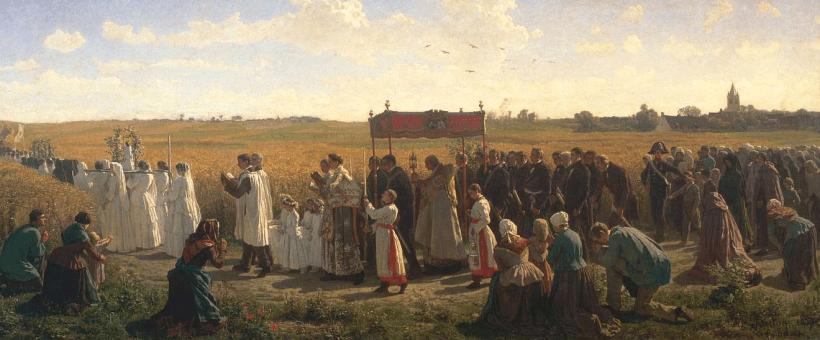
Main image: “Bénédiction des blés en Artois,” 1857, Jules Breton
Second image: “Joshua Commanding the Sun to Stand Upon Gideon,” 1816, John Martin

It’s supernatural, naturally…

There is a great temptation in the modern mind to put things “in boxes.” We have our lives at work, at play, at home, within ourselves, and we tend to consider these separately, on their own terms… even though a realistic perception of one’s life would have one admit that all these dimensions are in fact interrelated. There is, however, a special temptation to box the natural and the supernatural, in a way that they can never, ever touch: most often this manifests in the tendency to think of God only when one is at church or “needs a miracle,” as if God weren’t important at other times, or as if He didn’t even exist. But when the hallway is dark and a strange sound is heard, all of a sudden, “It might be a ghost!”

The readership might be interested to know that the area in which our Lord was baptized (an action which symbolized His “descent” into the sins of Israel and of all mankind) occupies a privileged place on the globe in its own right, apart from such a momentous event… It is the lowest piece of land on the planet. Yes, God became man, and was plunged into the waters of the lowest place on Earth!

That is an obvious example of a crossover between the natural and the supernatural, where a natural reality is used as a symbol to emphasize a supernatural reality (almost like a sacrament). And of course, the Incarnation itself is the perfect antithesis of the separation of God and creation.

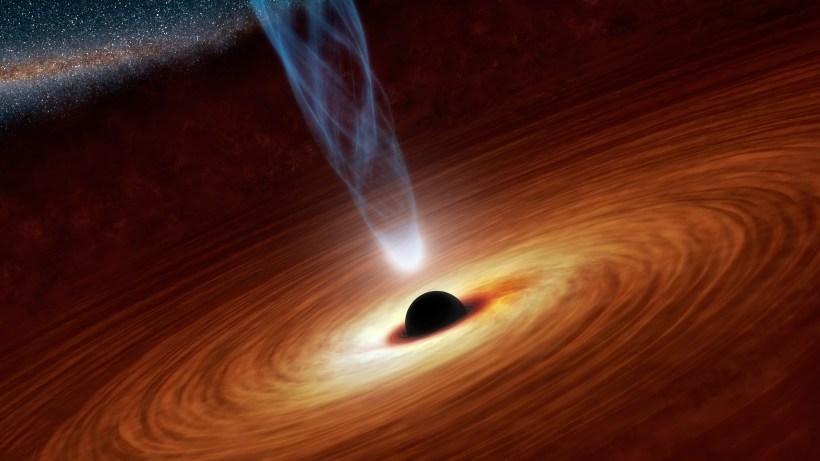
There is no reason this kind of crossover should be limited to the explicitly “theological.” Recently, black holes have been in the news. One story, while plenty interesting, is less relevant for our purposes here in this post than another story: what happens when two black holes collide? Apparently, you get a perfect Middle C.

That would be merely an odd kind of coincidence if it weren’t for St. Boethius, a 6th century Christian philosopher, claiming in his De Institutione Musica* that there is a sort of “musical schema” of the universe in which a creature with a nobler character – angels included – would tend to produce a higher sound. The note now called Middle C (261.6 hertz) has long been realized to be basically the center of the human vocal range, and Boethius figured that since humans are the existential center of creation, that would extend to the realm of music and sounds… Middle C is the Boethian center of audible reality.

What does this all mean? Are black hole collisions portals into the underlying order of creation? Who knows. Given the fact that in the world of pop-science, mystique swirls around these super-massive objects like clouds of gas do in reality, that theme could make for its own miniseries on the Discovery Channel. The point is that the idea that such “supernatural” concepts like Boethius put forward about music ought to be taken seriously in natural research, and an observation like this collision can call attention to that – the sound just as easily could have been over a hundred octaves lower! The supernatural and natural are intertwined, just like space and time. God, the Primal Logos, created the natural world with an order that goes back towards Himself and in which reason can perceive Him. Dismissing God as irrelevant to the quest for natural knowledge saws off the limb on which the scientist sits… “Where does it ultimately come from? Where is it ultimately going?” There can never be holistic science without answering these two questions, and the answer is always the Alpha and the Omega. There is not a science world and a religion world, there is just the one world.

*Unfortunately, this text of Boethius is not entirely available online, although you can see a sample of it here.