Eamonn Clark, STL
What’s hot with the young kids right now is learning Irish.
Maybe it’s part of the search for some kind of identity “qua” Irish. Now that the English aren’t oppressors, and the Church isn’t “status quo” as a point of reference for Irish culture, it is a bit difficult to nail down precisely what it is to be Irish, other than simply being born here, of a certain stock, etc. The language is one of the only major things mooring the country to itself.
Most Irish don’t speak the language. Sometimes (and somewhat incorrectly) called “Gaelic,” Irish is a very hard thing to master, or even get a grip on.
It’s a challenge, and a unifying cultural symbol which connects people to the past, in view of the future.
I think this is also why young people in general are drawn to the older forms of the liturgy. It’s a challenge, and a root which ties one to something whence one comes. There is interest in this in Ireland, albeit in a different form from the major hot-spots of motion on the old mass, namely, the USA and France. I am still getting familiarized with that situation, so I will just point out that the note is there in the song, not quite as a refrain but more as something of a leitmotif. It’s in the background, but it’s noticeable, and it means something.
I’ve been getting around to different events and places these past two weeks. The time flies – like a carpet being pulled out from my feet. A wedding, a wake, a monastery… All things that Irish do typically rather well historically.
Irish also do hospitality very well. I’ve been made quite welcome during my stay. My picture’s even been featured in a national newspaper. A story for another day…
A story I must tell is of Declan’s Rock – or, more specifically, the time a bishop tried to destroy it back in the 1800’s. St. Declan, whose feast day was two days ago, was mentioned in an earlier post. There is a whole charming narrative about this particular rock floating ashore, a connection to a bell, and the prophetic claim that connected the rock to where Declan would rise to meet Christ on the last day. Well, the local bishop some centuries ago thought all this was a load of crap. “The people with their superstitions. They need to wake up. It’s clearly from an ancient glacier, the science is obvious.” This was the attitude.
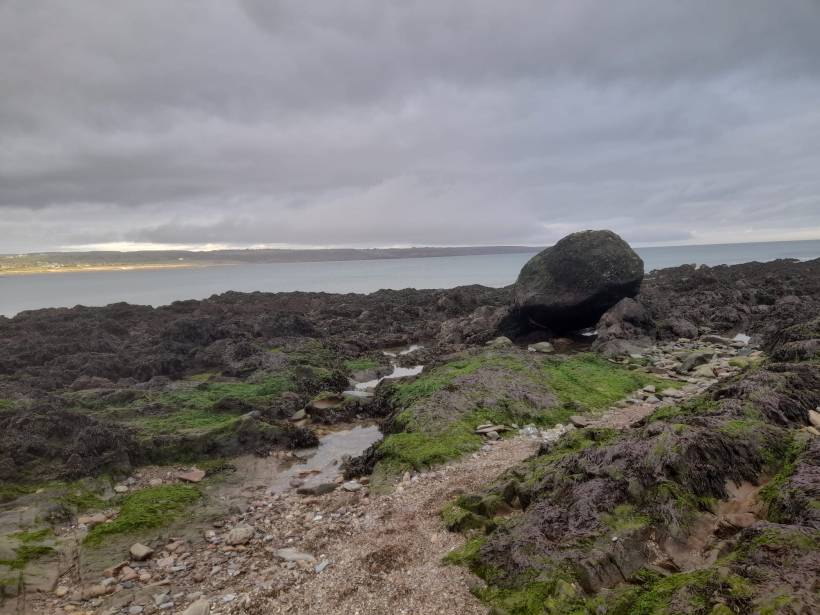
But in a country of fairy forts and Mass paths (a topic for another post), the bishop should have known better. Having found two adolescent boys to help him crush the rock down, the Bishop arrived in Ardmore to find the whole town standing up on the hill overlooking the beach where the rock sits. Staring the three of them down, silently. The kids turned to His Lordship the Bishop, and handed him the hammers, saying, “You first.” A strange reversal of the incident of the Woman Caught in Adultery! It was, in fact, the Bishop who needed to wake up. He walked away.
The people kept their rock. The initiation ritual into “Irish Catholicism” as such, which I will perhaps do myself one day, and which the Bishop was likely especially annoyed by, involves walking out to the rock, getting down on one’s stomach, and shimmying through the hole underneath to emerge from the other side. Just be sure the tide is right – or you’ll drown, as I’ve recently been informed.
Weddings, wakes, and the cloister. All kinds of death to self to be reborn in a greater way, and, thus, all kinds of initiation. All traditions which connect us to our past, despite the struggle, pain, and change involved. And all involve – hopefully – the right kind of hospitality.
Ireland does it particularly well.
Naomh Declan, guigh orainn!
(St. Declan, pray for us!)
 Christian Renaissance Movement