Eamonn Clark, STL
Nobody knows what the round towers were for.
Were they defense towers, or some kind of refuge for monks hiding from Viking raiders? Unlikely, but possible. Were they watchtowers? Belltowers? Astronomy towers? Communication towers? Maybe some of all of this? Who knows. These towers, so distinctive to Ireland, are a mystery.
On my last visit to this island, I had an extended visit to Ardmore, which boasts one of the most well-preserved round towers in the country.

Ardmore is where organized Christianity really began in Ireland. There had already been a small smattering of Christian presence on the island when St. Declan was born, as he was baptized by a priest. But there was no real structure yet, just individual Christians here and there. The bishop Palladius had been sent on a mission by the pope in 431, but no real apostolic efforts seem to have meaningfully penetrated what was then a thick forest covering essentially the entire land.
Declan was educated in Rome and ordained a bishop by the pope, and he returned to Ireland as perhaps its first proper missionary, after meeting with and agreeing to a strategy with none other than St. Patrick, who would follow behind him in some time. (There are four pre-Patrician saints of Munster, each a bishop.) The legend of the return of Declan is its own fascinating tale, nestled in the murky gap between fact and fiction. I’ll save the story for another time, as well as the anecdote about the local bishop in the 1800’s who had a different take on the popular piety associated with “Declan’s Rock” and his comical endeavor to destroy it.

The site of Ardmore became homebase for Declan, where a monastery was built according to Patrick’s instructions. Eventually he retreated into the wilderness nearby, where he lived in a small house as a hermit. Ardmore overlooks the sea, where Declan made his famous landing.

The “pattern” at Ardmore involves walking around some of these locations while reciting certain prayers, and, most distinctively, marking the wall near “Declan’s Well” (very likely the same spring he used, next to his house) with crosses by using a small stone. This has been going on for hundreds and hundreds of years.
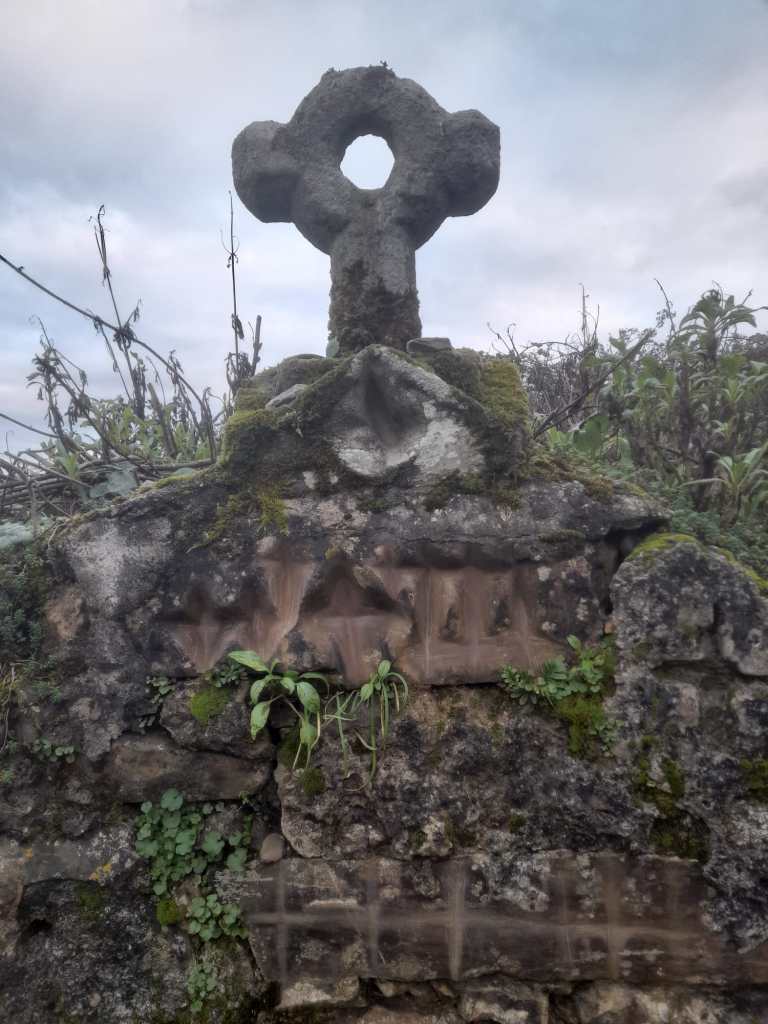
Soon after Declan came Patrick, whose missionary endeavors were more successful and thus more famous. You’ll notice, however, that Patrick concentrated his efforts in the northern part of the island – that’s because Declan had already been quite successful in the south.
St. Declan is now buried in a small tomb adjacent to the monastery which was for centuries the center of perhaps the most powerful ecclesiastical territory in Ireland. Now the monastery is in ruins, and the Diocese of Ardmore has long been swallowed, not even memorialized by a hyphenated name, as so many such dioceses are… it’s just gone.


The ground around it is host, most likely, to approximately 10,000 graves, almost all of them unmarked, and many of them likely quite ancient.

It’s a mesmerizing place. Haunting, almost.
I find myself increasingly fascinated both with graveyards and with archaeology. There is something so existentially alarming about old things and people, and the markers that indicate them. We stand on top of an entire world that has come and gone, and one day others will stand on top of ours. No doubt, there will be “digital archaeology” in a thousand years… But there will still be a need to dig stuff up and touch it. I’ve been privileged this past year to get my hands on some very interesting texts in various archives around Rome… the thrill of holding a manuscript or book that you know you are the first to handle in 50, 100, 200 or more years, is just really special. And I have a tactile mindset about even my own past – I want to be in this place and that, just to feel connected with my own life, to help make sense of it, and somehow thereby to see what it means. I’ve noticed that not everybody cares about that the way I do. I guess this same sort of impulse is at least part of what attracts me to the older liturgy… It connects me to those who’ve gone before, makes them alive again in some way, helps me to understand where I am from – and where I am to go.
I was at a gathering of priests a few days ago; the men were celebrating various major ordination anniversaries. I sat in on the mass. It was pointed out that there were a few hundred years of priesthood between them all. While contemporaneous, the cumulative experience of priests is nevertheless a bit like Ardmore. How many secrets held under the Seal… dead things, which are hidden underground now – finished, out of sight, out of mind. How many words or encounters which for them were not significant enough to remember, but were so powerful for others that they changed someone’s whole life and even saved their soul. How many repetitive but intentional rituals done, over and over, prayers and signs repeated on and on, to the edification of the faithful who devoutly attend to them. How many unique and always somewhat mysterious ministries – whatever they are, always reaching up towards God in service of His people… like a round tower.
And a saint lies buried within each one.
St. Declan of Ardmore, pray for us.
 Christian Renaissance Movement
Good memories of this visit
LikeLike